To avoid these ads, REGISTER NOW!

Ventillation in an energy efficient garage

OP
W

wssix99

Well-known member
Joined
Mar 2, 2011
Messages
5,156
Location
Chicago, IL
Our ICF house in SC has a summer cooling load of only 3/4 ton (9,000 BTU). In the hottest months, it costs about $20 a month with the thermostat at 74 F.

I understand that but my situation would be like going in to your house and having a raging fire going in the fireplace at the same time. (Adding heat to the house in addition to the solar and radiant gain from outside.) No doubt, I'd have a $20 or less cooling bill for the garage without cars inside, but I'm worried I'd have a $50-$100 cooling bill with the cars coming and going, adding all those BTU's to the area.

^ The ICF's work against me here because all this added heat can't get out. If I had a less efficient structure, some of this heat would move out of the room through the walls.


How well insulated is the garage door?

R-22


Co2 controllers and monitors are a popular accessory here, and people notice when they only have to get more Co2 half as much. Failure doesn't seem to be a huge problem.

My experience in Chicago is the same. Failure doesn't seem to be a problem because the HVAC techs just come out and disconnect the wires, leaving the dead, inactive sensor in place.


Why you'd have the sensor on the ceiling for a heavier than air gas is beyond me.

It avoids false readings from being close to the tailpipe plume. The weight of CO is immaterial: http://healthybuildingscience.com/2013/02/22/carbon-monoxide-facts/

Myth

Carbon monoxide is heavier than air, so CO detectors should not be placed on the ceiling or high on the wall.

Fact

CO is slightly lighter than air. However, studies have shown no significant difference in measurements based on what height CO detectors are mounted. Different manufacturers recommend different mounting locations, and you should always follow the manufacturers’ recommendation.

CO has a molar mass of 28.0, and air has an average molar mass of 28.8. The difference is so slight that CO is found to evenly distribute itself indoors. It is worth mentioning that CO indoors is usually generated from incomplete combustion (heat source) and therefore traveling in a warm air stream. Warm air is more buoyant and does rise. Coupling this fact with the knowledge that CO is lighter than air… I personally have my CO detector located on the ceilings.


As far as air exchange we usually shoot for about 2.5 minutes to swap the room

2.5 minute air changes for what? Sounds like hurricane force wind... Are you sure you don't mean 2.5 hours?
 
To avoid these ads, REGISTER NOW!

MushCreek

Well-known member
Joined
Jan 14, 2015
Messages
9,748
Location
Upstate South Carolina
I'd be surprised if residual engine heat had much more effect than baking something in the oven. It barely moves the needle when my wife does a lot of baking. Once you get those many tons of concrete core to a manageable temperature, a 400 lb. engine at 250 F. shouldn't make much difference. Someone much smarter than me could actually calculate how many BTU's are in a warm car engine v. how many BTU's it would take to warm the air and the walls. As a plus, the mini-split will heat your garage for much less money than electric unless the temperature is very cold. Mine are good to -13 F.
 

Modern Jess

Well-known member
Joined
Jan 2, 2011
Messages
1,362
Location
Bay Area, California
The theory I am testing is:
- During the day when the cars come in, they will make the air in the garage warm and the walls will soak up that heat. Can I then use this little fan (in the converted HRV unit) to "pee" on the walls at night, when the air is cool, to get that soaked heat out and reset for the next day?

My gut says no -- you'll probably need much more CFM than your hrv can provide. In my shop, I have 400cfm, a smaller space, and the fan still isn't enough to pull the temperature down to the level of the outside air by the time morning rolls around. Coincidentally, I have recently concluded that the culprit is stored heat in the shop structure, much like your ICF walls but on a smaller scale.

I reached that conclusion based on my data logs. Referring back to that graph I posted earlier, you can see the heat inside the shop rise a bit (the inside temp probe is at eye level) when the fan goes off, and then drop a bit when the fan goes on. There's really no other place the heat could be coming from than the structure.

Which segues nicely to your problem: I think I would be surprised if all of that heat was really just from the cars. But that's an easily testable premise, assuming you can just not drive them on some given day. Maybe you already have tested that theory and I just missed it.

Finally, speaking from my own experience, data logging gave me insight into the conditions I was working with that were completely unexpected, non-intuitive, and (sometimes) utterly baffling. I would bet that it could help here as well.
 
OP
W

wssix99

Well-known member
Joined
Mar 2, 2011
Messages
5,156
Location
Chicago, IL
My gut says no -- you'll probably need much more CFM than your hrv can provide.

My gut said the same thing and as I was about to tear the duct insulation off to look at tapping in dampers and another fan, it occurred to me that I have these HRV fans and figured that I should test their limits before making more investments and adding complexity to all the contractors, switches, and gizmos that already control the garage.

Plus... this exercise allows me to use the thermal camera, giving me a false sense that my wife didn't waste a ton of money when she bought the thing.


A dehumidifier is an air condition that dumps it heat right back into the room as well as the heat produced by the motor and compressor.

Guess what??? I walked in to the garage this morning and for the first time all summer, it was tolerable. :) Aside from having the HRV fans running full time, the only other change was that I unplugged the dehumidifier...

I'm sure unplugging that additional 30kW of heat helped some, but I'll be surprised if it ends up being the sole factor that tips the scales. We'll see...


Finally, speaking from my own experience, data logging gave me insight into the conditions I was working with that were completely unexpected, non-intuitive, and (sometimes) utterly baffling. I would bet that it could help here as well.

I am coming around to this conclusion. I still have some internal resistance as I still have the rest-of-the house to build and I don't want to be fiddling with one more gadget and have more computer work to do when I need to be swinging a hammer and painting. :)

How do you do your data logging? What kind of sensors do you use?
 

Modern Jess

Well-known member
Joined
Jan 2, 2011
Messages
1,362
Location
Bay Area, California
My gut said the same thing and as I was about to tear the duct insulation off to look at tapping in dampers and another fan, it occurred to me that I have these HRV fans and figured that I should test their limits before making more investments and adding complexity to all the contractors, switches, and gizmos that already control the garage.

Agreed. Start with the low hanging fruit and work up from there.

How do you do your data logging? What kind of sensors do you use?

I thought you'd never ask. ;)

I first stumbled on these devices when I was preparing to improve the attic ventilation in my house. I wanted a baseline, so I could tell definitively when (or if) there was an improvement. I didn't want to rely on my computer, either -- I wanted something that would run forever with no dependencies.

The device is the ControlByWeb X-300 Temperature Logger. It uses (relatively standard) 1wire temperature and humidity sensors, up to 8 in total. It has enough built-in memory to hold months of log data, and everything about it is controlled and configured via a built-in web server.

I bought the PoE version, so that I can power the device over ethernet and not have a wall wart plugged into it.

This device also has on-board relays that can be configured to trip under specific conditions or under program control. Oh, it has a built-in BASIC interpreter as well, if you want to get fancy. This is how I do the temperature differential trigger that my shop ventilation system uses.

It can be as easy or as complicated as you like, depending on which of its features you want to use. But they run forever with no intervention whatsoever. And I like that.
 
OP
W

wssix99

Well-known member
Joined
Mar 2, 2011
Messages
5,156
Location
Chicago, IL
Oh, it has a built-in BASIC interpreter as well, if you want to get fancy.

BASIC??? I think I once used that when I was a small child to program a computer to draw a triangle. :)


It can be as easy or as complicated as you like, depending on which of its features you want to use. But they run forever with no intervention whatsoever. And I like that.

It looks like the remote temperature sensor package would be useful. We could also move it around the house. (We currently have a wireless/remote thermometer package that eats batteries. I wired the house with 6 miles of structured CAT6 and RG-6, so we could move this around to wherever we want to watch temperatures and use the PoE.)

How does the data logging work? I assume the storage in the unit just overwrites as it gathers more and more data? Do they give you cloud options or software? Do you have to download the data in a raw format yourself and graph it in something else?
 

Modern Jess

Well-known member
Joined
Jan 2, 2011
Messages
1,362
Location
Bay Area, California
BASIC??? I think I once used that when I was a small child to program a computer to draw a triangle. :)

I cut my teeth on BASIC as a kid. Eventually, I became a professional software engineer. I hadn't used BASIC in a long, long time, and this device really only supports a tiny "BASIC-like" interpreter. But that's still enough to do simple logic control that never, ever needs to be rebooted.

It looks like the remote temperature sensor package would be useful. We could also move it around the house.

You pretty much have to add temperature probes to this. The product description is a little misleading -- the built-in temperature sensor is for the unit itself, and isn't useful for measuring ambient air temperature.

I use a mix of weatherproof temp probes (for outdoor readings) and temp / humidity combo sensors, which are actually two 1wire devices on a single board. This lets me compare indoor, outdoor, and attic temperatures in the house.

I have a separate unit running the shop, and there I have indoor, outdoor, compressor closet, and ceiling probes.

I wired the house with 6 miles of structured CAT6 and RG-6, so we could move this around to wherever we want to watch temperatures and use the PoE.)

Yes, but: you'll be dragging all the temperature probes around too, and all the wiring. Definitely possible, but it won't be especially convenient. If you have unused CAT6 cables, you can run the temperature probes across those.

How does the data logging work? I assume the storage in the unit just overwrites as it gathers more and more data?

Yep. Circular buffer. It overwrites the oldest readings with newer ones. How much time you get out of it depends on how many devices you want logged and at what interval.

Do they give you cloud options or software?

None. They design their devices to be entirely web-controlled on your local network, with no software required. They aren't in the cloud business, either, though if you're adventurous you could punch a hole in your firewall and see the current temp readings from anywhere with a web connection.

Do you have to download the data in a raw format yourself and graph it in something else?

You download it from the device in a simple comma-delimited format (CSV), which you can import into a spreadsheet and graph. You can also see current readings (but no graphs) just by pointing your web browser at its IP address.
 
Last edited:

TooMuchHair

Well-known member
Joined
May 25, 2014
Messages
64
Low cost, wireless, incredible accuracy and long battery life plus data logging of temp and humidity for up to a year using a free, intuitive ap on your smart device includes current reading and graphs for hour, day, week, month and year.
In case you missed it.
www.sensorpush.com
 

thejaq

Well-known member
Joined
Jan 2, 2016
Messages
49
Location
Minnesota
I agree with others here that your HRV blower does not deliver the airflow adequate to leverage economizer "free cooling" mode. It is sized and designed to deliver adequate ventilation air, not space conditioning. The auto exhaust and high mass construction exacerbate the issue.

In commercial hvac systems (and some fancy residential stuff) it is typical to have a minimum outside airflow setting to satisfy ventilation requirements and a higher flow rate for bringing in fresh air for free cooling when conditions allow. The ratio of high to low flows is maybe 4-6 max/min. In your case the ratio to get effective economizing may be even higher say, 10:1 or ~750+ cfm or higher, which will probably require a ductwork retrofit and a bigger blower.

Running ER on unconditioned spaces is tricky and may defy regular control sequences. Basically if ventilation is required, there will always be times where energy recovery can work for you or against you. So there is need to turn it off and on strategically without impacting ventilation. Without active cooling your building will trend toward outside conditions. Energy recovery gives you some latitude in picking those conditions (day/night, wet/dry). The flow rate is the means by which you can affect the rate of that trend (in a tight, insulated building).

I wish there was an easier solution. I'm building a well-insulated garage that will be initially unconditioned. My solution is to use a chimney effect, assisted by the prevailing winds, to keep the inside not much warmer than the outside.
 

Modern Jess

Well-known member
Joined
Jan 2, 2011
Messages
1,362
Location
Bay Area, California
Running ER on unconditioned spaces is tricky and may defy regular control sequences. Basically if ventilation is required, there will always be times where energy recovery can work for you or against you. So there is need to turn it off and on strategically without impacting ventilation. Without active cooling your building will trend toward outside conditions. Energy recovery gives you some latitude in picking those conditions (day/night, wet/dry). The flow rate is the means by which you can affect the rate of that trend (in a tight, insulated building).

I am given to understand that there are HRVs with "summer bypass" features that are electrically controllable. This would allow the HRV to serve in a variety of capacities. OP's HRV doesn't appear to be one of them, though.
 

Ole Slewfoot

Well-known member
Joined
Feb 22, 2016
Messages
5,098
Location
Freedom, CA
R-22

My experience in Chicago is the same. Failure doesn't seem to be a problem because the HVAC techs just come out and disconnect the wires, leaving the dead, inactive sensor in place.

It avoids false readings from being close to the tailpipe plume. The weight of CO is immaterial: http://healthybuildingscience.com/2013/02/22/carbon-monoxide-facts/

Myth

Carbon monoxide is heavier than air, so CO detectors should not be placed on the ceiling or high on the wall.

Fact

CO is slightly lighter than air. However, studies have shown no significant difference in measurements based on what height CO detectors are mounted. Different manufacturers recommend different mounting locations, and you should always follow the manufacturers’ recommendation.

CO has a molar mass of 28.0, and air has an average molar mass of 28.8. The difference is so slight that CO is found to evenly distribute itself indoors. It is worth mentioning that CO indoors is usually generated from incomplete combustion (heat source) and therefore traveling in a warm air stream. Warm air is more buoyant and does rise. Coupling this fact with the knowledge that CO is lighter than air… I personally have my CO detector located on the ceilings.


2.5 minute air changes for what? Sounds like hurricane force wind... Are you sure you don't mean 2.5 hours?
If you read what I wrote, Co2 sensing...its cheap, effective, and can infer the recent arrival of a car as the Co2 emissions tend to be a significant %, while co is only a few PPM, and CO2 is in fact heavier than air.

Enough fan CFM to swap out all the air in the room in a couple minutes assuming perfect ducting. Its a little loud, but not for long, and you can turn the fan speed down if you don't need it all. Notypo

there are several styles of this https://www.amazon.com/dp/B01E97XDR6/?tag=atomicindus08-20
which will datalog temp and humidity in 2 or more zones.
 

Nexussian

Well-known member
Joined
Mar 12, 2014
Messages
639
Location
Alaska
Perhaps I'm reading this wrong, but, I see where the conversation (when it covers this) seems to suggest a mini split can't be used with a well type heat source.

Is that the case?

I hope not, I was hoping to build a "reasonably" sized shop with two small mini splits (opposite corners so when they run they stir the air around) with a ground source well, however deep it needed to be.


OP, my apologies if this is a hijack, thank you for posting this as I intend to insulate the daylights out of it, if not make it with ICF (earthquakes, reinforced concrete, seems like a plan ;) ).
 
To avoid these ads, REGISTER NOW!
OP
W

wssix99

Well-known member
Joined
Mar 2, 2011
Messages
5,156
Location
Chicago, IL
I use a mix of weatherproof temp probes (for outdoor readings) and temp / humidity combo sensors, which are actually two 1wire devices on a single board. This lets me compare indoor, outdoor, and attic temperatures in the house.

Thanks for all the info on this. I think I will grab one of these over the winter. I may not end up with a permanent installation anywhere, but I like the versatility of this and may even use it for data logging my geothermal system in advance of calculating the headroom on our well. (We use gas for the radiant floors, clothes dryer, and cooktop - and I want the gas company out of my life! I think we have enough room on the well to move the floors over to geothermal, take the dryer to electric, and then convert the cooktop to propane.)


Real men use Fortran ! Or as my friends says,"I can write Fortran is any language !"

I think I still have Fortran, but its on floppy disk. If I only had a computer that could read a floppy disk...
 
OP
W

wssix99

Well-known member
Joined
Mar 2, 2011
Messages
5,156
Location
Chicago, IL
I am given to understand that there are HRVs with "summer bypass" features that are electrically controllable. This would allow the HRV to serve in a variety of capacities. OP's HRV doesn't appear to be one of them, though.

Right. Our garage HRV is a very small/basic unit - the goal was really to meet code for CO elimination. Expecting we may have an exercise like we are discussing here, I don't think we would have invested in a higher end HRV for the garage - there's too many variables and we may end up needing something heavier duty (for the bypass) than what the HRV could provide natively.

... Although, now that I look at the max airflow of my existing 6" ducts, I don't think that I'm going to be able to get a lot of additional CFM through them, if needed.


Perhaps I'm reading this wrong, but, I see where the conversation (when it covers this) seems to suggest a mini split can't be used with a well type heat source.

Is that the case?

A mini split is just an air to air heat pump. For Alaska, you could use one for cooling in the summer, but your winters would probably be too cold for it to be effective. (We are borderline here in Chicago and they don't work well for heating here through the full winter.)

Ground source heat pumps are similar, except they come in water-to-water or water-to-air versions. So, with a ground source, you'd have a heat pump unit that would either do:
- water-to-water for a radiant floor heating
- water-to-water to supply heated or chilled water to localized air heat exchangers in your house or garage
- water-to-air for both either heating and cooling

^ In our case, we selected a water-to-air central unit to provide heating and cooling to the house and a gas boiler to supply hot water to our radiant floors to heat the garage and provide make-up heat to the house, which we don't really need. This was not our ideal system, but maximized our tax rebate and kept the building department happy. (Our future upgrade will move the radiant floors over to a water-to-water heat pump grafted on to our existing well, which will take us closer to geothermal nirvana. Ideally, we would have put in a water-to-water unit and supplied heated/chilled water to localized heat exchangers in the house and garage, but the tax law was not written such that we could get a rebate for a lot of that infrastructure.)
 
OP
W

wssix99

Well-known member
Joined
Mar 2, 2011
Messages
5,156
Location
Chicago, IL
Overthink !

Park one of these in front of the car. Put it on a 15 minute timer. Leave the garage door open. Figure out some kind of "sail switch" that will trigger the garage door when the fan shuts off.

Capture.JPG

I have one of those, as a part of my wife's blower door system. I may play around with it in the spring.

... BTW - If anyone wants a blower door, I have a very very lightly used one that we need to get rid of.
 
OP
W

wssix99

Well-known member
Joined
Mar 2, 2011
Messages
5,156
Location
Chicago, IL
I agree with others here that your HRV blower does not deliver the airflow adequate to leverage economizer "free cooling" mode. It is sized and designed to deliver adequate ventilation air, not space conditioning. The auto exhaust and high mass construction exacerbate the issue.

Right now the little HRV is getting job done. :headscrat It's really not what I was expecting, given the way things were when I started the thread. Turning off the dang dehumidifier did miracles for the situation! (Not only did turning off the dehumidifier cool the room, but it made things 10X less humid - OMG.)
That being said, it has been in the 70's this week. The garage is currently 78 degrees and the temperature at the ceiling is around 84 degrees. We should have some 90 degree temperatures (outside) later this week, so it will be interesting to see what happens then.

I have to think that once the extra heat from the dehumidifier was removed from the equation the walls have started to cool down.

Stay tuned... With fall just around the corner, I don't think that my plans will be settled this year but I am hopeful at this point that I won't need the mini split and that I can keep the garage comfortable with fans. If we have a good week, this week, with the higher temperatures - I'll put in data logging over the winter and set things up to get real data as the summer starts next year.

a818GGRRzxr1fJfbE86Y.gif
 
Last edited:

Nexussian

Well-known member
Joined
Mar 12, 2014
Messages
639
Location
Alaska
A mini split is just an air to air heat pump. For Alaska, you could use one for cooling in the summer, but your winters would probably be too cold for it to be effective. (We are borderline here in Chicago and they don't work well for heating here through the full winter.)

Ground source heat pumps are similar, except they come in water-to-water or water-to-air versions. So, with a ground source, you'd have a heat pump unit that would either do:
- water-to-water for a radiant floor heating
- water-to-water to supply heated or chilled water to localized air heat exchangers in your house or garage
- water-to-air for both either heating and cooling

^ In our case, we selected a water-to-air central unit to provide heating and cooling to the house and a gas boiler to supply hot water to our radiant floors to heat the garage and provide make-up heat to the house, which we don't really need. This was not our ideal system, but maximized our tax rebate and kept the building department happy. (Our future upgrade will move the radiant floors over to a water-to-water heat pump grafted on to our existing well, which will take us closer to geothermal nirvana. Ideally, we would have put in a water-to-water unit and supplied heated/chilled water to localized heat exchangers in the house and garage, but the tax law was not written such that we could get a rebate for a lot of that infrastructure.)


Ok, thanks. :)

I guess I hadn't realized the "Mini Split" was only air to air, but I'm fairly early in my research portion of that particular project.
 

Nexussian

Well-known member
Joined
Mar 12, 2014
Messages
639
Location
Alaska
Not only did turning off the dehumidifier cool the room, but it made things 10X less humid.

By any chance is the fan drawing instead of pushing the air through the dehumidifier (or vice versa)?

Is the drain clogged? (all the dehumidifiers I've seen have some sort drain to get rid of the water they collect).
 
OP
W

wssix99

Well-known member
Joined
Mar 2, 2011
Messages
5,156
Location
Chicago, IL
Sometimes it's the little things.


Okay, that's just weird.

With a garage warmer than the outside air, pumping air continuously through the garage would work the reverse of a dehumidifier, right? So, even though I have a little electric dehumidifier in the garage, the entire garage would be acting as one giant humidifier.


By any chance is the fan drawing instead of pushing the air through the dehumidifier (or vice versa)?

Is the drain clogged? (all the dehumidifiers I've seen have some sort drain to get rid of the water they collect).

Nope. It was producing 3 gallons of water per day through the drain and into a bucket.
 
OP
W

wssix99

Well-known member
Joined
Mar 2, 2011
Messages
5,156
Location
Chicago, IL
2018 update to this thread. I though I updated this last year, but I didn't - I'm sorry for that.

After going all last year by just taking out the HRV heat exchanger/core and replacing it with a blank filter holder (and turning the HRV into a regular fan vs. a HRV in the summer), the garage was tolerable. Thus, I was able to postpone my project for putting in a fan control.

This year, we started using an EV for most of our driving, which has cut down the amount of engine heat we bring into the garage. In this situation (without internal combustion engines coming and going from the garage) the concrete walls are wicking heat and the garage feels pretty cool. (We are also having an unseasonably cool summer this year.)

So, the fan control is going to get pushed another year... I still expect to add the controls, but will probably prioritize it higher once we finish some other construction projects around the house and I'm ready to spend more time in the garage.
 

MDJAK

Well-known member
Joined
Mar 30, 2015
Messages
61
Location
NY
Wssix99. Thank you for pointing me to this thread. Unfortunately most of it is way over my head.

So one quick question. While I did read most of it, will a simple AC window unit work in my case? I do have spares from before I retrofitted my home with central AC.

Thanks again.
 
OP
W

wssix99

Well-known member
Joined
Mar 2, 2011
Messages
5,156
Location
Chicago, IL
An AC unit would work, but it's the most expensive/most inefficient option. (You will spend a lot of money to perform the heat transfer.) You'd be in a situation similar to lighting a fire in your fireplace and then turning on the A/C to cool things down - when you really just want to open a window.

If you have a fan that turns off and on at "smart" times, you can move the hotter air inside the garage out and bring cooler outside air in. (For a much lower cost than running the A/C.)

The fan control methods we are discussing here are pretty fancy. You can also find "Differential Temperature Controllers" out there for solar water heating applications. Not all will work for a fan, but some can be retrofitted. They are intended to sense when the sun is heating up supply hot water and the tank is cooling down - they then kick on a circulating pump. Here, you'd want to sense the inside and outside temperatures and kick on a fan instead.
 

gnpenning

Well-known member
Joined
Jan 25, 2015
Messages
2,754
Location
I have more questions than answers.
Glad this came back up. I mentioned early in the thread that my place is ICF and opening windows at night and closing in the morning. Works well for me. I have this place up for sale and my next place will be ICF as well. You reminded me with the taller walls I will be putting in my next shop, I need to put windows up high that I can open from the ground for dumping heat.

I know this doesn't help you, but thank you for reminding me. My trucks heat my garage as well, plus welding or any heat generator really needs to be addressed with ICF.

Glad you made some progress, hopefully you will get it cured.
 
Last edited:

ripperd

Well-known member
Joined
Jul 2, 2014
Messages
2,044
Location
Twin Cities, MN
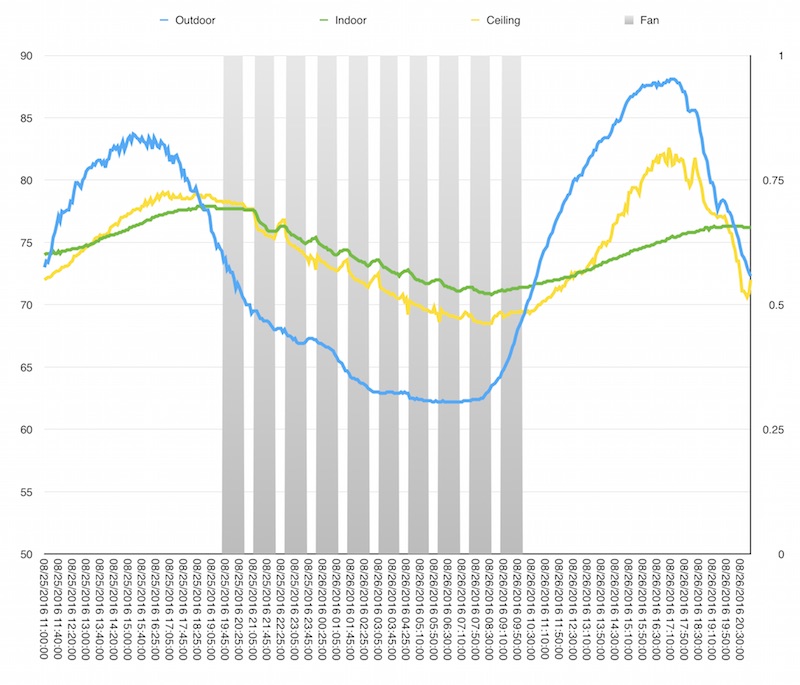
Here's why I mentioned data logging. This graph is a snapshot of the outdoor, indoor, and ceiling temperatures in my shop. The gray bars are when the automated fan is running. I have it programmed in a run/stop/run pattern in order to be able to see and evaluate how effective it is.

My shop has good insulation and no heating or cooling whatsoever. Just ventilation fans. The fans are hooked up to an automatic system that I built and programmed myself. The fans switch on whenever there is a favorable temperature delta between inside and outside in order to take advantage of the natural temperature swings. In cooling mode (which it is at the moment) it will typically switch on at night as it starts to cool off, bringing cool night air into the shop. In the winter, I switch it to heating mode, and it switches on during the day when it warms up. This balances out the temperature in the shop, generally keeping it in a range that is comfortable.

The system isn't perfect -- during sustained hot spells, the shop is still too warm. And during the really cold days of winter (which, to be honest, aren't all that cold out here in California) I will sometimes drag a small space heater into the shop. Still, overall there's a noticeable improvement.

shoptemp-8.27.jpg

OP:

I've read through alot of this thread, and you need to do what the above poster did. Get rid of the de-humidifiers too. This, combined with proper fan sizing means that your garage should maintain a temperature somewhere around the average daily temperature.

I definitely have experienced the hot-car effect, even in a normally insulated garage. Garage starts out OK temperature, but when my wife and I get home from work and drop our hot vehicles into the garage, if we shut the door the garage temp will increase by 10+ degrees over the next 2 or so hours. We end up leaving the doors open some after we get home now in the summer. But in the winter that heat is nice.

We also have a CO monitor, pulling modern cars in and out for normal driving doesn't even register. Warm cars and warm catalytic converters mean almost no CO, so its really only leaving that it happens on anyway. Modern healthy cars don't make much CO anyway, and the amount they do make is exchanged pretty quickly by the doors being open when you are leaving.
 

gnpenning

Well-known member
Joined
Jan 25, 2015
Messages
2,754
Location
I have more questions than answers.
Perhaps this might help.
https://www.tjernlund.com/cool_breeze_garage_cooling_fan.htm

You could operate it off a thermostat and a timer. When the cars pull in and the heat hits, it could make. Run it at night and have the air velocity to draw down the mass temp.


For cold climate areas you would need to replace the insulation that was removed for the clod months. I didn't spend much time on that site, but cutting a hole for the grate on a upper line garage door wouldn't look very good to me. Also I didn't see a jamb extension or inside jamb for insulated steel backed doors. That should go into a wall, just be a little expensive cutting into a ICF wall. I'm surprised they are dumping the heat into the attic as well instead of dumping the heat outside. It will pull heat out of the parking area.
 
OP
W

wssix99

Well-known member
Joined
Mar 2, 2011
Messages
5,156
Location
Chicago, IL
Glad you made some progress, hopefully you will get it cured.

The easy cure is to replace all my internal combustion engine cars with electric ones. I don't think I'll achieve that any time soon. :) Although, having my daily driver as an EV helps like you all wouldn't believe.


OP:

I've read through alot of this thread, and you need to do what the above poster did. Get rid of the de-humidifiers too. This, combined with proper fan sizing means that your garage should maintain a temperature somewhere around the average daily temperature.

The de-humidifiers went away a long time ago and had an instant positive impact. The proper fan is there - all that is left is a "smart" thermostat to optimize electrical usage. (A simple attic fan thermostat doesn't work.)


Modern healthy cars don't make much CO anyway, and the amount they do make is exchanged pretty quickly by the doors being open when you are leaving.

I expect that the code concern is more about older cars that might come by and newer cars that might transition to an unhealthy state.
 

Jackfre

Well-known member
Joined
Dec 26, 2010
Messages
4,406
Location
N CA
For cold climate areas you would need to replace the insulation that was removed for the clod months. I didn't spend much time on that site, but cutting a hole for the grate on a upper line garage door wouldn't look very good to me. Also I didn't see a jamb extension or inside jamb for insulated steel backed doors. That should go into a wall, just be a little expensive cutting into a ICF wall. I'm surprised they are dumping the heat into the attic as well instead of dumping the heat outside. It will pull heat out of the parking area.

I ran a whole house fan in my MA home with very good results blowing the air into the attic and using the gable vents in my attic as exhaust. I would open the downstairs windows once the sun got low and fire up the WHF and cool the house with the evening/night air. If I was to use the Tjernlund product I would duct it to a grill on the side of the building. The Suction side would require a bit of thought as well as you would want to balance the air flow and draw equally across the garage. The brochure shows the simplest, but not the best application of the product in my opinion, but you are not limited by the brochure.
Tjernlund is an old US Manuf and they make some innovative ventilation products. As a disclaimer, in my business I represented them in the New England States for 20 years. I no longer have any business affiliation with the company and have no gain from the promotion of the products. The people at Tjernlund remain good friends.
 
To avoid these ads, REGISTER NOW!
Top Bottom