Our ICF house in SC has a summer cooling load of only 3/4 ton (9,000 BTU). In the hottest months, it costs about $20 a month with the thermostat at 74 F.
I understand that but my situation would be like going in to your house and having a raging fire going in the fireplace at the same time. (Adding heat to the house in addition to the solar and radiant gain from outside.) No doubt, I'd have a $20 or less cooling bill for the garage without cars inside, but I'm worried I'd have a $50-$100 cooling bill with the cars coming and going, adding all those BTU's to the area.
^ The ICF's work against me here because all this added heat can't get out. If I had a less efficient structure, some of this heat would move out of the room through the walls.
How well insulated is the garage door?
R-22
Co2 controllers and monitors are a popular accessory here, and people notice when they only have to get more Co2 half as much. Failure doesn't seem to be a huge problem.
My experience in Chicago is the same. Failure doesn't seem to be a problem because the HVAC techs just come out and disconnect the wires, leaving the dead, inactive sensor in place.
Why you'd have the sensor on the ceiling for a heavier than air gas is beyond me.
It avoids false readings from being close to the tailpipe plume. The weight of CO is immaterial: http://healthybuildingscience.com/2013/02/22/carbon-monoxide-facts/
Myth
Carbon monoxide is heavier than air, so CO detectors should not be placed on the ceiling or high on the wall.
Fact
CO is slightly lighter than air. However, studies have shown no significant difference in measurements based on what height CO detectors are mounted. Different manufacturers recommend different mounting locations, and you should always follow the manufacturers’ recommendation.
CO has a molar mass of 28.0, and air has an average molar mass of 28.8. The difference is so slight that CO is found to evenly distribute itself indoors. It is worth mentioning that CO indoors is usually generated from incomplete combustion (heat source) and therefore traveling in a warm air stream. Warm air is more buoyant and does rise. Coupling this fact with the knowledge that CO is lighter than air… I personally have my CO detector located on the ceilings.
As far as air exchange we usually shoot for about 2.5 minutes to swap the room
2.5 minute air changes for what? Sounds like hurricane force wind... Are you sure you don't mean 2.5 hours?


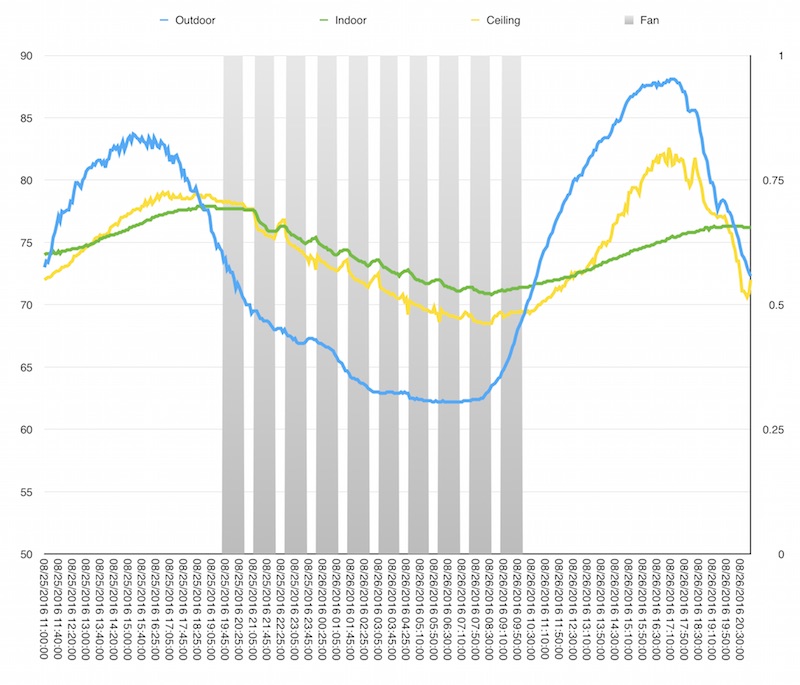
 It's really not what I was expecting, given the way things were when I started the thread. Turning off the dang dehumidifier did miracles for the situation! (Not only did turning off the dehumidifier cool the room, but it made things 10X less humid - OMG.)