To avoid these ads, REGISTER NOW!

My attempt to make a better hose coupler

OP
L

Leveleer

Well-known member
Joined
May 19, 2016
Messages
272
Location
Superior/Duluth
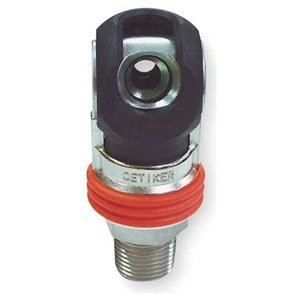
I have a Oetiker but it is stuck in a Vidmar on its back.

Once I figure out how to open it I'll do a test.

Let this be a lesson to all who put casters on a non latching Vidmar.

Red

Thanks and good luck.

I just did a quick flow test on the Coilhose coupler and I was disappointed with the back pressure as well as what I mentioned in the above video.
With the same Milton high flow plug as gave me 0 back pressure in the Milton V coupler, The Coilhose drops about 5 PSI.
 
To avoid these ads, REGISTER NOW!

Sticky Grips

Well-known member
Joined
Aug 13, 2014
Messages
92
It looks like the Oetiker swing couplers were bought out by RTC.

http://rtc-northamerica.com (USA branch, obviously)

Also:
http://www.rtc-tec.com/products?cat_id=35&p=1

Try as I might, I couldn't find a swing coupler they make that will fit the euro high flow plug (same as Milton v?). Perhaps others can find it. It looks like they definitely work with industrial interchange, among others. The catalog's language style is European, and a bit hard to figure out.

Oetiker Swing Coupler's were purchased by TST in Turkey. They're available in the Euro interchange, but they're very large.


OP, If you send me your info, I'll have a group of my company's couplers sent to you for testing. No strings attached, in industrial interchange.

We have a line of units made in Japan. One of them does not have any valving in it, similar to the TST/Oetiker, but without the collar. It works on pressure to lock in place. (pictured below)

14DF-N2F-400x400.jpg


The European/V Series is simply a 3/8 body size in a smaller package. They work well, and are a standard for most of Western Europe...they just never picked up here in the US.
 
OP
L

Leveleer

Well-known member
Joined
May 19, 2016
Messages
272
Location
Superior/Duluth
14DF-N2F-400x400.jpg


The European/V Series is simply a 3/8 body size in a smaller package. They work well, and are a standard for most of Western Europe...they just never picked up here in the US.

Interesting coupling.
I see they are available from ATP4pneumatics.com

I would like to test one.
 

tarbellb

Well-known member
Joined
Apr 17, 2011
Messages
5,756
Location
Oregon
Part of the drama are those loose bolts on your rigid pipe connected to the compressor.

For a Safety First guy..... seems a bit suspect?

(
)
 
OP
L

Leveleer

Well-known member
Joined
May 19, 2016
Messages
272
Location
Superior/Duluth
Part of the drama are those loose bolts on your rigid pipe connected to the compressor.

For a Safety First guy..... seems a bit suspect?

(
)
The reason the bolts keep getting loose

That temporary plumbing was originally intended to do some tests on my prototype fittings. It is OK for that but not so much for Milton V couplers.
Besides, my former hockey player assistant is capable of breaking the pipes so I had better keep him away from it until I have a more rigid setup.
Thanks
 

bigredmf

Well-known member
Joined
Jan 2, 2012
Messages
414
Location
Between Boston and Detroit
I tested a Oetiker today at 150 psi.

1/4" Size Coupler connected to a 1/4" hose x 25' long

I could not get the ****** to launch out when I disconnected it, no matter how hard I tired it appears to dissipate the energy rather effectively.

Also the force required to connect is minimal

Sorry no video

Red
 

Schurkey

Well-known member
Joined
Oct 27, 2011
Messages
2,369
Location
The Seasonally Frozen Wastelands
I still would like to know what happens when you rapidly swing it past the vent position to the fully open position under pressure. I assume that the plug is ejected under pressure.
31ae2PKelwL.jpg

The smaller (partial) hole you see in back of where the coupler plug goes in is the vent. There is no "swing it past the vent position". The coupler is inserted and removed with the vent fully open. The vent is partially-aligned with the coupler plug still locked-into the coupler body, though, so the pressure is relieved before the plug can be released unless there's some unusually huge volume of air to be vented.

In any case, it can't be worse and should be enormously better than a typical non-vented coupler.
 
Last edited:

AffableCurmudgeon

Well-known member
Joined
Jan 26, 2009
Messages
1,906
Location
Triad Area NC
Thank you.
Price is not known at this point.
I won't be finished refining the design until I believe it's the best coupler you can buy.

Looks great!

As a patent attorney, just a bit of friendly advice (Not legal advice, not a legal opinion, just a friendly comment).

If you are serious about producing and/or licensing it, do not offer it for sale to anyone until you have filed at least a Provisional patent application. Also file that within a year starting from when you first disclosed it.

Again, looks great.
 
OP
L

Leveleer

Well-known member
Joined
May 19, 2016
Messages
272
Location
Superior/Duluth
Looks great!

As a patent attorney, just a bit of friendly advice (Not legal advice, not a legal opinion, just a friendly comment).

If you are serious about producing and/or licensing it, do not offer it for sale to anyone until you have filed at least a Provisional patent application. Also file that within a year starting from when you first disclosed it.

Again, looks great.

Thanks and I appreciate the "friendly advice". I do have a patent attorney.
 
OP
L

Leveleer

Well-known member
Joined
May 19, 2016
Messages
272
Location
Superior/Duluth
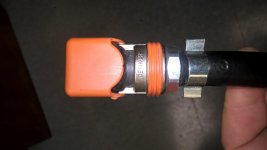
There is a optional cover for the vent though I am pretty sure it won't mitigate the "noise"

Red


Sent from my iPad using Tapatalk

I don't have any idea how many people suffer hearing damage from the explosive decompression of air hoses through couplers but I'm pretty sure it's extensive.
I am one of them.

IMO the "cover" should be standard on the Oetiker.
 

bigredmf

Well-known member
Joined
Jan 2, 2012
Messages
414
Location
Between Boston and Detroit
I don't have any idea how many people suffer hearing damage from the explosive decompression of air hoses through couplers but I'm pretty sure it's extensive.

I am one of them.


IMO the "cover" should be standard on the Oetiker.


My guess is it is a rarity to have hearing damage from coupling quick connects.

If this had been previously litigated you would see a ton of hearing protection warnings on quick connects.

I'll look at my inventory to see if I find any warnings.

Red


Sent from my iPad using Tapatalk
 

usdemt

Well-known member
Joined
Nov 1, 2010
Messages
644
Location
South Dakota
My thoughts are that your are approaching this all wrong, like a serious case of identity crisis. The videos you made are great if you want to push this as an infomercial product. But you are trying to market this to professional users who will demand a lot out of it. So your video screams, make this in china, but your idea is a professional made product. I love the idea but I dont see the need. If these where sitting next to the Miltons I buy for a similar price, I would probably go for it, but you have to break into that market. You have the niche just have to find the market IMO.
 
OP
L

Leveleer

Well-known member
Joined
May 19, 2016
Messages
272
Location
Superior/Duluth
My thoughts are that your are approaching this all wrong, like a serious case of identity crisis. The videos you made are great if you want to push this as an infomercial product. But you are trying to market this to professional users who will demand a lot out of it. So your video screams, make this in china, but your idea is a professional made product. I love the idea but I dont see the need. If these where sitting next to the Miltons I buy for a similar price, I would probably go for it, but you have to break into that market. You have the niche just have to find the market IMO.

Thanks for the feedback, after all ,that is the reason I started this thread in the first place. My intention was never to market anything.
I started this thread less then an hour after I made the first video comparing my prototype to the Prevost and a Milton V.
I was so excited about how mine performed that I wanted to know what others thought.
Simple as that.
Thanks to all that contributed to this thread, I have learned about a lot of other couplers that I knew nothing about.
 
OP
L

Leveleer

Well-known member
Joined
May 19, 2016
Messages
272
Location
Superior/Duluth
My guess is it is a rarity to have hearing damage from coupling quick connects.

If this had been previously litigated you would see a ton of hearing protection warnings on quick connects.

I'll look at my inventory to see if I find any warnings.

Red


Sent from my iPad using Tapatalk

I suspect the reason it hasn't been litigated is because it would be extremely difficult to prove cause and effect. My hearing damage occurred as a result of many years of this type of noise.
 
To avoid these ads, REGISTER NOW!
OP
L

Leveleer

Well-known member
Joined
May 19, 2016
Messages
272
Location
Superior/Duluth
I just tested the force to connect my latest high flow coupling at <14 pounds @ 120 PSI.
This compares to 30 pounds for the Prevost S1 and 38 to 40 pounds for the Milton V.

My coupling has exceeded all my expectations for performance. however I am using a non standard plug that I designed specifically for best performance.
I am unable to get this type of performance with any of my couplings that I designed to be compatible with standard plugs.
My plan is to manufacture a few hundred for beta testing and go from there.
 
OP
L

Leveleer

Well-known member
Joined
May 19, 2016
Messages
272
Location
Superior/Duluth
In the video of the force test above, I had the pressure set to 100 PSI instead of 120. My mistake. I re ran the test at 120 and the force went up to 14.5 pounds.

This morning I disassembled a Milton V fitting and a Menards branded high flow coupler to see the differences. I wondered why the Menards version was so much easier to connect and disconnect.
The reason appears to be because the Milton uses a poppet which is separate from the plug seal. This results in a much higher force.
In this picture the Milton is on the right.
miltonvsmenards.jpg
 

All

Well-known member
Joined
Mar 28, 2013
Messages
606
Thank you.
Price is not known at this point.
I won't be finished refining the design until I believe it's the best coupler you can buy.

Frank, I've been sort of following your thread, and admiring your journey to make something that you haven't yet found among the products you've thus far seen.

The way you respond to people's feedback, accepting and adapting, without defending nor being dissuaded from your goal, is also admirable. That could be why people are willing to send you stuff to compare... because your enthusiasm as a lone tinkerer to take on improving a pneumatic coupler. Bravo!

Thirty years ago, I purchased the air releasing safety ball valves from Grainger, and while they work fantastic at the compressor end, a lever handled ball valve is a little much to be dangling on the working end of an air hose. So what you are making makes sense to me, to the extent that I understand it.

Price really doesn't matter much to me in a pneumatic coupler. I value long term durability, quality, high flow, rotational articulation, wear resistance, security of attachment... and, now that you've brought it up... some type of controlled pressure discharge safety release would be a nice. I'd pay for that, as long as the other qualities were all there. And that would not be a trivial expense, to convert all tools to the new system.

Yet, I'm not looking for universal fit, nor common compatibility with the "free" fittings and plugs that often come with air tools. I couldn't care less if my fittings match up to others, because I generally don't borrow other people's tools, and generally don't lend mine. I never use the fittings that come with the tool, as I standardized on the 3/8" bore diameter Milton "P" style industrial plugs and couplers around 25 years ago, because the P style appeared to meet my laundry list of criterion the best among the choices available back at that time.

I didn't like how brass male V style plugs wore down. When the shoulders wore down, the loss of tight tolerance in the fitting led to inadvertent separations between hose and tool, and/or iffy engagements. This was especially the case with the smaller diameter (1/4" bore diameter) versions of that series.

I also didn't like how smaller brass male plugs could sustain damage from bumps, scrapes, and knocking about when not connected to an air hose. Both the material (brass) and the thin wall of the plug orifice construction contributed to the damage sustained. Yes, it is always easier to blame the product, rather than take better care of how the tools are handled, but that is another debate. We are talking about ideal features in an air coupler system.

The Milton P Style 1800 series 3/8" bore diameter system is all steel, like high pressure hydraulic fittings. All the components are yellow plated for corrosion resistance. All the fittings are rated at 300 PSI. The insertion part of the plugs are thick walled, not thin walled. This is helpful for durability on the exposed end when not attached to a female coupler.

And when attached, the female couplers feature not just 3, not 4, not 6, but EIGHT (8) retention ball bearings inside the coupler sleeve, for rugged secure tool rotation and retention. 8 ball bearings. Count em!

View media item 67956
And, while I don't have a close up photo of the male counter part to these couplers, you can see them on the end of some of my small grinders in this photo....

View media item 31200
On edit, I decided that the pic of my grinders doesn't do the construction features of the P style male coupler plug justice, so I took a couple of comparison pics with an older steel coupler of the more common style that I retired, compared to the male coupler plugs of the yellow plated steel P style. As you will see in the photos below, the retention seat is in the larger plug has a tighter engagement tolerance (the U shaped annular groove) than the smaller plug with the inverted V retention shoulder.

Also notice the full length shoulder of the larger plug, contributing to the plug's wall thickness and sturdiness at the exposed open end of the plug. Obviously the larger inside diameter contributes to the effective tool power, which is a function of CFM. Anyway, I hope that you consider some of these other features in pneumatic couplers as you set about refining yours.

View media item 67970

View media item 67969
View media item 67968

So, I encourage you in your quest to make "the best coupler you can buy", and just wanted to share a few features that floated my boat when I shopped for couplers, as well as state that low cost didn't enter into my decision.
 
Last edited:
OP
L

Leveleer

Well-known member
Joined
May 19, 2016
Messages
272
Location
Superior/Duluth
Many thanks for taking time to post all this useful information.
I will add it to my list of things to consider as part of my design process.
I'll just say that I am a fan of hard anodized aluminum and just leave it at that for now.
 

MedicOC

Member
Joined
Nov 13, 2016
Messages
14
Location
Atlanta, GA
Bump for an update. Been enjoying this thread.

Also a question. I know I always try to protect my hearing when possible, but I rarely find myself disconnecting a charged 25' airhose. Is that something you do frequently? Not a criticism, just a question.
 

MedicOC

Member
Joined
Nov 13, 2016
Messages
14
Location
Atlanta, GA
Oetiker Swing Coupler's were purchased by TST in Turkey. They're available in the Euro interchange, but they're very large.


OP, If you send me your info, I'll have a group of my company's couplers sent to you for testing. No strings attached, in industrial interchange.

We have a line of units made in Japan. One of them does not have any valving in it, similar to the TST/Oetiker, but without the collar. It works on pressure to lock in place. (pictured below)

14DF-N2F-400x400.jpg


The European/V Series is simply a 3/8 body size in a smaller package. They work well, and are a standard for most of Western Europe...they just never picked up here in the US.


I've installed quite a few of these, they are simplicity perfected. It uses a ball valve and as such when opened is a straight through design. I imagine it flows very well when compared to a traditional design. This has the same vented back as the Oetiker unit which I know the OP doesn't care for, and it also doesn't have a collar. All of my customers have loved that there is no collar, loved the vented design, and loved that the ball valve doesn't leak when closed.

Disclaimer: I don't work for the manufacturer, but I do stock these in my brick and mortar shops as well as on our mobile units. I'm not trying to shill for the manufacturer or myself, just relay my experience.
 

Fcvapor05

Well-known member
Joined
May 4, 2014
Messages
1,079
One aspect of a coupler design that bears some importance, which I have yet to see addressed in this thread, is pull out force- in other words, once the coupler is coupled, it should be difficult or impossible to accidentally decouple the parts by pull on one end or the other.

Have you done any testing or comparisons of coupling pull out force? If not you may want to start.
 

Schurkey

Well-known member
Joined
Oct 27, 2011
Messages
2,369
Location
The Seasonally Frozen Wastelands
One aspect of a coupler design that bears some importance, which I have yet to see addressed in this thread, is pull out force- in other words, once the coupler is coupled, it should be difficult or impossible to accidentally decouple the parts by pull on one end or the other.

Have you done any testing or comparisons of coupling pull out force? If not you may want to start.
Does ANY coupler not lock the two pieces together, so that some sort of release mechanism has to be activated to un-couple the two parts?

There's no amount of force short of mechanical breakage that could cause the coupler to come disconnected unless the release mechanism is accidentally tripped.

The issue is that some couplers are easier to accidentally release the locking device than others.
 
OP
L

Leveleer

Well-known member
Joined
May 19, 2016
Messages
272
Location
Superior/Duluth
Bump for an update. Been enjoying this thread.

Also a question. I know I always try to protect my hearing when possible, but I rarely find myself disconnecting a charged 25' airhose. Is that something you do frequently? Not a criticism, just a question.
Affirmative.
Since I started working in a machine shop back in 1972 I must have done it many thousands of times. Did a lot of damage to my hearing.
 
OP
L

Leveleer

Well-known member
Joined
May 19, 2016
Messages
272
Location
Superior/Duluth
One aspect of a coupler design that bears some importance, which I have yet to see addressed in this thread, is pull out force- in other words, once the coupler is coupled, it should be difficult or impossible to accidentally decouple the parts by pull on one end or the other.

Have you done any testing or comparisons of coupling pull out force? If not you may want to start.
video demo

I believe my coupling design is inherently safe. If the collar is accidentally pulled back then the flow is shut off and that's about it.
 

Mike.ASC

Well-known member
Joined
Apr 21, 2010
Messages
880
Location
East coast
I've installed quite a few of these, they are simplicity perfected. It uses a ball valve and as such when opened is a straight through design. I imagine it flows very well when compared to a traditional design. This has the same vented back as the Oetiker unit which I know the OP doesn't care for, and it also doesn't have a collar. All of my customers have loved that there is no collar, loved the vented design, and loved that the ball valve doesn't leak when closed.

Disclaimer: I don't work for the manufacturer, but I do stock these in my brick and mortar shops as well as on our mobile units. I'm not trying to shill for the manufacturer or myself, just relay my experience.

MedicOC, I would be interested in purchasing one of your couplers to try.....
 

Fcvapor05

Well-known member
Joined
May 4, 2014
Messages
1,079
There's no amount of force short of mechanical breakage that could cause the coupler to come disconnected unless the release mechanism is accidentally tripped.

That's an assumption you're making, not a fact.
 

Fcvapor05

Well-known member
Joined
May 4, 2014
Messages
1,079
video demo

I believe my coupling design is inherently safe. If the collar is accidentally pulled back then the flow is shut off and that's about it.


I've watched your videos, and am familiar with the intended function.

What I'm talking about is unintended tension on the hose. There is some amount of force which will cause any coupler, including yours, to either disconnect or mechanically fail. The question is whether or not that amount of force is low enough that someone could realistically cause it to happen by some strange confluence of events.

Personally, I wouldn't want to be selling couplers unless I knew that number.

Not trying to **** on your design- by all accounts it appears to function very well. It just occurred to me as something that, if I were in your shoes, I would want to know; and also something that you appear to not have considered testing.
 
To avoid these ads, REGISTER NOW!
Top Bottom