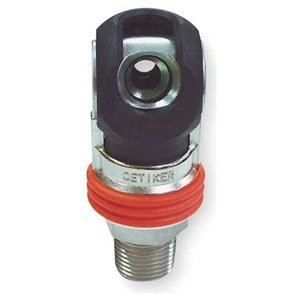
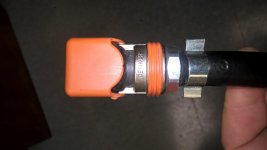
Thank you.
Price is not known at this point.
I won't be finished refining the design until I believe it's the best coupler you can buy.
Frank, I've been sort of following your thread, and admiring your journey to make something that you haven't yet found among the products you've thus far seen.
The way you respond to people's feedback, accepting and adapting, without defending nor being dissuaded from your goal, is also admirable. That could be why people are willing to send you stuff to compare... because your enthusiasm as a lone tinkerer to take on improving a pneumatic coupler. Bravo!
Thirty years ago, I purchased the air releasing safety ball valves from Grainger, and while they work fantastic at the compressor end, a lever handled ball valve is a little much to be dangling on the working end of an air hose. So what you are making makes sense to me, to the extent that I understand it.
Price really doesn't matter much to me in a pneumatic coupler. I value long term durability, quality, high flow, rotational articulation, wear resistance, security of attachment... and, now that you've brought it up... some type of controlled pressure discharge safety release would be a nice. I'd pay for that, as long as the other qualities were all there. And that would not be a trivial expense, to convert all tools to the new system.
Yet, I'm not looking for universal fit, nor common compatibility with the "free" fittings and plugs that often come with air tools. I couldn't care less if my fittings match up to others, because I generally don't borrow other people's tools, and generally don't lend mine. I never use the fittings that come with the tool, as I standardized on the 3/8" bore diameter Milton "P" style industrial plugs and couplers around 25 years ago, because the P style appeared to meet my laundry list of criterion the best among the choices available back at that time.
I didn't like how brass male V style plugs wore down. When the shoulders wore down, the loss of tight tolerance in the fitting led to inadvertent separations between hose and tool, and/or iffy engagements. This was especially the case with the smaller diameter (1/4" bore diameter) versions of that series.
I also didn't like how smaller brass male plugs could sustain damage from bumps, scrapes, and knocking about when not connected to an air hose. Both the material (brass) and the thin wall of the plug orifice construction contributed to the damage sustained. Yes, it is always easier to blame the product, rather than take better care of how the tools are handled, but that is another debate. We are talking about ideal features in an air coupler system.
The Milton P Style 1800 series 3/8" bore diameter system is all steel, like high pressure hydraulic fittings. All the components are yellow plated for corrosion resistance. All the fittings are rated at 300 PSI. The insertion part of the plugs are thick walled, not thin walled. This is helpful for durability on the exposed end when not attached to a female coupler.
And when attached, the female couplers feature not just 3, not 4, not 6, but EIGHT (8) retention ball bearings inside the coupler sleeve, for rugged secure tool rotation and retention. 8 ball bearings. Count em!
View media item 67956
And, while I don't have a close up photo of the male counter part to these couplers, you can see them on the end of some of my small grinders in this photo....
View media item 31200
On edit, I decided that the pic of my grinders doesn't do the construction features of the P style male coupler plug justice, so I took a couple of comparison pics with an older steel coupler of the more common style that I retired, compared to the male coupler plugs of the yellow plated steel P style. As you will see in the photos below, the retention seat is in the larger plug has a tighter engagement tolerance (the U shaped annular groove) than the smaller plug with the inverted V retention shoulder.
Also notice the full length shoulder of the larger plug, contributing to the plug's wall thickness and sturdiness at the exposed open end of the plug. Obviously the larger inside diameter contributes to the effective tool power, which is a function of CFM. Anyway, I hope that you consider some of these other features in pneumatic couplers as you set about refining yours.
View media item 67970
View media item 67969
View media item 67968
So, I encourage you in your quest to make "the best coupler you can buy", and just wanted to share a few features that floated my boat when I shopped for couplers, as well as state that low cost didn't enter into my decision.