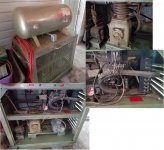
I posted this before in another place and didn't get any replies I'm hoping in the section I might get some.....
1966 Lincoln air compressor question
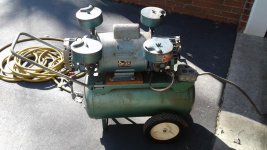
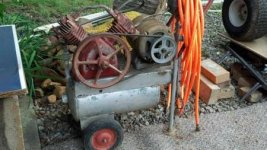
I have a Lincoln air compressor that was the right price (free) it says 7.5 horse 21cfm 80 gallon upright .... all good stuff now the problem its a 3 phase motor and I can't get 3 phase in a residential area. My question is I have a 5 horse 2 phase that spins at 2500 rpm the original spins at 900 rpm would this burn up the head ? Would a be ok going a different pulley arrangement suffice or am I on the wrong path here?
It ran amazingly quite and I would love to have it in my shop.
Thanks for you time
RESCUE-K9 is online now Report Post
Hello, Rescue,
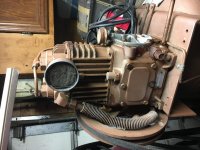
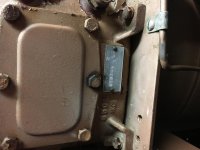
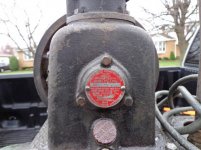
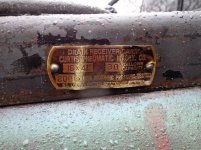
Your compressor would have been 'badged' and sold by the Lincoln Co., but the pump itself would have been made for them by one of the major manufacturers, quite possibly Quincy. If you'd care to provide a couple of clear close-up photos of the pump, it should be identifiable from details of construction.
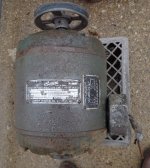
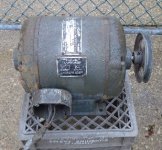
Also, if you would, please, provide a clear close-up photo of the data plate on the 5hp motor you plan to use. Unless it is a very uncommon older type, it would be 'single-phase', 230VAC, and either 1800 or 3600 nominal rpm (usually marked 1750 or 3450). Two-phase 'four-wire' AC power service is an early system, and long obsolete, but old motors for this power system do turn up occasionally. If you have one, its a 'decorative' museum artifact, these days.
I've repowered a number of 3-phase compressors in the 3-10hp range for single-phase 230V operation, one time and another. This means simply replacing the 3ph motor with a single-phase unit of similar frame size, but there are a couple of 'catches' in the details.
As a generality, recip pumps in that size range were rated to run from 400-ish min. pump speed (for adequate oiling), to a max. speed of 900-ish.
Since compressors were advertised as providing 'X' cfm output, it was common for them to be sold with the pump set up for max. rpm. This works, of course, but at the cost of lessened pump life between rebuilds.
When re-powering a compressor for single-phase, I've always preferred to check the pump mfgr's specs, for the rated min. pump speed, and fit a smaller motor pulley, to run the pump just a little above that min. rpm.
There are two reasons for this, firstly, the idea of maximising the service life of the pump before needing rebuild, and secondly, to pull the least electrical draw under 'starting load' conditions, which minimises voltage drop in the usual 'household power' arrangement in small private shops.
When selecting the motor pulley size for a specific pump rpm, determine the ratio of the desired pump speed to the motor speed (in practice, only 1750 rpm motors will be suitable, and be readily available for use on 230V single-phase power.) Then measure the pump flywheel diameter, and select a motor pulley which provides the same ratio, as nearly as may be available.
In theory, you are free to try to run the pump on single-phase with a motor of the same hp rating as the original three-phase motor, with the same pulley and belts, but, in practice, that doesn't work well. Only the heaviest-duty and most expensive single-phase motors will develop even nearly the starting torque of a three-phase motor, under load.
Note that you may need a motor starter one size larger when going from 3-phase to single-phase....check the motor rating in amps v. the starter amp rating. You will need higher amp rating heaters for the starter. I've bypassed heater circuits when using older magstarters for which the correct heaters were not available, having fitted a fused disconnect box before the starter.....this is technically illegal, and is not best practice, but has worked for me.
True enough, the unloader system of any of the good makes of pump willl provide for so-called 'loadless starting', but just the inertial load involved in rotating the pump components is about as much as the motor should be expected to handle. Re-speeding the pump to a slower speed to lessen the starting load is a good investment in longer motor life, particularly with the so-called 'ratings game' motors commonly available, these days.
(if you have one of the seriously heavy-duty GE, Wagner, or Century 'repulsion-induction' motors built for 'farm duty' on single-phase in the '40's and '50's, thats a different story....but those are hard to find, now.)
cheers
Carla