To avoid these ads, REGISTER NOW!

Old Faithful

Well-known member
Joined
Sep 10, 2015
Messages
82
Funny fact, the corrosion inside the tank really wasnt atrocious, I used a dwalt snake camera to look inside before i bought it, but I either missed where this spot was bad, or it was just that hard to see.

Hmmm... Metal fatigue perhaps? Even more dangerous because lack of visible defect gives false confidence...


Live and learn. As an Engineer, I am not comfortable welding the tank due to failures Ive seen in different pressure vessels, I guess I error a little more on the safe side due to my profession.

I concur and my experience has shown it's a bad idea. I've tried repairing an old tank with a MIG welder and it didn't hold after hydro testing. I believe the heat weakens the metal too much to withstand the pressure... I shudder thinking what would have happened if I hadn't hydro tested it.

Before this, I was considering welding my pumps and motors ON the replacement propane tank but have decided against it after this fiasco. Instead I may strap the motor and pump platform to the tank. No welding, no weakening. The only area I feel comfortable welding is the collet, just not the tank itself. For piping I'm considering plumbing everything through the filler tap, which means using the tank upside down...

Of course, a master welder could probably do a great job, but it's definitely something I'd only trust a seasoned expert with and considering liability, most of them would probably refuse to weld on anything questionable in the first place.

So your best bet would be to locate a replacement tank and buying it conditional to passing the hydro test.

Sent from my SGH-I317M using Tapatalk 2
 
To avoid these ads, REGISTER NOW!

RESCUE-K9

Active member
Joined
Jan 22, 2016
Messages
32
Location
Plainfield IL
I posted this before in another place and didn't get any replies I'm hoping in the section I might get some.....

1966 Lincoln air compressor question

I have a Lincoln air compressor that was the right price (free) it says 7.5 horse 21cfm 80 gallon upright .... all good stuff now the problem its a 3 phase motor and I can't get 3 phase in a residential area. My question is I have a 5 horse 2 phase that spins at 2500 rpm the original spins at 900 rpm would this burn up the head ? Would a be ok going a different pulley arrangement suffice or am I on the wrong path here?
It ran amazingly quite and I would love to have it in my shop.
Thanks for you time
RESCUE-K9 is online now Report Post
 

redmondjp

Well-known member
Joined
Nov 25, 2014
Messages
2,318
Location
Redmond, WA
I posted this before in another place and didn't get any replies I'm hoping in the section I might get some.....

1966 Lincoln air compressor question

I have a Lincoln air compressor that was the right price (free) it says 7.5 horse 21cfm 80 gallon upright .... all good stuff now the problem its a 3 phase motor and I can't get 3 phase in a residential area. My question is I have a 5 horse 2 phase that spins at 2500 rpm the original spins at 900 rpm would this burn up the head ? Would a be ok going a different pulley arrangement suffice or am I on the wrong path here?
It ran amazingly quite and I would love to have it in my shop.
Thanks for you time
RESCUE-K9 is online now Report Post

It would be very helpful if you could post some pictures of the compressor pump as well as of the motor nameplates. Once you have correctly identified the pump (Lincoln is the brand name - they didn't make the pump), the next step is to get the pump specifications to see how fast you can turn that pump with a 5HP motor. From that, you will be able to calculate the correct pulley size needed for your motor.
 

Old Faithful

Well-known member
Joined
Sep 10, 2015
Messages
82
I posted this before in another place and didn't get any replies I'm hoping in the section I might get some.....

1966 Lincoln air compressor question

I have a Lincoln air compressor that was the right price (free) it says 7.5 horse 21cfm 80 gallon upright .... all good stuff now the problem its a 3 phase motor and I can't get 3 phase in a residential area. My question is I have a 5 horse 2 phase that spins at 2500 rpm the original spins at 900 rpm would this burn up the head ? Would a be ok going a different pulley arrangement suffice or am I on the wrong path here?
It ran amazingly quite and I would love to have it in my shop.
Thanks for you time
RESCUE-K9 is online now Report Post

In short, your 5 horse motor will do fine but since the output is 2/3 of the original, you will have to lower the pump speed by the same ratio, from 900 down to 600 RPM (if I understood correctly that 900 RPM is the speed of the original PUMP and NOT that of the 3 phase motor), which should be OK. You'd have to check that the pump can handle this lower speed, although with splash lubricated pumps problems usually only start to occur when they run much slower, such as less than 3-400 RPM or so.

As for the motor pulley, you would have to get one that gives you the ratio (new pump RPM)/(motor RPM) to that of the pump pulley. Are you sure this motor runs at 2500 RPM and not 3450 or 1725 like most single phase AC motors do?

In other words: check existing and replacement motor RPM (from the nameplates). Check PUMP EXISTING RPM and its MINIMUM RPM (usually indicated on the same plate). Measure pump pulley.

Find your Replacement motor pulley such as ((Existing Pump Pulley Diameter)*((Existing Pump RPM)/((New Motor HP)/(Old Motor HP))))=((Replacement Motor Pulley Diameter)*(Replacement Motor RPM)

Which is

Replacement Motor Pulley Diameter=((Existing Pump Pulley Diameter)*((Existing Pump RPM)/((New Motor HP)/(Old Motor HP))))/Replacement Motor RPM

Correct me if my arithmetic is wrong and double check the brackets, but that's basically what it is. Pump RPM (for a given motor HP) * its pulley diameter has to be equal to the same on the motor side. For example, a pump running at 500 RPM with a 10 inch pulley would require a 5000 RPM motor with a 1 inch pulley. Just remember you need to correct the pump RPM factor to the power output of your new motor. If it takes 7.5 HP to run the pump at 900 RPM, if you use a 5HP motor and try to turn the pump at that same speed, you'll burn the motor. Lower the pump speed accordingly.
 
Last edited:

marinusdees

Well-known member
Joined
Oct 30, 2012
Messages
1,325
Location
Edgewood, Washington
I posted this before in another place and didn't get any replies I'm hoping in the section I might get some.....

1966 Lincoln air compressor question

I have a Lincoln air compressor that was the right price (free) it says 7.5 horse 21cfm 80 gallon upright .... all good stuff now the problem its a 3 phase motor and I can't get 3 phase in a residential area. My question is I have a 5 horse 2 phase that spins at 2500 rpm the original spins at 900 rpm would this burn up the head ? Would a be ok going a different pulley arrangement suffice or am I on the wrong path here?
It ran amazingly quite and I would love to have it in my shop.
Thanks for you time
RESCUE-K9 is online now Report Post

I sincerely doubt you have a 2 phase motor. They may have once existed, but long ago. Also, 2500 rpm is weird.
 

Carla

MEMBER EMERITUS
Joined
Nov 27, 2010
Messages
672
I posted this before in another place and didn't get any replies I'm hoping in the section I might get some.....

1966 Lincoln air compressor question

I have a Lincoln air compressor that was the right price (free) it says 7.5 horse 21cfm 80 gallon upright .... all good stuff now the problem its a 3 phase motor and I can't get 3 phase in a residential area. My question is I have a 5 horse 2 phase that spins at 2500 rpm the original spins at 900 rpm would this burn up the head ? Would a be ok going a different pulley arrangement suffice or am I on the wrong path here?
It ran amazingly quite and I would love to have it in my shop.
Thanks for you time
RESCUE-K9 is online now Report Post

Hello, Rescue,

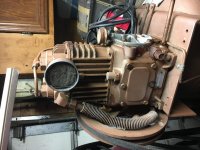
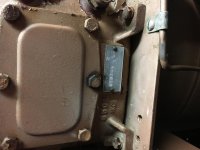
Your compressor would have been 'badged' and sold by the Lincoln Co., but the pump itself would have been made for them by one of the major manufacturers, quite possibly Quincy. If you'd care to provide a couple of clear close-up photos of the pump, it should be identifiable from details of construction.

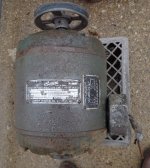
Also, if you would, please, provide a clear close-up photo of the data plate on the 5hp motor you plan to use. Unless it is a very uncommon older type, it would be 'single-phase', 230VAC, and either 1800 or 3600 nominal rpm (usually marked 1750 or 3450). Two-phase 'four-wire' AC power service is an early system, and long obsolete, but old motors for this power system do turn up occasionally. If you have one, its a 'decorative' museum artifact, these days.

I've repowered a number of 3-phase compressors in the 3-10hp range for single-phase 230V operation, one time and another. This means simply replacing the 3ph motor with a single-phase unit of similar frame size, but there are a couple of 'catches' in the details.

As a generality, recip pumps in that size range were rated to run from 400-ish min. pump speed (for adequate oiling), to a max. speed of 900-ish.

Since compressors were advertised as providing 'X' cfm output, it was common for them to be sold with the pump set up for max. rpm. This works, of course, but at the cost of lessened pump life between rebuilds.

When re-powering a compressor for single-phase, I've always preferred to check the pump mfgr's specs, for the rated min. pump speed, and fit a smaller motor pulley, to run the pump just a little above that min. rpm.

There are two reasons for this, firstly, the idea of maximising the service life of the pump before needing rebuild, and secondly, to pull the least electrical draw under 'starting load' conditions, which minimises voltage drop in the usual 'household power' arrangement in small private shops.

When selecting the motor pulley size for a specific pump rpm, determine the ratio of the desired pump speed to the motor speed (in practice, only 1750 rpm motors will be suitable, and be readily available for use on 230V single-phase power.) Then measure the pump flywheel diameter, and select a motor pulley which provides the same ratio, as nearly as may be available.

In theory, you are free to try to run the pump on single-phase with a motor of the same hp rating as the original three-phase motor, with the same pulley and belts, but, in practice, that doesn't work well. Only the heaviest-duty and most expensive single-phase motors will develop even nearly the starting torque of a three-phase motor, under load.

Note that you may need a motor starter one size larger when going from 3-phase to single-phase....check the motor rating in amps v. the starter amp rating. You will need higher amp rating heaters for the starter. I've bypassed heater circuits when using older magstarters for which the correct heaters were not available, having fitted a fused disconnect box before the starter.....this is technically illegal, and is not best practice, but has worked for me.

True enough, the unloader system of any of the good makes of pump willl provide for so-called 'loadless starting', but just the inertial load involved in rotating the pump components is about as much as the motor should be expected to handle. Re-speeding the pump to a slower speed to lessen the starting load is a good investment in longer motor life, particularly with the so-called 'ratings game' motors commonly available, these days.

(if you have one of the seriously heavy-duty GE, Wagner, or Century 'repulsion-induction' motors built for 'farm duty' on single-phase in the '40's and '50's, thats a different story....but those are hard to find, now.)

cheers

Carla
 
Last edited:

RESCUE-K9

Active member
Joined
Jan 22, 2016
Messages
32
Location
Plainfield IL
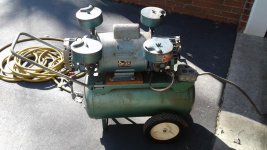
Here some quick pictures Thank you all for the info any more you can tell me would be great. I can't wait to have her ruling again.

Thank you

Hello, Rescue,

Your compressor would have been 'badged' and sold by the Lincoln Co., but the pump itself would have been made for them by one of the major manufacturers, quite possibly Quincy. If you'd care to provide a couple of clear close-up photos of the pump, it should be identifiable from details of construction.

Also, if you would, please, provide a clear close-up photo of the data plate on the 5hp motor you plan to use. Unless it is a very uncommon older type, it would be 'single-phase', 230VAC, and either 1800 or 3600 nominal rpm (usually marked 1750 or 3450). Two-phase 'four-wire' AC power service is an early system, and long obsolete, but old motors for this power system do turn up occasionally. If you have one, its a 'decorative' museum artifact, these days.

I've repowered a number of 3-phase compressors in the 3-10hp range for single-phase 230V operation, one time and another. This means simply replacing the 3ph motor with a single-phase unit of similar frame size, but there are a couple of 'catches' in the details.

As a generality, recip pumps in that size range were rated to run from 400-ish min. pump speed (for adequate oiling), to a max. speed of 900-ish.

Since compressors were advertised as providing 'X' cfm output, it was common for them to be sold with the pump set up for max. rpm. This works, of course, but at the cost of lessened pump life between rebuilds.

When re-powering a compressor for single-phase, I've always preferred to check the pump mfgr's specs, for the rated min. pump speed, and fit a smaller motor pulley, to run the pump just a little above that min. rpm.

There are two reasons for this, firstly, the idea of maximising the service life of the pump before needing rebuild, and secondly, to pull the least electrical draw under 'starting load' conditions, which minimises voltage drop in the usual 'household power' arrangement in small private shops.

When selecting the motor pulley size for a specific pump rpm, determine the ratio of the desired pump speed to the motor speed (in practice, only 1750 rpm motors will be suitable, and be readily available for use on 230V single-phase power.) Then measure the pump flywheel diameter, and select a motor pulley which provides the same ratio, as nearly as may be available.

In theory, you are free to try to run the pump on single-phase with a motor of the same hp rating as the original three-phase motor, with the same pulley and belts, but, in practice, that doesn't work well. Only the heaviest-duty and most expensive single-phase motors will develop even nearly the starting torque of a three-phase motor, under load.

Note that you may need a motor starter one size larger when going from 3-phase to single-phase....check the motor rating in amps v. the starter amp rating. You will need higher amp rating heaters for the starter. I've bypassed heater circuits when using older magstarters for which the correct heaters were not available, having fitted a fused disconnect box before the starter.....this is technically illegal, and is not best practice, but has worked for me.

True enough, the unloader system of any of the good makes of pump willl provide for so-called 'loadless starting', but just the inertial load involved in rotating the pump components is about as much as the motor should be expected to handle. Re-speeding the pump to a slower speed to lessen the starting load is a good investment in longer motor life, particularly with the so-called 'ratings game' motors commonly available, these days.

(if you have one of the seriously heavy-duty GE, Wagner, or Century 'repulsion-induction' motors built for 'farm duty' on single-phase in the '40's and '50's, thats a different story....but those are hard to find, now.)

cheers

Carla
 

Attachments

  • IMG_3776.jpg
    IMG_3776.jpg
    130.4 KB · Views: 76
  • IMG_3774.jpg
    IMG_3774.jpg
    183.3 KB · Views: 75
  • IMG_3772.jpg
    IMG_3772.jpg
    143.7 KB · Views: 86
  • IMG_3771.jpg
    IMG_3771.jpg
    136.6 KB · Views: 73

ksj138

New member
Joined
Mar 24, 2017
Messages
3
This compressor is in my grandfather's garage. He passed away 2 year ago and his work shed is mostly untouched.

My family would like to see his tools go to good use and this compressor caught my eye.

The flywheel still turned and the electric Wagner motor powered up (wired for 110V). No compression though. I could do more at my house, so I brought it home:

Mills Novelty Company
Chicago, U.S.A.
Model 42
Volts 220
Cycles 60
Serial 1766
Amps 6.4
Phase 1
? 15 lbs
CH3CL
Test Pressure 75 LBS PER SQ IN
the rest is illegible

The best I can tell is that this was originally used for a refrigeration compressor. Not sure beyond that. I can tell you my grandfather used this for his woodworking shop.

I wanted to use this in my garage for air tools/auto mechanics, but I'm leery about the pump output as well as the 75 psi test pressure as indicated on the tag. I figured it was still worth a shot since I can probably invest a little time and not sacrifice money.

Here is a link to the photos. I can't get the link to photos to display right in this forum. I think I must be doing something wrong:
https://goo.gl/photos/uieXXszhvTo3hNGD6
 
Last edited:

ksj138

New member
Joined
Mar 24, 2017
Messages
3
After I got it home, I drained the sludge and replaced with 3 quarts of 30W oil. I removed the heads and was pleased to find that there were still a top and bottom metal gasket on the valve plate. There was a bit of surface rust that was cleaned off with a wire brush and finished off with some fine sand paper.

The valves are disc shaped. The valve keepers have 4 small springs each. Some of them were corroded. luckily, I found some suitable replacements laying around. After cleaning everything up, I put it back together. On the gaskets, I put some indian head gasket on both sides and locked everything down.
 

ksj138

New member
Joined
Mar 24, 2017
Messages
3
The motor is manufactured by:
Wagner Electric Corporation
Type KA
Frame 75
Model V24 B184 K??48
1/2 HP
1725 R.P.M.
1 PH.
60 Cycles
110 Volts 7.2 AMP
220 Volts 3.6 AMP
CONT. Rating 40°C
Ser. No. 1620418

When the motor was turned on, the brushes did not sound happy and were throwing a few sparks. I could not find a manufacturer's replacement, but I did find a site called Eurton that sells shunted wedge-shaped brushes as this model requires.

My caliper measured the brushes .13" x .21" x .74" x .68" with 0.68 being the wear side. The replacement I bought was .13" x .21" x .74" x .75".

With everything together and the new brushes installed, I get compression, but it's not enough for what I want to use this for. At most, I get 40 P.S.I. I used a strobe tach on my smartphone to determine the motor was spinning at the correct speed, but how do I know what the maximum RPM of the pump should be?

Currently, I'm debating whether to stop here and resolve that I won't/shouldn't try to get more performance out of this compressor. I don't know how far I could push the pump. I'm completely new to this, so I could use any suggestions. Thanks!
 

redmondjp

Well-known member
Joined
Nov 25, 2014
Messages
2,318
Location
Redmond, WA
Currently, I'm debating whether to stop here and resolve that I won't/shouldn't try to get more performance out of this compressor. I don't know how far I could push the pump. I'm completely new to this, so I could use any suggestions. Thanks!

With a 1/2HP motor (that has brushes? It has to be ancient then!), you are never going to get very high performance out of that unit. I would definitely not use that motor if you are planning on regularly using the compressor.

Most pumps have a speed range between 400 - 900rpm. With a larger motor, you can spin the pump faster and get a higher flow from it. If you get a pump motor from a dead "5HP" compressor (which will probably be about 3.2HP due to compressor manufacturers lying about that in the 1970s - 2000s, see internet for details), you can spin that pump much faster and get a decent output from it. Some calculations will be required to determine the proper motor pulley size (spelled out in dozens of other compressor threads already).

Or you may want to keep that unit as-is as an antique showpiece. Your choice.
 

Pavedog

Active member
Joined
Feb 26, 2017
Messages
28
Location
Fairfax VA
Jemin,

Do you still have the compressor? If so I was wondering if you would mind taking more pictures as I am in the process of restoring the same one. If you notice mine has had the original compressor/motor replaced.
 

Attachments

  • 20170226_141503.jpg
    20170226_141503.jpg
    150.1 KB · Views: 88

z1kzonly

Well-known member
Joined
Apr 25, 2014
Messages
56
Location
Western New York
Re: Vintage Curtis Air Compressor

Hello, been awhile since I have been around. I have an old vintage CURTIS air compressor that has been around since 1970. I was 10yrs. old. This was my Dad's. It looked old back then! I was a cool kid with a mini-bike. I would wash it and blow it off dry, and blow out the spark plug. Dad passed in 1972. I used this up until 1996. Yes it still works.
My questions are? What to do with it? I have no room for it! My son had it stored for me. He moved, I took this back. (I took the motor off to lift it! The motor weighs about 60 pounds) It has MUCH sentimental value to me! I can't part with it. I want to restore it with correct paint colors.
It is a 30 gallon tank. It has a 2 5/8" x 2 5/8" bore stroke. It is a Century, single phase, dual voltage 1 HP motor. It shows 30 / 87-9746, I assume serial number. Question? What type of value would this have cleaned up and painted, re-wired etc. Not crazy overdone. Maybe place it at an Automobile / Garage type of Museum of some sort for display? Just looking for opinions?
I would think the #9746# could 46 mean 1946?
Thanks in advance for any ones knowledge!
Marty in Buffalo, NY
 

Attachments

  • DSC00066 (2).JPG
    DSC00066 (2).JPG
    99.1 KB · Views: 43
  • DSC00067 (2).JPG
    DSC00067 (2).JPG
    69.4 KB · Views: 44
  • DSC00068.jpg
    DSC00068.jpg
    50.4 KB · Views: 41
  • DSC00069.jpg
    DSC00069.jpg
    64.3 KB · Views: 41
  • DSC00070 (2).JPG
    DSC00070 (2).JPG
    112.3 KB · Views: 49
  • DSC00071 (2).JPG
    DSC00071 (2).JPG
    125.5 KB · Views: 45
  • DSC00072 (2).JPG
    DSC00072 (2).JPG
    108.6 KB · Views: 49
Last edited:

Qtrtilldawn

New member
Joined
Jul 11, 2017
Messages
1
I have my grand fathers vintage, two-stage, 3/4 hp, looks home made air compressor. The motor says, "Sears Craftsman" dtd Oct. 1955. The rest I know nothing.

Measured it is about a 6 gallon tank. SCFM I have no idea. But hooked up a F350S nail gun and ran about a dozen nails before it kicked on. Old but good.

Question is, it is my gran pappies air compressor. I don't want to trash it, but am interested in hooking another tank to it. Leave the old timey compressor to look at, but a bigger tank hidden.

Oiled twin/two-stage, 62 yo motor that hums along, heck, maybe the same belts. Keep it as it is, upgrade it, is my question.


Plus I have a same era Dewalt radial-arm saw. Post that elsewhere.
 

Attachments

  • Air Compressor.jpg
    Air Compressor.jpg
    23.2 KB · Views: 56

Old Faithful

Well-known member
Joined
Sep 10, 2015
Messages
82
I have my grand fathers vintage, two-stage, 3/4 hp, looks home made air compressor. The motor says, "Sears Craftsman" dtd Oct. 1955. The rest I know nothing.

Measured it is about a 6 gallon tank. SCFM I have no idea. But hooked up a F350S nail gun and ran about a dozen nails before it kicked on. Old but good.

Question is, it is my gran pappies air compressor. I don't want to trash it, but am interested in hooking another tank to it. Leave the old timey compressor to look at, but a bigger tank hidden.

Oiled twin/two-stage, 62 yo motor that hums along, heck, maybe the same belts. Keep it as it is, upgrade it, is my question.


Plus I have a same era Dewalt radial-arm saw. Post that elsewhere.
That pump doesn't look original - As far as I've learned about these compressors, they came with dual inline cylinders. Are you sure the pump isn't more recent? Seems it should be able to push a decent amount of air (between 6 and 10CFM from the looks of it, provided you have the right motor and pulley for it).

I'd get a recent 20 or 30 gallon tank from a recent oilless compressor that was trashed because the pump failed and mount the mechanicals on it, after the used tank passed a hydro test of course (you can fill it with water and pump the few remaining cubic inches with air to 50% above rated pressure, if it bursts it wil simply leak instead of exploding like it would if it was full of air)

With a big tank you would then have a decent amount of reserve air and it would also be better for the motor (it wouldn't start and stop as often)

Classic Sears Craftsman compressors are so rare in my parts it's hard to get them for less than $100 these days, with asking price more like $150 and at that price they aren't in the best of shapes. Got one with a bad pump bearing (crankshaft worn out) and another one I couldn't test (bad motor) that turned out to have a bad pump after I managed to take out the oil filler (it was absolutely dry). It fortunately works, but I've had to use very thick oil to quiet the thumping. They aren't always great deals :-(
 

bernietech

Member
Joined
Jan 8, 2012
Messages
23
What model dewalt? Where did you post pictures? Radial arm saw forum on delphi is the best for older dewalts. I am currently working on my MFB circa 1956 and want to start again on my old Pelton air compressor. going to mount a NOS montgomery ward compressor on it.

bernie
 
To avoid these ads, REGISTER NOW!

Daddyjeep

New member
Joined
Aug 30, 2017
Messages
1
I just joined here and was wondering if anyone was familiar with my new compressor. I have seen some posts about old Westinghouse Airbrake compressors, but have yet to see a vertical. It is a 1AYC compressor with the original Westinghouse 1.5 HP motor. It runs great and I picked it up for $125. The previous owner could not get it to build above 20 PSI he said. He must have been extremely impatient because I got it to about 100 PSI before it stopped building. It was wired for 110v at the time, but according to the tag on the motor, it was not wired correctly. I rewired for 220v and she pumped up to 150 in no time at all. Anyone have any idea when this might have been produced?

Eo4gTA_PbjaPQDFRZ8rqxHSLs2Xbzjxk5grEWM0V-CTzfrHE7pFpGvXk04dc_W2NX24DLc3O94X-ErERxwLeBO6gQRPP8VN5GgeJinxIQs93f_hbrIibSDSUXpGwuKHGju_0TvCncFYNFd9C4XPTQ-YTjKFniTTnGYk5k8RmkSNAzaCTI7ZnodwJ-MC9yKUP4GO8aJPuBz1yTxR1tEWVdHCYlk9kyZNBrp16PlGNKXJo1SBlW25vleXRa7shub4x_xqHb0iQbt7eMu4X77JYbl2nnChIpL0e29qG8Gjw4W5G2-UsW3LNQK_ZAAAutYOlR9Y1d0RO9tukohlsfC1JUm_FatPgn8Ytwf13cH4vt_Ipf50al4-cpom36GwL8oYBNbSQDEUv7PurC8ZsQliAQTVQPJnyDw26yd6WhzjKyTE9Z_BmtSIJZml_Q-0WDdmVp9YxEggRjpNFU0TIH3XL5bYqtCJJ-RnMusYb80_7CPK_ZDB1FGAX00P7tuNl-4z5TGDrCvy1700b7WRI_hqQ8Vi1uaSE1WJNvyQfgBI-ux9SgLtcOQCWbVr6fEcpHLSsFvWUku16OWvwUAh-hBGr6tiw3okDrnMO_vTu0f89_pJMXcRFoxMo=w572-h1016-no


teHvriiAVcrGy5z4cY2PiXfohzilJstIF9TBd8I8uiNJzgdtadV3VygDTLtoGcC6-jKAREGAQgy7Ic64zDYuFv-ptehWJMfPgh67fa-JXcG7KiIESq7lI3nj2v9Mg0Po5uZKsQSq5sLktAkbL1do5lBM1UUU6lELpgUeUqqeUfOFx9sxJuQ889fjxBLTou60YKF2CIAAhwlN3-nUy5Oam8XNfmDc6hzretoLyTSmzYXBDAKB1GRPZUBSJ4pjQ5rMf50_2FAA1LGe0lw-kotRqnYYpZ1TkMHegxe0qKh-9zcz5KumegE91e41WViNSeO8kzeLjNVNPUeYYE74tPavLvm5jAo1idgu3oRPts4xJpJecZwCPKKl57mkAaBzQCaeITC7G4Hym2jiXRVMTAOUNENNUrFizqRuEb_RUvWumaBlw5Y-WqORzLX7DJ5OMSqlRTCTXpujOff7E2KUEjn2ojl4a2gJ9nK6o3U2XyGk6so55tmZxCG-8YrUwLjAaEx7_CiRWtIruNih4uNGDaSvfkktcFt-JJxUzjy3eXpnxVbayVUAOq2-0-Lle4wQ-kFdn7XeVQ85FBFb3Zaav-b74o0soFwbq93DcU9p3OXsgt2-_bk1SK8Z=w572-h1016-no
 
Last edited:

wrenchguy

Well-known member
Joined
Sep 22, 2011
Messages
4,698
Location
NW Indiana
This is a 1934 quincy wall compressor powered by a briggs stratton 1 1/2hp, model "a" engine. My uncle pulled it out to a crystal flash gas station just north of monon indiana in the early 60's. He told me it was used in a lean too shed attached to the garage. He didn't know how old it was but used it up into 80's. I got it in the 90's and put it away for a future project. Anyway now i'm able to date the engine to the spring 1934 using the serial number and internal parts. I'm now refurbing/restoring it. He told me they used a gas engine 1 in the beginning because tricity cost a lot and the gas was cheap to pump up tires. He told me of hand pumping gas up into the glass cylinders in visible pumps when he started to drive in the late 20's. He started that compressor many times keeping his worn out wartime tires up on his model t hot rod. This machine was put together by kato engineering and marketed to the filling station business in the 30's and 40's. It runs good, heres a vid of it running b4 i tore it apart.


"f-34" date code on the coils


"d 34" date code on the magneto plate.


all the engine parts taken to bare metal ready 4 paint.
 
Last edited:

bernietech

Member
Joined
Jan 8, 2012
Messages
23
Very NICE post. Please post again when you have it finished and working. Or better yet as you progress through the rebuild.

On another note, glad to see this thread is alive. been awhile since the last post. I wish folks would follow up on posts and not just post once on a project.

I try to.

bernie
 

Old Faithful

Well-known member
Joined
Sep 10, 2015
Messages
82
Very NICE post. Please post again when you have it finished and working. Or better yet as you progress through the rebuild.

On another note, glad to see this thread is alive. been awhile since the last post. I wish folks would follow up on posts and not just post once on a project.

I try to.

bernie
I too am always looking forward to thread updates. The thing is, vintage machines are getting harder and harder to come by and parts are even more difficult to get. Haven't seen anything in the past couple of years in my area except for hopeless junk with out of this world 'vintage ' asking prices.

Sent from my Lenovo TAB 2 A10-70F using Tapatalk 2
 

wrenchguy

Well-known member
Joined
Sep 22, 2011
Messages
4,698
Location
NW Indiana
RE:1934 quincy wall redo.
plugging along…. compressor down to bare, along with desludgeing and cleaning the crankcase.


Last edited:

N_Jay

Well-known member
Joined
Nov 1, 2016
Messages
1,168
One last chance before the scrap yard.

I have a tank from a very old air compressor.

It is a rolled and riveted plate with a hand-hole like a boiler.

It came from a compressor that was putting out 175 PSI, but might have been a newer pump than the original. It was a very old Quincy, I think.

The tank probably weighs 300 lb, and is probably about 60 gallons.

I am in NE Illinois, (Chicago NW suburbs) and getting ready to move. The tank is NOT going with me.

I will add some picture tomorrow.
 

topbrent

New member
Joined
Sep 27, 2015
Messages
1
Anyone recognize this model? I believe it has a Quincy compressor unit. It is equipped with an air drier as well. Dates to around 1973 I'm told.
 

Attachments

  • Unknown 1973 compressor.jpg
    Unknown 1973 compressor.jpg
    112.9 KB · Views: 92
Last edited:

Loose Ctrl

Well-known member
Joined
Dec 21, 2014
Messages
759
Location
Upstate SC
Anyone recognize this model? I believe it has a Quincy compressor unit. It is equipped with an air drier as well. Dates to around 1973 I'm told.

I can't answer your question but I have seen some similar comps. A place I worked at, WABCO, had dozens of compressors that looked similar. I was told they were used on trains and some of them had a 300PSI working pressure.
 

wrenchguy

Well-known member
Joined
Sep 22, 2011
Messages
4,698
Location
NW Indiana
Re: 1934 quincy refurb.

Base top down to bare.


underside, i think they jigged and machined the top to accept multiple different motors or power sources to run the compressor. all the mounting holes are drilled/tapped in areas of built up bosses underside.


with fuel tank end removed i used a 14" piece of 2 1/2" round stock to slowly pound out major dents from inside out. it looks good enough 4 the wimmen i go out with. no bondo but did use some glazing.
 

wrenchguy

Well-known member
Joined
Sep 22, 2011
Messages
4,698
Location
NW Indiana
Re: 1934 quincy refurb.

Stand in gloss black and old caterpillar yellow. Tank taken to bare and in primer.

About the tank… I never had pressure in it. B4 i cleaned it up i chased the fittings, plugged 3 and put in a milton male. I placed it under a cat d4 tractor and remotely hooked it up to a different compressor and put 100 lbs pressure in it. It did not blow-up or leak 1 pound i could see on the remote gauge for 2 hours. Cleaned it up and primed it. I plan on using a 50lb pop-off when running it. I plan on safely testing it often in the future. This may wrankle some u up but do you see any problem with this?

 
Last edited:

Loose Ctrl

Well-known member
Joined
Dec 21, 2014
Messages
759
Location
Upstate SC
Can someone post info on testing tanks? I have been avoiding comps made before the 70's and 80's because of the unknowns of the tank(s).
 

N_Jay

Well-known member
Joined
Nov 1, 2016
Messages
1,168
Do a search.
One way is fill completely with water, then close off all valves, use a grease gun to pump the tank up to the test pressure. Here is the guess, 1.25X, 1.5X or 2X the working pressure. Let stand and check for leaks.
My 60 gallon took 2 tubes of grease to get to 250 PSI (I run at 175).
I had to do it twice because the pressure relief decided to start dripping.

The rolled and riveted tank I have (different talk) has a hand-hole, so I got a good look inside and was very surprised at how little rust. Seems the old steel/iron does not rust like modern steel. Of course I would worry about high pressures due to it maybe being brittle.
 

wrenchguy

Well-known member
Joined
Sep 22, 2011
Messages
4,698
Location
NW Indiana
Do a search.
One way is fill completely with water, then close off all valves, use a grease gun to pump the tank up to the test pressure. Here is the guess, 1.25X, 1.5X or 2X the working pressure. Let stand and check for leaks.
My 60 gallon took 2 tubes of grease to get to 250 PSI (I run at 175).
I had to do it twice because the pressure relief decided to start dripping

then what do u do with the grease in the tank?
 

N_Jay

Well-known member
Joined
Nov 1, 2016
Messages
1,168
then what do u do with the grease in the tank?
Most comes out when you drain the tank, and rest drips/sprays out when you bleed the tank for a while, and some probably sticks to the inside.

Does it really matter?

I have been told you can use ATF if you have a good enough grease gun to pump something thinner than grease.

I tried, and failed. ATF would not pump well enough and water started backing up into the grease gun. (My connection was on teh side of a vertical tank. It might have worked if I connected at the top.)

I also topped up the water fill with a quart of ATF.
Thoughts were;
1) it would keep water out of the pressure gauge at the top of the tank.
2) It would coat the inside of the tank after the water wash
3) It would help the grease not stick and be flushed out easier.
 
Last edited:

Loose Ctrl

Well-known member
Joined
Dec 21, 2014
Messages
759
Location
Upstate SC
Do a search.
One way is fill completely with water, then close off all valves, use a grease gun to pump the tank up to the test pressure. Here is the guess, 1.25X, 1.5X or 2X the working pressure. Let stand and check for leaks.
My 60 gallon took 2 tubes of grease to get to 250 PSI (I run at 175).
I had to do it twice because the pressure relief decided to start dripping.

The rolled and riveted tank I have (different talk) has a hand-hole, so I got a good look inside and was very surprised at how little rust. Seems the old steel/iron does not rust like modern steel. Of course I would worry about high pressures due to it maybe being brittle.

Most comes out when you drain the tank, and rest drips/sprays out when you bleed the tank for a while, and some probably sticks to the inside.

Does it really matter?

I have been told you can use ATF if you have a good enough grease gun to pump something thinner than grease.

I tried, and failed. ATF would not pump well enough and water started backing up into the grease gun. (My connection was on teh side of a vertical tank. It might have worked if I connected at the top.)

I also topped up the water fill with a quart of ATF.
Thoughts were;
1) it would keep water out of the pressure gauge at the top of the tank.
2) It would coat the inside of the tank after the water wash
3) It would help the grease not stick and be flushed out easier.

Thanks for the info. I haven't found the info through a search on here. I'm not to good at search on forums or on the open interwebs.
 

wrenchguy

Well-known member
Joined
Sep 22, 2011
Messages
4,698
Location
NW Indiana
Re: 1934 quincy refurb.

Plugging along dryfitting original plumbing fittings and trying to decide/find ideas about going modern plumbing? u guys got any ideas? I'm going present this as a Caterpillar service truck compressor decals and all.
New videos below.


Engine magneto spark video.

Dry fitting parts video.

thanks 4 looking
 
Last edited:
To avoid these ads, REGISTER NOW!
Top Bottom