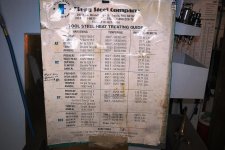
007. Do you have a project in mind and want to know a steel type to use? If so check out these books. These books have the steel type and what are the products made from these different Tool Steels. Most Tool Steels out of the oven and quenched, (Quenching is done mostly with Oil, Air or Water) after quenching the steel is around 62 R/C and needs to be drawn back to relieve the stresses and bring it to a more usable hardness. Look at my chart and you can see what temps are needed to bring the hardness down to what application your steel is used for. I like my A2 at 54-56 R/C like the early Wilton jaws.
I could share a few pic's of the pages so you could make your chart if you want, I have a couple old Carpenter books like in the pic floating around and happy to share. The Carpenter hand Books are still pretty useful but really out dated. In fact I am out dated since every time I go to the heat treater I check out what the other shops are building and the steel type and hear a different steel name that I never heard from.
Keep us posted on what you find.
Dr. Scott Thank you very much for the information. I will check the local library and see if I can find any of these books.
My main interest is to be little bit more informed and get a better feel for a material that obviously has prolific applications in everyday life from vises to other tools to everything else.
Personally and I would speculate most people beyond knowing steel is an alloy of Iron and Carbon (and depending on the steel type possibly manganese, silicon, nickel, titanium, copper, chromium and aluminum) and is harder than Iron but more brittle (less ductile) and some superficial understanding of the quenching process, know very little detail about it.
For example a leaf spring is obviously made out of some hardened steel yet it is still flexible but not ductile but I do not know where it would fall in the spectrum of hardness (eg is a leaf spring steel harder than a knife steel? Is an anvil face plate or vise jaw insert harder than a hammer steel?) and what kind of steel is used to make it. Or when someone expert like yourself says something about a jaw insert made from A2 steel, -until your recent explanation- I had no feel for is this really hard steel or what.
On a more specific and immediate concern, I was interested in the following anvil
https://www.ebay.com/itm/New-Blacksmith-Silversmith-110-Pound-Forged-Steel-Metal-Working-Anvil/323045182223?hash=item4b36fe4b0f:g:VagAAOSw56NaJ2do
But now that I have just a little bit of feel (thanks to what I have learned from your recent posts) I am concerned that an RC of 52 for anvil face might not be as hard as it is portrait to be! (on a side note these are selling like cake, the last link I posted is already sold and I updated the link to a new posting but I bet this will be sold again)
In summary it seems to me if someone is interested in tools and in particular vises and anvils etc , it is probably a good idea to have some basic understanding of main material they are made off.
PS
The Flagg Steel Company chart is definitely a great cheat sheet where at a glance one can get a lot of concise information and the also the great summary on A2 steel. Thank you again for posting