To avoid these ads, REGISTER NOW!

The VISES of Garage Journal

BMR24

Well-known member
Joined
Oct 2, 2017
Messages
234
Location
Rocky Mountains Colorado
VA You have a valid point, since this is an RI vise this is not doable, however if this was a Columbian (boy I am going to get an earful from Columbian fans and I even do have a few Columbians myself) with its hallow structure one could use at a flotation device :)

You mean "floatation de-VISE"
 
To avoid these ads, REGISTER NOW!

KMScott

Well-known member
Joined
Feb 14, 2012
Messages
4,642
Location
Daufuskie Island, South Carolina
Ursus Are those jaw inserts replacements or original? Here is why I am curious. I find it rather odd that the vise is in great shape and specially the jaw inserts are in immaculate shape and look almost never used, but the anvil seems to have taken a bit of beating (and as everyone here agrees the anvil on a vise is really a cosmetic feature and should not be ever used).

Since the jaw inserts look almost never used
, it seems someone mistook this Wilton bullet vise for Wilton Bullet anvil :bounce:

In any case if this was my vise and I was to use to the dremel to buff the anvil, I would first use an angle grinder to get ride of some of the scars off and smooth the anvil surface (there is enough meat there to easily withstand shaving off a little bit of material). But that is my two cents and others might agree or disagree and more importantly it is your vise to do whatever with.

007, the first and second generation jaws were 56/58 Rockwell which is very hard. I know because I checked a pile of them at my Heat Treater when I was starting out. I have seen jaws built in the 40's that are almost perfect. You will see more chipping then crushed serration diamonds. Later Wilton went to a different steel type in their third generation where now it is Sintered metal on their Tradesman jaws which is brittle and the diamonds flatten out. I have not seen the jaws used in the newer Bullet vises sold at high prices. The steel choice I use is pretty close to Wilton's early jaws (A2) or at least it gets as hard and does not chip as easy. We figured Wilton used water hard Carpenter steel like the W1 steel type. (going by memory which ain't very good) My steel in the Carpenter steel book is called Vega (A6).
 
Joined
Sep 19, 2013
Messages
20
Ursus Are those jaw inserts replacements or original? Here is why I am curious. I find it rather odd that the vise is in great shape and specially the jaw inserts are in immaculate shape and look almost never used, but the anvil seems to have taken a bit of beating (and as everyone here agrees the anvil on a vise is really a cosmetic feature and should not be ever used).


Since the jaw inserts look almost never used, it seems someone mistook this Wilton bullet vise for Wilton Bullet anvil :bounce:


In any case if this was my vise and I was to use to the dremel to buff the anvil, I would first use an angle grinder to get ride of some of the scars off and smooth the anvil surface (there is enough meat there to easily withstand shaving off a little bit of material). But that is my two cents and others might agree or disagree and more importantly it is your vise to do whatever with.


007, they are the original and are in remarkably good shape. That said, I did also turn them over so that the slightly scarred top edges now face down, but, they were really not bad at all and cleaned up like that with a wire brush on the angle grinder.

Good call on the anvil. It is a little beat up and the grinder will likely make quick work of it. Maybe even an aggressive flap disk will do it. I’ll post the results.


Sent from my iPhone using Tapatalk
 

gman007

Well-known member
Joined
May 17, 2017
Messages
2,736
Location
West Michigan
007, the first and second generation jaws were 56/58 Rockwell which is very hard. I know because I checked a pile of them at my Heat Treater when I was starting out. I have seen jaws built in the 40's that are almost perfect. You will see more chipping then crushed serration diamonds. Later Wilton went to a different steel type in their third generation where now it is Sintered metal on their Tradesman jaws which is brittle and the diamonds flatten out. I have not seen the jaws used in the newer Bullet vises sold at high prices. The steel choice I use is pretty close to Wilton's early jaws (A2) or at least it gets as hard and does not chip as easy. We figured Wilton used water hard Carpenter steel like the W1 steel type. (going by memory which ain't very good) My steel in the Carpenter steel book is called Vega (A6).

Dr. Scott Thank you so much for the detailed information and explanation and as usual this is great educational material for me personally and mostly likely for many others here as well.

So is the hardness of A2 around 56/58 Rockwell ? What about W1 then? What are other common types of steel? If there is an A2, are there then A1, A3, or W2, W3 etc steel? and how do these compare on the RC scale?

Would you care to give some examples of some common steel items and corresponding RC and type of steel used to make them? This would be very helpful as we all have some rudimentary idea off their hardness vs their functionality but really not a good idea of hardness on a technical level. Is a chisel harder than a knife and if so how much harder? I have no idea!

For example I think I read somewhere that a good knife should have RC 58-62 and good anvil face plate should be 60 RC and higher but what is the hardness of a hammer? How hard and what kind of steel is a truck leaf spring made off? Or a Chisel?


Here is another example, on the forged in fire tv show every now and then one of the smith will say something like I made this sword form W or A something steel (and I am thinking well is that a really hard steel? And what the heck is it in the first place).

Any information will be greatly appreciated.
 
Last edited:

jrobb316

Well-known member
Joined
May 18, 2014
Messages
1,377
Location
WI
Now I can swim with the 150 lb vise 50 miles (half point), if Jrobb agrees to meet there and take it back from there :lol_hitti

Alternatively, he can wait for the lake to freeze (and some years it does freeze solid nearly 100%) and skate or snow mobile across. :D

I'm thinking dog sled team. :lol_hitti
Not this year, been too warm.
 

CrotalusAtrox

Well-known member
Joined
Mar 5, 2016
Messages
796
Location
The Great Southwest
Dr. Scott Thank you so much for the detailed information and explanation and as usual this is great educational material for me personally and mostly likely for many others here as well.

So is the hardness of A2 around 56/58 Rockwell ? What about W1 then? What are other common types of steel? If there is an A2, are there then A1, A3, or W2, W3 etc steel? and how do these compare on the RC scale?

Would you care to give some examples of some common steel items and corresponding RC and type of steel used to make them? This would be very helpful as we all have some rudimentary idea off their hardness vs their functionality but really not a good idea of hardness on a technical level. Is a chisel harder than a knife and if so how much harder? I have no idea!

For example I think I read somewhere that a good knife should have RC 58-62 and good anvil face plate should be 60 RC and higher but what is the hardness of a hammer? How hard and what kind of steel is a truck leaf spring made off? Or a Chisel?


Here is another example, on the forged in fire tv show every now and then one of the smith will say something like I made this sword form W or A something steel (and I am thinking well is that a really hard steel? And what the heck is it in the first place).

Any information will be greatly appreciated.


Use the great Oracle of the web and Google it. http://www.carbidedepot.com/formulas-hardness.htm


https://www.metalsupermarkets.com/types-of-steel/
 
Last edited:

gman007

Well-known member
Joined
May 17, 2017
Messages
2,736
Location
West Michigan

Thanks for the links. The table in the first link seems be a conversion table between different measurement standards Rockwell,Rockwell Superficial,
Brinell, Vickers, and Shore but if one has no feel for one standard , then knowing how it converts to others is not that helpful. The second link is more like I have seen when I have searched, a bit of information and then a link to another information none of which are concise and aggregated in meaningful way for a novice.

There are millions of ways to skin this cat but here is an outline of what I would
consider really helpful. Say a table like in the attached photo (essentially a cheat sheet)
 

Attachments

  • steel.jpg
    steel.jpg
    21.8 KB · Views: 35
Last edited:

autopts

Well-known member
Joined
Jul 4, 2009
Messages
2,268
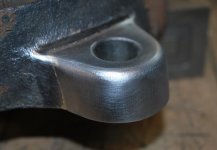
Replacing a missing foot on a swivel base. I am restoring this 200lb Rock Island 544B Combination vise and when I picked it up the owner said I forgot to mention one ear was broke off. Right away I thought this would be a great practice repair since it has been since 1987 since I brazed anything. After spending some time figuring out how I should do this I went for it. Without going into much detail I machined out a pocket underneath the base then found a donor vise for the ear. A Static Chas Parker was the donor. Yep another transplant. I gave .005 clearance on all fits and used a shim of Silver Solder and sandwiched the insert with plenty of Sta-Silv fluz. Took 10 minutes to heat up and the Easy Flow Silver Solder pulled in and stuck. Machining the base flat will help this repair hold up. Still not as strong as original but this will put this vise back to work.

kevin that's some awesome work there..
 

Attachments

  • Brazing a broken foot 8-2017 (31).jpg
    Brazing a broken foot 8-2017 (31).jpg
    107.4 KB · Views: 69

KMScott

Well-known member
Joined
Feb 14, 2012
Messages
4,642
Location
Daufuskie Island, South Carolina
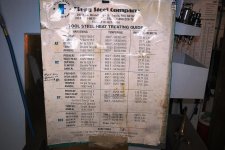
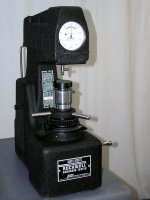
007. Do you have a project in mind and want to know a steel type to use? If so check out these books. These books have the steel type and what are the products made from these different Tool Steels. Most Tool Steels out of the oven and quenched, (Quenching is done mostly with Oil, Air or Water) after quenching the steel is around 62 R/C and needs to be drawn back to relieve the stresses and bring it to a more usable hardness. Look at my chart and you can see what temps are needed to bring the hardness down to what application your steel is used for. I like my A2 at 54-56 R/C like the early Wilton jaws.

I could share a few pic's of the pages so you could make your chart if you want, I have a couple old Carpenter books like in the pic floating around and happy to share. The Carpenter hand Books are still pretty useful but really out dated. In fact I am out dated since every time I go to the heat treater I check out what the other shops are building and the steel type and hear a different steel name that I never heard from.

Keep us posted on what you find.
 

Attachments

  • heat Treat info (3).jpg
    heat Treat info (3).jpg
    144 KB · Views: 22
  • heat Treat info (5).jpg
    heat Treat info (5).jpg
    145.1 KB · Views: 25
  • heat Treat info (8).jpg
    heat Treat info (8).jpg
    105.3 KB · Views: 26
  • heat Treat info (2).jpg
    heat Treat info (2).jpg
    148.5 KB · Views: 27
  • Rockwell tester.JPG
    Rockwell tester.JPG
    130.5 KB · Views: 30
  • Tool Steel Blackbook.jpg
    Tool Steel Blackbook.jpg
    84.3 KB · Views: 25

gman007

Well-known member
Joined
May 17, 2017
Messages
2,736
Location
West Michigan
007. Do you have a project in mind and want to know a steel type to use? If so check out these books. These books have the steel type and what are the products made from these different Tool Steels. Most Tool Steels out of the oven and quenched, (Quenching is done mostly with Oil, Air or Water) after quenching the steel is around 62 R/C and needs to be drawn back to relieve the stresses and bring it to a more usable hardness. Look at my chart and you can see what temps are needed to bring the hardness down to what application your steel is used for. I like my A2 at 54-56 R/C like the early Wilton jaws.

I could share a few pic's of the pages so you could make your chart if you want, I have a couple old Carpenter books like in the pic floating around and happy to share. The Carpenter hand Books are still pretty useful but really out dated. In fact I am out dated since every time I go to the heat treater I check out what the other shops are building and the steel type and hear a different steel name that I never heard from.

Keep us posted on what you find.

Dr. Scott Thank you very much for the information. I will check the local library and see if I can find any of these books.

My main interest is to be little bit more informed and get a better feel for a material that obviously has prolific applications in everyday life from vises to other tools to everything else.

Personally and I would speculate most people beyond knowing steel is an alloy of Iron and Carbon (and depending on the steel type possibly manganese, silicon, nickel, titanium, copper, chromium and aluminum) and is harder than Iron but more brittle (less ductile) and some superficial understanding of the quenching process, know very little detail about it.

For example a leaf spring is obviously made out of some hardened steel yet it is still flexible but not ductile but I do not know where it would fall in the spectrum of hardness (eg is a leaf spring steel harder than a knife steel? Is an anvil face plate or vise jaw insert harder than a hammer steel?) and what kind of steel is used to make it. Or when someone expert like yourself says something about a jaw insert made from A2 steel, -until your recent explanation- I had no feel for is this really hard steel or what.

On a more specific and immediate concern, I was interested in the following anvil

https://www.ebay.com/itm/New-Blacksmith-Silversmith-110-Pound-Forged-Steel-Metal-Working-Anvil/323045182223?hash=item4b36fe4b0f:g:VagAAOSw56NaJ2do

But now that I have just a little bit of feel (thanks to what I have learned from your recent posts) I am concerned that an RC of 52 for anvil face might not be as hard as it is portrait to be! (on a side note these are selling like cake, the last link I posted is already sold and I updated the link to a new posting but I bet this will be sold again)

In summary it seems to me if someone is interested in tools and in particular vises and anvils etc , it is probably a good idea to have some basic understanding of main material they are made off.

PS
The Flagg Steel Company chart is definitely a great cheat sheet where at a glance one can get a lot of concise information and the also the great summary on A2 steel. Thank you again for posting
 
Last edited:

BMR24

Well-known member
Joined
Oct 2, 2017
Messages
234
Location
Rocky Mountains Colorado
007 my metallurgy knowledge is very limited and comes from pipe fitting and backyard black smithing projects /reaserch. Generally, any steel has a range of hardness/ characteristics that depend on the heat treating it goes through. Mild steel (angle iron, Ibeams, sheet steel, ect) won't harden because it has very low to no carbon content. Leaf springs (5160 from as best I can tell from reaserch) can be heat treated to be soft like mild steel, springy like the leaf spring, or very hard and problibly brittle) file or rasp steel can be made soft or extremely hard and brittle.
My understanding with anvils, is that you want the face to be soft enough not to chip or crack if mis-struck, but hard enough not to dent or deform with use. The hammer should be softer than the anvil so that it wears out and the anvil doesn't.
All of the above understanding comes from Internet articles/ YouTube videos. I have no way of knowing weather these people knew what they were talking about or not other than my own trial and error. So far this seems to be accurate information.
I found a brand new anvil for about $300 less then any old one I could find that was the same size and in good shape. Mine is made by Texas ferrier supply.
 

gman007

Well-known member
Joined
May 17, 2017
Messages
2,736
Location
West Michigan
007 my metallurgy knowledge is very limited and comes from pipe fitting and backyard black smithing projects /reaserch. Generally, any steel has a range of hardness/ characteristics that depend on the heat treating it goes through. Mild steel (angle iron, Ibeams, sheet steel, ect) won't harden because it has very low to no carbon content. Leaf springs (5160 from as best I can tell from reaserch) can be heat treated to be soft like mild steel, springy like the leaf spring, or very hard and problibly brittle) file or rasp steel can be made soft or extremely hard and brittle.
My understanding with anvils, is that you want the face to be soft enough not to chip or crack if mis-struck, but hard enough not to dent or deform with use. The hammer should be softer than the anvil so that it wears out and the anvil doesn't.
All of the above understanding comes from Internet articles/ YouTube videos. I have no way of knowing weather these people knew what they were talking about or not other than my own trial and error. So far this seems to be accurate information.
I found a brand new anvil for about $300 less then any old one I could find that was the same size and in good shape. Mine is made by Texas ferrier supply.

BMR Thank you for the information. Based on your lead I found the
http://www.texasfarriersupply.com/, their prices seem reasonable (and like you said frankly a lot less than for old anvils which are going for crazy $8-10 per lb) as long as the quality is also good , I might find something here that fits my need (and no I am NOT getting into blacksmithing- I wish I could- but need an anvil for general usage and banging on)
 
Last edited:

BMR24

Well-known member
Joined
Oct 2, 2017
Messages
234
Location
Rocky Mountains Colorado
BMR Thank you for the information. Based on your lead I found the
http://www.texasfarriersupply.com/, their prices seem reasonable (and like you said frankly a lot less than for old anvils which are going for crazy $8-10 per lb) as long as the quality is also good , I might find something here that fits my need (and no I am getting into blacksmithing- I wish I could- but need an anvil for general usage and banging on)

Try and find a ferrier supply house in your area, lots of young ferries start out with a smaller anvil and then upgrade when funds allow. They trade em in for another one like cars. Might be able to save a lot by getting a used ferrier anvil rather than a black smithing one.
 
To avoid these ads, REGISTER NOW!

gman007

Well-known member
Joined
May 17, 2017
Messages
2,736
Location
West Michigan
Dr Scott After seeing the information provided by you, I started searching for more information on the A1,D2,O1,S7,A13 and I think I hit a gold mine (well I guess more like a steel mine)!

Hudson Tool Steel Corporation web site has a wealth of information on a huge list of steel types from hardness, composition, typical application to comparison to similar types of steel. All concisely described, tabulated as well as nicely charted in diagrams.

https://www.hudsontoolsteel.com/?gclid=EAIaIQobChMI1ZiHkeqH2QIVix-GCh14PglOEAAYASAAEgID6_D_BwE

One half of me wants to started summarizing the information in a spread sheet but the other half is nagging me that the web site has copyright and it would be illegal, unethical and also hypocritical of me. I just hope that they keep this information on their web site and it will not disappear sometime in the future.

On the page that I have posted the link to, they have a huge list of steel types listed. These are links that one can click on and which take you to pages that show the details for each type. Here is the list of steels they have information on

•A2
•D2
•S7
•S5
•O1
•H13
•Premium H13
•P20
•420 Mold Quality
•M2
•M42
•A6
•A7
•A10 GraphAir
•O6 GraphMo
•D3
•D7
•L6
•LescoWear
•CPM 1V
•CPM 3V
•CPM 4V
•CPM 9V
•CPM 10V
•CPM 15V
•CPM M4/PM M4
•CPM T15/PM T15
•CPM Rex 76/PM M48
•LSS™ 4140 and 4142HT
 
Last edited:

wkndwarrior29

Well-known member
Joined
Jan 19, 2015
Messages
719
Location
NorthEast
One of my co-workers is always on the lookout for vises for me, he made a deal for this one on my behalf - a paramo #4. At first I thought about restoring it for a friend but it's growing on me..

Any recommendations on color?
a93bfe6232f0641e40d2d74f13853ecf.jpg
02f6b3361e18e11bfd48c0159a80c6e5.jpg
f9bf0f68faf0c4547e08dfd4ef93b879.jpg


Sent from my XT1650 using Tapatalk
 

RagTopTA

Well-known member
Joined
Feb 26, 2015
Messages
1,892
Location
Wichita Falls , Texas
Found this Craftsman for $5 today! Gonna need some work. where do you guys find the replacement tags for these?
 

Attachments

  • IMG_20180202_163702.jpg
    IMG_20180202_163702.jpg
    143.5 KB · Views: 53

wkndwarrior29

Well-known member
Joined
Jan 19, 2015
Messages
719
Location
NorthEast
Thanks for a very specific recommendation. In my past restorations I have used a variety of different spray cans and primers but read that engine enamel is the most durable. And recommendations on a specific engine enamel for the job? Do you primer before using it?

Sent from my XT1650 using Tapatalk
 

drivesitfar

Well-known member
Joined
Oct 23, 2013
Messages
36,034
Location
Pacific Northwest
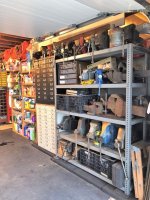
Warrior: i'd strip the vise and put on BLO (boiled linseed oil) and leave it NAKED and if you still want to paint it Blue you can just paint over the BLO. of course using a primer on the raw steel is maybe a better method, but get it on quick before it flash rusts cause in most of the states in the northern USA these will rust fast after they are stripped.

ALL: looks like my STOUT SHELVING WON'T BE NEEDED any longer cause i'm going on the hunt for vises you can put in the palm of your hand. GEESH a quick release solid brass vise. i loved to see that in the hands of a few members that really know how to make brass shine that are posting stuff on this thread.

https://www.garagejournal.com/forum/showthread.php?t=377463

i've almost filled one shelving unit and my bride parks her car next to it daily and hasn't said much about them, but i don't think i'll have the rest of them in her eyesight for a while unless on a working bench.
 

Attachments

  • vise rack (2).jpg
    vise rack (2).jpg
    151.3 KB · Views: 83

va.grouseman

Well-known member
Joined
Mar 26, 2011
Messages
4,965
Location
Southern-Central VA.
200, 5 lb. vises is still a half a ton Drive.---Might need those shelves yet.


Thanks for that link Drive.---I had never seen that thread before.---Some of those refinishes are unbelievable.
 
Last edited:

Teufelshund1097

Active member
Joined
Jan 14, 2016
Messages
33
Location
The Great Lakes State
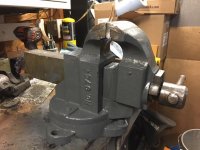
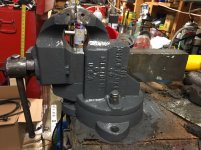
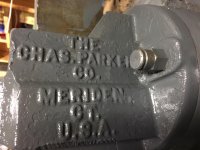
Chas. Parker 974

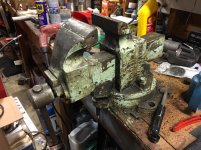
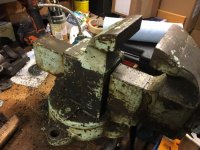
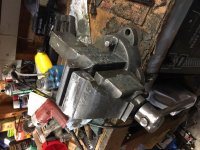
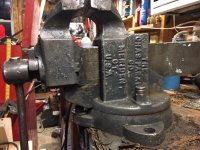
I picked up an old Parker vise the other day at a local salvage tool supply. I had needed something more substantial than the light-duty hobby vise I have had for several years. I got about half way through a caliper rebuild last week when I decided that a "real" vise was needed. When I saw the vise, I didn't think much of it other than it was heavy duty and made in the U.S.A. Good enough.

Of course at that time, I had no idea what guys on GJ were doing with old vises...after checking out some of the posts in this thread - I am better acquainted. In light of those posts, what I did with my Parker was just a down and dirty cleanup, paint and lube. I needed to get it mounted because I have work to do, and it's not meant to be a museum piece anyway. As you can clearly see, this vise has done some real work in its lifetime - and I plan to keep using myself.

Here's some pics of how I found it; what a quick scrub down revealed; and how it's being pressed into service. Nice, solid piece of U.S. steel with years of work ahead.

Found as:
IMG_0002.jpg
IMG_0001.jpg

Cleaning:
IMG_0003.jpg
IMG_0004.jpg

Some new paint:
IMG_0008.jpg
IMG_0010.jpg
IMG_0011.jpg
 

gman007

Well-known member
Joined
May 17, 2017
Messages
2,736
Location
West Michigan
Re: Chas. Parker 974

I picked up an old Parker vise the other day at a local salvage tool supply. I had needed something more substantial than the light-duty hobby vise I have had for several years. I got about half way through a caliper rebuild last week when I decided that a "real" vise was needed. When I saw the vise, I didn't think much of it other than it was heavy duty and made in the U.S.A. Good enough.

Of course at that time, I had no idea what guys on GJ were doing with old vises...after checking out some of the posts in this thread - I am better acquainted. In light of those posts, what I did with my Parker was just a down and dirty cleanup, paint and lube. I needed to get it mounted because I have work to do, and it's not meant to be a museum piece anyway. As you can clearly see, this vise has done some real work in its lifetime - and I plan to keep using myself.

Here's some pics of how I found it; what a quick scrub down revealed; and how it's being pressed into service. Nice, solid piece of U.S. steel with years of work ahead.

Teuf Great find ! It looks to be in fairly good shape and nice job cleaning it. I second outlaw, this is an excellent vise and I speak from experience as I have an identical Parker 974 (without the 1930 patent) which were most likely manufactured in 1950s.

The only odd thing about your 974 is the two holes that someone drilled into the jaws on the right hand side! I am perplexed as to why someone would do this to this nice vise! Also you probably know that the swivel wrench is missing.
 
Last edited:
To avoid these ads, REGISTER NOW!
Top Bottom