EDIT: See picture link below. I feel like a *****, deal with it. And sorry fellows, the China ones are on the left, the USA ones on the right.
Preface: China Craftsman I will reference as "C socket" and USA as "U socket", or simply C or U respectively as needed. I will refer to the Craftsman warranty. In doing so, I a realizing some things. First is that a Sears location to walk into for a quick exchange is not so easy anymore, since most Sears stores are no longer there. Second is that I am working with SB&D statements that they are honoring Craftsman warranty as-is for all current and past Craftsman products. I also note that I am unsure how that warranty will exactly work as there is a conflict in there. Craftsman provides/provided in-store warranty service, no questions asked, no receipt needed. SB&D typically wants to deal with you directly and have you contact them for warranty service, but still not receipt needed. This is still a solid warranty, but maybe not as good anymore as Tekton, Husky, Kobalt, etc.... but you do not need to be a professional with a large credit account to get warranty service either, making the warranty for non professionals better. Better meaning easier to get warranty service on your broken tool.
Chapter 1, well, the only chapter: On first look, I can see the C sockets have more defined circular corners than the U sockets. But the U has a more defined convex side vs C socket. I believe this is a design change from a while back unrelated to the outsourcing in 2012. Can someone interject with some actual facts here? And the chrome, I will say it again so it is not lost, the chrome looks awful in my opinion. My experience tells me that when something is shiny and flashy, it lacks in fit and function, or in other words, is junk. The reason I add this is because if the chrome is of poor quality, it may chip leaving my socket open to potential rust, which can effect the fit of the socket to the nut or bolt it is removing, which is a real and tangible performance issue. I gave some a toss in the air and let them drop to concrete and none chipped, cracked or otherwise altered the tool, in attempt to over simulate dropping the socket while using it which should be common. I did not expect a fail here, but you never know.
I have a more generic ratchet marked "Pro Series", something I grabbed for a beater tool. The ratchet works fine, but my U sockets have fit issues onto this ratchet. The pin does not fit proper into the detents in the sockets, leaving it abnormally easy to pull and separate socket and ratchet. However, the C sockets fit well on both my generic ratchet as well as my USA Craftsman ratchets. So this may be meaningless to the pros, but it does say that the fit of the C socket is maybe more compatible or accommodating to cheaper tools. It is worth noting that the cheap ratchet I mentioned is clearly lower quality in the head/anvil area as well as the ratcheting mechanism itself. But for my portable box of beater tools, these sockets are a more appropriate match, and still carry the same warranty as the tools I keep in my main boxes. So... plus .25 points to C sockets for being compatible with cheap stuff.
The general overall sizes appear to be the same. I do not have my dial calipre handy (it is actually lost at the moment), so I cannot tell you the exact dimensions and differences, but they fit in the same holes in my socket organizer (I have the old style where the sockets drop into holes in the plastic bottom. I mention that as I do have some sockets from other brands that are either smaller or larger than the holes drilled into the organizer. So the point is that generally speaking, these are interchangeable in that sense. There is also be no noticeable difference in use, as the width, length, etc is the same between the C and U sockets. This assumes that a non visible size difference will not make a difference and that we compare C to U only, not to other brands which is out of scope for a C to U comparison.
Regarding detents, someone who knows better please feel free to correct my verbiage. But my old U sockets have a single detent per side of the ratchet side. The C sockets have a dual detent per side. Although I cannot provide a side by side for this, I can say that some of the U sockets I added to my original set, while still made in USA, also have this dual detent. I have also seem USA Craftsmans' have a dual detent with the inner most being small/short and the outer one, the ones closest to the ratchet insertion point being somewhat long in that it goes to the edge of the socket and extends deeper with an overall lengthier greater than that of the inner detent. I am unsure if that is relevant, but it is something I see and is for sure a difference to users of the older U sockets. I will get some pictures if wanted, or if someone else can help. I think it will help the statements I am making for those who do not know this first hand.
I have this 1/2 inch nut I just took off today from a muffler clamp. I grabbed a C and a U socket, as I need to somehow show a fit portion here. I do not notice any difference on the wiggle of the socket on nut here, but I know that in fact the actual fit is different. I know this because the design as shown above is in fact different. I do not feel as I am qualified to say and explain which of these designs grips and holds a faster better, but I can tell you as one who does maintenance on many cars, rebuilt a few engines and help work on a buddies race car, my old design U sockets have worked just fine for my applications. You can see I am not professional, as a hand full of rebuilds is what professionals already have once they start working, but my only point is that I am at least exposed to such things, and used my tools to do so, as limited it may be (compared to those with a masters degree, LOL! I just had to, sorry).
There is also a difference, maybe cosmetic only, maybe not ... but on the ratchet drive side of the socket, the C sockets seem to have most all of the bottom side tapering in to the center, whereas the U sockets have a portion tapered, but also a portion that is flat surface. Now, this could be an effort to save money by a slight reduction in metal used or there could be another reason, I cannot say. I also cannot say if this has any impact on the structural integrity of the socket. All I can say is that this is a noticeable difference, and in fact, one that stuck out to me almost immediately.
The fit into my normally used 3/8 drive ratchet is different. I believe this is a valid functional point. The U socket has a firmer fit to the ratchet than does the C socket. This fit comparison was done with the 1/2 in ch socket mentioned above used on a muffler clamp nut, and the socket attached directly to the ratchet also aforementioned. With socket on ratchet, there is more wiggle or slop with the C socket than with the U socket. You know how you take the standard Craftsman RP ratchets and feel that wiggle between the teeth and compare that to a fine tooth ratchet, that is what I mean, just not quite that bad. There is definitely some wiggle though. With just socket on ratchet, this is likely no matter to anyone. But in cases where you have multiple extensions a knuckle adapter or what have you, that slop gets multiplied all the way down the line. I can see this being a functional issue in some cases. It is hard enough to keep such things straight and stable, so adding even a bit of wiggle can make a difference. This may be related to the fit to the generic ratchet mentioned above. Regardless, this is a clear minus one point for C sockets.
Conclusionary Comments, or maybe Conclusory Findings: All that said... I feel that the C sockets are at least partially factually lesser quality than the U sockets, as represented by those items specifically used and stated above. Only time will answer my actual question ... is that quality difference going to make a difference? My opinion is likely it will not. I believe that the design changes that are causing the fit/function issues I have were made earlier and independent of the outsourcing of 2012. Can anyone confirm that, since opinions without fact is, well, not the intent? I will say, if I have a choice of which to put in my box, I will take my old U sockets over the new C sockets.... but that might apply to the later U sockets as well, the pre-2012 ones, but newer than my pre-2000 ones. For one US dollar per socket delivered to my door, I think the C sockets are a good deal. But as one who has busted a knuckle or two on sloppy fit tools, the socket to ratchet slop is concerning, making these likely not desirable for professionals or even serious DIYs, or anyone who values their hands. For the guy doing his car maintenance, swapping an alternator here and a water pump there, I am sure these are just fine and at a great value and warranty.
I am unsure how to comment on those saying the C sockets (well actually it was "tools", not sockets specifically), are expensive, meaning at the same cost and/or at USA cost. I do not see it. The cost has gone down in my local market, including the world wide web market. But, pricing is known to be location specific, even seeing items I can buy in a store at 20-30 cheaper than eBay lists them at. So please keep that in mind, and please take note of the prices I stated. Charge me 20.88 vs 9.88 per set, and I will absolutely remove C sockets as a good value.
On a side note... I will still whack my U sockets all day with 2x4s and smack them with hammers and tossing them onto my impact when I need to ... but I will hesitate before risking my knuckles until I either have enough trust in the C sockets to perform as my U sockets have for years, or know better not to. Disclaimer ... misusing tools is not recommended, and placing a chrome socket on impact is not at all recommended for your own safety. Even the best tool can have a manufacturing defect causing unexpected failure.
Epilogue: I have added into my pictures some Blue Point and Snap On tools. Why? Because I have them, I have used them and I know what they are. I cannot comment on something I do not know and state it as a real fact based opinion. Attached are some Snap On and Blue Point tools I use.
Please see attachments, apparently not in order. Please do ask me if you want more, I think some are missing actually.
https://imgur.com/a/iCOA0aS

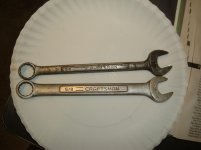


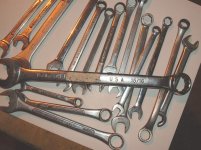


 ). The openings are almost identically sized, but the China-made set is a little thinner, which is nice as that's the whole purpose of having a tappet wrench, and each of the China-made ones are just a few millimeters longer.