To avoid these ads, REGISTER NOW!

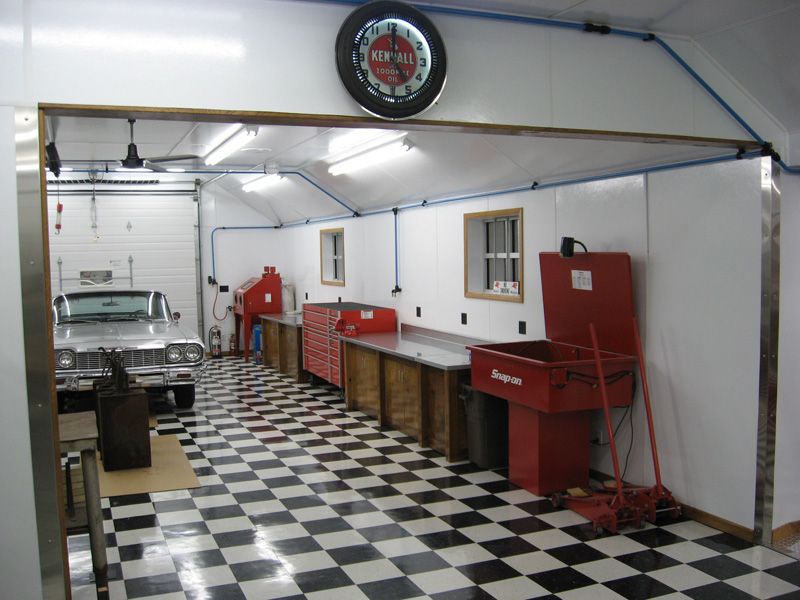
Above 1200 Sq/FT Restored 1930's Auto Shop

Wokspaces above 1200 squarefeet.
OP
B

BB767

Well-known member
Joined
Dec 24, 2009
Messages
3,724
Location
Philo, IL
How about some bench building? I think work benches are the heart of any shop. You spend a lot of time at them so why not make that a pleasant environment and something aesthetically pleasing to the eye? As you've seen the old benches were in terrible condition what little you could see of them. Really not even worth salvaging. I cleaned up the cast iron welders bench and used it but I needed some good general work benches elsewhere in the shop. Here's how I went about building those. They say 1 picture is worth a 1000 words so I've got a bunch of pictures here showing the construction.
BenchBuild1sm.jpg


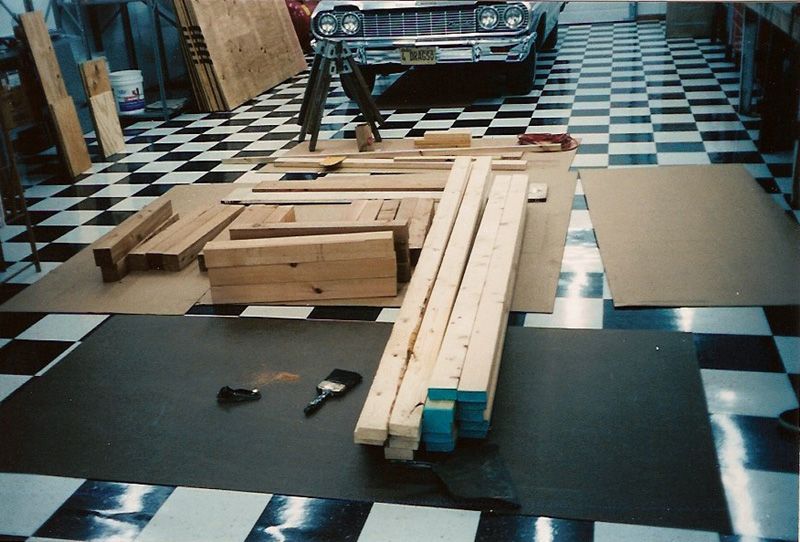
This is the pile of material I started with. Those are the sheets of 1/4" Masonite as well as card board I used to protect the tile floor.
BenchBuild2sm.jpg


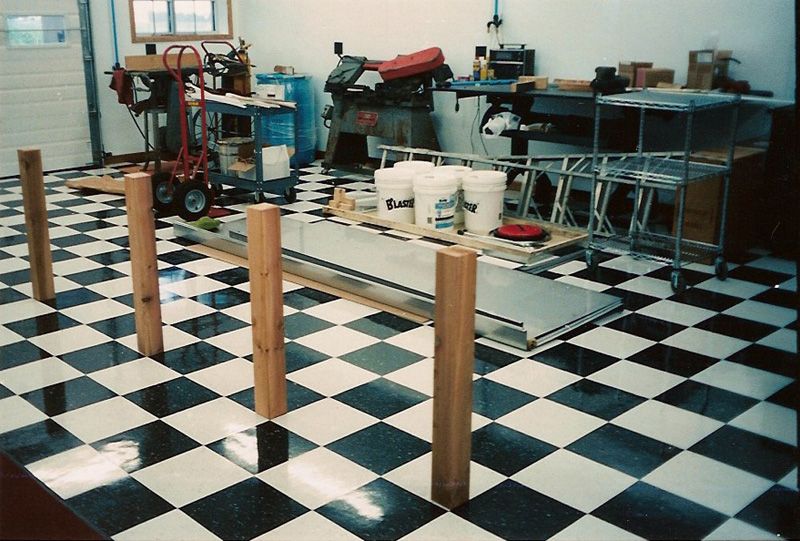
Fabricating in the fabrication room!! I build three benches, 2 - 10' long and 1 - 8' long. The 10 footers had 4 legs across as seen here and the 8 footer had 3. Legs were 4" X 4". The floor tiles are 1 foot square so that helped with the general lay out. Piled in the background are the bench tops. I had a local machine shop bend them up for me. I had the front edge bent all the way under the front lip so if you clamp something along the front edge the bottom of the clamp would be bearing on metal and not on the bottom edge of the wood substrate. I also had a 4" back splash with a top edge on it to prevent objects from rolling off the back. I used 12 gauge stainless steel which is pretty thick metal. That should resist denting over the years and of course they can't rust. Also see that the ends are unfinished so I had end caps in the profile of the tops made which were tig welded to the edges to finish it off. I didn't want the wood substrate seen from an end view. They could bend 10' long, 12 gauge stainless and give me a 1/2 lip on top of the back splash. Pretty nice piece of work. They needed to use a hydraulic brake to bend them.
BenchBuild3sm.jpg


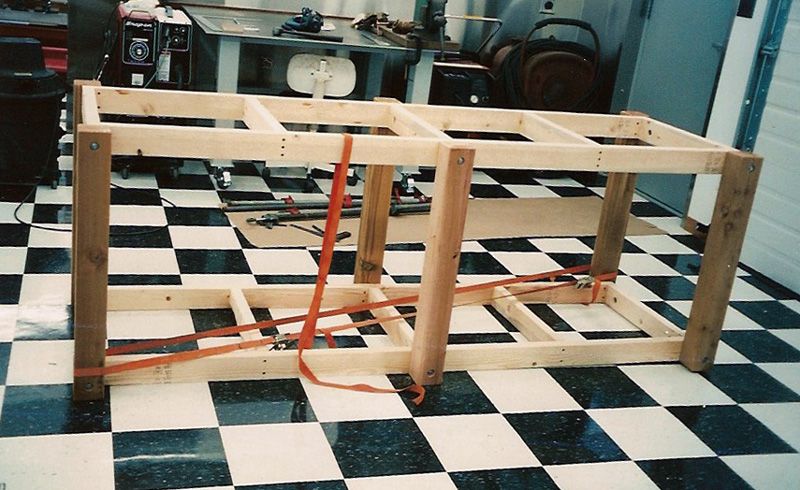
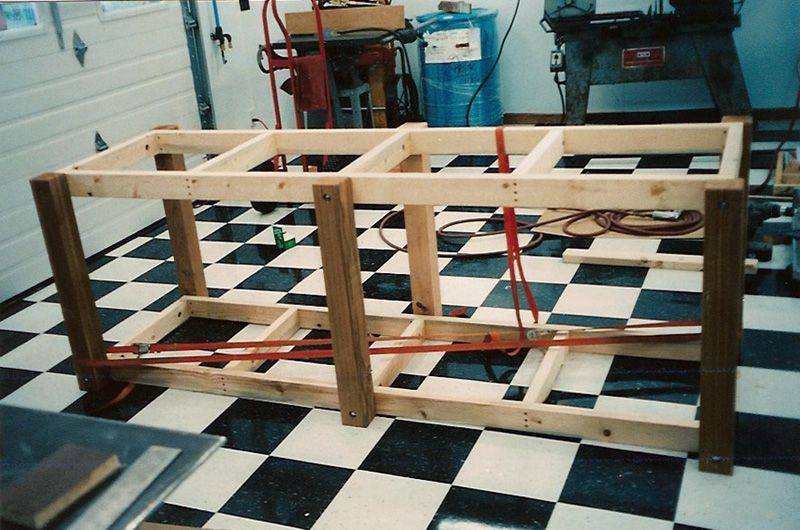
Normal framing with screws used on the 2 X 4's and the legs were bolted on. The ratchet straps were used to keep everything square. The quality of the material these days is awful. It will really move around if you don't stop it! This is the 8 foot bench, 3 legs. BTW these pictures were taken with the same 35MM camera as the earlier interior pictures. Notice how much better the quality is with proper lighting?!
BenchBuild4sm.jpg


BenchBuild5sm.jpg


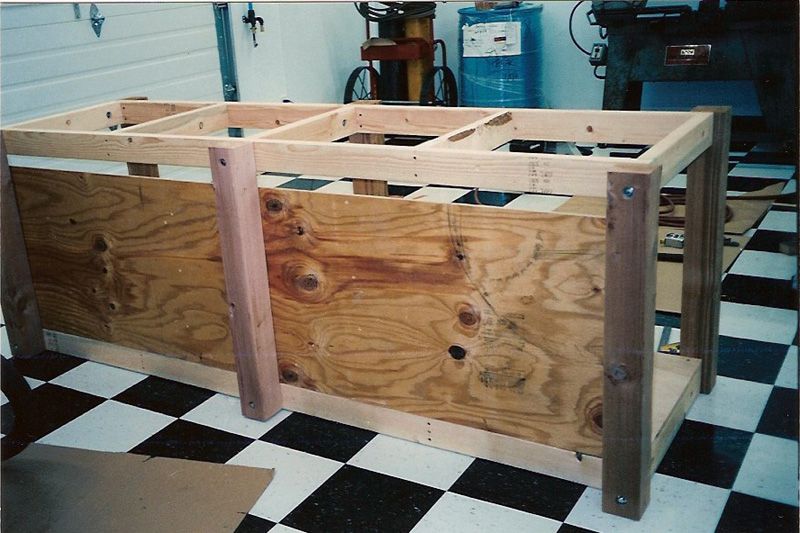
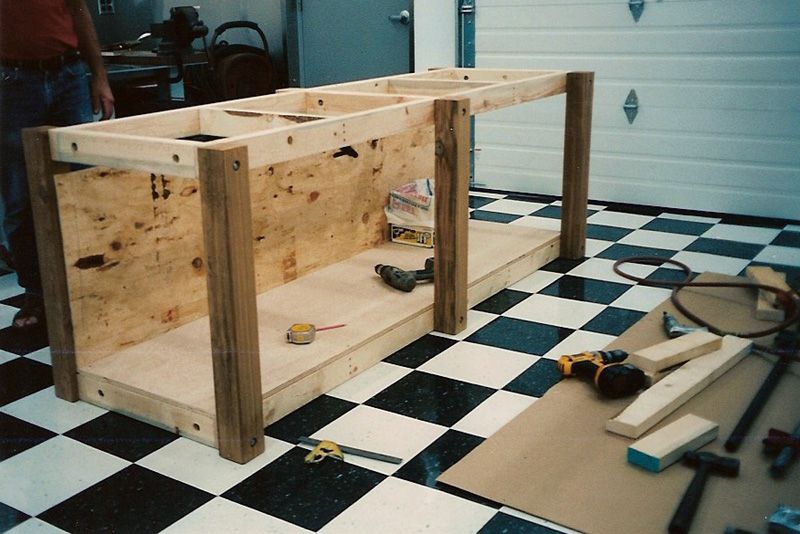
I put floors in them and backs on them as well. It not only finishes them off nicer but helps stiffen them up and keeps them square. 3/4" floors and 1/2" backs.
BenchBuild6sm.jpg


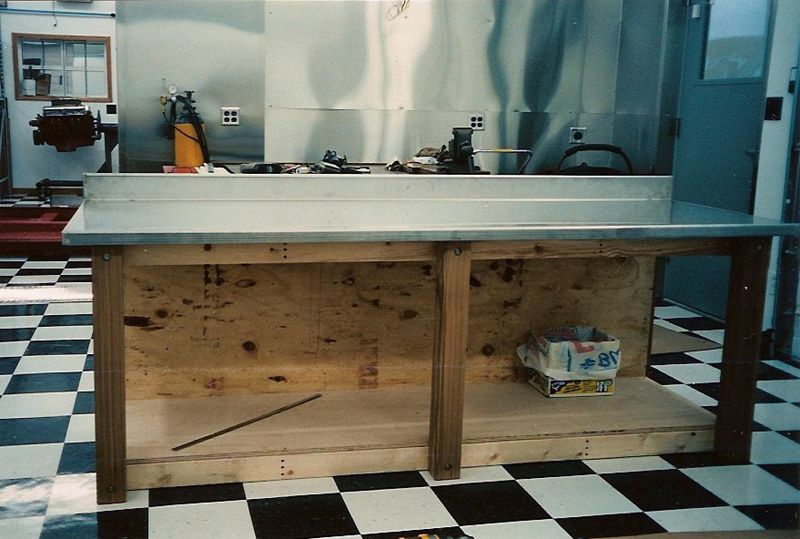
Here you can see how the legs were attached to the frames. In the short horizontal 2 X 4's I bored a 1" hole in the side. See that the top and bottom, end 2 X 4's have a hole in their sides. It's toward each end of the 2 X 4 near the legs. Then I bored a hole the diameter of the bolt through the leg and end of the 2 X 4 into that 1" hole. I took a piece of 1" electrical conduit pipe and cut a piece the width of the 2 X 4. That was then cut in half leaving two 1/2 circle pieces which had a hole drilled in them the diameter of the bolt. This was used as a wide washer inside the 2 X 4 so when the nut was drawn up on the leg bolt, it wouldn't split the 2 X 4. Pretty clear, huh?? I'll get a close up picture of another bench and post it if some wants to see that detail.
BenchBuild7sm.jpg


BenchBuild8sm.jpg


The end caps have been welded on the top and see how much better that finishes it off rather than just having the thin metal of the tops showing? A casual glance and the top appears to be all metal 1 1/2 " thick. Visually adds heft.

BenchBuild9sm.jpg


Here the benches are laying on their backs, bottoms toward each other. The end panels have been attached as well as the finished wood that covered the 2 X 4's on the face between each leg. The end panels and doors were 7 ply 3/4" Baltic birch plywood, the face wood was some sycamore I had.

BenchBuild10sm.jpg


Notice the bench at the top. On the right end you can see inside it has an extra pair of legs inside that end cabinet and no floor at that end. Hold that thought, we'll come back to it in a moment.

BenchBuild11sm.jpg


I had door panels laying all over the shop! I had to stain and then finish with gloss polyurethane. I sanded between each coat and got a creditable finish. 3 coats only, just a work bench not a piece of furniture.

BenchBuild12sm.jpg


Now I know you're looking at the end of that bench and have noticed it's a jolly big notch in it. Again hold that thought.

BenchBuild13sm.jpg


Here is the process of tig welding the end caps on and around the big notch.

BenchBuild14sm.jpg


See how the front of the top is bent all the way around to form a C in profile. Note the work area, out under my car port in front. This on of my favorite work spots. Outside with loads of natural light but sheltered just the same.

BenchBuild15sm.jpg


This is a temporary bench that will soon be replaced with the notched bench.

BenchBuild17sm-1.jpg


BenchBuild20sm.jpg


OK in this picture we've got a couple of things to point out. First off if you would go back to post # 181 ( it's on page #10 ) and scroll to the last picture of that series on lift repair. It's the one of my son sitting on top of the lift cylinder up in the air. Note when you're there that he is sitting on top of a big hunk of metal which is sitting on the lift cylinder. Also note that the chunk of metal just happens to be the size of this notch. Go ahead and look right now, I'll wait for you.............


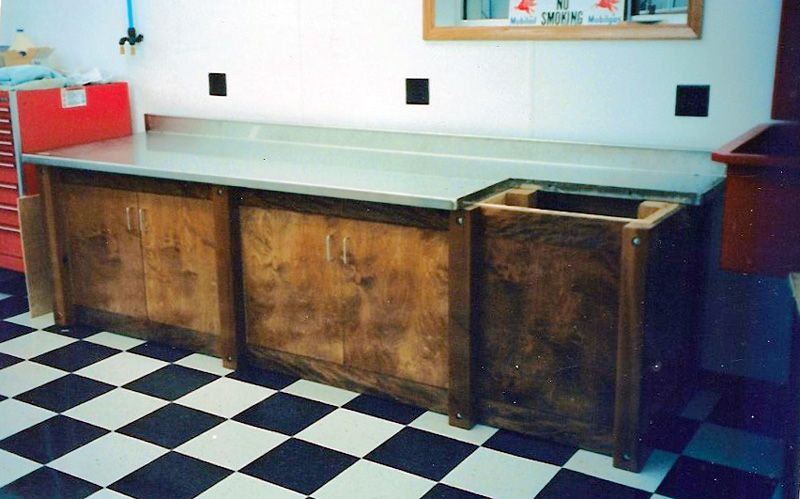
..............OK that is a piece of steel 18" X 27" X 1 1/2" thick he's sitting on, flat both sides which was just laying around the shop waiting for me to find it and do something with it. I hung on to it knowing it would come in handy at some point. It occurred to me that my benches would have tops of 1 1/2" thickness. Why not incorporate that steel into the tops? Why not indeed and so here you are. See in the back two more 4 x 4 legs. Those are the ones you saw with the bench laying on it's back a few pictures back. That's to support that steel plate in all 4 corners. In addition there are two curved notches in the back edge. That's to provide room to install the bolts which tie the steel to the top. The wood substrate is two pieces of 3/4" particle board. I used that as underlayment to back up the stainless tops. It helps the tops resist denting, makes them feel real solid, keeps them from sounding tinny and adds weight for stability plus it's cheap too!

BenchBuild21sm.jpg


The edge of the notch is faced with stainless like the ends. It strengthens up the notch area and provides an edge to bolt the steel plate to.
BenchBuild22sm.jpg


BenchBuild19sm.jpg


Here's that chunk of steel, don't know what it weighs but I can just barely move it. Really takes two people to handle it safely. Those are the two bolts sticking out of the edge. I just tapped the steel to receive the bolts. The bolts are stainless steel too. I painted the plate so it wouldn't rust and look nasty.
BenchHvyPlatesm.jpg


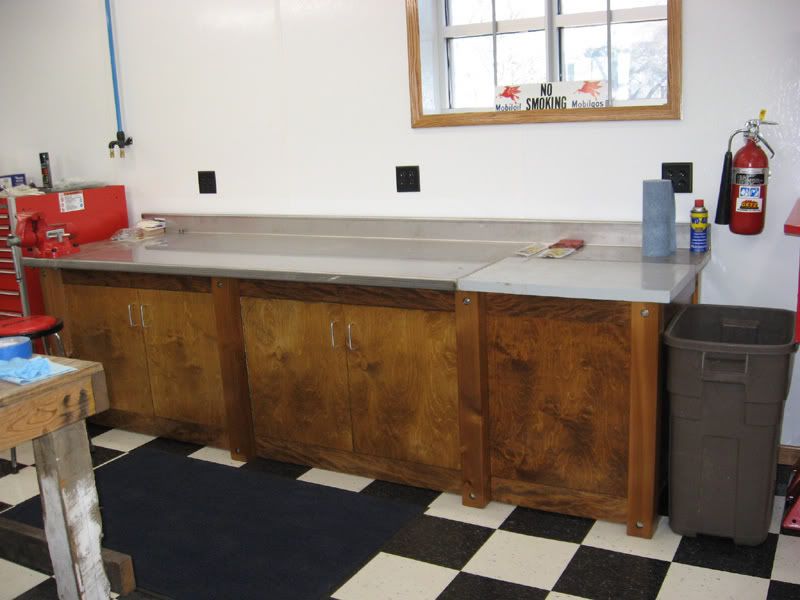
Now I have a large, solid corner surface for those times you just need to beat the living tar out of something and not mar up the nice tops.


The doors were hung with stainless steel piano hinges and also incorporate touch latches so you can bump the door open with you knee should your hands be full. The wood you visually see is cedar legs, birch doors and sycamore horizontals between the legs. I managed to get them to stain up fairly close in color. This post may have been long but I hope you found it informative. The other two benches are in the next post.

Thomas
 
To avoid these ads, REGISTER NOW!
OP
B

BB767

Well-known member
Joined
Dec 24, 2009
Messages
3,724
Location
Philo, IL
Here are the other two benches.

BenchBuild16sm.jpg


This metal bench will be replaced with the 8' one.

BenchBuild18sm.jpg


BenchBuild24sm.jpg


BenchBuild25sm.jpg


The lift room bench.

BenchBuild26sm.jpg


BenchBuild27sm.jpg


Thomas
 

Fireman39

Member
Joined
Dec 5, 2007
Messages
10
BB67,how fast is the Blue Chevy Nova run in the 1/4? I've raced at Stanton every fall for the last eight years. This year was the quickest so far. 13.31 @ 108. My car is the red 68 GTO. I pit up in southeast quarter of the parking lot with the Glasgos, Brad Rising, and the Lombaris from R.L. Thanks Noel.
 

Jack Olsen

Super Moderator
Staff member
Joined
Mar 22, 2009
Messages
6,678
Location
Los Angeles
Those benches look great! Nice design, and they look at home in a working shop -- without simply being the same old, by-the-numbers bare plywood over 2x4s.
 
OP
B

BB767

Well-known member
Joined
Dec 24, 2009
Messages
3,724
Location
Philo, IL
Here are some more images during the interior work.

FabRm5sm.jpg


This is the fab room, the window is the one facing south that I added and the long wall is the one I replaced with concrete block. That's the Chrysler engine under the blanket and on the engine stand and the cast iron welders bench which hasn't moved much from where it's always been.

FabRm4sm.jpg


This shows the floor pretty well BT ( before tile ).

FabRMsm.jpg


FabRmMid1sm.jpg


The fab room, other end. The dark area is one of the office walls with the light square area in the middle a window as that's the outside wall of the original shop. Beyond it , the north room.

FabRmMidFloor1sm.jpg


Same corner now paneled.

FabRmLookNthsm.jpg


FabRm7sm.jpg


The other side of the fab room. My son is walking into the lift room. Note the window in the wall and the Lincoln welder. You can see where the original ceiling rafters were at the 8' level and how we raised them to 10'.


FabRmLookWestsm.jpg


NorthRmShop2sm.jpg


North Room, east side.

NorthRoomsm.jpg


LiftRm10sm.jpg


North room, west side

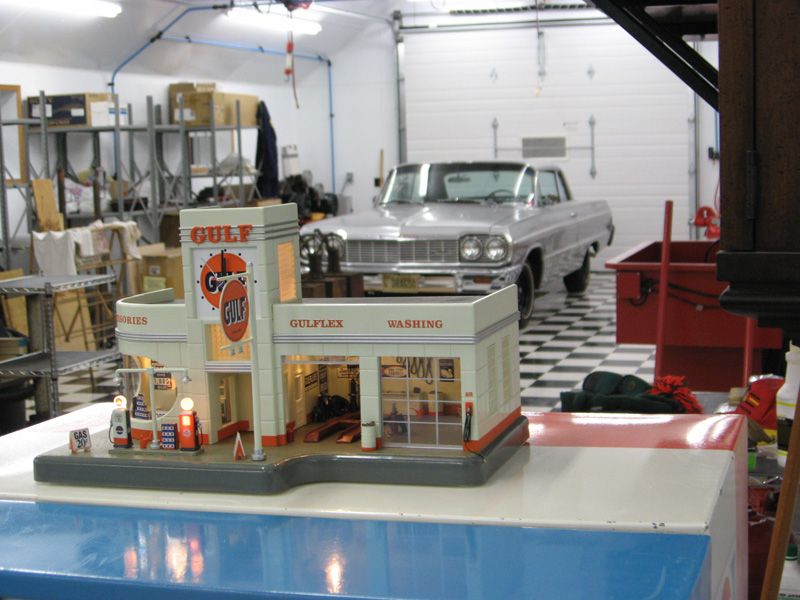
GasSationNrtRmsm.jpg


FabRmMidTile2sm.jpg


Welding corner and you can see cracks in the floor repaired with epoxy. Lift lays beyond the doorway.

FabRmMidTile3sm.jpg


Notice that the floor pattern lines up room to room even though they were installed several days apart and the floors are at a different heights. The lift room floor is about 2" higher.

WeldingCorner2008sm.jpg


Thomas
 
OP
B

BB767

Well-known member
Joined
Dec 24, 2009
Messages
3,724
Location
Philo, IL
Hopefully I didn't miss it but how about a little more info on the Impala SS, 409? 4 speed? My girlfriend's father collects cars and has quite a few Impala's (my favorite is his '61 SS convertible, 409, 4 Speed), looks like you a few as well.


Awesome, I worked at a gas station when I was a kid a remember those bells, I'd like one in my driveway.

Sure,

1964ImpalaSSIndysm.jpg


Here are two of my '64's. Both are 327/300, 4 speeds. Both also happen to be Satin Silver exterior, silver interior cars. They were made within 2 weeks of one another though at different plants. The one with hubcaps is also P/S,P/B.A/C etc and my favorite cruiser.

64ImpalaOnLiftsm.jpg


The without caps I drag race in PSMCDR when not using my Chevy II. It is manual steering, brakes, radio delete and is several hundred pounds lighter than the air car.

Thomas
 
OP
B

BB767

Well-known member
Joined
Dec 24, 2009
Messages
3,724
Location
Philo, IL
BB67,how fast is the Blue Chevy Nova run in the 1/4? I've raced at Stanton every fall for the last eight years. This year was the quickest so far. 13.31 @ 108. My car is the red 68 GTO. I pit up in southeast quarter of the parking lot with the Glasgos, Brad Rising, and the Lombaris from R.L. Thanks Noel.

Noel I managed a best of 12.92 @ 111mph at Stanton last fall. The planets and moon were all aligned for sure!! I pit right across from you toward the track. Same place every year next to my buddies blue '69 SS Chevelle. Charlie was a big help back when I was racing my sliver '64 Impala. I'll wander across the lane next year and introduce myself. Cheers.:beer:

Thomas
 

Grizz1963

Well-known member
Joined
Jan 7, 2010
Messages
12,003
Location
Rochester, KENT. UK
Thomas, I am absolutely addicted to this thread, I come here daily, and tell friends to take a look.

Thanks again for sharing an amazing project.
 

toxicz28

Well-known member
Joined
Sep 23, 2006
Messages
738
Location
NY
BenchBuild19sm.jpg


Here's that chunk of steel, don't know what it weighs but I can just barely move it. Really takes two people to handle it safely.

If my calculations are correct, 197.5 pounds +/-, depending on the alloy. BTW beautiful build! :thumbup:

Oh yeah, I love the Hudson yard art too!
 

Jack90210

Well-known member
Joined
Nov 2, 2009
Messages
304
Location
VA, USA
BenchBuild6sm.jpg


Here you can see how the legs were attached to the frames. In the short horizontal 2 X 4's I bored a 1" hole in the side. See that the top and bottom, end 2 X 4's have a hole in their sides. It's toward each end of the 2 X 4 near the legs. Then I bored a hole the diameter of the bolt through the leg and end of the 2 X 4 into that 1" hole. I took a piece of 1" electrical conduit pipe and cut a piece the width of the 2 X 4. That was then cut in half leaving two 1/2 circle pieces which had a hole drilled in them the diameter of the bolt. This was used as a wide washer inside the 2 X 4 so when the nut was drawn up on the leg bolt, it wouldn't split the 2 X 4. Pretty clear, huh?? I'll get a close up picture of another bench and post it if some wants to see that detail.

I'm having a hard time wrapping my head around this detail, and would love to see another pic or two if it's convenient for you.
 

knucklehead

Well-known member
Joined
Nov 18, 2005
Messages
307
Location
Lane County, Or
funny, i calced' out the weight also! :lol_hitti
i came up with 206.29 lbs though, based on 1/4" plate weighing approx. 10.18 lbs. / sq. ft. :beer:

If my calculations are correct, 197.5 pounds +/-, depending on the alloy. BTW beautiful build! :thumbup:

Oh yeah, I love the Hudson yard art too!
 

c.schulz

Well-known member
Joined
Jul 22, 2005
Messages
164
Location
mi
I dont know if this has been asked before or not but what did you cover the walls with? The white sheets? And then a seam cover on the edges??

Thanks Thomas

Chris
 
OP
B

BB767

Well-known member
Joined
Dec 24, 2009
Messages
3,724
Location
Philo, IL
If my calculations are correct, 197.5 pounds +/-, depending on the alloy. BTW beautiful build! :thumbup:

Oh yeah, I love the Hudson yard art too!

funny, i calced' out the weight also! :lol_hitti
i came up with 206.29 lbs though, based on 1/4" plate weighing approx. 10.18 lbs. / sq. ft. :beer:

Well no wonder I could barely move it!! Here I thought maybe I just hadn't eaten my Wheaties. I know it was a handful even for two people. Lets just say it weighed around 200 lbs. Thanks for the follow up information guys.

Thomas
 
OP
B

BB767

Well-known member
Joined
Dec 24, 2009
Messages
3,724
Location
Philo, IL
I dont know if this has been asked before or not but what did you cover the walls with? The white sheets? And then a seam cover on the edges??

Thanks Thomas

Chris

Chris you're right I guess I forgot to post that information. My apologies to those who asked earlier. I called our local lumber yard and they said the brand name is FRP board. The fiberglass coating can be ordered on drywall, plywood, OSB and probably other mediums. Just about any thickness and length. The trim strips come in outside and inside corners, glued on and for in between each panel a "Tee" strip. It has tapered teeth on the part that inserts between the panels which holds it in place and the top of the "Tee" hides the screws along the edge. If you space the panels too close together the "Tee" won't fit in and space them too far apart and the teeth have nothing to grip. We used a temporary 8 penny nail set between them when installing the panels to gap them correctly. To fasten them to the ceiling we used liquid nails, and down the center, a fastener from FRP that is called a "drive rivet" with a finish head on it. This is the third building I've used it in and I really like the product.

Thomas
 
OP
B

BB767

Well-known member
Joined
Dec 24, 2009
Messages
3,724
Location
Philo, IL
I'm having a hard time wrapping my head around this detail, and would love to see another pic or two if it's convenient for you.

Jack I was really afraid that I wouldn't be able to accurately describe that detail. I should be able to post a picture or two that I hope will make it immediately clear. Coming soon, thanks.

Thomas
 
OP
B

BB767

Well-known member
Joined
Dec 24, 2009
Messages
3,724
Location
Philo, IL
The following pictures, courtesy of a family member, are of the north addition being built in 1958.

NorthAdd58-1sm.jpg


That white object projecting out the left side of the building is the lift control cabinet. The window to the left of the chimney is one I left in place with the restoration. See post #326, third picture down, showing the booth and the clap board wall with that window if you're really interested.

NorthAdd58-2sm.jpg


NorthAdd58-3sm.jpg


The block protruding from the overhead door opening is a unique feature that was also used in front on the lift door opening. I've never seen it done that way before. I presume it's to add stability to the wall.


NorthAdd58-4sm.jpg


The addition just about doubled the shop size. Look for the lift and it can be seen, just barely. I just treasure all these early photos of the shop and homestead am grateful that the family cared enough to get them to me.


NorthOHD05-1sm.jpg


Now fast forward 47 years.

NorthOHD05-2sm.jpg


NorthOut05-1smEdit.jpg


This how we cleared the property initially. A tractor with a bush hog and a front bucket. The shop with the overhead door open to the left.

NorthOut05-2sm.jpg


NorthOut05-3sm.jpg


In the background, the man door to the lift room which was removed.


NorthOut05-4sm.jpg


NorthOut05-6sm.jpg


NorthOut05-5sm.jpg


NorthOut05-7sm.jpg


NorthOut05-8sm.jpg


Notice how close the block matches where I removed the man door from the lift room. On the left side of the roof is a cable from the lighting rods which I reinstalled. I had to slope up dirt next to the shop to improve surface drainage and move water away from it. Nice close up view of one of the columns supporting the car port. I used block with one round radius corner instead of normal hard 90' corner.

NorthOut08-2sm.jpg


About two years later. Terraplane is to the right.

NorthOur08-1sm.jpg


Nice view of my hedge row in the background.

NorthOut08-3sm.jpg


Putting cedar mulch down and then planted ground cover to prevent erosion. That little tractor is a diesel, 4 wheel drive unit that was probably the smartest thing I bought to help around the property. It was narrow so I could get it in and around all the trees I have. It has a bush hog, grade box and snow plow all which were used extensively. More coming......


Thomas
 
Last edited:

dipper

Well-known member
Joined
Jun 27, 2007
Messages
759
Location
Rochester, NY
This thread is just awesome!!!! This certainly has to be a dream come true for you.
It appears with your son there lending a helping hand all the time that it will be in your family for a long time too.
 
To avoid these ads, REGISTER NOW!

tdkkart

Well-known member
Joined
Jun 17, 2006
Messages
6,887
Location
Eastern Iowa
NorthOut05-3sm.jpg


In the background, the man door to the lift room which was removed.


Are those hatches in the roof??
Any idea what they were used for??
I have a hard time believing they would have put in skylights.

We see them around here when the building was built over a well, have to have a way to pull the pump with the long pieces of pipe attached, but you don't see two of them.


This project is simply awesome.
The amount of work that you put in to achieve the end results would be overwhelming for most. I'm sure you'll agree that it was worth it though.

We looked at a property that wasn't even close to needing this much work, my wife cried on the way home, she thought for sure I was gonna buy it.
 
Last edited:
OP
B

BB767

Well-known member
Joined
Dec 24, 2009
Messages
3,724
Location
Philo, IL
Are those hatches in the roof??
Any idea what they were used for??
I have a hard time believing they would have put in skylights.

We see them around here when the building was built over a well, have to have a way to pull the pump with the long pieces of pipe attached, but you don't see two of them.


This project is simply awesome.
The amount of work that you put in to achieve the end results would be overwhelming for most. I'm sure you'll agree that it was worth it though.

We looked at a property that wasn't even close to needing this much work, my wife cried on the way home, she thought for sure I was gonna buy it.

If you go back to post #163 on page 9 you'll see them in the series on the lift room construction. Additionally see post #73, page 4. In the first picture, look over the top of the florescent light fixture and 4th picture ( with ladders on either side of the beam ) center, at top of the picture you can see a light panel on the ceiling. That's the interior view of those translucent panels. They were fixed non opening and let in a surprising amount of light.

LiftRoomWall1sm.jpg


Hard to believe but true, they were skylights.

As for buying a property like this and your wife crying.................it's every woman's nightmare and every man's dream. :)

Thank you for the remarks and for the inquiry.

Thomas
 
OP
B

BB767

Well-known member
Joined
Dec 24, 2009
Messages
3,724
Location
Philo, IL
This is the engine stand the Chrysler engine was mounted to.

EngineStand1sm.jpg


It was made in the shop, not sure when. It is extra heavy duty. They used it not only for cars and trucks but tractors also.

EngineStand2sm.jpg


EngineStand3sm.jpg


The only thing I've done is install 4 proper, locking casters. It appears it was adapted to various engines through out the years.

EngineStand5sm.jpg


They made it with material found in the shop. The smaller pipe turns inside the larger one. To make this easier they laid used valve train push rods inside the larger pipe. That in effect turned them into oversize needle bearings. To keep it from turning it's clamped with the long bolt Works remarkable well.

EngineStand6sm.jpg


The holes were cut with a torch.

Thomas
 

garageking

Well-known member
Joined
Dec 18, 2009
Messages
58
Location
southdakota
Sorry again that I've been jumping around a little on the pictures. In a perfect world I'd have had them all organized and displayed in order from the very first moment I opened the shop door 4 years ago, running sequentially to when the shop was finished. But nooooo such is not the case so you'll just have to bear with me, gnash your teeth and mutter to yourself, why didn't that picture get shown 3 days ago?! See, the reason is, as I'm going back through my files I'm finding photographs, the kind printed on paper, not digital " images " that maybe should be seen even though that makes them out of order in this post. So I scan them into my computer and post them hoping it will be OK. As they say, " work with me here "! All that said, these should have been among the first if not THE first pictures posted.

1939AerialViewFull_Edited01sm.jpg


One of the advantages of growing up in a small town is that you really get to know people. After I bought the property I let it be known that I really did intend to restore it. As such I wanted any and all pictures the family came across of the shop and homestead back "in the day". They have been terrific and here are a few they came up with.
Well here is that original shop I've been yammering on about in this post and the family homestead next to it. As you can see it truly was in the country back then but it's now on the southern edge of town. There's no date on it but they guessed it to be taken in the late '30's to early 40's.

1939shopPhotoSmall_Edited01sm.jpg


Here's a close up of that pesky " original " shop. For those of you who've stuck with me up to now hope it's not a let down. Not a huge, impressive building but you can see it does indeed have a Rotary Lift situated outside to the right of the shop. I know right now you're also looking for the Terraplane and that tree as a sapling before it grew through the steering wheel, but it's not there yet. I know that's one of the first things I looked for when I first saw this picture!


LiftRoomWall5sm.jpg


Next are pictures showing the 3 walls being built around the lift so they didn't have to work outside in the weather anymore. This is the front of the lift room, overhead doorway opening.You can make out one of the ramps by the stack of blocks. I didn't crop out the pictures date, April 1962.

LiftRoomWall4sm.jpg


This shows it a little clearer. Three new block walls and the outer clapboard wood wall of the shop making up the fourth. A lift ramp can be seen inside the space to the left by the saw horse. All that smoke coming out the chimney tells me that the forge was in use here. They still have not cut in the second doorway into the fab room. It will be placed between the two windows. The doorway by the lift control cabinet is there toward the back.


LiftRoomWall7sm.jpg


The back wall. This shows where the 1958 addition was attached to the back of the original shop. Note where the wood wall stops and the block wall starts. Also and the roof shingles are also not as faded as the ones on the front shop. I have pictures like this of that addition being built also. I'll get to it in another thread later.

LiftRoomWall6sm.jpg


The side and back wall. That doorway is the one I closed up when I redid the lift room. It faced north and figured it would just leak a lot of cold air. Also gave me more wall space in the lift room with it gone.

LiftRoomWall1sm.jpg


Finished. That door is just waiting for me to remove it 43 years later. The lift room had two skylights, just translucent panels, which you can see on the roof. No ceiling inside there so it was open all the way to the roof. I removed them as well.

LiftRoomWall3sm.jpg


It really looks nice doesn't it? See all the glass on the overhead door. They didn't have good inside lighting and that really helped flood the space with natural light. Summers they worked with the door open.

LiftCIRA1965sm.jpg


They also worked on small engines. They got a contract around 1965 to rebuild a couple dozen Wisconsin single cylinder engines. This is the first batch done and sitting on the lift. They improvised and turned one of the lift ramps into a work bench. Probably the only clear spot in the whole shop! See that metal pipe propped under the lift. That kept the lift from settling down while they worked since this took several days. There's the "CASH" sign up front and part of the Pepsi machine seen through the door.

WillysTrucksm.jpg


This is the shop work truck and I'm pretty sure it's vehicle the Willy's engine sitting on the north room floor came from. You guys tell me the year, early to mid 50's I think? If that had been still sitting around for sure I would have restored it. Just might try to find another one and restore it to look like this. I've been know to do such foolish things!! :bounce:

Thomas
my neighbor has one of those jeep pickups,it would be very cool to see one restored and put out there.my hats off to you on the garage and equip resto
 
OP
B

BB767

Well-known member
Joined
Dec 24, 2009
Messages
3,724
Location
Philo, IL
my neighbor has one of those jeep pickups,it would be very cool to see one restored and put out there.my hats off to you on the garage and equip resto

garageking, just have your neighbor drop it off and make sure he leaves the keys. I promise to give it a good home. :thumbup:

Thomas
 
OP
B

BB767

Well-known member
Joined
Dec 24, 2009
Messages
3,724
Location
Philo, IL
On the lift installation I referred to the safety leg. In those pictures it was a gray pipe. Post #181, page 10, 8th and 9th pictures.

SaftyLeg1sm.jpg


This is the safety leg that slides down that gray pipe. It serves two functions. This is a lift manufactured by Rotary Lift and it does rotate. It would swivel 360 degrees if there was enough room unless the safety leg is installed. That keeps the lift from swiveling. This leg also has tabs on it that fold out as the lift is raised.These provide a mechanical means of preventing the lift from collapsing down if it should lose hydraulic pressure. Shown are two tabs, the second is used when the lift is halfway up when you're probably doing brake or tire work.

SaftyLeg5.jpg


These tabs are self storing. When you want to lower the lift, you have to manually positioned the tabs over center and they then slide back in the safety leg as it goes down. Here they are in the stowed position. Very clever design and execution.

SaftyLeg2sm.jpg


This how the safety leg bolts on.

SaftyLeg3sm.jpg


SaftyLeg4sm.jpg


If you look at the window in the background on the right you'll see the tire reflection in it. Since they are now inside and look like windows I put mirrors in them to help them look like functional windows.

LiftUnder1sm.jpg


Old school square headed nuts and bolts. Love that look.


Thomas
 
OP
B

BB767

Well-known member
Joined
Dec 24, 2009
Messages
3,724
Location
Philo, IL
The lift incorporates wheel chocks front and rear to keep the vehicle from rolling off and giving you a bad day .

FrontChocks1sm.jpg


The chock on the right was bent pretty badly on the inside corner. They're cast iron so it had to be heated up and then straightened.

FrontChocks2sm.jpg


Also the supporting rib on the right was cracked about 4" long which was repaired. I think the lift was lowered onto something on the floor which cracked it.

FrontChocks3sm.jpg


Chocks1sm.jpg


The rear chocks are more complex.

Chocks2sm.jpg


They have a counter weight which moves over center to lock the chock in the upright position. When I bought the shop the windows were leaking on the overhead door badly and the rear end of the lift was badly rusted in places. Neither chock moved and the counter weight on the right ramp had been cut off and was gone. This is the replacement I had fabricated using the left side as a pattern. All the cotter pins are stainless steel.

Chocks3sm.jpg


This is the original, still badly pitted.

Chocks4sm.jpg


This is the right side one I had fabricated. I wanted it to look and function exactly as the original one. It's actually in better condition than the left one. This is true restoration work IMO. It takes effort but I find it quite rewarding.

Chocks5sm.jpg


Original, left side.

Chocks6sm.jpg


Copy right side. The roller on the bottom is mounted slightly off center so it will contact the floor on one side first and move the counter weight in the right direction, backward.

Chocks7sm.jpg


About 2 inches off the floor going down.

Chocks8sm.jpg


Chocks9sm.jpg


Chocks10sm.jpg


Chocks11sm.jpg


Chocks12sm.jpg


True story as told by one of the sons. He had his '57 Chevy up on the lift late one night in the late 1960's. The rear lift chocks hadn't worked years, they usually just chocked them with a piece of wood. As he was working he turned to get something off the bench. When he turned around he saw the rear wheels just going off the end of the rear ramps. The car came to a rest sitting on the rear bumper, the front wheels still on the ramps and the car pointed almost straight up. He laughs about it now. Still owns that '57 and will never sell it! Good man.

Chocks13sm.jpg


Chocks14sm.jpg


Rotary Lift is now located in Madison, Indiana and still manufactures lifts. It is considered by many to be the leader in the field. Still made in the USA. :thumbup:

Thomas
 
OP
B

BB767

Well-known member
Joined
Dec 24, 2009
Messages
3,724
Location
Philo, IL
not many people can out Snap-On me, but you may be one of them. :bowdown:
are you a SO dealer or just a rabid collector like me?

Can you imagine being surrounded by all those new tools and equipment all the time? It would be hard to let them go when you sold them! LOL When I was an impressionable 18 year old student getting my A & P license, I had an instructor who had a fondness for Snap On tools. He preached the gospel about not buying cheap tools. He felt that there were many good brands, but he just thought Snap On was the best. His tool box gleamed in and out and I guess it rubbed off on me. :dunno:

Thomas
 
Last edited:
OP
B

BB767

Well-known member
Joined
Dec 24, 2009
Messages
3,724
Location
Philo, IL
This thread is just awesome!!!! This certainly has to be a dream come true for you.
It appears with your son there lending a helping hand all the time that it will be in your family for a long time too.

Thanks dipper. I am very fortunate my son puts up with me and my "little" quirks. He'll stay right with me and work as long as I do, even if it's been 12 hours or more. Never a complaint. Over the years we've done some great projects together. He likes it out there as much as I do. His sister took several of the very first pictures out there and fell in love with it also. Yes I suspect it will be passed down a generation.

Thomas
 

Lippyp

Well-known member
Joined
Jun 26, 2006
Messages
6,720
Location
Shropshire, UK
As for buying a property like this and your wife crying.................it's every woman's nightmare and every man's dream. :)

I must be very lucky as my wife shares my love of old buildings, our current house had been empty for 12 years when we bought it and moved in with no carpets, curtains, mold on the walls and ceilings, no heating and so on, then we bought a roofless wreck in France and now we're looking to do it again here as soon as we can sell this house.

Now old cars she's not so certain about, just gives a wry smile as I dissapear underneath it again.
 

Fubar

Well-known member
Joined
Jan 22, 2010
Messages
360
Location
Cape Cod Ma
Absolutely great thread. I was linked to this from another automotive board and decided to join. Like most people that have been in the trade for years I love to see period shops no matter what the condition. I took over a local shop that had been in business since 48, but there was precious little of anything old inside, hardly any pictures.

Outstanding job on the restoration also....
 

eborcim

Well-known member
Joined
Apr 5, 2009
Messages
2,425
Location
Central, MO
I wonder if Rotary has seen one of their grandaddy lifts still in operation here? There's an old service station near my folks home that used to have one. I still remember the old guy running it...he chewed on cigars rather than smoked them. I loved that place, it was cluttered but it was the local hangout for about 30 years.
 

alberto

Well-known member
Joined
May 28, 2007
Messages
756
Cool how that wheel chock works. The counterbalance you had made was made in steel or was it cast? (I assume the original was cast?)


You might want to bend the open ends of most of those cotter pins a bit more, seems like they could back out pretty easy.
 
OP
B

BB767

Well-known member
Joined
Dec 24, 2009
Messages
3,724
Location
Philo, IL
Next are some " items " built in the shop.

GoKartJig1sm.jpg

This is the jig that was used to make who knows how many go karts over the years. They were made from the late 1950's up to late 1960's. Most were square tubing with the hooped backs and steering wheel supports made from plumbing pipe. The threads would sometimes still be on one end of the pipe. He used his tubing bender to make those. Once all the various lengths were fabricated they were secured in this jig and welded up. He also had jigs to make all the angled parts like the front spindles.

GoKartFrame1sm.jpg

These are some frames that were started and never completed. Look at the kart found in the lift room, page 1, post #8, 8th picture on the left with the wheels turned. It can also be seen on page 4, post # 73 on the right side. In both it's sitting on the rear bumper and pointed up.

GoKart8sm.jpg

Here it is seeing daylight for the first time in a long time. This is identical to the the first ones my buddy and I had. This picture is just outside the front door to the shop. This was around January '06.

GoKart9sm.jpg

The steering wheel rim was a little thin. I took a piece of garden hose, cut to length, slit it and put it over the rim. Then lots of black electrical tape was wrapped around that to thicken it up and give it a racy look!

GoKart10sm.jpg

The Play Boy sticker was an extra cost option.

GoKart11.jpg

This engine is a West Bend 580. My first engine was a Clinton 2 1/2 hp, 2 cycle. I then later installed a West Bend 820. All that wire is for the kill switch. No power boost on those brakes. They were highly ineffective, especially if you riding in the rain. Then they only gave you the slightest suggestion of slowing down!

GoKart12sm.jpg

The stop for the spring was just a nut welded on.

GoKart14sm.jpg

Some did indeed have two engines but most were singles.


GoKart16sm.jpg

The owner of this kart came looking for it after word got out that I had purchased the shop. Seems he dropped it off many, many years ago for some work that never got done. I tried to buy it but he wanted to keep it. Shame really. I'd love to find an original. Should anyone out there recognize one like this you'd be my friend for life if I could get one!!

GoKart15sm.jpg

I went from the cockpit of this to the cockpit of a 767 about 35 years later. Who knew!


GoKart1sm.jpg

A couple years later this was build by my buddy and me out of what we found around the shop. I do remember the engine as a 4 cylinder from an Anglia with a 3 speed, non syncro 1st, transmission. I think I'm spelling that car name correctly. It came from England. Acceleration was ........satisfying. Fuel tank is ahead of the radiator. At the time it seemed like a good idea. :wtf:

GoKart2sm.jpg

His older brothers sure made fun of us, just unrelenting! The only new parts were the seats. We went to Kmart and bought those chairs, took the legs off and welded them on. Even had seat belts. We were way ahead of our time!

GoKart4sm.jpg

Don't remember too many other details. It did have a speedometer that we once coaxed up to 75 mph indicated on a back country road. Don't know how fast it really was but I think we both decided after that we really didn't need to go that fast! It was more than a little scary, yes. Again....... kids.

GoKart3sm.jpg

In the foreground is the kart I moved up to after my first one. This one was much more sophisticated. Drum brake ( note the singular, one drum brake on the live axle) a big improvement!!

GoKart6sm.jpg

GoKart5sm.jpg

GoKart7sm.jpg

The engine was a West Bend 820 which I special ordered without paint to help it run cooler. Originally I used a megaphone on the exhaust. It's a wonder I can still hear. I then found this muffler made by G.E.M. that was very quiet but didn't hurt engine performance at all. Tuned exhausts were just starting to appear but they were too pricey for me.

A little while later we both got our licenses and moved on to bigger and better.

I'm counting on you guys to let me know if I'm straying too far from what the intent of this forum is. I joined this site less than a month ago ( Dec 24th) and not quite sure what the protocol is. Thank you to all thus far for the supportive comments. For better or worse that has encouraged me to go back through all my files on the shop. :thumbup: to all!

Thomas
 
Last edited:
OP
B

BB767

Well-known member
Joined
Dec 24, 2009
Messages
3,724
Location
Philo, IL
I must be very lucky as my wife shares my love of old buildings, our current house had been empty for 12 years when we bought it and moved in with no carpets, curtains, mold on the walls and ceilings, no heating and so on, then we bought a roofless wreck in France and now we're looking to do it again here as soon as we can sell this house.

Now old cars she's not so certain about, just gives a wry smile as I dissapear underneath it again.

You sir are indeed a lucky man. Isn't it nice to have that support? Team work at it's best. My wife has been nothing but supportive. She'd walk about a mile from our home to the property after work each day just to see what got done that day and then walk home.

Thomas
 
OP
B

BB767

Well-known member
Joined
Dec 24, 2009
Messages
3,724
Location
Philo, IL
Cool how that wheel chock works. The counterbalance you had made was made in steel or was it cast? (I assume the original was cast?)

You might want to bend the open ends of most of those cotter pins a bit more, seems like they could back out pretty easy.

alberto you are correct that the original was cast and the reproduction is steel. The rear chocks are made up of just 4 moving parts. An extremely well designed yet simple solution. Just maintain with grease and it's all automatic. Works good and lasts a long time.

Sharp eye on the cotter pins. This is a test fit before I take the chocks apart for one final coat of paint. Thanks for the heads up.

Thomas
 
To avoid these ads, REGISTER NOW!
Top Bottom