Floor Treatment : Part II
See Post # 464 for Part I
I now had a clean, oil and grease free floor or as oil and grease free as possible. The floor had very few cracks and was quite level. To repair the cracks we used a masonry repair epoxy and to level the floor a bit better a concrete grinder was rented and then we went over the whole floor removing the high spots. It also ground the top layer of the floor a little to expose fresh concrete and made grooves so there would be more surface area for the next step.
Fab room here. The lift can be seen through the doorway. The repaired crack shown here was the only major crack in the original shop floor.
You can faintly see the grooves in the floor from the grinder. They run from the overhead toward the back of the shop.
Other side of the fab room. What appears to be stains is just the way the photograph came out. Compare the above and below pictures of the same room.
Other end of fab room. That's a score line down the middle of the floor that was put in the floor when it was poured back in the '30's.
This is the north room. Just one long longitudinal crack repaired which was really the score line but it was pretty ragged so we repaired it. That '57 Chevy in the background doesn't look that bad does it? Couldn't give it away so it was junked!! This picture also shows a sheen to the floor. A primer has been laid down in preparation for the application of a self-lever. This primer was also a sealer to prevent oil or grease from coming back to the surface and dissolving the tile adhesive.
Here the self-leveler is being used to build up a low spot. The floor area where it transitions from the original shop to the 1958 addition wasn't too level. To minimize that, the self-lever helped ramp to the different levels. You can see where the outside wall of the original shop was cut to make the opening for the north room just to the left.
Go with your strengths. I'd never tiled a floor from an old automotive shop and the potential for problems was such that I hired professionals to tile it. They took over starting with the application of the primer which was rolled on with a paint roller.
Looking back into the shop. We did the shop in three sections. Starting with the north room, then the fab room, finishing up with the lift room. I had to move equipment from from one area to another while this was being done.
The fab room here. All the equipment is back in the north room while this is being tiled.
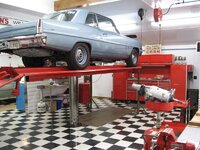
Lift room of course.
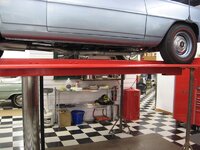
That shelving on the wall was made by Mr.Johnson for that spot. I just cleaned and repainted it and reinstalled it. The white pipe to the right of the shelf carries the wiring from the lift pump to the circuit panel box.
The two above pictures show the tile being formed for the base of the lift cabinet.

The skillful work necessary to cut, form and install the tile is seen here.
After this the tile was scrubbed clean with a power scrubber as it comes with a protective coating and then I applied 5 coats of wax to protect it.
Key to success here was degreasing the floor thoroughly to start. I vacuumed the whole floor just prior to the sealer being applied so there would be no debris. Using a sealer that would prevent petroleum based products from resurfacing from deep in the concrete. Also because the property is on a hill there is never any moisture build up under the concrete. When I pour new concrete for interior areas I always use a vapor barrier. Thankfully, since I doubt one was used here, the topography saved me. If there was a problem with moisture I probably wouldn't have tiled it.
Thomas


 We used a squeegee to move the dirty water out. Once this was done, we did it all over a second time to catch spots we may have missed the first time. We also applied bleach and Simple Green to the walls, using a stiff brush on a handle and cleaned the walls down at the same time. There were spots on the walls, which were still bare concrete block at this time, where there was mold and mildew that needed bleach while the floors didn't. The change in the floors and shop in general was rather dramatic.