Do you have to scrape the ways after they are ground?
-No. The grinding should produce a precision surface, ready to use.
And the trick from a guy over on PM is you make some fittings that go in place of the way wipers, that have essentially 'jackscrews' so you can raise the saddle up from the ground ways, and back up to the original ride height.
Then- using mold release as appropriate, of course- you simply use the new ways themselves as a form to mold a way-repair material called Moglice, in place to get basically a perfect fit.
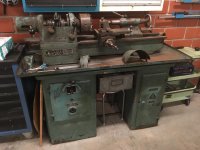
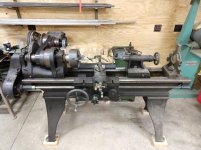
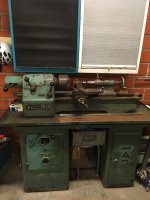
Can someone explain these terms? I see engine lathes, and toolroom lathes, precision lathes, and super-precision lathes.
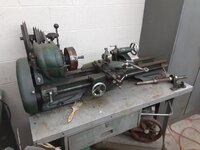
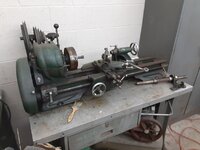
-Typically there's a littler "fluidity" to the terms, but generally speaking an "engine" lathe is a basic, standard lathe. In some cases it may even be very basic, without a quickchange gearbox, etc. Standard generic lathe.
And "engine" has nothing to do with internal combustion- the term dates back to a time when virtually any machine was referred to as an "engine"- a treadle powered lathe might have been referred to as a "turning engine", an early loom might have been called a "weaving engine", etc.
What we now call an "engine" today kind of co-opted the term.

Anyway, a "toolroom" lathe is just an engine lathe with more accessories. Generally speaking, in a factory, they might have rows and rows of standard engine lathes, each one set up to do a specific job and only that specific job. Why have a QCGB on a machine that will never do any threading? Moreoever, if you're setting up a factory or production line, why buy more expensive lathes with features you don't need?
However, in a "toolroom", that's where they're making "tools" to put on those lathes (and mils, etc.) That is, fixtures and jigs and specialty cutting tools, etc.
As such, the machines in the tool room generally need to do a wider variety of work, and thus need accessories like a quickchange gearbox and a taper attachment, etc.
"Precision" lathes generally are a buzzword. All lathes, at least when they were originally built, were designed to do precision work. In the old belt-drive days, "precision" might have meant "a couple of thousandths", but that was still better than the blacksmith could do.
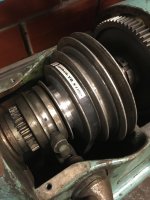
"Super precision" does usually mean a little better- better spindle bearings, more precise balance on the rotating parts, a tighter fit to the sliding parts, more precise fit between gears and the like, etc. They also usually have bigger dials so it's easier to see, say, a half thou mark, etc.
Doc.