To avoid these ads, REGISTER NOW!

Show off your vintage lathe.

Steve from Socal

Well-known member
Joined
Jan 27, 2009
Messages
3,498
Location
Hutchinson Ks.
-What, no taper attachment? Geeze, why even bother then?

:D

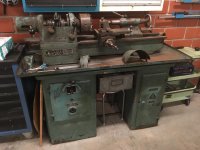
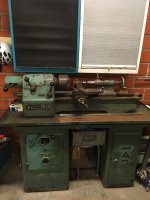
Seriously, what originally went in that little pocket thing under the tach?

Doc.
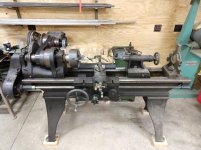
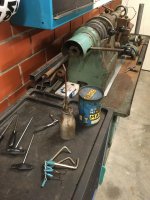
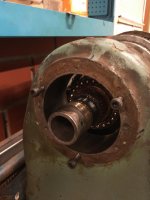
The first picture is the carriage from the back, that blob of cast iron IS the taper attachment.

The window where the VFD remote is used to house a surface feet per minute gauge. The 13EE had one of the first constant surface speed functions for facing.

Steve
 
To avoid these ads, REGISTER NOW!

Steve from Socal

Well-known member
Joined
Jan 27, 2009
Messages
3,498
Location
Hutchinson Ks.
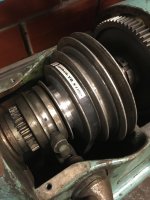
Here is the taper attachment with the rod and bracket, the chip tray covers the taper in use.

Steve
 

Attachments

  • 20191226_150923.jpg
    20191226_150923.jpg
    112.5 KB · Views: 161
  • 20191226_150947.jpg
    20191226_150947.jpg
    131.1 KB · Views: 130

DocsMachine

Well-known member
Joined
Sep 16, 2006
Messages
1,863
Here is the taper attachment with the rod and bracket, the chip tray covers the taper in use.

-Nice. That pic from the previous posting made it look like there wasn't one- I'm used to taper attachments being somewhat more obvious. :D

And I have to admit I've never seen a lathe with any kind of 'protective cover' for the taper- I know I'm constantly having to sweep chips out of my Sheldon attachment. That thing collects 'em better than a strong magnet. :)

Doc.
 

DocsMachine

Well-known member
Joined
Sep 16, 2006
Messages
1,863
Love that backsplash with the light, and I recall seeing that little tray for the tool blocks in a different post. Been keeping that in mind for if/when I get my big lathe back together- it has a cast in "catch all" tray on top of the QCGB, and might be handy to have a rack of the "most used" blocks right there at hand.

Doc.
 

JHuston

Well-known member
Joined
Feb 21, 2016
Messages
301
Location
Canton, Ohio
This is my 1918 Mulliner Enlund 14" engine lathe; I rebuilt it a few years ago, and was pleasantly surprised by the accuracy, which is still pretty respectable for a lathe from a hundred years ago ( the lathe is more accurate than I am).
The lathe was originally a lineshaft machine, but someone in the 1930's or so retrofitted a South Bend overhead drive from a 13" lathe. It's a pretty well done conversion, although the step pulley doesn't quite match, so the slightly stretchy conveyor belting is necessary to allow for changing speeds.This is the kind of machine you find excuses to use.

36578921334_cc34b52e73.jpg

The little red lathe on the shelf is a Parker McKnight armature lathe.

-James Huston
 

wout

Well-known member
Joined
Dec 26, 2013
Messages
786
Location
Belgium
A few more pictures of my Lindeteves lathe. Also the very worn belt in the picture.

Wout
 

Attachments

  • 6E234FF7-E0BA-4032-BE0F-1B912DB5166F.jpg
    6E234FF7-E0BA-4032-BE0F-1B912DB5166F.jpg
    146.7 KB · Views: 92
  • D2ED5BB0-A116-4992-AC9B-7089FB98C94D.jpg
    D2ED5BB0-A116-4992-AC9B-7089FB98C94D.jpg
    71.7 KB · Views: 85
  • 2DFB8858-D4FE-4F2C-86FB-F107921457C8.jpg
    2DFB8858-D4FE-4F2C-86FB-F107921457C8.jpg
    138.3 KB · Views: 97

cnc-me

Well-known member
Joined
Jan 6, 2010
Messages
1,183
Location
MI
Love that backsplash with the light, and I recall seeing that little tray for the tool blocks in a different post. Been keeping that in mind for if/when I get my big lathe back together- it has a cast in "catch all" tray on top of the QCGB, and might be handy to have a rack of the "most used" blocks right there at hand.

Doc.

Yes, that's the "hot" or most used holders, I have a large cabinet
with more holders right behind the machine.

What make is your big lathe?
 

DocsMachine

Well-known member
Joined
Sep 16, 2006
Messages
1,863
Yes, that's the "hot" or most used holders, I have a large cabinet with more holders right behind the machine.

What make is your big lathe?

-The Springfield mentioned on the first page.

Currently redisassembled and the bed is off being reground (which is a story an and of itself. :rolleyes: ) Once it's back, I'll be re-fitting the saddle with Moglice to bring it back up to original height, and then I just have to do a few minor bits like the clutch linkage to get it back to operational.

On my smaller lathes, I have those against a wall, and I just hang toolblocks on racks screwed to the plywood walls. The Springer will be up against a wall too, but is considerably larger- I could rack the toolholders in a similar manner, but I'd probably have to lean way over the bed to reach 'em. :D

So as I said, I've been thinking of something more accessible for the "most used" tools, and a little tray like yours, in a similar location, is near the top of my list.

Another idea is a plywood shelf/tray/rack that sits on the Vee-ways, and spends most of it's time at the far tailstock end. (But can be picked up and moved, whole, if I need the full bed length.)

Doc.
 

cnc-me

Well-known member
Joined
Jan 6, 2010
Messages
1,183
Location
MI
-T
Another idea is a plywood shelf/tray/rack that sits on the Vee-ways, and spends most of it's time at the far tailstock end. (But can be picked up and moved, whole, if I need the full bed length.)

Doc.

I used to have a setup like that on my old Carrol Jamison lathe.
A 13 X 36 from the 1920's I believe, must of been one of the earliest
lathes with a quick change gearbox.

That Springfield looks like a very nice and (heavy) machine.
Do you have to scrape the ways after they are ground?
 
Last edited:

poppinjohnnies

Well-known member
Joined
Dec 10, 2014
Messages
342
Location
Kansas
This is my 1918 Mulliner Enlund 14" engine lathe; I rebuilt it a few years ago, and was pleasantly surprised by the accuracy, which is still pretty respectable for a lathe from a hundred years ago ( the lathe is more accurate than I am).

The lathe was originally a lineshaft machine, but someone in the 1930's or so retrofitted a South Bend overhead drive from a 13" lathe. It's a pretty well done conversion, although the step pulley doesn't quite match, so the slightly stretchy conveyor belting is necessary to allow for changing speeds.This is the kind of machine you find excuses to use.


36578921334_cc34b52e73.jpg


The little red lathe on the shelf is a Parker McKnight armature lathe.


-James Huston


That’s too cool.


Sent from my iPad using The Garage Journal mobile app
 

Roberts210

Well-known member
Joined
Dec 21, 2015
Messages
3,177
Location
Missouri
Can someone explain these terms? I see engine lathes, and toolroom lathes, precision lathes, and super-precision lathes. I know what I turret lathe is--I ran one one summer after I got out of High School. But what is the difference between the other types?
 

DocsMachine

Well-known member
Joined
Sep 16, 2006
Messages
1,863
Do you have to scrape the ways after they are ground?

-No. The grinding should produce a precision surface, ready to use.

And the trick from a guy over on PM is you make some fittings that go in place of the way wipers, that have essentially 'jackscrews' so you can raise the saddle up from the ground ways, and back up to the original ride height.

Then- using mold release as appropriate, of course- you simply use the new ways themselves as a form to mold a way-repair material called Moglice, in place to get basically a perfect fit.

Can someone explain these terms? I see engine lathes, and toolroom lathes, precision lathes, and super-precision lathes.

-Typically there's a littler "fluidity" to the terms, but generally speaking an "engine" lathe is a basic, standard lathe. In some cases it may even be very basic, without a quickchange gearbox, etc. Standard generic lathe.

And "engine" has nothing to do with internal combustion- the term dates back to a time when virtually any machine was referred to as an "engine"- a treadle powered lathe might have been referred to as a "turning engine", an early loom might have been called a "weaving engine", etc.

What we now call an "engine" today kind of co-opted the term. :D

Anyway, a "toolroom" lathe is just an engine lathe with more accessories. Generally speaking, in a factory, they might have rows and rows of standard engine lathes, each one set up to do a specific job and only that specific job. Why have a QCGB on a machine that will never do any threading? Moreoever, if you're setting up a factory or production line, why buy more expensive lathes with features you don't need?

However, in a "toolroom", that's where they're making "tools" to put on those lathes (and mils, etc.) That is, fixtures and jigs and specialty cutting tools, etc.

As such, the machines in the tool room generally need to do a wider variety of work, and thus need accessories like a quickchange gearbox and a taper attachment, etc.

"Precision" lathes generally are a buzzword. All lathes, at least when they were originally built, were designed to do precision work. In the old belt-drive days, "precision" might have meant "a couple of thousandths", but that was still better than the blacksmith could do. :D

"Super precision" does usually mean a little better- better spindle bearings, more precise balance on the rotating parts, a tighter fit to the sliding parts, more precise fit between gears and the like, etc. They also usually have bigger dials so it's easier to see, say, a half thou mark, etc.

Doc.
 
To avoid these ads, REGISTER NOW!

Maui

Well-known member
Joined
Sep 16, 2012
Messages
2,864
Location
Upstate NY
Re: Show off your vintage lathe

Here’s my 1917 16” South Bend Lathe. It weighs about 1700 lbs. I was using it last week to make a new 8” diameter rotational base for a Reed 33 bench vise. I love the quality of this machine.

Maui
 

Attachments

  • 0CCC2366-94DB-42A2-AEC6-F866474967AB.jpg
    0CCC2366-94DB-42A2-AEC6-F866474967AB.jpg
    151.6 KB · Views: 153

JHuston

Well-known member
Joined
Feb 21, 2016
Messages
301
Location
Canton, Ohio
Need some pixs of that lil red beauty as well mate.

Here you go; I think it was probably designed for automotive generators, as the ways are quite long in comparison to the small swing. I've never seen another, and can't find any information on the firm that made it. I'm guessing late '40's, but even that is speculation.
The lathe is very well thought out. The feed is controlled by the spring loaded bronze half nut, and feed stops when you let go. The lever acts both as a return for the carriage and the actuator for a (missing) undercutter assembly.

16984831435_23c0651194.jpg

-James Huston
 

wout

Well-known member
Joined
Dec 26, 2013
Messages
786
Location
Belgium
-What kind of belt is it? Technically you may be able to replace it without having to remove the spindle (which, I'm assuming, is why you say it'll be a big job.)

If it's a modern V-belt, they make linked or "Power Twist" belts that can be installed in place. I have a pair of these on my Sheldon lathe, and they work great.

If it's a flat belt, they make cut-to-length flat belts with clip joiners that can also be assembled in place.

Either way might be quicker than having to disassemble the spindle, especially if you're just planning to sell it off.

Doc.

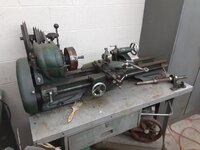
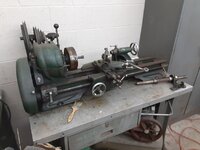
Took some work but I was able to change the belt. Probably unbolted a few more screws and parts then really necessary but it came to a good end so very satisfying job done. Lathe runs very smooth now.

Wout
 

Attachments

  • 7D5DE6E3-D574-40F6-881E-92799F3735B1.jpg
    7D5DE6E3-D574-40F6-881E-92799F3735B1.jpg
    85.4 KB · Views: 78
  • D9D5A25C-2B0A-46E2-8FAA-02DAD00D78F8.jpg
    D9D5A25C-2B0A-46E2-8FAA-02DAD00D78F8.jpg
    147.2 KB · Views: 67
  • D4CE41EE-6C67-4B1D-BD7D-838563B94640.jpg
    D4CE41EE-6C67-4B1D-BD7D-838563B94640.jpg
    86.4 KB · Views: 56
  • 84119963-9203-4B34-9B74-9B4D94D73B20.jpg
    84119963-9203-4B34-9B74-9B4D94D73B20.jpg
    102.1 KB · Views: 55
  • 6C3D0CDF-56B2-4A6C-9ADE-E112D3581BFC.jpg
    6C3D0CDF-56B2-4A6C-9ADE-E112D3581BFC.jpg
    64.7 KB · Views: 54
  • D22E5533-2563-42B8-B086-A54C817E07ED.jpg
    D22E5533-2563-42B8-B086-A54C817E07ED.jpg
    76.3 KB · Views: 54
  • 48D0003A-01F6-4CFE-AAA7-4CB2C32D566A.jpg
    48D0003A-01F6-4CFE-AAA7-4CB2C32D566A.jpg
    107.5 KB · Views: 61
Last edited:

MShaw

Well-known member
Joined
Mar 2, 2015
Messages
1,013
Location
York, Pa.
Here's my contribution. I purchased it from a retired jeweler about 20 years ago. That would make it at least 50 years old. It was made in Germany by Boley. The 6" scale on the cross slide gives you an idea of the size..
 

Attachments

  • lathe.jpg
    lathe.jpg
    94.9 KB · Views: 115

bmwrd0

Well-known member
Joined
Nov 7, 2010
Messages
5,463
Location
Beaver Fever Oregon
That is nice! Out of curiosity, what do you do with it? I have thought about picking up a jewelers lathe when I see one cheap(relatively) but can never think what to do with it.
 

harley jim

Well-known member
Joined
Dec 6, 2013
Messages
11,408
Location
Cleveland Tn..........out in the sticks
Re: Show off your vintage or not so vintage lathe.

This is mine I'm not sure of the year but was told by the guy I bought it from it was a 50s era. I have had it since the 80s when I bought it it was in a box in the back of his garage. I cut down the lyon metal bench and mounted it. It is on the list for restoration but since I use it so much it is going to be a little while. Dose anyone have any information on the age. Thanks, Jim

Sent from my SM-A102U using Tapatalk
661bf34a2daae1467df93385cac6bdcc.jpg021868351ecf74ddfca5ac4f1a87c3d6.jpg
 

Attachments

  • 021868351ecf74ddfca5ac4f1a87c3d6.jpg
    021868351ecf74ddfca5ac4f1a87c3d6.jpg
    307.6 KB · Views: 14
  • 661bf34a2daae1467df93385cac6bdcc.jpg
    661bf34a2daae1467df93385cac6bdcc.jpg
    323.4 KB · Views: 8
Last edited:

MShaw

Well-known member
Joined
Mar 2, 2015
Messages
1,013
Location
York, Pa.
"Out of curiosity, what do you do with it? "

I had a part time business repairing clocks for many years. Lots of small parts to make.
 

harley jim

Well-known member
Joined
Dec 6, 2013
Messages
11,408
Location
Cleveland Tn..........out in the sticks
"Out of curiosity, what do you do with it? "


I had a part time business repairing clocks for many years. Lots of small parts to make.
Last week I had to have an extension for a fostner bit so I took a tap handle and counter board the collet to fit my bit set then I cut the T handle flush with the shaft and turned it down to fit my drill press. This gave me about a three inch extension that will fit all my fostner set. I turned a 5/8" cap screw into an arbor for mounting circular saw blades to so I can true and sharpen them. I also turned a couple of pieces to make a steady rest for my wood lathe, I am making some walking sticks and the get very wobbly as they get thinner. I really use it just like it was a tool in my box. That was just last week . Thank you for asking, Jim

Sent from my SM-A102U using Tapatalk
 

Provincial

Well-known member
Joined
Sep 21, 2011
Messages
6,867
Location
Near Salem, OR
Jim, your lathe has plain bearings for the headstock (spindle) so it was likely made prior to WWII. There should be a tag on the tailstock end of the lathe bed (the vertical surface of the very end, below the ways) that gives the model and serial number. The serial number should begin with a "9-" or "10-" which also will help. These lathes started out rated at 9" swing, which was later up-rated to 10" swing. If it has a 9- serial number, it is likely from the first half of the 1930's.
 

Pressingonward

Well-known member
Joined
Mar 9, 2016
Messages
522
Location
SW WA
Thanks for the explanation on toolroom lathes, that is most helpful.

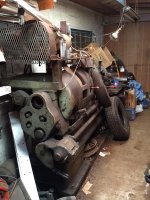
My family's wrecking yard has a monster belt drive lathe that will most likely be available soon if anyone is interested. It's dirty but functional. They used to put full sized rear axles (Ford 9" and the like) into this monster and cut the tubes down to narrow them, as well as making widened steel wheels for racing and other various automotive projects. I'll have to measure it and try to find the manufacturer's tag next time I'm up there, but I'm guessing it has a 18"+ swing and a 8'+ bed. It was originally a line drive machine but it's had a Do-All gearbox added on and is powered with a 3 phase motor and a rotary phase converter. They added an old tire carcass as a safety shield over the chuck in typical wrecking yard fashion.

attachment.php


attachment.php


attachment.php


attachment.php


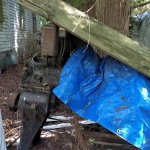
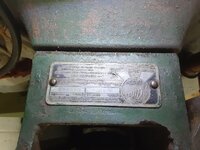
They also have a small Craftsman lathe that is badly in need of a tune-up (this one is spoken for), and an as-yet unidentified ~1920 lathe that's been sitting under a tarp. I might be bringing the mystery lathe home with me if it's salvageable. I think it could be a Flather lathe, but with an integrated motor:

attachment.php
 

Attachments

  • IMG_20190902_132018671_crop_58.jpg
    IMG_20190902_132018671_crop_58.jpg
    110.4 KB · Views: 840
  • IMG_20190902_132039412_crop_55.jpg
    IMG_20190902_132039412_crop_55.jpg
    115.4 KB · Views: 823
  • IMG_20190902_131954586_crop_38.jpg
    IMG_20190902_131954586_crop_38.jpg
    149.4 KB · Views: 829
  • IMG_20190902_131945779_crop_97.jpg
    IMG_20190902_131945779_crop_97.jpg
    121.3 KB · Views: 837
  • IMG_20190902_125320128_crop_72.jpg
    IMG_20190902_125320128_crop_72.jpg
    155.1 KB · Views: 826
Last edited:

harley jim

Well-known member
Joined
Dec 6, 2013
Messages
11,408
Location
Cleveland Tn..........out in the sticks
Jim, your lathe has plain bearings for the headstock (spindle) so it was likely made prior to WWII. There should be a tag on the tailstock end of the lathe bed (the vertical surface of the very end, below the ways) that gives the model and serial number. The serial number should begin with a "9-" or "10-" which also will help. These lathes started out rated at 9" swing, which was later up-rated to 10" swing. If it has a 9- serial number, it is likely from the first half of the 1930's.
Provincial
Thank you for the responce.
I had never seen that tag. I had looked around the head end for a tag in the past. Looks like model is H42 and ser.is 043943 it is an atlas

Sent from my SM-A102U using Tapatalk
e53b6a48d7b85282ecc7c3e0b16a0a49.jpg
 

Attachments

  • e53b6a48d7b85282ecc7c3e0b16a0a49.jpg
    e53b6a48d7b85282ecc7c3e0b16a0a49.jpg
    396.4 KB · Views: 4
Last edited:

Provincial

Well-known member
Joined
Sep 21, 2011
Messages
6,867
Location
Near Salem, OR
Jim, I believe your lathe is a 10" model. If it had Timken roller bearings, the serial number would have a T in front of the H, like TH _______. The 42 indicates the total length of the bed ways, in this case 42". The distance between centers (if you put a center in the spindle taper) would be 24" for this lathe. Using a chuck reduces the distance available for the work, since the face of the chuck extends out further than the center.
 

harley jim

Well-known member
Joined
Dec 6, 2013
Messages
11,408
Location
Cleveland Tn..........out in the sticks
Re: Show off your vintage or not so vintage lathe.

Thank you for that information. I do plan on restoring it some day but like I said earlier I have to finish all the projects that I have in progress first. I would like to build a pan around the back and sides and put a chip hole in the bench to collect chips in a can below. I keep it oiled and clean.1f4c46b94e1e75521e8d05282801952b.jpg

Sent from my SM-A102U using Tapatalk
 

Attachments

  • 1f4c46b94e1e75521e8d05282801952b.jpg
    1f4c46b94e1e75521e8d05282801952b.jpg
    349 KB · Views: 18

DocsMachine

Well-known member
Joined
Sep 16, 2006
Messages
1,863
Bringing this back up for the moment, I've recently finished the last major mod to my 1956 Sheldon lathe: Drawers!

drawerz60.jpg

Here's how it originally looked when I bought it back in 2008:

sl01.jpg

The previous owner had converted it from a sort of table drive (with the motor mounted to the wall or bench behind the machine, and connected only by a belt) to a proper underdrive. The underdrive mechanism was a proper Sheldon unit, but the PO never had a cabinet or chassis.

So be welded one together out of 2" box tubing, which was functional but very basic. And shortly before I got it, he'd sawed the feet off the frame so he could fit it with casters to move about his garage.

I refitted some feet, and later, added panels and a door to enclose the motor end. Make it look more like a real cabinet lathe, y'know? :D

When I did that, I also added extra framing at the tailstock end in order to eventually add drawers, and over the last two months, as I've had time, I've finally fitted and finished those drawers.

Threee of which are just miscellaneous storage, with some eBay rubber drawer liner to cushion things a bit, but the third one down I fitted specifically to hold my collection of 5C collets:

drawerz42.jpg

It's been effectively my main lathe for a decade now, and it's finally damn near done. I still need to do some repairs to the cross-slide, but apart from that, it's 100%.

Doc.
 

wrenchguy

Well-known member
Joined
Sep 22, 2011
Messages
4,698
Location
NW Indiana
Here's a 1974 NOS 12x36 Craftsman still in the crate i had few years back. With packing slip which was stapled to the crate.
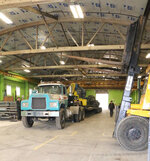


Here's 1 of my sons machines new to his shop.

Loading for 100 mile trip to NW Indiana.
IMG_1194.jpg
Unloading.
IMG_1201.jpg
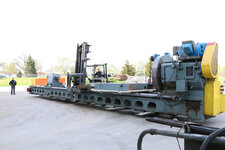
1981 40' Le Blond, 54' total length
SAM_0721.jpg
 
Last edited:
To avoid these ads, REGISTER NOW!
Top Bottom