To avoid these ads, REGISTER NOW!

Atlas 2 post lift anchor spacing too close?

ryan1000

Active member
Joined
Oct 25, 2012
Messages
34
Curious on the spacing of anchors on my atlas platinum 10k 2 post lift. I'm using the supplied anchors, unknown brand.

I've read on multiple anchor sites that the general rule of thumb for anchor spacing is a minimum of 10 times the diameter. That equals 7.5 inches for these 3/4" wedge anchors.
Guessing that rule is too ensure enough concrete strength after being drilled and stresses by the anchors.

I'm assuming it was designed properly and everything will be fine but anyone know why the rules don't apply here?

On the outside of my posts, the centers of the 3 holes are each 3.5" from each other. See attachment.
 

Attachments

  • lift.jpg
    lift.jpg
    126.4 KB · Views: 243
Last edited:
To avoid these ads, REGISTER NOW!

navycryppie

Active member
Joined
Oct 25, 2016
Messages
31
Location
Salem, OR
Never thought about that, but interesting since the Rotary model it's cloned after only has one anchor on that side. I've had my Apex-10 installed for a couple years, no issue with the three being there...I see your point though.
 

matt_i

Well-known member
Joined
Mar 14, 2008
Messages
10,753
Location
SE Michigan
I wouldn't tighten them down all the way until all 3 holes are drilled and the anchors seated. Its a minimal hedge against cracking but the only one I can think of.

[start broken record player] here's where epoxied anchor studs shine as they put no outward force on the concrete sidewall [/stop broken record player]
 

finn

Well-known member
Joined
Mar 27, 2005
Messages
16,393
Location
The UP, God's country
[start broken record player] here's where epoxied anchor studs shine as they put no outward force on the concrete sidewall [/stop broken record player]

You will have to show me a detailed finite element model before I buy that statement. All anchore, when installed, tensioned, and loaded, transfer load to the slab in a cone.

Otherwise they wouldn’t work, ie they would pull out.
 

SJW

Well-known member
Joined
Apr 4, 2018
Messages
67
Location
Thousand Oaks, CA
To me, they clearly seem too close together.

Does the manual say anything about this? Have you contacted the company?

If I recall how this goes from previous discussions, the anchor bolts create a cone through which the weight on the lift is distributed. The deeper the anchor bolt, the bigger the cone, the more weight that can be supported. If the cones overlap, as they would appear to do here, the weight the anchor bolt can support is reduced.

I would definitely not use all three holes without knowing a lot more.
 

Jagmandave

Well-known member
Joined
Nov 6, 2011
Messages
6,305
Location
Overland Park, Ks.
In the case of a 2 post, the anchors are mostly just locating the base of the post, aren't they? There should be no shear or even pullout unless the lift is loaded wrong and is trying to fall over? The bar across the top will keep the posts from trying to move inward under the weight of the car?

I've seen some lifts that have extensions to either side for extra strength against tipping sideways. I would hate those as I'd be tripping over them constantly.....
 

Kaizen

Well-known member
Joined
Jan 9, 2015
Messages
6,948
Location
New England
don't know about all that fancy numbers stuff. good practice is to tighten each at the same time so pressure is equal across them. Not using all bolts that are included is just scary stupid. I put my atlas in with all bolts and only issue i had was them not seating. If the concrete blows out i'm guessing it would have with just two evenly spaced bolts as well.
 

Scud67

Well-known member
Joined
Mar 1, 2014
Messages
331
Location
Metrowest Boston MA
The lifts are engineered with this in mind - and the specified concrete slab. If the installation instructions say to use all of the bolts and anchors, then do so. If they say otherwise, then do that. Pretty simple.
 

WNYflyer

Well-known member
Joined
Sep 13, 2009
Messages
2,124
Location
Lockport, NY
The lift manufacturer when designing the anchor bolt pattern and base plate needs to specify the correct anchor bolt and installation for a correct/complete design. The pattern and anchor bolt need to be worked together for a correct design. Technical publications by the anchor manufacturers typically have load tables indicating anchor diameter, material, anchor spacing, embedment, etc. versus required load capacities. Installed load capacity could be controlled by the strength of the bolt material itself or by the strength of the concrete it is connected too.

If the bolt spacing does not meet the published minimum bolt spacing required to develop the strength of the bolt material itself then strength reduction factors are published so the designer can determine a reduced load capacity.
 

rattle_snake

Well-known member
Joined
Jun 25, 2015
Messages
5,240
Location
Chandler, AZ
The lift manufacturer when designing the anchor bolt pattern and base plate needs to specify the correct anchor bolt and installation for a correct/complete design. The pattern and anchor bolt need to be worked together for a correct design. Technical publications by the anchor manufacturers typically have load tables indicating anchor diameter, material, anchor spacing, embedment, etc. versus required load capacities. Installed load capacity could be controlled by the strength of the bolt material itself or by the strength of the concrete it is connected too.

If the bolt spacing does not meet the published minimum bolt spacing required to develop the strength of the bolt material itself then strength reduction factors are published so the designer can determine a reduced load capacity.

This. Look at datasheet of anchor, it gives min spacing and distance to edge.
 
Last edited:

22george

Well-known member
Joined
Jan 26, 2011
Messages
1,637
Location
SW Ohio
I have an Atlas 10k extra tall extra wide lift. When l built my pole barn l had the concrete poured 8 inches thick. I also scrapped the anchor bolts from Atlas and bought 8 inch long anchor bolts from Fastenal and used them. I believe in having extra safety margin. I also fabricated and bolted on extra bracing across the top of the lift. The channel across the top of the lift that the cables and hydraulic lines are in was not in my opinion attached to the columns strong enough to provide any support other than holding the channel in place. I bought it about 8 years ago and am very happy with the lift.
 

finn

Well-known member
Joined
Mar 27, 2005
Messages
16,393
Location
The UP, God's country
I have an Atlas 10k extra tall extra wide lift. When l built my pole barn l had the concrete poured 8 inches thick. I also scrapped the anchor bolts from Atlas and bought 8 inch long anchor bolts from Fastenal and used them. I believe in having extra safety margin. I also fabricated and bolted on extra bracing across the top of the lift. The channel across the top of the lift that the cables and hydraulic lines are in was not in my opinion attached to the columns strong enough to provide any support other than holding the channel in place. I bought it about 8 years ago and am very happy with the lift.

You’re just guessing, not re-engineering.
 

lakeroadster

Well-known member
Joined
Jan 19, 2015
Messages
5,166
Location
Central Colorado
here's where epoxied anchor studs shine as they put no outward force on the concrete sidewall [/stop broken record player]

You will have to show me a detailed finite element model before I buy that statement. All anchore, when installed, tensioned, and loaded, transfer load to the slab in a cone.

Otherwise they wouldn’t work, ie they would pull out.

Typical mechanical anchors apply outward loads on the concrete when you tighten them down, that's how they hold onto the concrete, outward force.

So they load the concrete just sitting there with no load at all on the lift.

Epoxy anchors apply zero load to the concrete, if there is no load on the lift.

Therefore epoxy anchors apply less force to the concrete.
 
Last edited:

lakeroadster

Well-known member
Joined
Jan 19, 2015
Messages
5,166
Location
Central Colorado
Never thought about that, but interesting since the Rotary model it's cloned after only has one anchor on that side. I've had my Apex-10 installed for a couple years, no issue with the three being there...I see your point though.

I've got the original version... a Rotary, and the base plate on that Atlas appears thinner to me from that photo?

Perhaps that's the reason for the extra anchors... thin base plates?
 

finn

Well-known member
Joined
Mar 27, 2005
Messages
16,393
Location
The UP, God's country
Typical mechanical anchors apply outward loads on the concrete when you tighten them down, that's how they hold onto the concrete, outward force.

So they load the concrete just sitting there with no load at all on the lift.

Epoxy anchors apply zero load to the concrete, if there is no load on the lift.

Therefore epoxy anchors apply less force to the concrete.

Makes no sense. Draw a free body diagram showing your assertion. As soon as the nut is torqued on the anchor, epoxy or otherwise, there’s an equal but opposite load transferred to the concrete, pulling upwards on the anchor.

The form factor of that load distribution is about the same as a conventional wedge anchor, although the wedge anchor stress concentration would emanate from the wedge contrast patch.

Load is load. Any tipping load from a lift in use is added to the installation torque induced load, no matter what type of fastener is used.
 
OP
R

ryan1000

Active member
Joined
Oct 25, 2012
Messages
34
This info makes me feel a bit more confident with close spacing. I don't have Simpson anchors but this doc gives the impression that close spacing is an option and shows the load adjustment tables.

It looks like perhaps the load rating for my application (.75 diameter, 3.25 inch embedment and 3.5 inch spacing) would put me around 75% of the max load.....if I had their anchors.

Would spacing be centers of holes or from edge to edge?

Page 8 - http://embed.widencdn.net/pdf/plus/ssttoolbox/jbt2lcsbeh/C-A-2018-Wedge-All-designinfo.pdf
 

Attachments

  • anchor simpson3.jpg
    anchor simpson3.jpg
    131.8 KB · Views: 67
Last edited:

lakeroadster

Well-known member
Joined
Jan 19, 2015
Messages
5,166
Location
Central Colorado
Makes no sense. Draw a free body diagram showing your assertion. As soon as the nut is torqued on the anchor, epoxy or otherwise, there’s an equal but opposite load transferred to the concrete, pulling upwards on the anchor.

The form factor of that load distribution is about the same as a conventional wedge anchor, although the wedge anchor stress concentration would emanate from the wedge contrast patch.

Load is load. Any tipping load from a lift in use is added to the installation torque induced load, no matter what type of fastener is used.

FEA and Free body diagrams aren't needed, you're simply being argumentative.

Without any load applied via the 2 post lift, the anchor itself exerts high loads into the concrete due to the "wedge" design it uses to prevent itself from slipping out of the concrete.

The epoxy anchor does not load the concrete to hold the stud in place, it bonds to the concrete.

So just sitting there, the wedge anchor is loading the concrete... always unless the wedge anchor has failed.

In every application the wedge style anchor applies more loading to the concrete.

This guy explains it very well ----> https://www.fastenerandfixing.com/c...-versus-mechanical-anchors-the-pros-and-cons/

This info makes me feel a bit more confident with close spacing. I don't have Simpson anchors but this doc gives the impression that close spacing is an option and shows the load adjustment tables.

It looks like perhaps the load rating for my application (.75 diameter, 3.25 inch embedment and 3.5 inch spacing) would put me around 75% of the max load.....if I had their anchors.

Would spacing be centers of holes or from edge to edge?

Page 8 - http://embed.widencdn.net/pdf/plus/ssttoolbox/jbt2lcsbeh/C-A-2018-Wedge-All-designinfo.pdf

You really need to contact the manufacturer of the specific type of anchor your are using... and if they recommend against the layout, then contact your lift manufacturer.
 

Attachments

  • Wedge Anchor   .jpg
    Wedge Anchor .jpg
    96.3 KB · Views: 41
Last edited:

22george

Well-known member
Joined
Jan 26, 2011
Messages
1,637
Location
SW Ohio
You’re just guessing, not re-engineering.


You are correct. I wasn't trying to re-engineer it. I was trying to built in a little more safety factor.:) I work mostly by myself, so anything l can do for safety is worth it IMHO:)
 
To avoid these ads, REGISTER NOW!
OP
R

ryan1000

Active member
Joined
Oct 25, 2012
Messages
34
You are correct. I wasn't trying to re-engineer it. I was trying to built in a little more safety factor.:) I work mostly by myself, so anything l can do for safety is worth it IMHO:)


Longer anchors to take advantage of deeper concrete is great. And I don't see how beefing up the overhead cross bar can't add strength overall. Its not
necessary because the posts are designed to hold the load with no crossbar like a baseplate setup but I'm sure its even stronger now after your modification.
 

firebirdparts

Well-known member
Joined
Jun 8, 2016
Messages
10,678
Location
Kingsport, TN
In the case of a 2 post, the anchors are mostly just locating the base of the post, aren't they? There should be no shear or even pullout unless the lift is loaded wrong and is trying to fall over? .

No, this is totally wrong. There is plenty of shear. thousands of pounds.
 

Retroman

Well-known member
Joined
Jan 21, 2018
Messages
1,364
Location
Mojave Desert
I would use Titan concrete bolts on the outside holes and your good. I don't see many commercial projects calling for wedge anchors these days either epoxy and threaded rod or concrete bolts.
 
OP
R

ryan1000

Active member
Joined
Oct 25, 2012
Messages
34
I would use Titan concrete bolts on the outside holes and your good. I don't see many commercial projects calling for wedge anchors these days either epoxy and threaded rod or concrete bolts.

If those titan concrete bolts you mentioned are similar to Tapcons, they can't handle as much as much as wedge anchors.
 

finn

Well-known member
Joined
Mar 27, 2005
Messages
16,393
Location
The UP, God's country
FEA and Free body diagrams aren't needed, you're simply being argumentative.

Without any load applied via the 2 post lift, the anchor itself exerts high loads into the concrete due to the "wedge" design it uses to prevent itself from slipping out of the concrete.

The epoxy anchor does not load the concrete to hold the stud in place, it bonds to the concrete.

So just sitting there, the wedge anchor is loading the concrete... always unless the wedge anchor has failed.

In every application the wedge style anchor applies more loading to the concrete.

This guy explains it very well ----> https://www.fastenerandfixing.com/c...-versus-mechanical-anchors-the-pros-and-cons/

I don’t see any technical qualifications in the guy’s bio, other than he writes stories for a trade magazine. Probably a journalism or History major.

The load on the anchor is determined by the torque on the nut clamping down on the baseplate, and any tipping load caused by the moment created by the way the vehicle is loaded on the lift, ie off center from the center of the baseplate. Basically, the torque and static load puts the fastener in tension, and the concrete is in compression except for tipping forces

Both mechanical and chemical fasteners see exactly the same total load, although the distribution along the length of the fastener is different.

The mechanical fastener transfers that load to the concrete from an area eminating from the wedge. The concrete above that area is in compression, caused by the downward force on the baseplate, reduced by any tipping force. The fastener is in tension between the nut and the wedge, with uniform stretch along its length. As long as the forces at the wedge don’t exceed the strength of the concrete, there are no issues.

The chemical fastener has contact with the resin and the concrete, along the entire fastener length, but the majority of the load is transferred to the concrete from the top, tapering to zero load transferred at the bottom of the fastener rod. Remember, fasteners work by stretch and spring rate.

Which is better? I don’t know. I have used both with success, but know that lift manufacturers generally recommend mechanical over resin, probably because they are more foolproof, ie not as sensitive to poor cleaning.

As long as your concrete is within spec ( and that bar isn’t too high), there’s no reason to go to resin anchors unless you screwed up drilling the holes, and you need a salvage procedure.

Something that I hadn thought of before, is the whole stress cone you see in the literature has to be modified when looking at the geometry and mechanics of a lift installation. The cone, I think, only considers pull out force, and ignores the clamp load that the nut puts on the baseplate, transfering that load back into the concrete as a compressive load.
 

JeepJohn62

Well-known member
Joined
Feb 25, 2019
Messages
157
Location
Alaska
If the load on the lift post was centered straight down, then the attaching bolts would just be holding it in place. This isn't the case.

There is a large torque arm; two actually; holding your truck off the ground. The distance from the center of the post to the frame of your truck is likely about 4 feet in total.

If your truck weighs 8000 lbs, then each side is holding 1/2 of that, or 4000 lbs.

Take 4000 lbs and multiply by the torque of 4 feet and you will notice a number of 16000 lbs placing the anchor fasteners in tension.

Luckily we generally have several anchors to spread that load with a safety factor.

The top bar is a cable guide and is not designed to supplement the anchor loads.

That's why the arms and anchors are hefty. A lot of steel braced against a significant load.

Sent from my SM-A102U using The Garage Journal mobile app
 

matt_i

Well-known member
Joined
Mar 14, 2008
Messages
10,753
Location
SE Michigan
The chemical fastener has contact with the resin and the concrete, along the entire fastener length, but the majority of the load is transferred to the concrete from the top, tapering to zero load transferred at the bottom of the fastener rod. Remember, fasteners work by stretch and spring rate.

Which is better? I don’t know. I have used both with success, but know that lift manufacturers generally recommend mechanical over resin, probably because they are more foolproof, ie not as sensitive to poor cleaning.

I'm going to put it out there that the epoxied anchors are superior. Wedge anchors can't hold down industrial robots nor jib cranes or they would work loose with bad consequences. Some of that is dynamics and some is pure static tensile strength.

But I agree completely with your thought on the "prep they can't control".

It is interesting that the lift installers aren't required to do a "proof test" as one would do with an overhead crane/lifting system.
 

lakeroadster

Well-known member
Joined
Jan 19, 2015
Messages
5,166
Location
Central Colorado
As long as the forces at the wedge don’t exceed the strength of the concrete, there are no issues.

And that is what is being discussed. The wedge loads the concrete, the epoxy anchor doesn't. The anchor to anchor spacing is close.

So if the user wants to minimize the loading on the concrete, use the epoxy anchor.
 

brownbagg

Well-known member
Joined
Mar 20, 2006
Messages
5,208
atlas has buiilt 100 of thousands of lift, I think they know what they doing by now
 

finn

Well-known member
Joined
Mar 27, 2005
Messages
16,393
Location
The UP, God's country
And that is what is being discussed. The wedge loads the concrete, the epoxy anchor doesn't. The anchor to anchor spacing is close.

So if the user wants to minimize the loading on the concrete, use the epoxy anchor.

The point is, ALL anchors load the concrete. It’s basic physics the teach in every high school.

Why doesn’t that compute? If you have a force in one direction, you have an equal and opposite force.

You can’t rewrite that law because it’s over your head!
 

lakeroadster

Well-known member
Joined
Jan 19, 2015
Messages
5,166
Location
Central Colorado
The point is, ALL anchors load the concrete. It’s basic physics the teach in every high school.

Why doesn’t that compute? If you have a force in one direction, you have an equal and opposite force.

You can’t rewrite that law because it’s over your head!

Focus Finn because once again, you miss the point.

Just sitting there... no load at all on the 2 post lift, just two columns sitting there, doesn't even need anchors at this point.

The wedge style anchors are applying a load into the concrete.

The epoxy anchors aren't.

The wedge, when you tighten the nut, the wedge pushes outward on the concrete. That outward force is critical when holes are drilled in close proximity to each other.

Again... we are talking no load on the anchor from the 2 post lift.

So if the user wants to minimize the loading on the concrete, use the epoxy anchor.
 

JeepJohn62

Well-known member
Joined
Feb 25, 2019
Messages
157
Location
Alaska
Interesting discussion. My thought is that the load on the lift is transferred to the anchors. I am defining the load as the working torque when the lift is in use.

The mechanical anchor is pre-tensioned in the concrete by the wedge. This force is applied radially outward, placing the localized material in compression and tension. There is no uplift component after the initial wedge is expanded into the edges of the hole.

The data I have seen, illustrates the strength of these fasteners is defined by the resistance of the concrete cone in tension. The failure mode of the concrete is a cone shaped slug that fractures radially upward from the deepest connection point.

I don't know if the epoxy expands slightly as it cures. If it does, then it would also preload the concrete to some extent.

When holes are placed closer than is specified by the manufacturer, then the tension cones must overlap somewhat.

However, there are more anchors than needed to provide a safety factor, and the resulting assembly is able to resist the torque load. If not, all the lifts would fall over.

Sent from my SM-A102U using The Garage Journal mobile app
 

boatshoes

Well-known member
Joined
Feb 20, 2019
Messages
126
Location
Atlanta
Focus Finn because once again, you miss the point.

Just sitting there... no load at all on the 2 post lift, just two columns sitting there, doesn't even need anchors at this point.

The wedge style anchors are applying a load into the concrete.

The epoxy anchors aren't.

The wedge, when you tighten the nut, the wedge pushes outward on the concrete. That outward force is critical when holes are drilled in close proximity to each other.

Again... we are talking no load on the anchor from the 2 post lift.

So if the user wants to minimize the loading on the concrete, use the epoxy anchor.

Do you not torque your epoxy anchors with no load on the lift? I don't understand. If you torque your epoxy anchor and your wedge anchor to the same ft-lbs, do they not both load the concrete (but in different fashions)?
You make it sound like your epoxy anchors are hand-tight
 

finn

Well-known member
Joined
Mar 27, 2005
Messages
16,393
Location
The UP, God's country
Focus Finn because once again, you miss the point.

Just sitting there... no load at all on the 2 post lift, just two columns sitting there, doesn't even need anchors at this point.

The wedge style anchors are applying a load into the concrete.

The epoxy anchors aren't.

The wedge, when you tighten the nut, the wedge pushes outward on the concrete. That outward force is critical when holes are drilled in close proximity to each other.

Again... we are talking no load on the anchor from the 2 post lift.

So if the user wants to minimize the loading on the concrete, use the epoxy anchor.


Well, I am certainly glad I didn’t graduate from the same Engineering School as you did!
 

WNYflyer

Well-known member
Joined
Sep 13, 2009
Messages
2,124
Location
Lockport, NY
Do you not torque your epoxy anchors with no load on the lift? I don't understand. If you torque your epoxy anchor and your wedge anchor to the same ft-lbs, do they not both load the concrete (but in different fashions)?
You make it sound like your epoxy anchors are hand-tight

Expansion wedge anchors need to be torqued per the manufacturer's recommendations to force the expansion wedges at the base to expand and engage the concrete appropriately. This also causes preload tension in the anchor which in turn creates a equal clamping force/preload/prestress force, whatever you want to call it in the concrete. The anchor is then sized for the actual external tension and shear that the anchor will see. I am assuming the preload is accounted for in some way in the manufacturer's testing of the anchor and thus the subsequent published test data for allowable external loads, spacings, etc.

Typically there is no reason to torque up an all-thread rod grouted in with adhesive. Torquing a bolt doesn't really mean much unless an representative assembly has been set up and tested to confirm that the torque induces the desired tension in the bolt and thus desired clamping force across mating surfaces. In my work we have jacked adhesive grouted anchor bolts and measured elongation which in turn is converted mathematical to a tension in the anchor bolt and clamping force. This was done solely due to the anchor bolts be subjected to tension cycling (fatigue) thus the anchor bolts needed to prestressed/preloaded to extended the fatigue life of the bolts.
 

JeepJohn62

Well-known member
Joined
Feb 25, 2019
Messages
157
Location
Alaska
Do you not torque your epoxy anchors with no load on the lift? I don't understand. If you torque your epoxy anchor and your wedge anchor to the same ft-lbs, do they not both load the concrete (but in different fashions)?
You make it sound like your epoxy anchors are hand-tight
Excellent point. I failed to include that in my long diatribe.

I think we have established that both anchor systems work when installed properly.

Sent from my SM-A102U using The Garage Journal mobile app
 

lakeroadster

Well-known member
Joined
Jan 19, 2015
Messages
5,166
Location
Central Colorado
Well, I am certainly glad I didn’t graduate from the same Engineering School as you did!

Agreed. This is a very simple concept, and you are failing to grasp it.

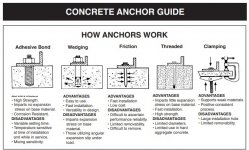
See the "Concrete Anchor Guide" below.

Do you not torque your epoxy anchors with no load on the lift? I don't understand. If you torque your epoxy anchor and your wedge anchor to the same ft-lbs, do they not both load the concrete (but in different fashions)?
You make it sound like your epoxy anchors are hand-tight

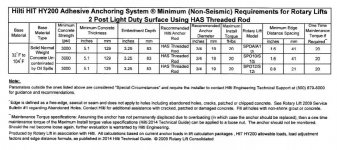
Epoxy anchors require very little torque on the hex nuts, 20 ft-lbs for 3/4" anchors.

Mechanical anchors require a lot of torque on the hex nuts, 180 ft-lbs for 3/4" anchors.

Once again... (for everybody except Finn) that means an increased load on the concrete if you are using mechanical anchors.
 

Attachments

  • Rotary Spec for Hilti HY200 Epoxy.jpg
    Rotary Spec for Hilti HY200 Epoxy.jpg
    97.8 KB · Views: 22
  • Wedge Anchor Data.jpg
    Wedge Anchor Data.jpg
    109.4 KB · Views: 22
  • Concrete Anchor Guide.jpg
    Concrete Anchor Guide.jpg
    92.9 KB · Views: 42
Last edited:

Bad Habit

Well-known member
Joined
Mar 19, 2014
Messages
2,017
Location
Chumstick WA
Digging this old post back up, because why not. Came across it as I had the same concerns as the OP about the anchors along the back side of the baseplate being too close together. Called the Atlas Tech Support line and got connected with a guy who knew exactly what I was talking about. While it may have been a bit of a company line, he said the lift, being ALI certified was fully tested in that anchor configuration, and while individually each anchor may not have as much pull out strength, the combination of the 3 provides the anchoring required. He also actually recommended to use epoxy for the anchors, that it doesn't impart as much stress into the concrete, and would minimize the concerns about having the anchors too close together. He sent me info an epoxy that he's familiar with and it easy to use - PC-Concrete (can be used with a standard caulking gun).

We also discussed shimming, non-shrink grout (felt it was always a good idea) and how the instructions do need a bit of help. Pointed out some tricks and things he did over the years as an installer to make things simpler and prevent problems (i.e. attach the cross piece before you anchor the 2nd post to make sure they're spaced correctly, etc). Actually felt pretty good as most of those things I had done that way.

All in all I was glad I called, real informative guy and definitely knew lifts and how to install them.
 
To avoid these ads, REGISTER NOW!
Top Bottom