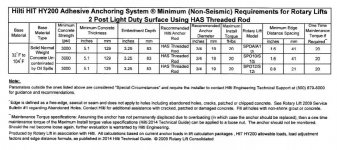
FEA and Free body diagrams aren't needed, you're simply being argumentative.
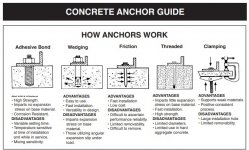
Without any load applied via the 2 post lift, the anchor itself exerts high loads into the concrete due to the "wedge" design it uses to prevent itself from slipping out of the concrete.
The epoxy anchor does not load the concrete to hold the stud in place, it bonds to the concrete.
So just sitting there, the wedge anchor is loading the concrete... always unless the wedge anchor has failed.
In every application the wedge style anchor applies more loading to the concrete.
This guy explains it very well ---->
https://www.fastenerandfixing.com/c...-versus-mechanical-anchors-the-pros-and-cons/
I don’t see any technical qualifications in the guy’s bio, other than he writes stories for a trade magazine. Probably a journalism or History major.
The load on the anchor is determined by the torque on the nut clamping down on the baseplate, and any tipping load caused by the moment created by the way the vehicle is loaded on the lift, ie off center from the center of the baseplate. Basically, the torque and static load puts the fastener in tension, and the concrete is in compression except for tipping forces
Both mechanical and chemical fasteners see exactly the same total load, although the distribution along the length of the fastener is different.
The mechanical fastener transfers that load to the concrete from an area eminating from the wedge. The concrete above that area is in compression, caused by the downward force on the baseplate, reduced by any tipping force. The fastener is in tension between the nut and the wedge, with uniform stretch along its length. As long as the forces at the wedge don’t exceed the strength of the concrete, there are no issues.
The chemical fastener has contact with the resin and the concrete, along the entire fastener length, but the majority of the load is transferred to the concrete from the top, tapering to zero load transferred at the bottom of the fastener rod. Remember, fasteners work by stretch and spring rate.
Which is better? I don’t know. I have used both with success, but know that lift manufacturers generally recommend mechanical over resin, probably because they are more foolproof, ie not as sensitive to poor cleaning.
As long as your concrete is within spec ( and that bar isn’t too high), there’s no reason to go to resin anchors unless you screwed up drilling the holes, and you need a salvage procedure.
Something that I hadn thought of before, is the whole stress cone you see in the literature has to be modified when looking at the geometry and mechanics of a lift installation. The cone, I think, only considers pull out force, and ignores the clamp load that the nut puts on the baseplate, transfering that load back into the concrete as a compressive load.




 I work mostly by myself, so anything l can do for safety is worth it IMHO