RAS61
Well-known member
Don't worry, I got your back!Exactly


Don't worry, I got your back!Exactly
I would think so. I am having mine set up as a switched outlet because that is how the valve I plan to use works. Open when on, closed when off but has a manual override. That seemed the best option for me but there are bluetooth and wifi valves also.Great point. I have added to my list for the electrician layout. A standard 110 should be sufficient, correct?
Thanks. Simple sounds best. Not interested in any of the Bluetooth/WiFi stuff.I would think so. I am having mine set up as a switched outlet because that is how the valve I plan to use works. Open when on, closed when off but has a manual override. That seemed the best option for me but there are bluetooth and wifi valves also.
That was my thinking also. Put the switch right beside the light switches when I walk in the door.Thanks. Simple sounds best. Not interested in any of the Bluetooth/WiFi stuff.
I hadn't thought about it that way, but even now that I do I like my way better. I don't use air every time I am in the shop so no need for it to be on every time I have the lights on. I admit it is more expensive in my case, but if you plan it from the building stage the cost should be pretty insignificant.There all kinds of conversations about this, but I wired in a relay to my lighting circuit that controls the compressor. Also you can buy a powered open ball valve for the outlet, again wired into the lights. Neither add a measurable load on the circuit. lights are on, the compressor is on.
My system doesn't leak so the compressor rarely runs unless I use it. I have been out there wood working 2-3 days in a row and the compressor never runs, so not an issue having it on when ever I an out there.I hadn't thought about it that way, but even now that I do I like my way better. I don't use air every time I am in the shop so no need for it to be on every time I have the lights on. I admit it is more expensive in my case, but if you plan it from the building stage the cost should be pretty insignificant.
Mine is a very slow leak. My compressor might kick on once a day or so if left on so really my solution is overkill and I know it, but it bugs me enough to do it anyway.My system doesn't leak so the compressor rarely runs unless I use it. I have been out there wood working 2-3 days in a row and the compressor never runs, so not an issue having it on when ever I an out there.
I have a 5HP, 80 gallon Curtis with the E57 pump. I believe the pump in Chinese, but I don't know for certain. It also has reed valves. I am not complaining as it works well and I bough it used for $100.I have stated my opinions on compressors elsewhere but will repeat them here.
For me, there are three relevant categories of compressors:
1) Pressure lubricated disk valve
2) Splash lubricated disk valve
3) Splash lubricated reed valve
For category 1, they are all pretty good. These are industrial-grade machines that will outlive most hobbyists and their shops. Quincy, Champion, and Saylor-Beall make notable examples
Category 2 is the budget version of category 1. If you don't think you will ever put more than 5k-ish hours on the compressor, this is a good option. Again the usual suspects: Quincy, Champion, Saylor-Beall, and some older Curtis (NOT FS-Curtis. I know nothing about those)
Category 3 is the bottom of the barrel. Here you will find the stereotypically loud, obnoxious, overheating, low duty-cycle compressor spun by a screaming 3450 RPM motor. IMO the best of this bunch is Rolair, they use an Italian pump and at least try to keep the RPMS down a bit. You will also find many units using ABAC pumps, including some by Quincy and most of the big-box and auto parts store brands. IR makes a lot of compressors in this category and they should be avoided at all costs IMO. Same with Quincy; a Quincy with an ABAC pump is basically a box-store brand compressor with a very expensive paint job.
There are also used compressors. I got mine (a splash-lube disk valve compressor) for $800. And pressure lubed Quincy pumps for very little at the scrap yard
Category 3 is the bottom of the barrel. Here you will find the stereotypically loud, obnoxious, overheating, low duty-cycle compressor spun by a screaming 3450 RPM motor. IMO the best of this bunch is Rolair, they use an Italian pump and at least try to keep the RPMS down a bit. You will also find many units using ABAC pumps, including some by Quincy and most of the big-box and auto parts store brands. IR makes a lot of compressors in this category and they should be avoided at all costs IMO. Same with Quincy; a Quincy with an ABAC pump is basically a box-store brand compressor with a very expensive paint job.
Thanks, sounds like this would be a great option.There all kinds of conversations about this, but I wired in a relay to my lighting circuit that controls the compressor. Also you can buy a powered open ball valve for the outlet, again wired into the lights. Neither add a measurable load on the circuit. lights are on, the compressor is on.
Yes there is no reason for it to always be on in my case as well. Makes perfect sense. This is not compressor related but I plan on having the light switches near the walk in door controlling the lights in the entire shop. Not sure if it makes sense to put lighting controls on the far end as well, since there will be no other entrance.I hadn't thought about it that way, but even now that I do I like my way better. I don't use air every time I am in the shop so no need for it to be on every time I have the lights on. I admit it is more expensive in my case, but if you plan it from the building stage the cost should be pretty insignificant.
My plan is to use one of the Rapid Air kits and run air along one side with 3 quick connect drops. Hopefully no leaks with my set up.My system doesn't leak so the compressor rarely runs unless I use it. I have been out there wood working 2-3 days in a row and the compressor never runs, so not an issue having it on when ever I an out there.
Thank you. I will get a #1 compressor. More $$$ on the front end but you get get what you pay for.................more efficient and the best option for long term use.I have stated my opinions on compressors elsewhere but will repeat them here.
For me, there are three relevant categories of compressors:
1) Pressure lubricated disk valve
2) Splash lubricated disk valve
3) Splash lubricated reed valve
For category 1, they are all pretty good. These are industrial-grade machines that will outlive most hobbyists and their shops. Quincy, Champion, and Saylor-Beall make notable examples
Category 2 is the budget version of category 1. If you don't think you will ever put more than 5k-ish hours on the compressor, this is a good option. Again the usual suspects: Quincy, Champion, Saylor-Beall, and some older Curtis (NOT FS-Curtis. I know nothing about those)
Category 3 is the bottom of the barrel. Here you will find the stereotypically loud, obnoxious, overheating, low duty-cycle compressor spun by a screaming 3450 RPM motor. IMO the best of this bunch is Rolair, they use an Italian pump and at least try to keep the RPMS down a bit. You will also find many units using ABAC pumps, including some by Quincy and most of the big-box and auto parts store brands. IR makes a lot of compressors in this category and they should be avoided at all costs IMO. Same with Quincy; a Quincy with an ABAC pump is basically a box-store brand compressor with a very expensive paint job.
There are also used compressors. I got mine (a splash-lube disk valve compressor) for $800. And pressure lubed Quincy pumps for very little at the scrap yard
Can't beat that priceI have a 5HP, 80 gallon Curtis with the E57 pump. I believe the pump in Chinese, but I don't know for certain. It also has reed valves. I am not complaining as it works well and I bough it used for $100.

I will second this and agree it's not worth the premium you pay for the blue paint. Quincy's quality control is also lacking.
Not sure if many have noticed this, but TP Tools seems to have stopped carrying Quincy compressors altogether, apparently replaced by FS-Curtis.
I did a variation on this because many trips to the shop don't require air (gathering tools for an outside job; hanging out in the shop; shop jobs that don't require air; etc.). I wired a relay with the coil powered by the shop lights through a momentary N.O. COMPRESSOR START button and interlocked through a N.O. seal-in contact on the relay. When the lights come on, the compressor doesn't start unless I press the COMPRESSOR START button . A second N.0. contact on the relay is in series with the compressor's run circuit. Once pressed, it runs until the lights go out under control of the pressure switch and its other factory controls.There all kinds of conversations about this, but I wired in a relay to my lighting circuit that controls the compressor. Also you can buy a powered open ball valve for the outlet, again wired into the lights. Neither add a measurable load on the circuit. lights are on, the compressor is on.
, I trimmed it out with air. Thank you for this, great info!I started out ~25 years ago with a Thomas T-2820ST twin tank (hot dog) portable air compressor. While I built my house with a framing hammer, I trimmed it out with air.
That compressor still runs strong. However...once you have air, you tend to use it. The more you use, the more you want, because you learn what you can do with air.
About 5 or 6 years ago I bought a Quincy QT-54. While the 80G would have been nice, the 60G QT-54 did fit everything I did at the time and everything I could possibly want to do later. Plasma cutter, blasting cabinet, die grinders, cutting wheels, etc. When you get used to using air, you find new uses for it. Especially when you pick up pneumatic tools for pennies on the dollar at auctions. I'm a hobbiest, retiring in a few years. I enjoy both wood and metal work.
It may not be used for days or sometimes weeks, then I may need it to feed me air for a few days straight. It has performed well, no issues.
If you factor in an integral tool like a compressor into the overall cost of a new shop it becomes very easy to justify upgrades or just buying the best - $51k vs $50k doesn't matter much, and this seems to be a dream project and retirement present, so go for it and enjoy, you only live once!When buying a piece of equipment like this, I want the best compressor I can get and will meet my needs currently and long into the future. The more I compare, the difference of $500+ (up to reasonable #) is worth it to upgrade to the next model or higher quality compressor.
Exactly! Big picture..................plus Wife is as excited as me and has given theIf you factor in an integral tool like a compressor into the overall cost of a new shop it becomes very easy to justify upgrades or just buying the best - $51k vs $50k doesn't matter much, and this seems to be a dream project and retirement present, so go for it and enjoy, you only live once!
LOL, sounds good if your budget is not already exceeded. I am actively looking for a compressor for a new shop, but intermittent hobbyist use. I have had good luck with a used hardware store special 5HP single stage 60gl. I did end up going with a large pressure washer and media blast kit. Sand blasting has been the tool that ran the compressor out of air for me.If you factor in an integral tool like a compressor into the overall cost of a new shop it becomes very easy to justify upgrades or just buying the best - $51k vs $50k doesn't matter much, and this seems to be a dream project and retirement present, so go for it and enjoy, you only live once!
Quincy's QR line is still pretty good I think. Hugely expensive though. Even more than Saylor-beall I believeI will second this and agree it's not worth the premium you pay for the blue paint. Quincy's quality control is also lacking.
Not sure if many have noticed this, but TP Tools seems to have stopped carrying Quincy compressors altogether, apparently replaced by FS-Curtis.
Except when you're talking new construction with it's high costs and inevitable overruns a thou$and or two is nothing. If your budget is that tight best not to even start a project like this. I don't know what the OP has planned (actually, posting some blueprints would be great!), but it doesn't sound cheapLOL, sounds good if your budget is not already exceeded.
I generally agree other than catagory 3 is a *very* broad category. It includes very good hardware like the Champion VR series (which include magnetic starters and lower RPM motors)I have stated my opinions on compressors elsewhere but will repeat them here.
For me, there are three relevant categories of compressors:
1) Pressure lubricated disk valve
2) Splash lubricated disk valve
3) Splash lubricated reed valve
For category 1, they are all pretty good. These are industrial-grade machines that will outlive most hobbyists and their shops. Quincy, Champion, and Saylor-Beall make notable examples
Category 2 is the budget version of category 1. If you don't think you will ever put more than 5k-ish hours on the compressor, this is a good option. Again the usual suspects: Quincy, Champion, Saylor-Beall, and some older Curtis (NOT FS-Curtis. I know nothing about those)
Category 3 is the bottom of the barrel. Here you will find the stereotypically loud, obnoxious, overheating, low duty-cycle compressor spun by a screaming 3450 RPM motor. IMO the best of this bunch is Rolair, they use an Italian pump and at least try to keep the RPMS down a bit. You will also find many units using ABAC pumps, including some by Quincy and most of the big-box and auto parts store brands. IR makes a lot of compressors in this category and they should be avoided at all costs IMO. Same with Quincy; a Quincy with an ABAC pump is basically a box-store brand compressor with a very expensive paint job.
There are also used compressors. I got mine (a splash-lube disk valve compressor) for $800. And pressure lubed Quincy pumps for very little at the scrap yard

Yeah I understand that. I hope to stay within budget for the whole project.......................we will see.LOL, sounds good if your budget is not already exceeded. I am actively looking for a compressor for a new shop, but intermittent hobbyist use. I have had good luck with a used hardware store special 5HP single stage 60gl. I did end up going with a large pressure washer and media blast kit. Sand blasting has been the tool that ran the compressor out of air for me.
For me it is get a cheap used compressor now, or a big bad new compressor in a few years when all of the other $2K to $3K items are paid for.
Nothing is cheap now.......................here is my build thread.Except when you're talking new construction with it's high costs and inevitable overruns a thou$and or two is nothing. If your budget is that tight best not to even start a project like this. I don't know what the OP has planned (actually, posting some blueprints would be great!), but it doesn't sound cheap
 www.garagejournal.com
I generally agree other than catagory 3 is a *very* broad category. It includes very good hardware like the Champion VR series (which include magnetic starters and lower RPM motors)
The RV line has been around in one form or another for decades. It would be an easy recommendation here, at least in terms of quality and longevity.RV-Series Two Stage Lubricated Reciprocating | Champion
The Champion RV-Series reciprocating air compressor is engineered to deliver industrial-rated dependability at an affordable price.www.championpneumatic.com
It also includes stuff that is really for pro-summers like the Kobalt the OP already owns. These are compressors that are far more affordable and should have no trouble keeping up with weekend warriors, even though who are doing sanding and blasting.
Of course if the OP wants to spend the money, go for the Champion 7.5 HP R series (cat 2) or the PL model (cat 1). But given the expected work load I can't see any of the service life of any of the 3 categories being an issue. Buying CAT 3 in this case is like buying a Ford F-650 instead of an F-150 to take your push mower to the shop*
*This analogy may be lost on some forum members so I will explain. Some people, who are almost certainly not GJ forum members, physically take their powered lawn care tools (aka lawn mower) to people who fix them in exchange for money. This is in contrast to GJ forum members who use the need to service powered lawn care tools as a reason to buy powered and non-powered hand tools
Thanks, I think Eaton is the way to go. No one ever said I wish my compressor was smaller, LOL. I just need to do it right the first time and only once. I think the Eaton 7.5 2 stage will be the ticket!The best deal is Eaton. EMAX, available at the Home Depot or Polar Air (directly from Eaton) are the way to go. LET ME TELL YOU SOMETHING. YOU NEVER EVER HAVE MORE AIR THAN YOU NEED. I paint cars. SATA spray guns consume 17 SCFM my Quincy 80 gallon two stage 5HP (rated at 17 SCFM) barely keeps up with my AirVantage sanders or my SATA paint guns. Everybody and his brother comes on here and thinks the CFM ratings on the box of an air tool are legit. THEY ARE COMPLETE ********!! A little right angle die grinder will eat 20 SCFM by itself. My final advice, unless you want to do this again in less than five years, BUY BIG!!!
Yes Sir, thanks for this. I talked with Eaton and I can get this one for $2500. I think it will be a great investment an hopefully last a long time. Great warranty and magnetic starter motor included.Just wanted to share what I paid for my Champion 2 stage 5hp VR5-6 with magnetic start on Nov 19, 2014 ($1,963) vs. today's price ($3,148). Living in Alaska keeps things interesting. I emailed every company, about 15 or 20 of 'em) with a web page that claimed free shipping w/o designating lower 48 states or contiguous. A company in Florida responded and managed to get me free shipping from the factory in Chicago (if I recall correctly), as long as I did not require lift gate service. I specifically wanted made in USA. I wanted to make this purchase once and keep it for the next 30 to 40 years of my life. I wanted to comfortably run a Hypertherm 45XP, air gun for 30 min without a coffee break, sand/media blast, run die grinders, DA sanders, and basically not be limited with CFM. This Champion has never let me down and I have only good things to say about it for what I have used it for.
I admit, it is a bit pricy nowadays! No doubt about it. I would be very hesitant about any compressor sold in a big box store as they are likely made to big box specs, which is why their prices are often desirable. Only buy what you can afford and what makes the most sense to you. Sometimes it is better to wait and save money for a few more months or buy an affordable used one to get you by until the finances match the need.
Hope it all works out for you!
Champion 5 HP Air Compressor Two Stage, 17 ACFM @ 175 PSI, 60 Gallon Air Tank, 230-Volt, 1-Phase | VR5-6
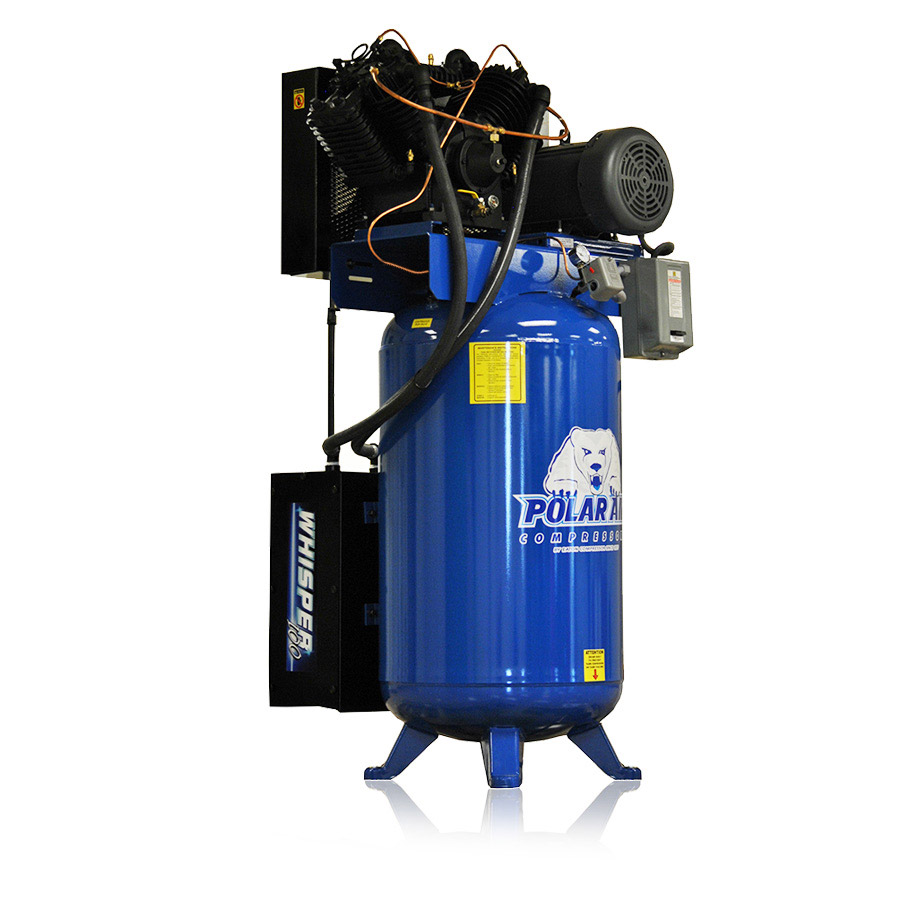
 eatoncompressor.com
Yes Sir, thanks for this. I talked with Eaton and I can get this one for $2500. I think it will be a great investment an hopefully last a long time. Great warranty and magnetic starter motor included.
7.5 HP Quiet Air Compressor, Single Phase, 80 Gallon Tank, Vertical, Industrial
Eaton Compressor carries an impressive line of quiet air compressors, including this single phase 7.5 HP Quiet Air Compressor with 80 Gallon Tank.
Thanks for this. I was wrong on the price of the maintenance kit that price was for a screw compressor. Like I said I go back and forth minute to minute ....................then a post like this makes me think about everything again. At least I have time to weigh everything and contemplate all the options. I would rather spend the time then money wasted. I just quickly google the QT 7.5 man they are expensive $3100+. I guess I also have the option of not following their warranty then I wonder what is covered? I will have to ask them that.For home use, splash lube and reed valves are fine. You are not going to wear out a quality-built cast iron pump with intermittent home use because it's splash lube. Yes, it's not the best, but probably 99% of piston compressors sold are splash lube. I have a QT7.5, it's somehow managed to survive just fine for 19? years. The only reason I need something this big is for sandblasting, but it's handy for when using a die grinder, etc. Agree that the CFM ratings on most air tools are complete BS- it's like they assume you're only going to use them for half that minute.
That Eaton warranty maintenance is crazy expensive. And changing compressor oil once a year for home use is ridiculous.
Edit- I've changed the oil 2-3 times, I can't remember, in 19 years. It comes out looking new, as it should.
Wise man.Thanks, I think Eaton is the way to go. No one ever said I wish my compressor was smaller, LOL. I just need to do it right the first time and only once. I think the Eaton 7.5 2 stage will be the ticket!
Quincy's QR line is still pretty good I think. Hugely expensive though. Even more than Saylor-beall I believe