To avoid these ads, REGISTER NOW!

Need Freeze Plug Installation Tool Made, Have Drawings

bulletpruf

Well-known member
Joined
Nov 28, 2013
Messages
10,954
Location
San Antonio
Fellas -

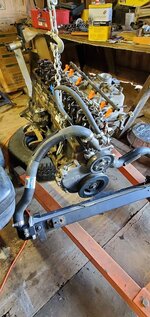
I have a 1994 Ford 7.3 IDI turbo diesel (not Powerstroke) that I need to rebuild and install new freeze plugs in. These are supposed to be really tricky to install without causing leaks, and I don't want to have to pull the motor to re-do.

Rotunda made the tool, but it's NLA and I can't find one to buy, new or used.

Someone was making these and selling them, but he quit a few years ago.

Here are the plans -- anyone here interested in making one? http://www.dieselwarden.net/temp/freezeplugtool.jpg

Thanks

Scott
 
To avoid these ads, REGISTER NOW!

larry4406

Well-known member
Joined
Jan 27, 2006
Messages
19,161
Location
Northern Virginia
How is it used? BFH used to drive in the plug?

I’m thinking a piece of 3/4” black iron pipe which is 1.05” outside diameter for the long stem. Thread it into a coupling, chuck it in your lathe, and bevel/machine the coupling to your dimensions.

🤷‍♂️
 
OP
B

bulletpruf

Well-known member
Joined
Nov 28, 2013
Messages
10,954
Location
San Antonio
How is it used? BFH used to drive in the plug?

I’m thinking a piece of 3/4” black iron pipe which is 1.05” outside diameter for the long stem. Thread it into a coupling, chuck it in your lathe, and bevel/machine the coupling to your dimensions.

🤷‍♂️

Yes, used with BFH to drive in.

Thanks
 

isb cornbinder

Well-known member
Joined
Nov 3, 2010
Messages
7,073
Location
Pacific South West, BC, Canada
Those plugs are core plugs. They have a purpose as part of the casting of the block.
I use a liberal layer of Permatex Aviation Form a Gasket on the outside circumference of the plug before installation. Driving the plug into place should not require a specialty tool. The machine shop I worked in had made a tool, but it was little more than a fitted steel punch that fit the inside of the plug. A machinist hammer and some carefully placed blows should seat the plug.
I hope, for your sake, you have had that block and the heads machined for flat and true. Those engines tend to change shape from heat cycling over years of use.
 
OP
B

bulletpruf

Well-known member
Joined
Nov 28, 2013
Messages
10,954
Location
San Antonio
Those plugs are core plugs. They have a purpose as part of the casting of the block.
I use a liberal layer of Permatex Aviation Form a Gasket on the outside circumference of the plug before installation. Driving the plug into place should not require a specialty tool. The machine shop I worked in had made a tool, but it was little more than a fitted steel punch that fit the inside of the plug. A machinist hammer and some carefully placed blows should seat the plug.
I hope, for your sake, you have had that block and the heads machined for flat and true. Those engines tend to change shape from heat cycling over years of use.

The block has not been machined yet.
 

lilredex

Well-known member
Joined
Apr 29, 2006
Messages
5,956
Location
Toronto
Many moons ago I worked in an engine rebuild shop and we installed "millions" of those cup type frost plugs. We had a machined stepped plug driver to drive them in flush with the surface. A liberal coating of gasket goo and staking like in the picture kept them in place.......never had a failure that I was aware of. In the years since I've used a flat washer welded on a punch to do the driving.
 

Attachments

  • Imperfect Thread.jpg
    Imperfect Thread.jpg
    167.3 KB · Views: 106

83VillageRepair

Well-known member
Joined
Aug 17, 2007
Messages
768
Location
Merkel, Texas
I would find a 1/2 or 3/4 drive socket with the right OD and carefully grind the profile you need and then use a sacrificial extension and bfh. I will be interested to see what you come up with as I have an IDI project waiting in the wings and I use a turbo IDI as my primary tow vehicle.
 
To avoid these ads, REGISTER NOW!

65ranchero

Well-known member
Joined
Dec 16, 2020
Messages
5,080
Location
Danville, VT left NJ forever
True Story

this expansion plug install reminds me of a install go bad.

While I was working in a dealer a flat rate flat rater ( also known as speedy) was given the chore of installing a block heater in a customers car. Being it was a simple task that would only take about an hour ( all that had to be done was drop the starter on a 4 cyl and knock out the exp. plug and install block heater.
Well this guy tried to knock in the FP straight in and being it was too close to the cyl wall so he could not move it to grab it by the edge for removal.
At about the same time the service manager was walking by and the tech commented to the SM that he cannot remove it.
SM said "drill it out" so he did but he was no paying attention and drilled right through the #4 cyl.

So this tech had to buy a short block and donate all his time .
 
Last edited:

isb cornbinder

Well-known member
Joined
Nov 3, 2010
Messages
7,073
Location
Pacific South West, BC, Canada
The block has not been machined yet.
It is common for a machine shop to install core plugs. It might cost you another dollar to have the machine shop do the installation. If the plug leaks, the machine shop should take responsibility. A good machine shop will want to clean the block with the plugs out.
Picture #1 sows a prepared core plug opening in an IHC LB stationary engine. Picture #3 shows using a hole saw to clean the core plug hole. Picture #4 needs no explanation.
 

Attachments

  • CORE PLUG HOLE.jpg
    CORE PLUG HOLE.jpg
    66 KB · Views: 94
  • IHC LB billet covers 2.jpg
    IHC LB billet covers 2.jpg
    56.3 KB · Views: 85
  • Resurface with a holesaw 2.75 inch.jpg
    Resurface with a holesaw 2.75 inch.jpg
    64.7 KB · Views: 83
  • WINGNUTS and coreplug.jpg
    WINGNUTS and coreplug.jpg
    36.4 KB · Views: 88
Last edited:

JHenke

Well-known member
Joined
Apr 4, 2017
Messages
47
You can rig up the radiator and pressure test your work.
This is a Jeep 4.0 being tested. Spray each core plug with soapy water, radiator tester pumped up to 15 - 18 psi.
 

Attachments

  • Core plug test 1.jpg
    Core plug test 1.jpg
    129.6 KB · Views: 86
  • Core plug test 2.jpg
    Core plug test 2.jpg
    152.7 KB · Views: 69
OP
B

bulletpruf

Well-known member
Joined
Nov 28, 2013
Messages
10,954
Location
San Antonio
It is common for a machine shop to install core plugs. It might cost you another dollar to have the machine shop do the installation. If the plug leaks, the machine shop should take responsibility. A good machine shop will want to clean the block with the plugs out.
Picture #1 sows a prepared core plug opening in an IHC LB stationary engine. Picture #3 shows using a hole saw to clean the core plug hole. Picture #4 needs no explanation.

Yep. I'm familiar with the process. Have rebuilt a few engines and usually have the machine shop install freeze plugs. Having said that, I'm inclined to do these myself unless I manage to find a shop locally that has experience building IDI's.

One of the guys who specializes in IDI's - R&D IDI - uses a hole saw to remove the step that the freeze plug sits on. Once that's done, he installs normal cup style brass freeze plugs. Video here -

Thanks
 

Garage Junkie

Well-known member
Joined
Jan 2, 2010
Messages
173
Location
Cleveland, OH
If you do decide to continue looking for someone to make this tool for you, I just want to point out that the dimensions as stated on the drawing are not accurate. I'm not sure which dimension is incorrect, but the drawing shows a chamfer of 45 degrees on the face of the tool, yet there is a .275" difference in diameter with only a .175" change in length. This will need clarification for a machinist to follow.

For another alternative to what others have posted- for less than the cost to have this tool made, you could go pick up the harbor freight seal installer tool kit. The 39.5MM head is close to the dimensions you are looking for and could be hand machined to the spec quite easily. Chuck it up in a drill press and grab a file. Just a thought.
 
OP
B

bulletpruf

Well-known member
Joined
Nov 28, 2013
Messages
10,954
Location
San Antonio
If you do decide to continue looking for someone to make this tool for you, I just want to point out that the dimensions as stated on the drawing are not accurate. I'm not sure which dimension is incorrect, but the drawing shows a chamfer of 45 degrees on the face of the tool, yet there is a .275" difference in diameter with only a .175" change in length. This will need clarification for a machinist to follow.

For another alternative to what others have posted- for less than the cost to have this tool made, you could go pick up the harbor freight seal installer tool kit. The 39.5MM head is close to the dimensions you are looking for and could be hand machined to the spec quite easily. Chuck it up in a drill press and grab a file. Just a thought.

Thanks! That's something that I can handle. I'll also need to check to see if any of the seal installers that I have on the shelf might work with some minor machining.
 

gorilla

Well-known member
Joined
Dec 13, 2007
Messages
1,652
If you study that installation tool it becomes clear that the length of the two parts controls the amount that the freeze plug is expanded. The difficult part would be machining the radius on the bottom of the larger tube. Heat treating would be a difficulty for a home shop I'd guess about two hours to machine and about $100.00 materials without heat treat.
 

ChevyEFI

Well-known member
Joined
Sep 2, 2012
Messages
8,721
Location
Phoenix, AZ
How is it used? BFH used to drive in the plug?

I’m thinking a piece of 3/4” black iron pipe which is 1.05” outside diameter for the long stem. Thread it into a coupling, chuck it in your lathe, and bevel/machine the coupling to your dimensions.

🤷‍♂️

I would find a 1/2 or 3/4 drive socket with the right OD and carefully grind the profile you need and then use a sacrificial extension and bfh. I will be interested to see what you come up with as I have an IDI project waiting in the wings and I use a turbo IDI as my primary tow vehicle.

Why does it need to be heat treated for a one time use? Unless you are a shop that plans on doing this job multiple times.
I have had a specific transmission application bushing driver (OEM tool and tool truck tool discontinued) turned.

I agree with the above messages. When you have the emgine in front of you, and the time, explore an off the shelf driver, or turn your own, or have one turned if it needs a tight dimension.
 

metlmunchr

Well-known member
Joined
Sep 10, 2011
Messages
1,278
If you study that installation tool it becomes clear that the length of the two parts controls the amount that the freeze plug is expanded. The difficult part would be machining the radius on the bottom of the larger tube. Heat treating would be a difficulty for a home shop I'd guess about two hours to machine and about $100.00 materials without heat treat.

I agree. That tool is designed to produce a specific amount of expansion once the plug bottoms on whatever lip is cast into the holes. Trying to get the same results from standard bushing drivers is unlikely.

I did notice a post on another site where an owner of one of the original OTC tools gave a couple details that are missing in the OPs sketch. He said the 1.5" OD on the tubular piece is undercut by about .030" on the last inch or so to make sure the piece doesn't jam in the block opening. Also, there's a flat about .060" wide on the end of the tube before the 3.5" radius starts such that the end of the tube doesn't have a sharp edge on the end.
 

Wrench97

Well-known member
Joined
Jun 23, 2018
Messages
12,081
Location
Southeastern Pa
It's been quite a few years but I have done several on T444E IH engines pretty sure they take the same plugs without a special tool.
 
To avoid these ads, REGISTER NOW!
Top Bottom