mike93lx
ALLIANCE MEMBER
It's 36" in front and 6'6" high. 30" total width, including the panelCode requires 30" Left, Right, and in front of the panel!

It's 36" in front and 6'6" high. 30" total width, including the panelCode requires 30" Left, Right, and in front of the panel!
Thanks !!! Couldn't remember. However, the inspectors in IL do check for that on inspections! It seams the only ones they seamed to leave alone were the ones built by Levitt?? back in the early 50's and were more or less prefab with the panel in a kitchen closet!It's 36" in front and 6'6" high. 30" total width, including the panel
At what point in my post did I say anything bad about homeline panels?Curious why you think this. My house was built with homeline panels in '03. Still working fine and they are certainly not junk
I was at an open house at our local "sq d" supply house at the time(the old electric fixture and supply in omaha)Unfortunately, electrical Codes have little control what homeowners and other trades do after the fact.
Homeline in '03? I was still installing FPE panels... Homeline (that replaced it) hadn't come out yet.
I didn't say you did. I just asked a question. Specifically calling out the panel type does make it feel that it is focus of your point though.At what point in my post did I say anything bad about homeline panels?
It's 30" wide total, not left and right. It's also 36" in front (depth). What does that have to do with closets? I've seen bedroom closets bigger than my living room, but that doesn't mean a panel can be there.Code requires 30" Left, Right, and in front of the panel!
I replaced our fusebox with a 200a Homeline panel in 2000.Unfortunately, electrical Codes have little control what homeowners and other trades do after the fact.
Homeline in '03? I was still installing FPE panels... Homeline (that replaced it) hadn't come out yet.
A clothes closet is one that has shelves or poles, hooks, or similar things for hanging clothes.What is the definition of "closet"
If the intended use is as a utility closet and you have the clearances, you should be ok. Just get rid of the coats and any clothes rods for a few minutes.Guys...my house was built in 2009...inspected and everything passed with flying colors.Wired by a friend who was a master electrician for over 35 years. Its a utility closet that happens to have a few coats hanging there presently.
Yep. No reason to switch the main. In that location it's just a shutoff not overcurrent protection. Protection is the feeding breaker.Just don't go buying a new main breaker for it if you already have a 125
I am not sure about this and others will likely chime in. My only thought on this is that the breaker panel label/nameplate is usually on the inside of the can and after swapping the guts you will still have the old label which could be an issue.
I promise I am not trying to be snarky. Is that definition universally or near-univerally agreed upon by inspectors? Or is it defined as such in the NEC?A clothes closet is one that has shelves or poles, hooks, or similar things for hanging clothes.
Here is the definition, right out of the 2020 NEC. There is no definition of any other type of closet, so if it's not a clothes closet, and the clearances are there, a panel can be in a closet.I promise I am not trying to be snarky. Is that definition universally or near-univerally agreed upon by inspectors? Or is it defined as such in the NEC?
ThanksHere is the definition, right out of the 2020 NEC. There is no definition of any other type of closet, so if it's not a clothes closet, and the clearances are there, a panel can be in a closet.
It wasnt permitted to store clothes even in 2009 which means the inspector missed it....Guys...my house was built in 2009...inspected and everything passed with flying colors. Wired by a friend who was a master electrician for over 35 years. Its a utility closet that happens to have a few coats hanging there presently.
doesnt matter. its a violation whether the inspector sees it or not.I guarantee they won't be there when the inspector shows up.
What is the definition of "closet" I have been on several jobs the last year and every one had the panel in a "closet". Slab on grade construction...owners don't want to see that ugly panel.
not quite. its 30" side to side (doesnt have to be centered), 36" in front of panel, and 6.5' floor to ceilingCode requires 30" Left, Right, and in front of the panel!

It doesn't sound to me like the intended use for the closet was for storing clothes. He said it's a utility closet that has a few coats hanging in it. What I refer to as a residential utility closet has the furnace and water heater in it also. I don't know if this is the case, but he did say it's a slab house so the mechanical has to go somewhere. That somewhere could be the attic, but that's a real ***** for the next guy.It wasnt permitted to store close even in 2009 which means the inspector missed it....
doesnt matter. its a violation whether the inspector sees it or not.
 As I think back Sq D had a deal going and I got 2 panels and a bunch of breakers as a value pak for like $50. My friend is now retired and is one of the most honest and nice guys you could ever meet. Until the heat pumps everything has been just fine.
You are implying that homeline is bad, which is incorrect. You can always spend more money on a project.I'll toss this in just for grins: Closet or not, why would anyone use a Homeline panel in their house (likely their largest investment) when a QO panel is only a few bucks more?
QO: 22K AIC vs. 10K on a Homeline
QO: silver-plated copper bus, vs. aluminum on a Homeline
It's your house, I suppose. As my friend likes to say, "Got a $20 brain? Buy a $20 helmet..."
What problems have been encountered with homeline? Sure, in theory, qo is better. But what is the practical impact?I'm implying no such thing. I'm simply stating that, as a comparison, Sq.D (Schneider) offers a far superior product for not a lot more. In my opinion, the Homeline serves one purpose only: cheapening a BOM's total cost. Again, my opinion: is the electrical infrastructure of one's house the place to make shortcuts?
Not really impressed with Homeline but ANYTHING is better then Eaton BR, even GE, if you see a BR panel, you have a **** electrical job in front of you, besides the difference between QO & HOM breakers, Homeline panels have a aluminum bus, until Eaton cheapened up the CH panels they were my preferred panel, now either Eaton CH, SQ D QO, or Siemens copper bussed panels. But back to Homeline, they were introduced to be more competitive in the residential market which is why they are only single phase, no 3 phase, and no QO all in ones, meter mains anymore, Eaton, & Siemens, responded by introducing UL classified breakers for QO panels.I'm implying no such thing. I'm simply stating that, as a comparison, Sq.D (Schneider) offers a far superior product for not a lot more. In my opinion, the Homeline serves one purpose only: cheapening a BOM's total cost. Again, my opinion: is the electrical infrastructure of one's house the place to make shortcuts?
That I would like to see, QO breakers are 3/4" wide, Homeline is 1" wide and they clip to the bus quite differently.Aluminum. It simply doesn't play nicely with other conductor materials without special treatments. Snapping on a (dissimilar metal) QO breaker isn't, in my view, a great idea when an alternative exists.
And I have, indeed, removed QO breakers from Homeline panels and seen signs of electrolysis.
I haven't pulled every breaker ,but I have moved a bunch and they all look clean to me. I guess anything is possible. Thankfully we can all spend out money how we want. I'll gladly take a donation for an upgrade, though^^^
Correct. I was trying to type while cooking dinner, and....woops. "QO" came out of my brain & down to my fingers.
That said, I have seen such corrosion when Homeline breakers (with clips that are a dissimilar metal) are removed from Homeline panels. I've seen it with my own eyes..
Sure you are. "why would anyone use a Homeline panel in their house" is pretty clear. You keep dancing around and changing what you are saying. "I was busy cooking..." What a bunch of bs. Homeline is a decent panel. It's not top of the line, I'll give you that.I'm implying no such thing.
It's just back pedaling.Sure you are. "why would anyone use a Homeline panel in their house" is pretty clear. You keep dancing around and changing what you are saying. "I was busy cooking..." What a bunch of bs. Homeline is a decent panel. It's not top of the line, I'll give you that.
No, the NEC requires a 30" wide clear space in front of the panel. It does not have to be centered on the panel, a 16" wide panel could have it's working space in front of it and 14" to the right ( or left ). The working space in front of a panel is 36" for up to 150V to ground conditions. NEC 110.26(A)(1) and (2)Code requires 30" Left, Right, and in front of the panel!
I wonder how many times a post needs to be refuted/correctedNo, the NEC requires a 30" wide clear space in front of the panel. It does not have to be centered on the panel, a 16" wide panel could have it's working space in front of it and 14" to the right ( or left ). The working space in front of a panel is 36" for up to 150V to ground conditions. NEC 110.26(A)(1) and (2)
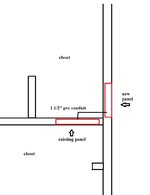
How can you move all of the branch circuit hots but not the neutrals and grounds?If I abandon the old panel in the closet and install a new panel on the other side of the wall and connect the 2 boxes with conduit, could I move the power wires with breakers to the new location and leave the grounds and neutrals in the old can? They would be connected with full size conductors. Essentially using the old panel as a junction box. This would move the panel to a much better location. I would like to avoid moving the grounds and neutrals if it is permitted.
So you are talking about pigtailing every wire and connecting to a new panel.I would have to extend them all...just hoping the avoid doing the same with all the neutrals and grounds.