cody1325
Well-known member
Oops
Just like me and cheap American adjustable wrenches--I don't blame you at all. Besides, when I need leverage to twist something, I always bring out a pipe wrench.

Oops
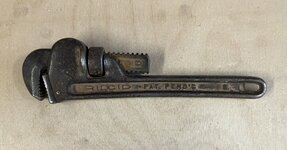


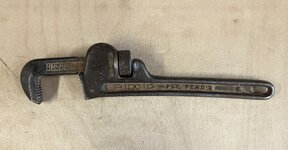


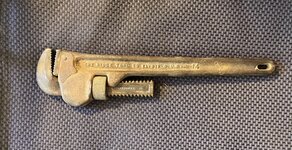


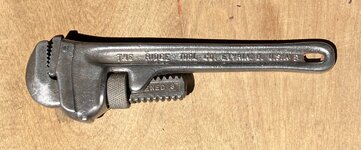
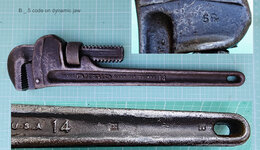
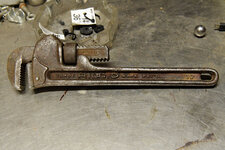

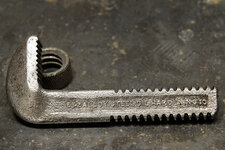
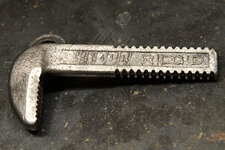

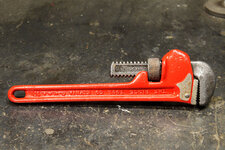


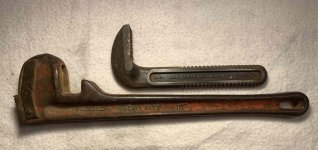


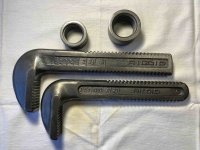

I believe we had this conversation here before, and the only advertisements I was able to find for anything early were black-and-white.I can't find anything saying they were painted

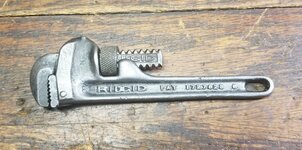
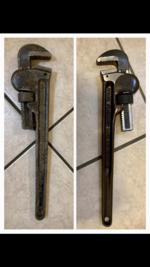
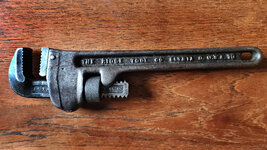
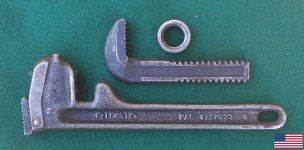
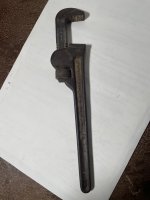
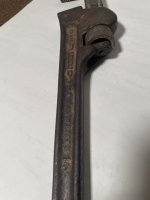
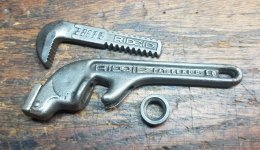
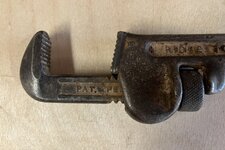
No leaning necessary. You nailed it. Not just the marking, but the other key features, as explained in this part of my dating guide in post #1...I am leaning towards the 24" wrench being from between 1928-1929. "PAT PEND'G" appearing on the handle is my reasoning.
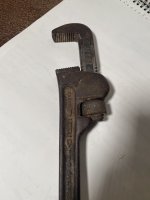
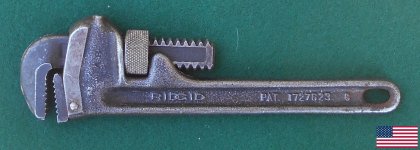
As for the other wrench...The next definitive generation RIDGID pipe wrench has the stabilizer (4) and the trapezoidal swash plate (5), as shown in the second patent drawing, but reads "PAT PEND'G" on the handle (6). That suggests that the second patent (1,727,623) had been applied for (on January 11, 1928), but not yet granted.
RIDGID pipe wrenches with "PAT'D" in that spot (6) or the forged-in patent number "1,727,623" in that spot (7) could not have been made before the patent was granted, on 9/10/1929.
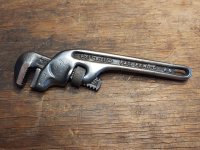
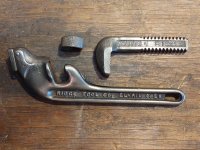
I don't know where you're getting the 1950 from, but the features all align with later than 1948, as described in the dating guide here...I did some more research on Google and I think the 18" wrench was manufactured in 1950.
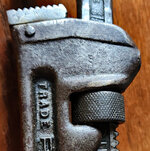
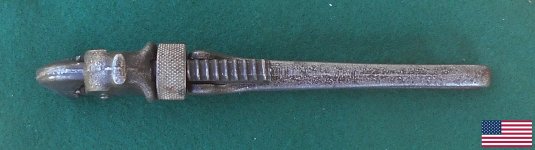
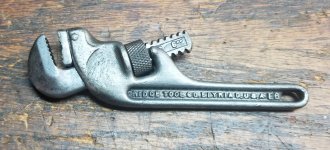
...and we have some evidence to suggest that the forged-in date codes in the hooks persisted into the 50's, which makes me want to read the "4" in the "B-4-10" marking as 1954.Magazine and journal ads c. 1948 show RIDGID pipe wrenches with an adjusting nut that is not completely knurled (12). Some have one recess, some have two, some even have the name with an interlocking D and G as the knurling. We're not sure of the sequence to those features, which is irrelevant to the salient point - that up until 1948 the adjusting nut was fully knurled.
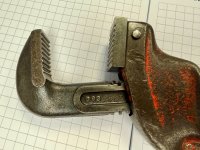
Magazine and journal ads c. 1952 show RIDGID pipe wrenches with a rounded end on the threaded dynamic jaw (13).
There is plenty of documented and empirical evidence to suggest the finish on prewar wrenches was black, and we have plenty of black finish prewar wrenches in the collective collection. Some collectors take that a step further to suggest that all the survivors found with a natural steel finish have been denuded of paint. I'm not a big believer in this theory. I think they made some with a natural steel finish.I don't think I am going to paint the 24" wrench. I can't find anything saying they were painted between 1928 and 1929. I don't see any traces of any color.
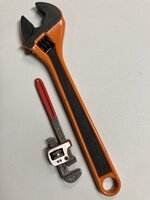
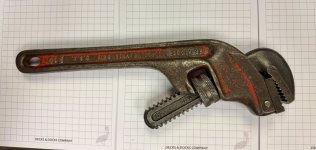
That or some shade of red fits that time period.I'm probably going to repaint the 18" Chevy orange later this week or next week.
1944. By '54 the end of the dynamic jaw was rounded, the adjusting nut had a groove in it, and they were finished in red.from reading could be from May 1944/1954 - is this correct?
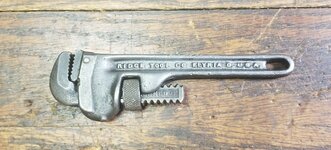
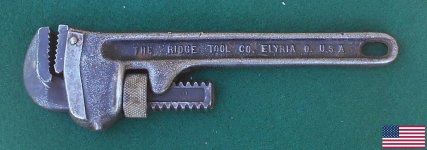
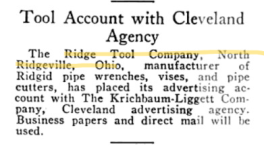
This has come up a few times on the thread. Ridge's own website contradicts itself, saying that it was founded in Elyria in 1923, but also that it moved to Elyria in 1943. Wiki says that Ridge was founded in N. Ridgeville in 1923 and moved to Elyria in 1943.Ridge tool moved to Elyria from North Ridgeville in 1943...[ ]...I have read they made pipe wrenches marked “Ridgeville” before moving to Elyria.

It shows up in all the early official USPTO documents, patents and trademarks.I had no idea they also called North Ridgeville home



Thank you, it’s great to confirm that it is in-fact 1944.1944. By '54 the end of the dynamic jaw was rounded, the adjusting nut had a groove in it, and they were finished in red.


Isn't that the part for hammering on things? Like a Crescent hammer?I don’t know about the protruding bit, probably part of the casting process. You can see it even in the ad.
Yes. Specifically, between 1/11/1928 and 9/10/1929.Would this be late 20's?
The next definitive generation RIDGID pipe wrench has the stabilizer (4) and the trapezoidal swash plate (5), as shown in the second patent drawing, but reads "PAT PEND'G" on the handle (6). That suggests that the second patent (1,727,623) had been applied for (on January 11, 1928), but not yet granted.
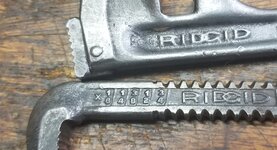
The date code ("B.1.2") on your dynamic jaw doesn't agree with the markings on the handle, but the dynamic jaws are replaceable and interchangeable, and because both parts were made so well, it's not at all unusual to find mismatch pieces.RIDGID pipe wrenches with "PAT'D" in that spot (6) or the forged-in patent number "1,727,623" in that spot (7) could not have been made before the patent was granted, on 9/10/1929.
Glad you're enjoying it. Welcome to GJ. Your entry point (Google Search result) is very common. The fastest way to get the lay of the land now that you found us is the A-Z Index of Threads in the Sticky at the very top of the forum. Whether by type or brand of tool, there are 100+ threads exploring a plethora of topics. Chances are your next thrift store find will have a thread for it.What a cool thread
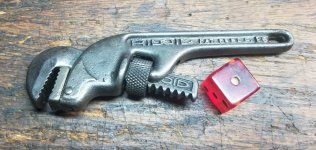
You won't see them unless they're active without the Sticky.I haven't kept track, so thanks for mentioning it. We've never figured what that code signified, probably something esoteric to the factory or dies.Haven’t seen many “A” alphanumerics on here so that’s kinda cool.

You're welcome. I moved your query here to reply rather than on a solo thread, because they disappear very quickly, never to be seen again...Hey. I read the Rigid dating info. Super helpful! Thanks!
Not really. The features did not change until ca. 1948-ish. If you really wanted to nerd out, patent 2,192,702, granted in 1940, supposedly improved upon the mechanism inside the cavity in the housing to further stabilize the dynamic jaw, but it requires removing the tongue in the static jaw to inspect it. See my note to that effect at the very bottom of post #1.I picked up a nice example that falls into the 1937 to 1948 range and the code on the jaw ends with a "7". Is there any way to tell if it would be a 1937 or a 1947 wrench? Just curious if I am missing something.

Thanks and welcome to GJ!I have thoroughly enjoyed reading this thread in its entirety!
That's the only prerequisite there is for enjoying this forum!Been a gatherer/user of old tools my whole life...
Cool. When you start diving into other topics, note that there is an A-Z Index of Threads in the Sticky at the top of the forum that essentially negates the tyranny of the forum's descending chronology....and recently dove into old Ridgids.
Yes. Well done.After reading through the whole thread, am I correct in assuming the date code B93 and identifiers would put this one at 1953?

Good question and one I don't know the answer to. They experimented with so many different mechanisms over the years, I'm tempted to guess not. If you live near a good flea market, cannibalizing one from a donor of the same time period is a good option.Also, it is missing the internal spring assembly. Are the current factory parts compatible w/ the older models?