Thanks, Don. That didn't come up in my thread search on "PAT'D" because your initial post didn't include that term.
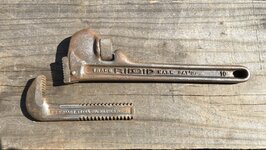
There are at least three known variations of prewar wrenches. The "PAT'D" wrenches make four. My initial purpose in this thread was to suss out the meaning of the forged in numbers, which we have established as date codes, but to do that, I needed a timeline, which necessitated sequencing the prewar, wartime, and postwar variants. Hence why this thread has turned into a fairly detailed total timeline for dating all RIDGID pipe wrenches. In that context, "early" is just too vague.
I'd like to amend post #1 to add these "PAT'D" wrenches, but the data is too fuzzy.
Follow my logic and chime in or argue with me. No ego here. Just trying to get this right.
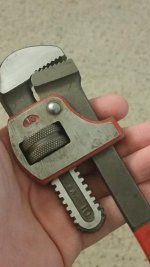
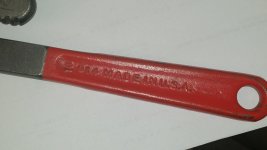
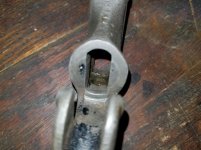
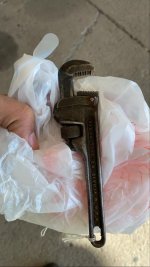
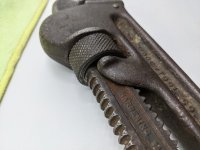
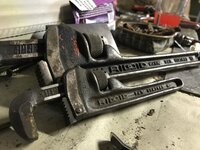
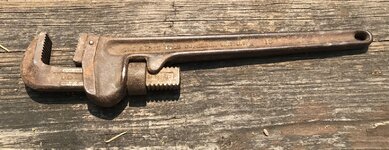
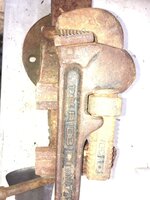
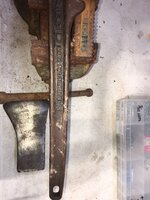
Your first "PAT'D" wrench is a 1928. Chronologically, that marking cannot be a past tense reference to the second (9-9-1929) patent, which was not yet granted. It would have to be a past tense reference to the first (1925) patent. But, it's on a 2nd gen wrench (with the trapezoidal swash plate and the stabilizer). Those normally have the "PAT PEND'G" marking, referring to the second (1929) patent, until after it was granted, when they have the actual patent number, marked "PAT. 1727623". Unless your 1928 dynamic jaw was put into a static jaw and handle made after 9-9-1929, which is entirely possible, by the factory or by a PO.
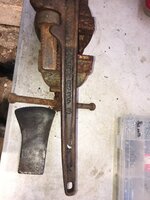
Your second "PAT'D" wrench is a 1931, which is after the second (1929) patent. That one makes more sense, suggesting they went from "PAT PEND'G" (1-11-1928 to 9-9-1929) to "PAT'D" (after 9-9-1929) to "PAT. 1727623."
We need more examples before we know with certainty where the "PAT'D" fits exactly. Inarguably after 1st gen and almost certainly before 3rd gen w/patent number. But, it's still a little dicey in between.