So here's the result of my experiments with engine-turning, one custom-made headband:
Here's how I did it. Start by making a template:
Trace this template onto a piece of .019 thickness aluminum and cut it out with snips (cut a little outside the line allow room for trimming). I situated my template on the lower edge of my aluminum sheet, saving me some cutting and giving me a nice straight edge. Logic would dictate putting the engine-turned pattern on the metal sheet first, then cutting the piece out. This is probably the way to go for someone who knows what they are doing, but it took me a bit of doing to get the piece cut out - I probably would have marred the circular finish as I cut and tweaked the piece:
This component of this resto has given me quite a bit of respect for those who can work sheet metal. I used aviation snips to get close to the line, then I used a 1" belt sander and oscillating drum sander to get smooth edges up to my lines. Regardless, this is pretty rough cast metal you are putting this thing on, so expect some adjustments to be needed along the way:
Once the piece will fit properly, smooth those edges by hand with some 220gr, then some 400gr. Next, I used some contact cement to stick the piece to a bit of MDF. I did this for two reasons: 1) So I could effectively smooth it out without it flopping all over the place, and 2) So I could properly index the piece to my engine-turning jig. This is after final smoothing with some Scotchbrite:
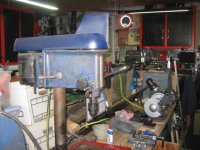
This shot shows two things: The table I mounted to the DP with a 1/4" grid on it, and the piece with dabs of valve grinding compound on it:
I watched several videos, read a lot of techniques, and experimented. After trying various combinations of valve grinding compound and water, Scotchbrite on a dowel end, and Cratex, I settled on a 1/2" Cratex rod at a very low speed, with a quick and firm press of the feed lever for a very short time. Additionally, I put quite a bit of valve grinding compound on the piece and then smeared it around for an even effect:

My concern was that the effect would not be consistent if I periodically reloaded the Cratex tip with the compound. Despite all this, I found that the single, biggest factor that influenced how my circles came out was the amount of pressure I used on the feed lever and how long I kept it down (the dwell time). My dwell time here was very quick, way faster than I first thought it would be. It seemed to me that a longer dwell time resulted in more circular striations, rather than the even circular "scrub" effect I was looking for. My feed pressure was way higher than I originally thought it should be - this seemed to really affect the evenness of the pattern as the rubber Cratex flattened into the piece and filled the space.
Here's some more pics of the process:
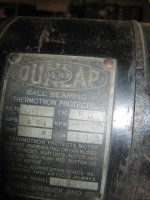
Up next is the trim band around the motor.