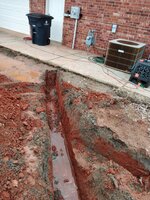
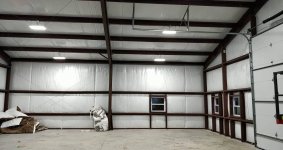
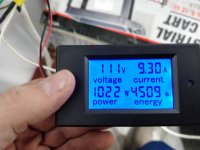
After going back and forth with the local electric company I've changed my plans on how to get power to the shop.
My first path was to get new 200amp service ran directly to the shop. Turns out in the last month the electric company no longer mounts meters on buildings, but rather on a stand off ** feet from any structures. This wouldn't have been a big deal, by my electrical junction box is about 5 feet from my shop (thought it was going to be an easy run) and even worse the orientation of it would require them to disconnect it and rotate it. They wanted to charge me a pretty penny.....so fast forward to plan #2.
I then said we'll let's upgrade the house to 400 and I can just sub 200 from it. Turns out the orientation of the box came into play again and they would still need to rotate it. I finally got them to admit, but not willing to cover the expenses, that the box wasn't orientated in the "best way" in the first place...okay scrap that.....plan#3
Based on my amp load and equipment in the shop, and that my house is new (2 years old) and fairly efficient I should be able to get away with just pulling from the existing 200 service. I would like to attempt this myself, but need some advice! Below is a picture of the panel on my house. Can I put a dual pole 125amp breaker in 2 of those slots and pull wire from there to a sub in my shop? My shop is about 7 feet from this box directly, but obviously would need to go down (under a sidewalk) and the back up. Still probably only 15ft of wire I'm estimating.
Thanks in advance... I'm sure I'll have more questions!
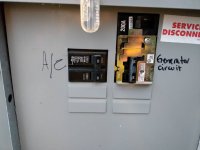
Yes, you can... but I'd like to offer another option. This is assuming that your panel is an Eaton BR series... if not, then we'll have to look closer. But here goes:
If you can relocate the breaker for the AC to the other side of the panel in the lower right, that frees up four positions on the left. That may allow you to install an Eaton BRS225 Sub-Feed Lug Block that can allow you to send the full panel capacity to the shop, where you can install a 200A panel. You'll want to check the orientation of how the sub-feed lugs exit the kit to make sure it can work for you. (Straight out, angled down, or angled up... more on that below in my project description. From what I can tell from the cut sheet below, it's straight out?)
The main 200A breaker in your existing panel will provide you with overcurrent protection for the whole system, so the 200A breaker in your shop panel will basically be acting as a disconnect.
Cut sheet from Eaton that shows the sub-feed kit:
https://cdn2.rexelusa.com/medias/sy...87717406/Eaton-Loadcenters-BR-Accessories.pdf
Found it here as a cost reference:
https://www.platt.com/platt-electri...-Blocks/Eaton/BRS225/product.aspx?zpid=270025
I'm sure there are many other places to buy it, so shop around for the best value.
You will also need to get some lugs for the neutral and ground connections to run to the shop. They are also listed on that Eaton cut sheet, I believe...
I did something similar for my shop, but got lucky with my local POCO and they were cool as hell with me relocating my meter from my house to the shop. I now have a meter/main at the shop with 200A service and feed-through lugs, which feeds it the back of the panel into the shop to a 200A main panel. From there I use a 225A capable sub-feed lug to feed the original 200A house panel. (I will need to change the house panel over to separate the neutrals from the grounds.)
The meter/main is the service disconnect. From there, my neutrals and grounds are split at the shop panel and the house panel. I had to buy a lug that plugs into the neutral bar to be able to send a 2/0 neutral to the house, and a lug for the ground.
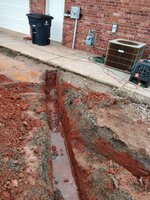
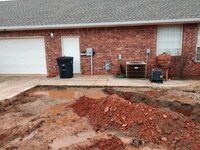
I went with Square D so my part numbers will be different than yours, but my guess is that they all have something similar. So far, the POCO has power to the shop and we just passed the rough in inspection for the shop. I'm fighting the rain right now... every time I dig the trench from the shop to the house it fills with water so connecting the house to the shop isn't completed yet. Pics below for reference.
You can see in my shop main panel where I have a main surge protection module in the lower left, then the four position 225A sub-feed lug kit, then breakers for shop loads. The lugs on the sub-feed kit are oriented such that the house feeders will go up and curve around to the right into the conduit feed to the house. You can also see the neutral lug kit on the left neutral bar, and the ground lug on the right side ground bar.
Note: The sub-feed block is also available in a 125A two position block. I bring this up because on my Square D 225A sub-feed lug kit, the lugs are designed so that you don't have to bend the conductors at a 90 degree angle to terminate them. They are oriented so that you have a "kick" which goes up if it's installed on the left, or down if it's installed on the right. I don't know how Eaton does this, so if they are the same as Square D you might run into a jam if the conductors leave the block up and to the left in your panel. That might cause you fits trying to bend the conductors around and it out of the panel? You might flip it to the right, but then you wouldn't have the option to keep the generator breaker there on the right... unless there is an interlock kit design that uses the upper left breaker instead? Just spit balling here... not sure what's more important to you at this point? Got any pictures of the existing panel(s) so we can see what's going on?
Hope this helps.
Mark
New meter/main panel:

...which feeds straight out the back and into my shop main panel in 2" conduit:

Closer shot of the inside shop panel. Feed lug kit is on the left above the surge protector. Neutral lug is on the lower left neutral bar, ground lug is on the right:

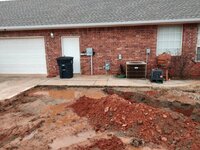
From the shop to the house... battling the water at this point.

Old meter box will be replaced with a 12x14 junction/pull box to make pulling the wire easier.
Sent from my Phone using Tapatalk