To avoid these ads, REGISTER NOW!

Craftsman Drill Press

cclfn

Well-known member
Joined
Jul 31, 2012
Messages
308
Location
NW
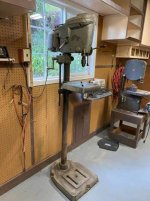
OK so here is the sneak peak! Got the Craftsman 150 w/ table raising mechanism, Early 12" Atlas bandsaw, box of tools and drill bits for... wait for it........:rocker:$210

Of course there are issues my friend wanted the bandsaw so I got the drill press and tools for $110. It's pretty rough and it may become a parts machine I haven't tried to source parts but already I know it needs a motor, motor mount bracket, depth stop nuts, head stop lock and nut, one maroon knob. Then it is covered with a heavy grey tractor paint so lots of work. The table raiser looks to be in excellent shape inside and I think it will clean up well. I am not sure how the bevel gear on the main screw comes out though. I read where its pressed on and saw Franks wonderful pictures where he has it totally disassembled but I couldn't find any discussion on how to get them apart. Anyway it's hot and were are going to eat. More photos later.
 

Attachments

  • 00Q0Q_ajOvDzdgdgB_0t20CI_600x450 (1).jpg
    00Q0Q_ajOvDzdgdgB_0t20CI_600x450 (1).jpg
    74.8 KB · Views: 97
  • IMG_0953.jpg
    IMG_0953.jpg
    109 KB · Views: 61
  • IMG_0952.jpg
    IMG_0952.jpg
    132.9 KB · Views: 71
  • IMG_0956.jpg
    IMG_0956.jpg
    104.8 KB · Views: 65
  • IMG_0957.jpg
    IMG_0957.jpg
    76 KB · Views: 57
  • IMG_0955.jpg
    IMG_0955.jpg
    131.8 KB · Views: 56
  • IMG_0954.jpg
    IMG_0954.jpg
    120 KB · Views: 59
To avoid these ads, REGISTER NOW!

gatewaysysop

Well-known member
Joined
Nov 11, 2008
Messages
3,286
Location
Arizona
OK so here is the sneak peak! Got the Craftsman 150 w/ table raising mechanism, Early 12" Atlas bandsaw, box of tools and drill bits for... wait for it........:rocker:$210

Of course there are issues my friend wanted the bandsaw so I got the drill press and tools for $110. It's pretty rough and it may become a parts machine I haven't tried to source parts but already I know it needs a motor, motor mount bracket, depth stop nuts, head stop lock and nut, one maroon knob. Then it is covered with a heavy grey tractor paint so lots of work. The table raiser looks to be in excellent shape inside and I think it will clean up well. I am not sure how the bevel gear on the main screw comes out though. I read where its pressed on and saw Franks wonderful pictures where he has it totally disassembled but I couldn't find any discussion on how to get them apart. Anyway it's hot and were are going to eat. More photos later.

Hell of a good deal for that price, even if parts are needed. Congrats on the score. :bowdown:
 
OP
F

FrankLee

Well-known member
Joined
Sep 13, 2010
Messages
3,546
Location
seMI, 48317
OK so here is the sneak peak! Got the Craftsman 150 w/ table raising mechanism, Early 12" Atlas bandsaw, box of tools and drill bits for... wait for it........:rocker:$210

Of course there are issues my friend wanted the bandsaw so I got the drill press and tools for $110. It's pretty rough and it may become a parts machine I haven't tried to source parts but already I know it needs a motor, motor mount bracket, depth stop nuts, head stop lock and nut, one maroon knob. Then it is covered with a heavy grey tractor paint so lots of work. The table raiser looks to be in excellent shape inside and I think it will clean up well. I am not sure how the bevel gear on the main screw comes out though. I read where its pressed on and saw Franks wonderful pictures where he has it totally disassembled but I couldn't find any discussion on how to get them apart. Anyway it's hot and were are going to eat. More photos later.
Congrats! Even though the drill press itself is rough, overall, it's an excellent find!

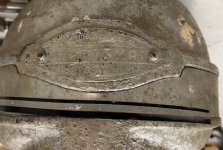
With the oval badge and cast handles, that's actually an early 100... probably no later than 1953.

The decision whether you refurbish the drill press or part it out should depend on the condition of the other critical parts; the spindle and the spindle pulley. Replacing parts can get expensive.

I agree... the bevel gears on the lift look great!

The first step to dismantle the gear housing is to remove the two jam nuts. A thin tappet wrench works well for the lower nut. IIRC, the nut is 11/16". Once the jam nuts are removed the main screw should slide out.

Next, retrieve the thrust bearing.

Then, there is a collar with set screw on the outside of the housing attached to the bottom of the sleeve of the bevel gear. Loosen that set screw and remove the collar. Push the bevel gear up into the housing and retrieve.

One more tidbit about dismantling... The pin attaching the crank handle to the shaft is tapered. It will only r&r from one direction. You should be able to spot the ends of the three grooves on one end of the pin.

I just added a bunch of pictures to Part4 of the table lift from dp#76. That should help a bit more.


The bevel gear is pressed onto the main screw only on the head-only lift.
 
Last edited:

cclfn

Well-known member
Joined
Jul 31, 2012
Messages
308
Location
NW
Congrats! Even though the drill press itself is rough, overall, it's an excellent find!

With the oval badge and cast handles, that's actually an early 100... probably no later than 1953.

I agree and I found another one a little farther away for short money that maybe become better option for restoration. At least with the two I should end up with one good machine. It also appears to be a 100 of the same vintage.

I didn't have a 11/16" tappet wrench but I did have several of those stamped wrenches for collars on routers and grinders - no markings but one of them was 11/16 so I got that apart and have the bearing soaking in mineral spirits now.

Part 4 was great info Thanks again Frank!!!!
 

Two Bit Woodworker

New member
Joined
Jun 15, 2020
Messages
4
Location
MA
Hey all. I've gone through and cleaned most of my Craftsman 100 and I'm working on reassembly of the spindle pulley assembly at the moment.

The spindle and pulley sleeve isn't going on easily. I got the first bearing on no problem, but the sleeve stops part way down. Does this thing have an orientation? With it on one way I can get it's top level with the slot for the inner snap ring, when I flip it I can't get it past that slot.

Before I force something, or take a file to the inside of the sleeve, does anyone have any thoughts?

There's no burr around the slot, so I'm guessing something is up with the sleeve or just need to whack it with a rubber hammer.

Finally, does anything here need grease or oil? I put a bit of 3-in-1 on the spindle but that's it.
 
OP
F

FrankLee

Well-known member
Joined
Sep 13, 2010
Messages
3,546
Location
seMI, 48317
Hey all. I've gone through and cleaned most of my Craftsman 100 and I'm working on reassembly of the spindle pulley assembly at the moment.

The spindle and pulley sleeve isn't going on easily. I got the first bearing on no problem, but the sleeve stops part way down. Does this thing have an orientation? With it on one way I can get it's top level with the slot for the inner snap ring, when I flip it I can't get it past that slot.

Before I force something, or take a file to the inside of the sleeve, does anyone have any thoughts?

There's no burr around the slot, so I'm guessing something is up with the sleeve or just need to whack it with a rubber hammer.

Finally, does anything here need grease or oil? I put a bit of 3-in-1 on the spindle but that's it.
Ok, just so I'm understanding, you have the upper bearing installed on the spindle pulley shaft as shown in the illustration below.

You're having trouble sliding the spacer sleeve, #2, onto the pulley shaft?

49327478851_ff997f2f5a_o.jpg
 

Two Bit Woodworker

New member
Joined
Jun 15, 2020
Messages
4
Location
MA
Correct. One end of the sleeve makes it past the slot for the snap right, but the other end does not. There doesn't appear to be anything wrong with the sleeve (dent, burr, etc).
 
OP
F

FrankLee

Well-known member
Joined
Sep 13, 2010
Messages
3,546
Location
seMI, 48317
I’ve never seen that. Those sleeves should have a very loose fit. If you roll it on a flat surface, does it roll smoothly?

Edit... maybe the upper bearing is not fully seated?

A picture would help.
 
Last edited:

Two Bit Woodworker

New member
Joined
Jun 15, 2020
Messages
4
Location
MA
I felt around on the inside again and there were some faint breaks in the smoothness that I figured were impeding it. I filed the inside for a few seconds and managed to get it on there. It didn't slide on quite like the upper bearing but everything is seated fully and the sleeve can spin freely enough. Thanks.
 
OP
F

FrankLee

Well-known member
Joined
Sep 13, 2010
Messages
3,546
Location
seMI, 48317
I felt around on the inside again and there were some faint breaks in the smoothness that I figured were impeding it. I filed the inside for a few seconds and managed to get it on there. It didn't slide on quite like the upper bearing but everything is seated fully and the sleeve can spin freely enough. Thanks.
Good news... another interesting first.

In the past, I cut a short piece of 1" copper tubing as a sleeve replacement.
 
OP
F

FrankLee

Well-known member
Joined
Sep 13, 2010
Messages
3,546
Location
seMI, 48317
Supreme Chucks

Supreme Chucks

7/27/2018

Model 6T33C

Below is a picture of a Supreme chuck, model 6T33C. The safety collar concept is the same as the Jacobs chuck except that the collar is attached to the chuck body using ball bearings instead of a c-clip.

The collar is slipped onto the chuck body and the ball bearings are inserted into a threaded hole on the side of the collar. I found 16 bb's, but there is room for more. A set screw is then threaded into the hole to trap the ball bearings. The ball bearings are 0.155" in diameter. It's an interesting design.


Below is a patent drawing of the Supreme chuck which shows in more detail how the safety collar attaches to the chuck body with ball bearings.


8/4/2020

I had always assumed that all Craftsman 80, 100 and 150 drill press came equipped with Jacobs chucks.


Model K4T33

I had a couple drill presses where I thought the previous owner swapped out the Jacobs chuck with a Supreme chuck. One Supreme was a keyless chuck, model K4T33, on dp#77, a Craftsman 150. That chuck capacity was 0-3/8", so I kinda figured that was not oe.


Model 15T33C

Supreme chuck models 15T33C were on three of my Craftsman 80s. Based on my dp#86, dp#81, dp#27 and others' posts, I think my assumption is debunked. I now believe that Supreme chucks were standard on later Craftsman 80s.

Both Jacobs and Supreme seem to be fine chucks and perform well. So, it's not really a big deal... until you want to dismantle and clean them. There are some internal similarities, but taking apart a Supreme chuck is very different than taking apart a Jacobs chuck. Jacobs chucks are discussed in a earlier post. Unfortunately, the 633C and the 15T33C require different keys.

Here is how a Supreme 15T33C comes apart.

 
Last edited:

StanleyF

New member
Joined
Aug 3, 2020
Messages
3
Location
MO
I am new to this website and thread and I hope I am asking my question in the right place. I recently purchased a Craftsman 150 drill press. I am looking for a couple of the feed stop rod stop nuts. By looking on this thread on the website, I saw that they are 5/8"-12 ACME style threads. I counted the threads on the rod on my drill press, and I counted 12 in 1 inch. Any help in acquiring these parts would be really appreciated. Thanks.
 
OP
F

FrankLee

Well-known member
Joined
Sep 13, 2010
Messages
3,546
Location
seMI, 48317
I am new to this website and thread and I hope I am asking my question in the right place. I recently purchased a Craftsman 150 drill press. I am looking for a couple of the feed stop rod stop nuts. By looking on this thread on the website, I saw that they are 5/8"-12 ACME style threads. I counted the threads on the rod on my drill press, and I counted 12 in 1 inch. Any help in acquiring these parts would be really appreciated. Thanks.
Welcome Stanley!

I did a fair amount of online searching, but I've never been able to find that size acme nut in any form from the major fastener players.

There are other options:
  • I have seen oe acme nuts show up on ebay, but that is rare.
  • I've seen the rapid adjust collar assembly on ebay, but that is also rare.
  • Complete 150 oe feed stop assemblies regularly show up on ebay, but they can be pricey.
  • The older style 5/8-18 feed stop rod assembly from a 100 will work on a 150.
  • There is currently an ebay auction with the rod, collar and nut from a third-gen Emerson machine. This will work on a 150 if the pointer is ground/sanded off. I've done that twice.
  • A Set Screw Shaft Collar will work, but you need to watch the od and replace the set screw with a brass screw/bolt. I've done this before.
  • If you need to work on a project immediately, a piece of 3/8" threaded rod with nuts attached to the feed stop bracket will suffice.

 
Last edited:
OP
F

FrankLee

Well-known member
Joined
Sep 13, 2010
Messages
3,546
Location
seMI, 48317
Dial Indicator Jig

I was constantly fumbling around trying to adjust a magnetic base to measure run-out on spindle tapers. So, I finally completed this long-desired project; a dedicated dial indicator jig for measuring spindle taper run-out. I already had all the parts and pieces. I just had to put together the right combination.


rccenteno

New member
Joined
Aug 10, 2020
Messages
1
Location
Littleton, NC
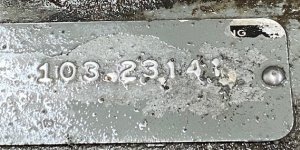
Help needed! I am new to this forum. I have a fully functioning Sears drill press, model 103.24821. However, I am missing the most basic piece....the chuck key! No clue where it has ended up and I need another one.
Does anyone out there have a part number for it or have one for sale? Also, what size is it?
Thank you in advance!!!
 
OP
F

FrankLee

Well-known member
Joined
Sep 13, 2010
Messages
3,546
Location
seMI, 48317
Help needed! I am new to this forum. I have a fully functioning Sears drill press, model 103.24821. However, I am missing the most basic piece....the chuck key! No clue where it has ended up and I need another one.
Does anyone out there have a part number for it or have one for sale? Also, what size is it?
Thank you in advance!!!
Welcome!

Your machine should have come equipped with a Jacobs 633C chuck. If so, a Jacobs K3, K3C or equivalent key will fit.

Jacobs key specs here: http://www.jacobschuck.com/MagentoShare/media/documents/jacobs-catalog.pdf#page=18
 
Last edited:

GreyEyes

Well-known member
Joined
Mar 25, 2019
Messages
54
Location
Florida
I did a fair amount of online searching, but I've never been able to find that size acme nut in any form from the major fastener players.

They are available as replacement parts as arbor nuts for some table saws (powermatic in particular) but they are ungodly expensive for a single nut, anywhere from $15 to $25 before tax and shipping:scared:
 
OP
F

FrankLee

Well-known member
Joined
Sep 13, 2010
Messages
3,546
Location
seMI, 48317
They are available as replacement parts as arbor nuts for some table saws (powermatic in particular) but they are ungodly expensive for a single nut, anywhere from $15 to $25 before tax and shipping:scared:
Thanks! That's good to know.

Here's an example from eReplacementParts.com , and yes, pricey.
https://www.ereplacementparts.com/saw-blade-retaining-nut5812-p-866394.html

If that background grid in the photo is 1" squares, the corners of the nut would need to be knocked down. I believe the largest OD can be no larger than 1-1/16".


An ebay option:
https://www.ebay.com/itm/Powermatic...-Blade-Nut-3530006-RH-thread-6-4/113342928195
 
Last edited:

ProJay

Member
Joined
Jun 27, 2020
Messages
13
Location
California
An update on my '49 Craftsman 100.

After redoing all the wiring using proper 16 ga machine tool wire, I finally achieved success with the motor. It's been running smooth installed, under load, and for extended periods. I'm calling success on that one.

No luck on finding an acceptable table yet. So I'm settling in for a long period of ebay and craigslist searching to find a good one. It'll happen, just have to be patient.

The steel cylinders worked perfectly for the headstock lock. Thank you for that everyone. I should be bind-free for good now.

As a reminder, the original head panel trim was in pretty bad shape. I went ahead and tried my hand at straightening it out. Your updated pics and post proved helpful again, FrankLee. I got most of the dings out and had some improvement with the hard creases. But I decided something had to be done about the corrosion pitting. At the cost of what remained of the original jeweling finish, I cleaned it up as best I could.

Originally I thought to go with the engine turned adhesive vinyl. However, I decided to try my hand at reworking the engine turning myself after watching a few videos. Considering the condition of the aluminum, I think it turned out pretty well. Here's a pic.

View media item 105843
 

paulm12

Well-known member
Joined
Apr 29, 2015
Messages
584
Location
NW Chicago 'burbs
Re: Dial Indicator Jig

I was constantly fumbling around trying to adjust a magnetic base to measure run-out on spindle tapers. So, I finally completed this long-desired project; a dedicated dial indicator jig for measuring spindle taper run-out. I already had all the parts and pieces. I just had to put together the right combination.


FrankLee: nicely done on the jig.

tx
 
To avoid these ads, REGISTER NOW!
OP
F

FrankLee

Well-known member
Joined
Sep 13, 2010
Messages
3,546
Location
seMI, 48317
DP#87, Emerson Drill Presses

8/13/2020

DP#87 is another 2nd gen Emerson drill press, model 113.24540. It's missing too many parts for a refurb, but because of the price, my roi should be pretty good.

Missing:
  • guard and guard plate assembly
  • the threaded quill lock cylinder (oddly, all other quill lock parts were there)
  • all three feed handle knobs
  • the front trim panel
  • the rapid-adjust lock screw


The motor is loud indicating the bearings need to be serviced or replaced.

50222746258_413294fbc1_c.jpg


8/14/2020

More about Emerson drill presses

First generation Emerson machines are virtually identical to late King-Seeley Craftsman 150s.


Second generation Emerson machines had a radically unique (ugly) design.

49468306327_cc26e251d1.jpg


Third generation Emerson machines were the first to utilize the 3/16" skinny belt with new 8-step pulleys.

50226185722_842cc26f7c_o.jpg


There were many changes to the Emerson Home Workshop model below from the original third gen machine, but I think the head frame casting is the same. Among the many changes is the table with a heavier cast-in sub-frame. Perhaps this could be considered the fourth generation Emerson.

50225321551_16e6e8ef4a.jpg


Tables

I really like the tables the came with 2nd and 3rd gen Emerson machines when used as grinder or sander stands. It's interesting to see how they changed over time.

Below is a 3rd gen table with a 2nd gen table face down on top. Both of these tables have a single machined plane. 2nd gen tables, casting number 167082, are ~17/32" thick; 3rd gen tables, casting number 800511, are ~15/16" thick.


The undersides are nearly identical.


4th gen table with a machined plateau and a heavier cast-in sub-frame.

 
Last edited:
OP
F

FrankLee

Well-known member
Joined
Sep 13, 2010
Messages
3,546
Location
seMI, 48317
Re: Craftsman 103.9770 Combination Kit (dp#86)

Another great refirb FrankLee the new owner should be very happy !
+1 on the great refurb. Awesome work !!
Gorgeous!
Ready for another 70 years.
Very impressive.
Cast iron looks so much better when a high gloss ISN'T used.

  • Thanks guys. I was so impressed with s14kev's and itsDROCK's flat-finish paint jobs on their machines, I had to try a non-gloss finish too. They used Rustoleum Flat Soft Iron. I used Matte Metallic Gunmetal Gray.


  • I also finally had the opportunity to use JZiggy's painting tip he posted a while back... using a motor mount as a painting stand for the head frame.


  • On another subject, this thread passed the 600,000 views milestone today. It took 38 months to reach 100,000 views and just another 42 months to reach 600,000 views. Thanks to all for the participation!
 
Last edited:

sai5021

Member
Joined
Jul 18, 2020
Messages
6
Location
Gettysburg, PA
Hi Frank,
I've been restoring a press given to me and I have to say your wealth of knowledge has been invaluable!

I'm to the point of looking at the motor and after dissasembling to do a quick cleanup the wiring is really bad. Like coming apart in my hands bad. I consulted a local motor shop and they recommended just replacing it. Do you know of any good replacements for the motor?

Thank you!
 
OP
F

FrankLee

Well-known member
Joined
Sep 13, 2010
Messages
3,546
Location
seMI, 48317
Hi Frank,
I've been restoring a press given to me and I have to say your wealth of knowledge has been invaluable!

I'm to the point of looking at the motor and after dissasembling to do a quick cleanup the wiring is really bad. Like coming apart in my hands bad. I consulted a local motor shop and they recommended just replacing it. Do you know of any good replacements for the motor?

Thank you!
Welcome and thanks for your comments.

When I need a motor, I look for other inexpensive complete Craftsman machines that have motors with the specs I need. For example, last month, I bought this jig saw just for the motor. I paid $40, removed the motor, cleaned up the saw and sold the saw and stand for $40. For a little work, I got a free motor!

50156195278_4e198ec0dd_n.jpg
50166110367_11df68bd3a_n.jpg

Band saws, jig saws, lathes and drill presses all normally use the slower speed motors. Occasionally, you can find a slower motor on some of the other bench machines that traditionally use the high speed motors.


Your motor still may be salvageable if there is enough good insulated wire coming from the stator to solder on new wire. An inch of good wire is likely enough. Pictures would be helpful.


Tell us more about your machine and the refurb. Model, etc. Pictures are always welcome.

Also, please update your profile with your geographical location. That frequently helps answer questions.
 

sai5021

Member
Joined
Jul 18, 2020
Messages
6
Location
Gettysburg, PA
Welcome and thanks for your comments.

When I need a motor, I look for other inexpensive complete Craftsman machines that have motors with the specs I need. For example, last month, I bought this jig saw just for the motor. I paid $40, removed the motor, cleaned up the saw and sold the saw and stand for $40. For a little work, I got a free motor!

50156195278_4e198ec0dd_n.jpg
50166110367_11df68bd3a_n.jpg

Band saws, jig saws, lathes and drill presses all normally use the slower speed motors. Occasionally, you can find a slower motor on some of the other bench machines that traditionally use the high speed motors.


Your motor still may be salvageable if there is enough good insulated wire coming from the stator to solder on new wire. An inch of good wire is likely enough. Pictures would be helpful.


Tell us more about your machine and the refurb. Model, etc. Pictures are always welcome.

Also, please update your profile with your geographical location. That frequently helps answer questions.

Thanks for the warm welcome, I've updated my profile.

The press came to me in fairly good condition. It needed to be cleaned of caked grease, the chord on the motor definitely needed to be switched out, etc but still worked very well. Had a vari-slow attachment, which was nice. I decided to switch out bearings and give it a paint job once I had it all apart and realized it wouldnt be all that difficult.

Before:
wuZTCCL.jpg


After:
prFATKo.jpg


Your basic "take it apart, clean, paint, put back together" job. Everything seems to be functioning correctly. The motor is the one thing that escapes me!

I havent taken any pictures of the motor after taking it apart, I'll try to get some tonight and post them!
 
Last edited:
OP
F

FrankLee

Well-known member
Joined
Sep 13, 2010
Messages
3,546
Location
seMI, 48317
Thanks for the warm welcome, I've updated my profile.

The press came to me in fairly good condition. It needed to be cleaned of caked grease, the chord on the motor definitely needed to be switched out, etc but still worked very well. Had a vari-slow attachment, which was nice. I decided to switch out bearings and give it a paint job once I had it all apart and realized it wouldnt be all that difficult.

Before:
wuZTCCL.jpg


After:
prFATKo.jpg


Your basic "take it apart, clean, paint, put back together" job. Everything seems to be functioning correctly. The motor is the one thing that escapes me!

I havent taken any pictures of the motor after taking it apart, I'll try to get some tonight and post them!
Nice work!

A tip about imgur... your pictures don't show for others because they do not allow hotlinking from forums. To get around it, remove the "s" from the "https". I removed them in quote.

Example:
[IMG]http://i.imgur.com/prFATKo.jpg[/IMG]
 

JZiggy

Well-known member
Joined
Dec 1, 2014
Messages
990
Location
Atlanta
Hey FrankLee - I had a 2nd gen Emerson (late 1960's Craftsman) "ugly" drill press come through my garage some years ago. It was an awesome deal since it had an Atlas XY table and Pressmate chain lift.

What impressed me about that design was the 6" quill travel vs. 4" on everything else. Is this the only version of the Craftsman drill press with this much travel?

Also -- thanks for the shoutout on the head casting painting method! Glad to see that nutty idea worked out for you.
 
OP
F

FrankLee

Well-known member
Joined
Sep 13, 2010
Messages
3,546
Location
seMI, 48317
Hey FrankLee - I had a 2nd gen Emerson (late 1960's Craftsman) "ugly" drill press come through my garage some years ago. It was an awesome deal since it had an Atlas XY table and Pressmate chain lift.

What impressed me about that design was the 6" quill travel vs. 4" on everything else. Is this the only version of the Craftsman drill press with this much travel?

Also -- thanks for the shoutout on the head casting painting method! Glad to see that nutty idea worked out for you.

That was a good painting tip!


I think 2nd gen and later Emersons had very similar quills with some design changes.

....

Here's an interesting variation between the Emerson gen 2 and gen 3 assemblies. The upper bearing on the gen 2 machine (below left) is near the top of the quill. The upper bearing on the gen 3 machine (below right) is recessed approximately 1-1/4" into the top of the quill.


....

BUT... below is the quill from dp#87, a 2nd gen Emerson. Notice the gear rack ends about an inch from the top of the quill.

It's difficult to see, but compare to the quills in my quote above. The gear rack in both of those end further down the quills. At the time I wrote that quoted post, I counted the same number of gear rack teeth in all quills from the earliest 100's through the 3rd gen Emersons and documented it as such. I'll need to research this more and find some old pictures.

50269042902_f333ddef82_b.jpg
 
Last edited:

mc4life27

Well-known member
Joined
Jul 2, 2014
Messages
404
That was a good painting tip!


I think 2nd gen and later Emersons had very similar quills with some design changes.


BUT... below is the quill from dp#87, a 2nd gen Emerson. Notice the gear rack ends about an inch from the top of the quill.

It's difficult to see, but compare to the quills in my quote above. The gear rack in both of those end further down the quills. At the time I wrote that quoted post, I counted the same number of gear rack teeth in all quills from the earliest 100's through the 3rd gen Emersons and documented it as such. I'll need to research this more and find some old pictures.

50269042902_f333ddef82_b.jpg


Is this the 2nd gen your talking about? I don’t remember the part number off of my head but i think it was made in 68 and it was the first year on the style change but it was only offered for two years. After that they went to the one with the skinny belt. It may not look as stylish as the first ones but it was free (took a lot of work to get it where it is now), it’s built like a tank, works great, and I like the longer quill travel. I have added a homemade slow speed pulley set up to it the hearing I have in there now goes so slow to the point to where is almost not even useable it’s that slow. I have like a 7 inch middle pulley. It goes from a 1 3/4 to the 7 and then the stock pulleys from there. It’s one of the tools I will never want to get rid of.
9dc020995fba99a84caa3fe01c6118b3.jpg


Sent from my iPhone using Garage Journal
 

Attachments

  • 9dc020995fba99a84caa3fe01c6118b3.jpg
    9dc020995fba99a84caa3fe01c6118b3.jpg
    120.6 KB · Views: 5
To avoid these ads, REGISTER NOW!
Top Bottom