To avoid these ads, REGISTER NOW!

Homemade electrolysis. What do you use?

Dave455

Well-known member
Joined
Mar 19, 2013
Messages
5,800
Location
Sussex, England
Well, if all you are looking to remove is rust, you needn't bother with electrolysis at all!

Just mix up a Boric acid solution and chuck your stuff in there for a few days!

The Boric acid eats the rust, not the steel, and the stuff comes out looking as good as, or better than, the examples in this thread!

You get Boric acid from any good chemists and it's totally harmless to anything except Iron Oxide (in fact it's a mild disinfectant)!
 
Last edited:
To avoid these ads, REGISTER NOW!

balane

Well-known member
Joined
May 4, 2011
Messages
2,996
Location
Pacific Northwest
I've used boric acid in the past for other things but it always came in powder form. Do you just mix it with tap water and let the items soak? What ratio mix?
 

Dave455

Well-known member
Joined
Mar 19, 2013
Messages
5,800
Location
Sussex, England
I've used boric acid in the past for other things but it always came in powder form. Do you just mix it with tap water and let the items soak? What ratio mix?

Yep! Do just that!

Get the finest powder you can, so it dissolves fast, and maybe use warm water as well!

Just get a bucket of water, chuck in a handful and stir till it dissolves! When you can't dissolve any more you have a saturated solution and are ready to go!

Just chuck your rusty stuff in and wait! Lightly rusted items are done in a couple of days, heavily rusted stuff will take a week! Works faster somewhere warm.

If I've got really heavily corrided stuff I wait a couple of days, then rub a scotch pad over, then chuck it back in!

It's an old gunsmiths trick, but I have yet to find anything better outside a plating shop!
 

balane

Well-known member
Joined
May 4, 2011
Messages
2,996
Location
Pacific Northwest
All righty then, thank you for the info. When I have a little time with a vise (Waiting on parts for example.) I'm going to give that a try. Sounds easy.
 

drivesitfar

Well-known member
Joined
Oct 23, 2013
Messages
36,003
Location
Pacific Northwest
Dave, where do you get that magic powder? online or someplace local because i'll be down your way next week to see a friend? cheap or spendy?
 

Fretters

Well-known member
Joined
Jan 25, 2014
Messages
4,217
Location
South Yorkshire, England
When I have a little time with a vise (Waiting on parts for example.) I'm going to give that a try. Sounds easy.

Keep us updated on that. Any chance you may have some old, (non HSS type), steel or iron knocking about for testing it on too? The type of stuff which citric tends to give that pickled, etched finish to. Be nice if there was a dependable alternative to citric for certain items.
 

zkling

Well-known member
Joined
Jan 23, 2007
Messages
16,939
Boric acid is one of those solution to a million problems chemical. Used for anything from medication to lubricant to pesticide. It is commonly sold as a pesticide for roaches in powder form, and can usually be found at most true hardware stores very cheap. It is a very weak acid and thus very slow working time, but it also gives you more time to react. Thus it works good for delicate parts.
 

Dave455

Well-known member
Joined
Mar 19, 2013
Messages
5,800
Location
Sussex, England
I have a friend who works at a chemists and she ordered a 1 kilo pack for me! Don't recall it cost much!

I have a 10 gallon barrel (an old plastic demineralised water container with the top cut off) permanently on the go in my workshop, and a similar setup at a friends machine shop. Still have over half of the powder left!
 

Outlawmws

Well-known member
Joined
Aug 9, 2011
Messages
39,146
Location
The Badlands
OK I missed all this cause I was in Idaho, but not entirely because DIF posted my setup! :lol:

My comments (Apologizes if some of it is repeated):

Chrome: Chromium Hex-a-something (poison gas) is a possibility. Heavy metal contamination of the solution's and its sludge is a certainty. Same for getting copper and other non steel/iron wire/parts in the soup (Zinc plated parts..). Rebar tie wire is cheap and easy to find.

You will probably peel off the good plating with the bad rust. A simpler solution to rusty chrome (within reason) is an SOS (not Brillo) pad and scrub it off. Its very fine steel wool and soap; you do it wet and I've always had good results. Another option is 0000 steel wool and oil and that also works well. Many have claimed a wad of aluminum foil and scrubbing dry. I haven't tried it (I always forget) but it has a good rep

Molasses and Vinegar:

No you don't mix then together (maybe if you want a BBQ sauce? :dunno: )

Vinegar is a full strength light acid soak. Works pretty well; I like it for old rusty files and drill bits and the like. things with nooks and cranny's, especially if you cannot disassemble the item. (some old slip joints, many other plier-type things like dykes and needle nose)

Molasses. Most guys get the feed store variety, but kitchen Molasses also works (more expensive, but for a test it's fine...). about 1 part for 10 with water. Best results when its warm. hot is not needed. I set a Tupperware tray on the hood of an old Samurai I had parked in the sun and it does very well, but its slow. Its a chelating (sp?) process and is also safe for painted/plated parts.


Back to E tanks: Lower voltage and amps are what the museums use to get things done, but they are in no hurry. The slower you go, the better the finished product. I've started going with 6V and my low setting for the most part.

If you keep the heavy metal out of the soup, it's safe enough to dump the soup and the sludge in your yard. Plants that love iron love the stuff, (Hydrangeas?) Mix with heavy metals and you have the start of a Superfund site...
 

taumac

Well-known member
Joined
Aug 30, 2011
Messages
8,104
Location
Brooksville, Fl
if anyone is looking for steel I just realize that old lawn mower blades work great. I put three in my 5 gal bucket.
 

outdoorsman310

Well-known member
Joined
Aug 23, 2013
Messages
915
Location
DE
I have used a 5 gallon bucket, a little transformer, and i think baking soda or something. I honestly don't remember but it worked well.
 

drivesitfar

Well-known member
Joined
Oct 23, 2013
Messages
36,003
Location
Pacific Northwest
OK I missed all this cause I was in Idaho, but not entirely because DIF posted my setup! :lol:

My comments (Apologizes if some of it is repeated):

Chrome: Chromium Hex-a-something (poison gas) is a possibility. Heavy metal contamination of the solution's and its sludge is a certainty. Same for getting copper and other non steel/iron wire/parts in the soup (Zinc plated parts..). Rebar tie wire is cheap and easy to find.

You will probably peel off the good plating with the bad rust. A simpler solution to rusty chrome (within reason) is an SOS (not Brillo) pad and scrub it off. Its very fine steel wool and soap; you do it wet and I've always had good results. Another option is 0000 steel wool and oil and that also works well. Many have claimed a wad of aluminum foil and scrubbing dry. I haven't tried it (I always forget) but it has a good rep

Molasses and Vinegar:

No you don't mix then together (maybe if you want a BBQ sauce? :dunno: )

Vinegar is a full strength light acid soak. Works pretty well; I like it for old rusty files and drill bits and the like. things with nooks and cranny's, especially if you cannot disassemble the item. (some old slip joints, many other plier-type things like dykes and needle nose)

Molasses. Most guys get the feed store variety, but kitchen Molasses also works (more expensive, but for a test it's fine...). about 1 part for 10 with water. Best results when its warm. hot is not needed. I set a Tupperware tray on the hood of an old Samurai I had parked in the sun and it does very well, but its slow. Its a chelating (sp?) process and is also safe for painted/plated parts.


Back to E tanks: Lower voltage and amps are what the museums use to get things done, but they are in no hurry. The slower you go, the better the finished product. I've started going with 6V and my low setting for the most part.

If you keep the heavy metal out of the soup, it's safe enough to dump the soup and the sludge in your yard. Plants that love iron love the stuff, (Hydrangeas?) Mix with heavy metals and you have the start of a Superfund site...

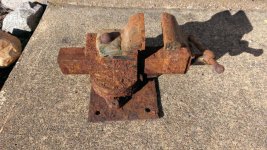
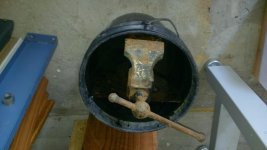
yes Outlaw you were here in spirit and your process was shared while you were in Idaho and I hope that's ok. you shared with me before and your process was laid out perfectly. I swear i'll have something bubbling soon in the Electolysis tank thanks to you and a few others that have me confident to do so now.

now another process has been mentioned, but I don't know a chemist and not sure I want to buy poison and start cooking my old vises and steel in it. any other sources for the boric acid?

also I have a really rusty vise sitting in 3 gallons of vinegar (no molasses in this tank) and its been 3 days. here is the before picture of the Prentiss 19 that might have been sitting in the rain for 80 years before I found it.
 

Attachments

  • WP_20140228_003.jpg
    WP_20140228_003.jpg
    159.6 KB · Views: 282
  • WP_20140228_002.jpg
    WP_20140228_002.jpg
    155.6 KB · Views: 279
  • soaking in 3 gallons of vinegar.jpg
    soaking in 3 gallons of vinegar.jpg
    111.3 KB · Views: 352

zkling

Well-known member
Joined
Jan 23, 2007
Messages
16,939
now another process has been mentioned, but I don't know a chemist and not sure I want to buy poison and start cooking my old vises and steel in it. any other sources for the boric acid?

Did you see my post? It's amazing what all you can buy between a hardware store and a supermarket chemical wise. I'm sure Grainger has it, but of course at a Grainger price. :lol:
 
Last edited:

drivesitfar

Well-known member
Joined
Oct 23, 2013
Messages
36,003
Location
Pacific Northwest
I did and wondered if there are other chemicals in those little bug killing containers besides the ones we want to cook our vises and old steel tools in. I think I have a few of those roach powder containers on a shelf up high in my garage so i'll grab one and check the ingredients.

if I don't have one i'll go check it out at the local hardware store and make sure I bring my readers in the store with me.

thanks again
 

zkling

Well-known member
Joined
Jan 23, 2007
Messages
16,939
I'm pretty sure most of them are 98%+, wouldn't hurt to check the label or pull the MSDS though.
 

Fretters

Well-known member
Joined
Jan 25, 2014
Messages
4,217
Location
South Yorkshire, England
Chrome: Chromium Hex-a-something (poison gas) is a possibility. Heavy metal contamination of the solution's and its sludge is a certainty. Same for getting copper and other non steel/iron wire/parts in the soup (Zinc plated parts..). Rebar tie wire is cheap and easy to find.

There's quite a few different issues there. The hex* issue with stainless, for example, is still an unproven, (though there's no harm erring on the side of caution), as far as I know, issue. That's not to say there aren't plenty of warnings out there about it, but still no actual facts to back it up.

The copper issue is entirely different. Copper is avoided for the simple fact that it may slightly plate the piece being cleaned, (though again, the conditions for that to happen are quite precise, and unlikely to be encountered in a home vat setup), and hence could instigate galvanic corrosion on the piece being cleaned at a later date. Though on that subject, if machinery or tools are being stored in conditions likely to promote rust, the conditions should be sorted rather than worrying excessively about galvanic corrosion, IMHO.

The whole thing is a minefield of speculation, but if you actually look at the facts, you'll be lucky to find many, if any, facts to back up the oft mentioned though unsubstantiated widespread claims.

I have put quite a lot of time in the past into trying to research this area as thoroughly as possible, btw, (so these aren't just random thoughts grabbed out of the air), and I would still say that barring common sense and basic precaution, a lot of the do's and don't are unsubstantiated. They're merely points of theoretically potential problems to consider.

If anyone does have any links to proven scientific fact on any of these issues though, I'd be glad of any further info. :)


Back to E tanks: Lower voltage and amps are what the museums use to get things done, but they are in no hurry. The slower you go, the better the finished product. I've started going with 6V and my low setting for the most part.

Controlling the current is the preferable option, IMHO. You can control current quite precisely. Voltage will vary quite a bit. I've set the bench power supply so that it's limited to 12V maximum permanently, and then vary the current for general use. 500mA maximum for smaller pieces, 1A to 1.5A maximum for larger pieces and the basket.

This is one machine which has been done exclusively in that large wooden vat, (I did in fact build that vat specifically for this machine), and with current of 1.5A or less, and with quite small anodes to boot.

1381112586large_current_06102012.jpg


That was in quite a state when I got it. (That's just surface flash rust on the slotted table, btw, from after it was taken out of the vat. That'll be cleaned off when needed). Usable, but definitely not well cared for. Thick paint and lots of rust. These are some photo's of it when I first got it, so you can fair imagine its original condition from those.

1366687148dcp_3551.jpg


1366686094dcp_3548.jpg


1341785261large_rapidor3.jpg


1341785261large_rapidor2.jpg


1364439600base_orig.jpg
 
Last edited:

drivesitfar

Well-known member
Joined
Oct 23, 2013
Messages
36,003
Location
Pacific Northwest
Fretters: there are not enough words to describe some of the nice pieces of restored cast iron and old English steel you post on GJ. thank you for that and i hope to see more and maybe a picture of the blue thing poking it's head out in the picture of your green machine.

by the way what is that? even if it is an old machine no longer functioning and just providing you a small work surface it has that cool factor appearance to it. very nice.:thumbup::thumbup::thumbup:

i'll let you and Outlaw and the other chemists and teachers discuss the technical parts of your posts and i'll read them and probably understand them more as i get to cooking some old US steel.

now I do have a few questions for you if you might be willing to share more information.
1) since it appears that before you placed the "green machine" in your big
electrolysis box that it had quite a bit of grease and grime on it. did you
clean all that off before placing in the "E" tank and how?
2) i think you might have shared before in the vise thread or on another thread
but can you share your process of preparing for painting after you de rust
and also i think you said before that you melt something on your bare steel
by setting it on your shop's stove. also how you keep up that wonderful
shine on your bare steel and keep the surface rust off of it?

By the way I love waking up and turning on my laptop and seeing these kind of before and after pictures so others please feel free to show yours and also any questions and success stories you have to share.

since it looks like that "green machine" might weigh a few hundred pounds did you just set it on the bottom of the tank that you said you put a piece of rubber on the bottom of and do one half and then turn over and do the other half?

very nice and thanks again for sharing
 
Last edited:

Craptain

Well-known member
Joined
Apr 18, 2013
Messages
4,027
Location
Tampa Bay FL
I usually go with the low current option myself. I use a computer power supply, carbon electrodes and put a 12V bulb in series as a current limiting resistor. I measured the current initially at 1/2 to 1 amp, but now I just use the brightness of the bulb as a guide. I also noticed that the current increases a bit as the rust is removed, exposing more clean metal. From experience with my system I can now make an educated guess as to progress by the brightness of the bulb.
The electrodes are about 2" wide and 24" long. I also have some 1/4" square rod that I use for motorcycle tanks. Wrap them in a plastic mesh of some kind to prevent shorts and stick them inside the tank.
I also use a "dip tank" with Evapo-rust for small parts. A plastic shoe box sized tub with dollar store baskets for the parts.
Sorry, I don't have pictures as the system is drained right now.
 

Outlawmws

Well-known member
Joined
Aug 9, 2011
Messages
39,146
Location
The Badlands
If you have been exposed to the issues with what plating shops have had to deal with on heavy metals getting into the wastewater, and as similar as the processes are, it's far from a hypothetical concern. One former employer "owns" the plating shop toxic waste on a property they sold 20-25 years ago including annual testing and will forever or until its cleaned up...

"Unproven" by whom? Toxic waste is one area I won't ever say "you can't or haven't proven it, so it is an acceptable risk..." It is a needless risk and if its ever disproven, then fine, I was overcautious.

I keep ALL non iron/steel materials out of my tank, and that way I know it's essentially benign. I've also seen the "arguments why it's all safe" I've even seen the argument that claims SS is safe to use as an anode. I disagree with the science that was used, and the conclusions. Again, even if I'm wrong, I'm wrong on the safe side, not the dirty side...
 
To avoid these ads, REGISTER NOW!

Fretters

Well-known member
Joined
Jan 25, 2014
Messages
4,217
Location
South Yorkshire, England
If you have been exposed to the issues with what plating shops have had to deal with on heavy metals getting into the wastewater, and as similar as the processes are, it's far from a hypothetical concern. One former employer "owns" the plating shop toxic waste on a property they sold 20-25 years ago including annual testing and will forever or until its cleaned up...

"Unproven" by whom? Toxic waste is one area I won't ever say "you can't or haven't proven it, so it is an acceptable risk..." It is a needless risk and if its ever disproven, then fine, I was overcautious.

I keep ALL non iron/steel materials out of my tank, and that way I know it's essentially benign. I've also seen the "arguments why it's all safe" I've even seen the argument that claims SS is safe to use as an anode. I disagree with the science that was used, and the conclusions. Again, even if I'm wrong, I'm wrong on the safe side, not the dirty side...

Not intending to be argumentative. :) Pretty much as earlier in the thread, it's just when certain things are mentioned that I like to try and keep things factual rather than just going with the hearsay or vague utterances commonly encountered. Like you, I do err on the side of caution. Not necessarily because I absolutely believe that certain things are harmful, but more for the fact that I prefer not to use something which has been flagged as being such potentially. Without being able to prove they're not, I use the cautious approach. That's the main reason why I'd be grateful for any info on the subject. :)
 

Fretters

Well-known member
Joined
Jan 25, 2014
Messages
4,217
Location
South Yorkshire, England
...maybe a picture of the blue thing poking it's head out in the picture of your green machine.

by the way what is that? even if it is an old machine no longer functioning and just providing you a small work surface it has that cool factor appearance to it. very nice.:thumbup::thumbup::thumbup:

The blue thing is a lighter version of that green hacksaw. They're both Rapidor's. I don't have that blue one any longer though. One of those rare occasions where circumstance dictated that I let it go, so that one was sold on. That blue one was derusted and such in the plywood vat too. These are a couple of shots of it, before and during.

1367488561major_suds3.jpg


138593332220112013028.jpg


That second photo was taken just before I sold it. End of the day, the green one will be more than ample for what I need once I get it finished off.


now I do have a few questions for you if you might be willing to share more information.
1) since it appears that before you placed the "green machine" in your big
electrolysis box that it had quite a bit of grease and grime on it. did you
clean all that off before placing in the "E" tank and how?

Aye, the **** was all cleaned off first. Paraffin and white spirit, (kerosene and mineral spirit, over your side of the pond).


2) i think you might have shared before in the vise thread or on another thread
but can you share your process of preparing for painting after you de rust
and also i think you said before that you melt something on your bare steel
by setting it on your shop's stove. also how you keep up that wonderful
shine on your bare steel and keep the surface rust off of it?

I'm not the one who stove applies any finish. Prepping before paint, it gets wiped down with white spirit several times and then the enamel is applied straight to the cast. Rust prevention wise, I merely go to great lengths to try and keep the humidity down in the workshop, which is no mean feat with the amount of rain we have. :D Sometimes I will apply a bit of linseed oil, car wax or clear boot polish, but that's rarely done.


since it looks like that "green machine" might weigh a few hundred pounds did you just set it on the bottom of the tank that you said you put a piece of rubber on the bottom of and do one half and then turn over and do the other half?

It was completely stripped down to component parts and each part done separately. I did have to flip the bed section over in the vat, but that was just due to the shape of the casting. I needed to be sure that the underside had done properly due to airlocks underneath the T slotted vice bed preventing the solution getting full coverage.
 

drivesitfar

Well-known member
Joined
Oct 23, 2013
Messages
36,003
Location
Pacific Northwest
thanks for sharing your picture of the blue metal bandsaw you call a power hacksaw and it looks great. not nearly as nice as that green one you are almost done restoring. is there a motor to be attached down below to the stand? I'd love to see a video of one running because they look like early 1900's or late 1800's styling.

thanks again for sharing your process of painting and keeping active rust from showing up on your un painted surfaces. also for translating for us Americans so we know which product you are using.

I have used WD 40 in the past to put a film on some metal and have learned of and used a few other products since then. WD 40 works just ok and actually can remove some rust with a rag and some elbow grease, but it dries out pretty quickly and needs to be re applied often. i am going to try vegetable oil on some surfaces like metal gym weight plates and such that might work similar to your linseed oil. also car wax is another option that isn't too messy or that hard to apply.

there are also some other rust preventative products that might be toxic or not but they work so good at keeping rust away in their videos it looks scary to breath or get on your hands. I think i have saved a file somewhere that I'll post those products later and can't find now.

yes i bet it rains where you are just like here in Seattle, but those poor guys in the high humidity climates might have it a bit worse in the summer with excess moisture.
 

Fretters

Well-known member
Joined
Jan 25, 2014
Messages
4,217
Location
South Yorkshire, England
The motor goes at the rear on a pivoting plate. This is the only photo I have of it complete, (this photo was taken by the seller). I had to dismantle it to be able to carry it from the truck to the workshop.

1341785261large_rapidor1.jpg


They are hacksaws, btw. Bandsaws have a continual loop blade. These have a fixed blade, like a normal hand held hacksaw, but larger. The bow then moves backwards and forwards, controlled via an arm on a crank assembly.
 
Last edited:

drivesitfar

Well-known member
Joined
Oct 23, 2013
Messages
36,003
Location
Pacific Northwest
sorry we have metal bandsaws that have a similar but not that same look. yours is very cool and thanks again for the picture. Hacksaw it is in any language.
 

Fretters

Well-known member
Joined
Jan 25, 2014
Messages
4,217
Location
South Yorkshire, England
No worries. :) These Rapidor's are a bit of a peculiar beast, and hacksaws don't tend to be as common nowadays as horizontal bandsaws. This is an old piece of advertising literature for it. Gives a nice side view of one.

1341787899rapidor_advert1.jpg


The green one is a 6", but they did make them with various size of bow for larger capacity cutting.
 

Alchymist

Well-known member
Joined
Mar 1, 2009
Messages
4,423
Location
Central PA
I've had pretty good luck with re-rod for electrodes, plastic tub, a 12v battery charger, and plain old tap water. usually overnight does it. Here's a link to a restoration project that relied heavily on it:

http://www.mytractorforum.com/showthread.php?t=195871&highlight=

Have also used the same setup in various other restoration projects.

Here's some pictures of a saw table - bucket was only big enough to do half at a time, covered the first half with paste wax while the second half was de-rusting. Third picture is finished and covered with paste wax awaiting further cleanup & adaptation - but that's another story. :)
 

Attachments

  • rtrust1.jpg
    rtrust1.jpg
    136.5 KB · Views: 198
  • rtrust2.jpg
    rtrust2.jpg
    146.8 KB · Views: 306
  • rtrust3.jpg
    rtrust3.jpg
    77.8 KB · Views: 254

Alchymist

Well-known member
Joined
Mar 1, 2009
Messages
4,423
Location
Central PA
The saw is an old Craftsman - paid $20 for it - burnt up motor. Bought it for the stand, top, and 2 cast iron wings - planning a router table conversion out of it.
 

Outlawmws

Well-known member
Joined
Aug 9, 2011
Messages
39,146
Location
The Badlands
Not intending to be argumentative. :) Pretty much as earlier in the thread, it's just when certain things are mentioned that I like to try and keep things factual rather than just going with the hearsay or vague utterances commonly encountered. Like you, I do err on the side of caution. Not necessarily because I absolutely believe that certain things are harmful, but more for the fact that I prefer not to use something which has been flagged as being such potentially. Without being able to prove they're not, I use the cautious approach. That's the main reason why I'd be grateful for any info on the subject. :)

That's the problem with the internet. Way too much speculation and not near enough hard facts. We have probably read much of the same stuff, and have to weigh the information and winnow out the casual nonsense. I've been an engineer all my life and have been around manufacturing, plating, etching (mostly PC boards) and all varieties of "how things are made" so I use that background knowledge base as well while I'm reading this stuff. I base my recommendations on what I believe to be the best info, and where it's a dead heat (******* match...) the safety concerns decide if they have to (or can) for me.

It sounds like you have come to essentially the same conclusions as me, and for much the same reasons.
 

Fretters

Well-known member
Joined
Jan 25, 2014
Messages
4,217
Location
South Yorkshire, England
That's the problem with the internet. Way too much speculation and not near enough hard facts. We have probably read much of the same stuff, and have to weigh the information and winnow out the casual nonsense. I've been an engineer all my life and have been around manufacturing, plating, etching (mostly PC boards) and all varieties of "how things are made" so I use that background knowledge base as well while I'm reading this stuff. I base my recommendations on what I believe to be the best info, and where it's a dead heat (******* match...) the safety concerns decide if they have to (or can) for me.

It sounds like you have come to essentially the same conclusions as me, and for much the same reasons.

It definitely does sound like we've pretty much both reached the same point after sifting through a lot of the information online. Attempting to sort the wheat from the chaff can be a time consuming and frustrating task, can't it. :D It seems to be that with these types of questions, even chemists are hard pushed to answer them too. I have tried brain picking on occasion when I've had specific questions, but even then the answers were tentative and vague at best.
 

Fretters

Well-known member
Joined
Jan 25, 2014
Messages
4,217
Location
South Yorkshire, England
i am going to try vegetable oil on some surfaces like metal gym weight plates and such that might work similar to your linseed oil.

Forgot to comment on this bit before. You might have some luck with vegetable oil, but it'll more than likely be of little use. You want to go with either Linseed or Tung preferably. Teak or Danish, (all are oils), are other possibilities.
 

larry4406

Well-known member
Joined
Jan 27, 2006
Messages
19,076
Location
Northern Virginia
One of the automotive websites I go to, there are many restorers who swear by Rust Prevention Magic (RPM) for treating unpainted metals. I do not have any first hand experience with it. They apply it after parts have been cleaned via methods including electrolysis, molassas dipping, vinegar cleaning, etc.

http://ecsautomotive.com/rpm.php
 

drivesitfar

Well-known member
Joined
Oct 23, 2013
Messages
36,003
Location
Pacific Northwest
I'm close to setting up my first Electrolysis tank and wondered if anybody has used those stakes that hold forms in place for cement sidewalks and other small projects.

the reason i'm asking is i have maybe 20 of the 2 footers that would have a pre drilled hole in them so i just need to grab some 10 or 12 gauge wire to put through the holes and then wrap one time to have a great connection for the positive. would this type of steel work or should i just find some flat scraps or cut up some rebar? i'm thinking of using maybe 8 of these 2 footers in the tank or should i use more or less?
 

Filson

Well-known member
Joined
Jun 14, 2013
Messages
1,218
Location
NE WA
Amazing thread. Fretters... Holy **** man. Haha!

So I've never used an electrolysis bath before (never heard of one prior to GJ). So I'm learning a lot here.

Still a little confusion though, hopefully you guys can clarify...

Using lower amps takes longer but will give a better finished product, if I'm understanding correctly?

The size of rebar or whatever you use matters in final product as well? Smaller = better?
 

EOC_Jason

Well-known member
Joined
Jun 25, 2012
Messages
11,388
Location
Bentonville, AR
Still a little confusion though, hopefully you guys can clarify...

Using lower amps takes longer but will give a better finished product, if I'm understanding correctly?

The size of rebar or whatever you use matters in final product as well? Smaller = better?

Supposedly low and slow is the way to do it... I think if you crank it up too high you run the risk of hydrogen embrittlement for thin / small parts.

It probably has more to do with surface area for #2 and also creates more of a field for the reaction to occur.
 

drivesitfar

Well-known member
Joined
Oct 23, 2013
Messages
36,003
Location
Pacific Northwest
Fretters: yes the pointed ones or at least they used to be a few sidewalk and footing projects ago. i'll take good pictures and probably have a few more questions before i actually get cooking and always appreciate all the help i can get from the experts. at this point i have the container that also has a lid if i choose to use it, battery charger, stakes, wire, half inch rubber for bottom of container in case i accidentally drop something and that should be about it. all i need to do is wire it up, add about 10 gallons of water and a maybe a cup of spa chemical and drop something old and rusty in it and let it cook. sound about right?

Filson: glad you can join the thread and maybe ask a few more questions i and others haven't thought of. I've been going to fire up an E tank for a few months now so had a bunch of questions stored up when Tex started this a few weeks ago. read through and you'll see some great answers to all of the questions and some great pictures too. it should be a nice addition to your shop especially when you find out who is hoarding all those old vises on your side of the mountains.
 

Outlawmws

Well-known member
Joined
Aug 9, 2011
Messages
39,146
Location
The Badlands
I'm close to setting up my first Electrolysis tank and wondered if anybody has used those stakes that hold forms in place for cement sidewalks and other small projects.

the reason i'm asking is i have maybe 20 of the 2 footers that would have a pre drilled hole in them so i just need to grab some 10 or 12 gauge wire to put through the holes and then wrap one time to have a great connection for the positive. would this type of steel work or should i just find some flat scraps or cut up some rebar? i'm thinking of using maybe 8 of these 2 footers in the tank or should i use more or less?

That stuff should work fine. You mean those pointed metal rods? Far as I know, they're just a standard steel.

Yup, and free is a good thing! :thumbup:
 

Outlawmws

Well-known member
Joined
Aug 9, 2011
Messages
39,146
Location
The Badlands
Amazing thread. Fretters... Holy **** man. Haha!

So I've never used an electrolysis bath before (never heard of one prior to GJ). So I'm learning a lot here.

Still a little confusion though, hopefully you guys can clarify...

Using lower amps takes longer but will give a better finished product, if I'm understanding correctly?

The size of rebar or whatever you use matters in final product as well? Smaller = better?

Supposedly low and slow is the way to do it... I think if you crank it up too high you run the risk of hydrogen embrittlement for thin / small parts.

It probably has more to do with surface area for #2 and also creates more of a field for the reaction to occur.

Yeah, the ones with 4-6 rebars in a 5 gallon bucket seem to work fine. if you only had one, it could be problematic, unless you were working inside a pipe or something.. The caution with that is not allowing the part and the anode to short out. it could be taps for your power supply...

Higher current comes in when you have HUGE things to deal with...
 
To avoid these ads, REGISTER NOW!
Top Bottom