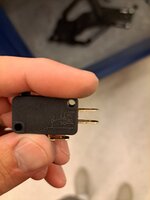
Hey Max, Ok. Educate me and I will be happy. But put aside the snarky stuff please. The questions I am posing are not so stupid as you seem to be assuming.
It certainly wasn't my intention to be snarky. You wrote a lot of stuff and I simply don't know what you were trying to say. Is it me? Is it you? I don't know. All I can tell you is that I didn't understand what you were trying to convey in that paragraph.
I looked over. Very little info, but yes, I am sure there is mass volumes to read online.
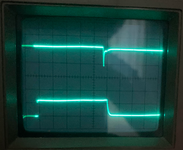
I agree that the article is on the lightweight side, but it did make some key points. Here is a different quote for something that you were questioning before: "When the switch is closed, the two contacts actually separate and reconnect, typically 10 to 100 times over a period of about 1ms." ("The Art of electronics", Horowitz & Hill, Second edition, pg 506.)" So the switch bounce period is much longer than the uS that you expected before.
Something humorous though: in the very picture on the link you give:

They use a switch with the *same* 15 A rating AC and DC. It is the voltage rating that is different. Yes, the voltage amplitude ratings are different by large factors (250/30 ~ 8, and I would assume AC is rms period average measure here).
Sure. I'm not telling you that there is a hard and fast rule that AC current is always higher than DC current in a switch. What I am telling you is that switch manufacturers do rate their switches for what they expect that switch will handle over a certain number of operations with a certain reliability. There is not some special huge margin for what they specify. So if a switch is rated for 10A AC and 2A DC then I expect that is what it will work correctly too. If it could do 10 A DC then it would be rated that way, and since it isn't rated for that current isn't it won't work, or it will work for a bit and then fail.
The switch you note is interesting. My take would be that they are trading off DC voltage - which will obviously reduce the internal arcing - in the interest of keeping the current the same. I expect that what they say about the rating is correct, and you that could run 10 A DC through it reliably - but not at say 100V DC. So it's trading off voltage for current for what they presume is an important spec. for their customers.
In general, if you run a part outside the manufacture's specs then you are completely on your own if there are issues.
So yes, I may be part wrong on the clearing being different @ 60 Hz and DC in spite of many many transit times in any half sine wave cycle or physical switching interval. If so, it might be more logical that the threshold issue correlates more to voltage being held on the switch cycle. I would also not be surprised if manufacturers are putting ratings based on what is often being switched since if the switch damages they get complaints but that might not be intrinsic to the switch component by itself on a resistive type load. Inductive loads I would presume will be more problematic in generating high voltage spikes across contacts that need to be held to avoid breakdown damage. The light article you cite below makes no estimates and emphasizes the load aspects not in the switch contacts themselves.
https://www.mouser.com/blog/which-switch-who-cares-if-its-ac-or-dc
I am not a materials engineer nor am I a physicist. I can't explain to you the details about a DC or AC arc at 60 Hz that would convince you on how they work. What I can tell you is that it's in a manufacturer's best interests to specify a part as broadly as they can as it will increase sales. So if a switch spec says 2A for DC and 10 for DC then that is what it is.
Ok, no need to be snarky. I am a research scientist by the way and do not work on EE but do work on charged particle dynamics including intense beams ... though not breakdown discharges. Granted, maybe I am a dumb one, but hopefully I can be enlightened. What I was describing was
I don't think that anyone is dumb here. Like I said, I've got no idea what your long paragraph said whereas one of your peers may have just nodded his head and said "sure".
characteristic scales of plasma (collective wave) and particle transit factors that would be associated with discharge breakdowns emitting charged particle streams. They are impacted by many effects including surface finish and materials, geometry, scale, voltage, density, etc. It is not a simple topic. But I am pretty sure from the respect of a discharge strike 60 Hz is not fast variation. As I pointed out initially, it is likely even 1eV electrons can transit switch gaps many million times in ony half swing of a single period of harmonic variation. The 1/60Hz period will also likely be fast on the physical time scale the physical switch contacts open.
I think our difference is that you are looking for a fundamental physical explanation in detail whereas I am talking about believing the manufacture's specs and understanding the very basic principles as to why the specs can be different. If you want the detailed theory you'll have to start going through old IEEE papers and textbooks.


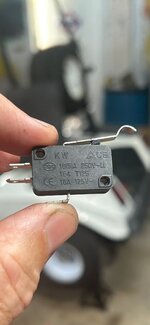
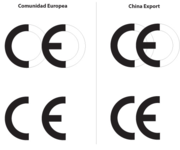
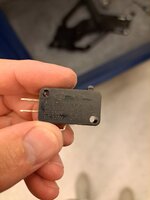
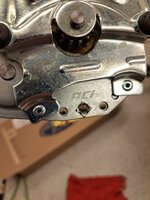
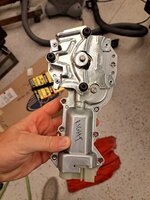
 Here is more information