
You are using an out of date browser. It may not display this or other websites correctly.
You should upgrade or use an alternative browser.
You should upgrade or use an alternative browser.
220V to Shop - Voltage Drop
- Thread starter billrigsby
- Start date

dave*99
Well-known member
There are no short answers to this complex topic. Recognize that the utility distribution system relies on a multi-grounded neutral. At the pole top transformers, ground rods are connected to the system neutral, and the primary and secondary neutrals are connected together.Nothing in the shop is GFCI equipped,
All of this is bringing up a question in my head, not to start another discussion or definitely not an argument but....
The power pole with the transformer on it has a copper plate on the base and a copper wire running up to the transformer which is the ground, from the triansformer triplex runs from the transformer to the meter, two hots and a neutral.
That meter in the main panel is then grounded similarly with about a 6 ft ground rod pounded into the ground. That is in fact how my entire house is grounded, built in 95 for what it's worth.
So now not to stir up controversy, just for my knowledge what is the difference between running two hots and a neutral from the main panel to a sub panel on the shop, via a circuit breaker, which also has a 6-ft ground rod pounded into the ground.
Obviously not an electrician and I don't want to be one!
It is nice to not go a day without learning something though.
Neutral conductors carry normal load current----- a full time job. The neutral is a grounded conductor.
Under normal operation, the neutral conductor can have a voltage drop across it and this gives rise to neutral to earth voltages.
Grounding conductors carry fault current --- during fault conditions. This is the EGC - equipment grounding conductor.
Under normal conditions there is no current in the EGC.
Under fault conditions, this provides a current path for the OCP - overcurrent protection ---- typically a breaker ---- to operate.
The current code would require your shop subpanel be connected to the main panel with a neutral conductor and a grounding conductor -EGC. And those two remain separated or isolated. So when your neutral conductor carries load current -- and a voltage drop across it -- that small voltage WILL NOT appear on the metal junctions boxes many of us have in our shops. Those boxes are connected to the EGC all the way back to the main panel.
The ground rods serve to equalize the local voltage of the utility distribution system with the voltage at the earth. What does that mean? Well the earth is not a perfect conductor. When there is a voltage drop across a neutral and it is connected to the ground rod at the main panel, the soil around the rod will have a small voltage present. This is called NEV or neutral to earth voltage. That voltage will dissipate as you move away from the ground rod. This limits the step potential that could cause a shock.
Consider this... when all this stuff is connected properly and working correctly.....
You can have a few volts dropped across the neutral due to normal load, and still stand barefoot while touching the hose bib on the side of your house and not get a shock or tingle. Of course there are many other safety conditions this properly connected system protects us from, this is only one example.
Last edited:
wyliesdiesels
Well-known member
A GFCI has nothing to do with EGCs or grounding electrodes.... A GFCI doesnt even need an EGC to functionNothing in the shop is GFCI equipped,
EGCs and grounding electrodes are different animals. both are required for subpanels in detached buildings however that requirement came with the 2008 code cycle UNLESS there are parallel metallic pathways between buildings (electrical conduit, gas line, water line, phone line, etc). then it was required even before 2008.The power pole with the transformer on it has a copper plate on the base and a copper wire running up to the transformer which is the ground, from the transformer triplex runs from the transformer to the meter, two hots and a neutral.
That meter in the main panel is then grounded similarly with about a 6 ft ground rod pounded into the ground. That is in fact how my entire house is grounded, built in 95 for what it's worth.
So now not to stir up controversy, just for my knowledge what is the difference between running two hots and a neutral from the main panel to a sub panel on the shop, via a circuit breaker, which also has a 6-ft ground rod pounded into the ground.
Obviously not an electrician and I don't want to be one!
It is nice to not go a day without learning something though.
I have a write up about the differences between the 2 on the electrical FAQs sticky (post #4) at the top of the forum. give it a read if you want to learn more.
Electrical FAQs
Welcome All I have started this sticky as an FAQ thread for info on the basics that are encountered countless times every week on here. Hopefully this will help some. If u have a topic request, go ahead and post it. And if you have an FAQ you would like covered let me know.... Or if you...
 www.garagejournal.com
wyliesdiesels
Well-known member
just an FYI- a neutral is just called a grounded conductor not a GEC. a GEC is a grounding electrode conductor- ie. the wire that connects the electrodes to the GES- grounding electrode system....There are no short answers to this complex topic. Recognize that the utility distribution system relies on a multi-grounded neutral. At the pole top transformers, ground rods are connected to the system neutral, and the primary and secondary neutrals are connected together.
Neutral conductors carry normal load current----- a full time job. The neutral is called the GEC - grounded electrical conductor.
Under normal operation, the neutral conductor can have a voltage drop across it and this gives rise to neutral to earth voltages.
Grounding conductors carry fault current --- during fault conditions. This is the EGC - equipment grounding conductor.
Under normal conditions there is no current in the EGC.
Under fault conditions, this provides a current path for the OCP - overcurrent protection ---- typically a breaker ---- to operate.
The current code would require your shop subpanel be connected to the main panel with a neutral conductor -GEC- and a grounding conductor -EGC. And those two remain separated or isolated. So when your neutral conductor carries load current -- and a voltage drop across it -- that small voltage WILL NOT appear on the metal junctions boxes many of us have in our shops. Those boxes are connected to the EGC all the way back to the main panel.
The ground rods serve to equalize the local voltage of the utility distribution system with the voltage at the earth. What does that mean? Well the earth is not a perfect conductor. When there is a voltage drop across a neutral and it is connected to the ground rod at the main panel, the soil around the rod will have a small voltage present. This is called NEV or neutral to earth voltage. That voltage will dissipate as you move away from the ground rod. This limits the step potential that could cause a shock.
Consider this... when all this stuff is connected properly and working correctly.....
You can have a few volts dropped across the neutral due to normal load, and still stand barefoot while touching the hose bib on the side of your house and not get a shock or tingle. Of course there are many other safety conditions this properly connected system protects us from, this is only one example.
dave*99
Well-known member
I'll edit. I missed a gear. Thanksjust an FYI- a neutral is just called a grounded conductor not a GEC. a GEC is a grounding electrode conductor- ie. the wire that connects the electrodes to the GES- grounding electrode system....
OP
billrigsby
Well-known member
- Joined
- Mar 17, 2017
- Messages
- 58
Well this is all very interesting and very immersive.
So since the neutral is a normal current carrying conductor and the ground is merely a fault carrying conductor, does the ground have to be the same AWG as the hots and the neutral?
In the buried wire it was but if I remember correctly my hot tub which is 6-3 with ground, I believe the ground was a considerably smaller AWG.
So since the neutral is a normal current carrying conductor and the ground is merely a fault carrying conductor, does the ground have to be the same AWG as the hots and the neutral?
In the buried wire it was but if I remember correctly my hot tub which is 6-3 with ground, I believe the ground was a considerably smaller AWG.
dave*99
Well-known member
The ground is the same gauge in 12/2 and 14/2 cables. In large cables, service cables etc. it is smaller than the current carrying conductors.Well this is all very interesting and very immersive.
So since the neutral is a normal current carrying conductor and the ground is merely a fault carrying conductor, does the ground have to be the same AWG as the hots and the neutral?
In the buried wire it was but if I remember correctly my hot tub which is 6-3 with ground, I believe the ground was a considerably smaller AWG.
wyliesdiesels
Well-known member
its a little complicated but if the ungrounded conductors (hots) are larger than #10, then the answer is no and anyone telling you otherwise doesnt know what theyre talking about. see NEC table 250.122Well this is all very interesting and very immersive.
So since the neutral is a normal current carrying conductor and the ground is merely a fault carrying conductor, does the ground have to be the same AWG as the hots and the neutral?
who told you that the EGC/ground wire needed to be the same size as the ungrounded conductors?In the buried wire it was but if I remember correctly my hot tub which is 6-3 with ground, I believe the ground was a considerably smaller AWG.
OP
billrigsby
Well-known member
- Joined
- Mar 17, 2017
- Messages
- 58
Okay that's what I thought, so if I run #2 ariel from the house to the shop,
which I already have someone who has about 130 ft ready for me to pick up Monday,
it does not however, have a ground, it's merely service wire so what size ground wire would I need to add to that to be within code and correct.
Alternatively, could I use one of the buried conductors as a ground, which is #2, or should the ground actually be smaller AWG?
Of course doing that there's always the chance that some varmint will kill my ground one day!
which I already have someone who has about 130 ft ready for me to pick up Monday,
it does not however, have a ground, it's merely service wire so what size ground wire would I need to add to that to be within code and correct.
Alternatively, could I use one of the buried conductors as a ground, which is #2, or should the ground actually be smaller AWG?
Of course doing that there's always the chance that some varmint will kill my ground one day!
OP
billrigsby
Well-known member
- Joined
- Mar 17, 2017
- Messages
- 58
who told you that the EGC/ground wire needed to be the same size as the ungrounded conductors?
No one but I do know that the buried wire I have all four wires were the same AWG, but not so for the wiring going to my hot tub.
wyliesdiesels
Well-known member
post a pic of the direct buried wire. Im guessing you have quadplex URD which is meant for 3 phase service entrance and thus all 4 conductors (3 hots & neutral) are the same size. IF thats the case then you have the wrong wire entirely. a manufactured cable like mobile home feeder has reduced size EGC per code and you can even get it with a reduced size neutral as well...No one but I do know that the buried wire I have all four wires were the same AWG, but not so for the wiring going to my hot tub.
dave*99
Well-known member
Hmmm. Listen to Wylie, he knows this stuff.Okay that's what I thought, so if I run #2 ariel from the house to the shop,
which I already have someone who has about 130 ft ready for me to pick up Monday,
it does not however, have a ground, it's merely service wire so what size ground wire would I need to add to that to be within code and correct.
Alternatively, could I use one of the buried conductors as a ground, which is #2, or should the ground actually be smaller AWG?
Of course doing that there's always the chance that some varmint will kill my ground one day!
OP
billrigsby
Well-known member
- Joined
- Mar 17, 2017
- Messages
- 58
post a pic of the direct buried wire.
Guess I should look before I leap or speak!, the ground is slightly smaller AWG, 4 vs 2.


wyliesdiesels
Well-known member
looks like 2-2-2-4 AL MHF
OP
billrigsby
Well-known member
- Joined
- Mar 17, 2017
- Messages
- 58
EGCs and grounding electrodes are different animals. both are required for subpanels in detached buildings however that requirement came with the 2008 code cycle UNLESS there are parallel metallic pathways between buildings (electrical conduit, gas line, water line, phone line, etc). then it was required even before 2008.
So does this mean that I can use the existing ground that is in ground and run three wires overhead for two hots and a neutral, and be acceptable?
larry4406
Well-known member
I’m no sparkie.So does this mean that I can use the existing ground that is in ground and run three wires overhead for two hots and a neutral, and be acceptable?
I’m going to say no and that all the conductors need to be in a single pull.
Real experts will chime in soon.
wyliesdiesels
Well-known member
no because code requires them to be all together unless youre running a ground wire for an existing circuit.So does this mean that I can use the existing ground that is in ground and run three wires overhead for two hots and a neutral, and be acceptable?
OP
billrigsby
Well-known member
- Joined
- Mar 17, 2017
- Messages
- 58
no because code requires them to be all together unless youre running a ground wire for an existing circuit.
Okay that's what I thought you were going to say I guess I was trying to read between the lines. So what would be the AWG size required if I'm running #2 wire?
sparky 1971
Well-known member
No. You need a quadplex overhead wire. Two hots, neutral, and the bare messenger wire, which will be the ground. I haven't used any in a loooong time, but if I remember correctly the three insulated wires were black and I had to do a continuity test to identify one wire as the neutral.So does this mean that I can use the existing ground that is in ground and run three wires overhead for two hots and a neutral, and be acceptable?
Something like this:
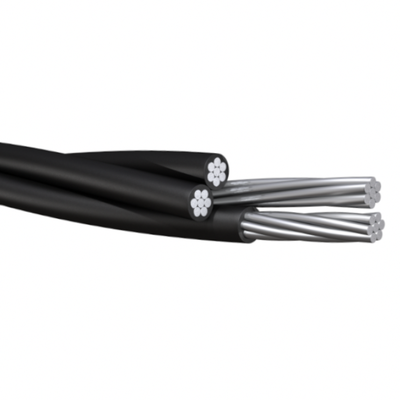
#2-2-2-2 Palomino Aluminum Quadruplex Overhead Service Drop Cable
2-2-2-2 Palomino Aluminum Quadruplex Overhead Cable. Sold by the foot.
sparky 1971
Well-known member
You need a #6 ground, but you're not going to find anything that you can just add on to the overhead run if that's what you are trying to find out. The messenger ground wire will be a #2 if you use #2. You could probably get by with #4 since it's free air.Okay that's what I thought you were going to say I guess I was trying to read between the lines. So what would be the AWG size required if I'm running #2 wire?
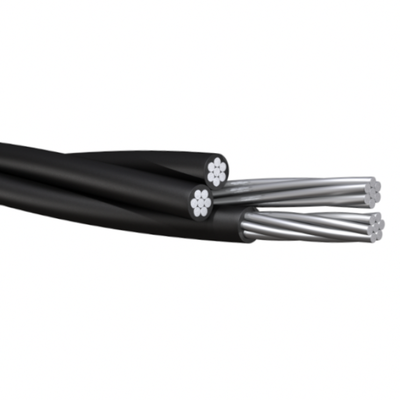
#4-4-4-4 Hackney Aluminum Quadruplex Overhead Service Drop Cable
4-4-4-4 Hackney Aluminum Quadruplex Overhead Cable. Sold by the foot.
Last edited:
OP
billrigsby
Well-known member
- Joined
- Mar 17, 2017
- Messages
- 58
Just trench and do it right with conduit.
I thought about that, and as much as I would not like to tear my yard up again,
the wires paid for I could just re bury it after I find the break put it in conduit,
but the neighbor had a rodent go through buried conduit for his hot tub
and I may go through all that for not, I can get the overhead wire for absolutely nothing
but it doesn't have the ground, decisions decisions good thing I'm not in any rush
I do have a 120 volt compressor and a pretty long extension cord for my welder in the interim.
I'd still put some effort into finding the issue and repairing for now.
Edit: @billrigsby how long is the proposed aerial run? How long is current run?
Edit: @billrigsby how long is the proposed aerial run? How long is current run?
OP
billrigsby
Well-known member
- Joined
- Mar 17, 2017
- Messages
- 58
@billrigsby how long is the proposed aerial run? How long is current run?
Both are / would be about 125 ft
Is that overall distance or point to point?Both are / would be about 125 ft
125' in the air is a pretty long run, not impossible but will have some sag....
OP
billrigsby
Well-known member
- Joined
- Mar 17, 2017
- Messages
- 58
Is that overall distance or point to point?
That would be total overall in the air would be about 80 ft
Monday I'm going to meet up with a guy that does installations for the local utility, I'm going to check with him on how they find faults. He is an aerial guy but probably would have some insight and possibly equipment available to check, hopefully
If nothing else he has 130 ft of wire for me!
OP
billrigsby
Well-known member
- Joined
- Mar 17, 2017
- Messages
- 58
This is what I plan on doing,
the guy that does aerial has no way to locate the ground fault,
the utility usually does that.
My thought is to abandon in place.

the guy that does aerial has no way to locate the ground fault,
the utility usually does that.
My thought is to abandon in place.
The cable you have the pic of is USE. It is not permitted inside buildings.
The overhead route is going to look ugly as compared to seeing nothing. Plus you will need anchors, cable/conduit down side of buildings, connectors and it then becomes vulnerable to trees falling if in the area.
Or just rent a 4"-6" wide ditchwitch and retrench it. You can add extra depth to the trench. Drop in 1.5" pvc along the flat and come out of the trench with a rigid 90 and short length of rigid on the vertical, both ends. Pull in XHHW AL conductors.
Pour dry sacrete into trench first to give a bedding, then further cover pvc conduit with more dry mix once in place. Soak the concrete powder in place to hydrate, let setup overnite, backfill. Probably 30 bags sakrete - no mixing, don't have to add it all in one shot.
The overhead route is going to look ugly as compared to seeing nothing. Plus you will need anchors, cable/conduit down side of buildings, connectors and it then becomes vulnerable to trees falling if in the area.
Or just rent a 4"-6" wide ditchwitch and retrench it. You can add extra depth to the trench. Drop in 1.5" pvc along the flat and come out of the trench with a rigid 90 and short length of rigid on the vertical, both ends. Pull in XHHW AL conductors.
Pour dry sacrete into trench first to give a bedding, then further cover pvc conduit with more dry mix once in place. Soak the concrete powder in place to hydrate, let setup overnite, backfill. Probably 30 bags sakrete - no mixing, don't have to add it all in one shot.
Nothing wrong with overhead. If you have large trees that can be an issue. It's definitely cheaper and faster than trenching in most cases. 2" emt is huge for what you are doing.
I would still try to find someone who can locate the fault before running a new wire. I might condemn it if it gets a second fault but I would definitely fix the first one.
I would still try to find someone who can locate the fault before running a new wire. I might condemn it if it gets a second fault but I would definitely fix the first one.
OP
billrigsby
Well-known member
- Joined
- Mar 17, 2017
- Messages
- 58
No trees, the view it will be in is only the neighbors house 1/2 an acre away.
The general consensus is, without a full break, it would be almost impossible to find
without making swiss cheese of the yard. Don't want that or a new trench!
It is not through a lawn, but all the native grasses have reestablished over time.
2" may be oversized, right, I'll will possibly adjust, it will only save money.
Also, both boxes are on the outside of the buildings.
The general consensus is, without a full break, it would be almost impossible to find
without making swiss cheese of the yard. Don't want that or a new trench!
It is not through a lawn, but all the native grasses have reestablished over time.
2" may be oversized, right, I'll will possibly adjust, it will only save money.
Also, both boxes are on the outside of the buildings.
alfredeneuman
Well-known member
Free Air (as applied to conductors). Open or ventilated environment that allows for air flow around an installed conductor with no other conductors closer than one cable diameter and no insulation or building materials in contact with the conductor insulation for more than 75 mm (3 in.) for every 3 m (10 ft) of conductor.You could probably get by with #4 since it's free air.
Cables don't meet that requirement.
FredWanaker
Well-known member
and I remember watching the squirrels chew the insulating jackets off the overhead wires at my late parent's house. The rodents would chew and chew and chew, until they went thru two jackets in the same place, then **** and the utility company would come out to replace the wires again.
mike93lx
ALLIANCE MEMBER
Makes me want to run a 2 conductor aerial across my backyard with some coating the squirrels will find tasty. I could watch those fireworks all dayand I remember watching the squirrels chew the insulating jackets off the overhead wires at my late parent's house. The rodents would chew and chew and chew, until they went thru two jackets in the same place, then **** and the utility company would come out to replace the wires again.
OP
billrigsby
Well-known member
- Joined
- Mar 17, 2017
- Messages
- 58
and I remember watching the squirrels chew the insulating jackets off the overhead wires at my late parent's house.
I don't foresee the squirrels being a problem,
I don't have any trees close enough for them to gain access to the house
and even if they were to climb up the side of the house, it's log,
I have a metal roof I don't think they would get enough traction
to access the roof and then the cables, birds would be the only issue.