Nothing to do with True RMS…Yes, OK, now I get it - post #1, he said it was 258 V - 263 V at the load, but 243 V at the breaker. Both measurements would have had to be done at the 600 V range.
I guess this is where I get out my oscilloscope and actually look at the waveform shape, as well as ask it to do an AC RMS measurement.

You are using an out of date browser. It may not display this or other websites correctly.
You should upgrade or use an alternative browser.
You should upgrade or use an alternative browser.
258v on a 240v outlet
- Thread starter FL Guy
- Start date
- Status
- Not open for further replies.
rlitman
Well-known member
It sure can have something to do with true RMS. A non-true RMS digital meter will measure the peak-to-peak voltage and divide by radical 2/2 (around .707) to give you the readout. That works perfectly for a clean sine wave, but reads high when there's harmonic distortion. Some distortion patterns may not deviate much, while others can deviate quite a bit from the true RMS value.Nothing to do with True RMS…
MovingAlong
Well-known member
- Joined
- Aug 17, 2013
- Messages
- 1,323
Swapped the wires around and still getting high reading at wires.
Battery was replaced as well.
I see some of y’all have questioned the accuracy of this device. I’ll see if my neighbor has one and compare the readings.
Your post is based on the premise that you're seeing a voltage increase at the end of the wire.. now that you've configured your DVM differently, both measurements should be redone. Is panel voltage still less than wire voltage?
wyliesdiesels
Well-known member
Do you have this circuit connected to a load at all? Is this in conduit with other circuits?Swapped the wires around and still getting high reading at wires.
Battery was replaced as well.
I see some of y’all have questioned the accuracy of this device. I’ll see if my neighbor has one and compare the readings.
what is RMS?It sure can have something to do with true RMS. A non-true RMS digital meter will measure the peak-to-peak voltage and divide by radical 2/2 (around .707) to give you the readout. That works perfectly for a clean sine wave, but reads high when there's harmonic distortion. Some distortion patterns may not deviate much, while others can deviate quite a bit from the true RMS value.
and my math is really bad.
what is LoZ ?
johnre
Well-known member
Since I mentioned both a DMM and an oscilloscope in my post, I'm not sure which one you are referring to with this statement.Nothing to do with True RMS…
- If you're talking about an oscilloscope, then the scope's AC RMS measurement will be true RMS, provided you've sampled at a reasonable density (easy for a 60 Hz sinusoid).
- If you're talking about a DMM, then refer to @Ritman's post #42 about a non-true-RMS (or standard) DMM.
Root mean square.what is RMS?
Odd that you first make a bold statement about RMS, then you proceed to ask us what it means.
So what is root mean square of an ac power wave form ?Since I mentioned both a DMM and an oscilloscope in my post, I'm not sure which one you are referring to with this statement.
Note that a true RMS DMM behaves somewhat like an oscilloscope without a display; it oversamples the waveform, figures out the period, then calculates the RMS voltage from the sample values over one period. For me, if it really matters that much that I need to know for sure, I'd rather have the scope.
- If you're talking about an oscilloscope, then the scope's AC RMS measurement will be true RMS, provided you've sampled at a reasonable density (easy for a 60 Hz sinusoid).
- If you're talking about a DMM, then refer to @Ritman's post #42 about a non-true-RMS (or standard) DMM.
Root mean square.
Odd that you first make a bold statement about RMS, then you proceed to ask us what it means.
What is LoZ?
johnre
Well-known member
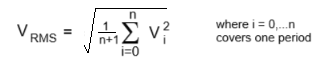
Assuming we're talking about a continuous stream of evenly spaced samples, it'sSo what is root mean square of an ac power wave form ?
I don't know. Not my terminology.What is LoZ?
Metal-Marc
Well-known member
The opposite of hiZWhat is LoZ?
What does that even mean other than it’s a math problem..Assuming we're talking about a continuous stream of evenly spaced samples, it's
I don't know. Not my terminology.
Metal-Marc
Well-known member
Yes. Root Mean Square.What does that even mean
Oh, no. It's a solution, not a problem.than it’s a math problem
Gozo
Well-known member
Since the OP hasn’t been back in a while, I’ll toss a real easy test he can do when (if) he checks this thread.
Turn off the breakers then measure the voltage at the long end. If it’s anything other than 0, it’s stray induced voltage. Won’t hurt a thing; the smallest load will swamp it out. Move on with life.
Turn off the breakers then measure the voltage at the long end. If it’s anything other than 0, it’s stray induced voltage. Won’t hurt a thing; the smallest load will swamp it out. Move on with life.
O
Ok math solutions then what does it meanYes. Root Mean Square.
Oh, no. It's a solution, not a problem.
Metal-Marc
Well-known member
Root mean squareOk math solutions then what does it mean
dave*99
Well-known member
LoZ means low input impedance. Typically 3000 ohms. General purpose DMM's will have a HiZ input, typically 10 Megohm. A LoZ capability is useful in eliminating induced or capacitively coupled voltages (phantom voltages) from measurement results.what is LoZ ?
rlitman
Well-known member
Ok, so you want me to explain something that requires calculus, without calculus. Let's see what I can do (which is probably not much, since I'm not a good teacher).what is RMS?
and my math is really bad...
If you're familiar with Ohm's law and Joule's law (V=IR and P=IV), and you've applied them to AC systems, then you've used RMS. An AC waveform is constantly changing voltage, up, down, positive, negative, so what number do you plug into those equations? It isn't the peak to peak (wave amplitude), or the peak above midline. That's where RMS voltage comes in, though RMS can apply to current as well, and RMS voltage and current can be used to calculate thermal power (there is no such thing as RMS power).
Let's start with a hypothetical 50% duty cycle 2V peak to peak square wave. It spends half it's time at +1V and the other half at -1V. The square of 1 is 1. But the square of -1 is ALSO 1. So step 1, "square", this wave is always 1 (i.e. the square step flips any negative half into positive territory, so an RMS value is always a positive number).
Now the "mean". In this case, we now have a flat line at 1, which averages out to 1, so the mean is just 1. Now we take the square root of 1, and get 1. So a 2V peak to peak square wave has an RMS voltage of 1.
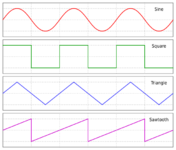
Moving onto a triangle wave, also 2V peak to peak. Here, the square still gets us an all positive wave that peaks at 1V, but now we have peaks, rather than a straight line. The mean here is the average voltage over the cycle. Without math, picture a wave made out of play-doh. It's a nice shape until a gigantic sky foot comes down and squashes it. Well, that level is the mean, and that foot unfortunately just did calculus. So I guess my explanation needs to end there.
dave*99
Well-known member
RMS can be thought of as the heating value.
Apply 10V DC to a resistor. Measure its temperature. Let’s say it heats up to 100 degrees.
Now substitute your wackiest noisiest AC waveform to power the resistor. If it goes up to exactly 100 degrees then your waveform was 10V RMS.
Some waveforms are very complex and there is no equation available to calculate the RMS value.
Others are quite simple and have a direct calculation available.
Apply 10V DC to a resistor. Measure its temperature. Let’s say it heats up to 100 degrees.
Now substitute your wackiest noisiest AC waveform to power the resistor. If it goes up to exactly 100 degrees then your waveform was 10V RMS.
Some waveforms are very complex and there is no equation available to calculate the RMS value.
Others are quite simple and have a direct calculation available.
Free energy for all ? The op have this problem that he probe voltage at breaker is different from voltage probed (higher) at the end of a 70’ electrical run ? So rms is the answer?Ok, so you want me to explain something that requires calculus, without calculus. Let's see what I can do (which is probably not much, since I'm not a good teacher).
If you're familiar with Ohm's law and Joule's law (V=IR and P=IV), and you've applied them to AC systems, then you've used RMS. An AC waveform is constantly changing voltage, up, down, positive, negative, so what number do you plug into those equations? It isn't the peak to peak (wave amplitude), or the peak above midline. That's where RMS voltage comes in, though RMS can apply to current as well, and RMS voltage and current can be used to calculate thermal power (there is no such thing as RMS power).
Let's start with a hypothetical 50% duty cycle 2V peak to peak square wave. It spends half it's time at +1V and the other half at -1V. The square of 1 is 1. But the square of -1 is ALSO 1. So step 1, "square", this wave is always 1 (i.e. the square step flips any negative half into positive territory, so an RMS value is always a positive number).
Now the "mean". In this case, we now have a flat line at 1, which averages out to 1, so the mean is just 1. Now we take the square root of 1, and get 1. So a 2V peak to peak square wave has an RMS voltage of 1.
Moving onto a triangle wave, also 2V peak to peak. Here, the square still gets us an all positive wave that peaks at 1V, but now we have peaks, rather than a straight line. The mean here is the average voltage over the cycle. Without math, picture a wave made out of play-doh. It's a nice shape until a gigantic sky foot comes down and squashes it. Well, that level is the mean, and that foot unfortunately just did calculus. So I guess my explanation needs to end there.
Metal-Marc
Well-known member
Free energy for all ? The op have this problem that he probe voltage at breaker is different from voltage probed (higher) at the end of a 70’ electrical run ? So rms is the answer?
Nah, OP is using a crappy meter that is most likely out of wack on top of being crappy and everyone is out there running crazy trying to solve the problem by using differential equations. or something.
Nah, OP is using a crappy meter that is most likely out of wack on top of being crappy and everyone is out there running crazy trying to solve the problem by using differential equations. or something.
It’s been point out multiple times. Op have a crappy meter, but as long as he took the measurements correctly on the same setting and time frame, the voltage differential should not increase and should only be decrease under normal circumstances at the end of a 70’ run. Vs doesn’t change right ? Why would Vpp be higher at the end of a 70’ run and not at closer to the Vs? Right ? Breaker is Vs. let’s say it’s a crappy meter but still a meter that behave the same for point a and point b measurements right.
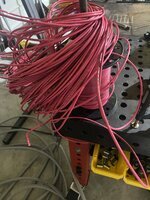
Pretty sure this is the wire condition when op took the measurements, doesn’t look like there is a load on the end of those wires, doesn’t looks like it’s in any flex conduit or it is pulled into a conduit yet. (Maybe, dunno for sure) but this pic. From his other thread says, it ain’t looking liking it.
Other thread
Last edited:
SlappyWhite
Well-known member
Is this a serious question or trolling?O
Ok math solutions then what does it mean
Assuming it was serious it is the equivalent AC voltage (based on power) compared to a DC voltage. For example 240 VAC (RMS) will dissipate the same amount of power for a fixed resistance value as 240 VDC. RMS is more or less a given (it is redundant and not noted) when someone says 120v, 240v, etc. it is RMS. The formula is how it is calculated.
What we call 240 VAC is the actually the RMS value (as per above) and it is around 340 v peak. When we say 120 VAC is will be around 170 v peak. We don't generally use peak and if we do, peak will specifically be noted. All this is the very, very, very basics of alternating current electricity.
Does it sounds like any one explains rms ?Is this a serious question or trolling?
Or how it fits into the op?
Every one throws out acronyms like they are Rapping like that half dollar guy
SlappyWhite
Well-known member
Perfectly clear what people are saying to most. RMS is not just some acronym, it is the very, very basics of understanding AC.Does it sounds like any one explains rms ?
Or how it fits into the op?
Every one throws out acronyms like they are Rapping like that half dollar guy
A cheap or bad meter can get RMS wrong and it is a possible explanation on how the measured voltage increased.
Cruzan80
Well-known member
But what happens when your oscilloscope comes with a DMM attached? Stole pic off eBay, faster than digging mine out.Since I mentioned both a DMM and an oscilloscope in my post, I'm not sure which one you are referring to with this statement.
- If you're talking about an oscilloscope, then the scope's AC RMS measurement will be true RMS, provided you've sampled at a reasonable density (easy for a 60 Hz sinusoid).
- If you're talking about a DMM, then refer to @Ritman's post #42 about a non-true-RMS (or standard) DMM

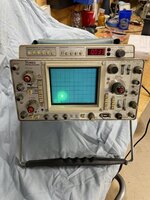
In seriousness, I get where you are going with this.
A bad meter gets rms wrong on the same Voltage source? Should have the same result on point a or point b right not just point b and not point a ? Must be a smart meter.Perfectly clear what people are saying to most. RMS is not just some acronym, it is the very, very basics of understanding AC.
A cheap or bad meter can get RMS wrong and it is a possible explanation on how the measured voltage increased.
wyliesdiesels
Well-known member
Where did the OP go?
SlappyWhite
Well-known member
Multiple posters explained this already. The RMS formula is for a perfect sinusoidal wave aka sinewave. If there is EMI, induction, whatever along the path the output may have distortions and maybe that meter does not deal well with them. A true RMS meter may give better results. But this is just a possible cause for a false reading not an end diagnosis.A bad meter gets rms wrong on the same Voltage source? Should have the same result on point a or point b right not just point b and not point a ? Must be a smart meter.
Metal-Marc
Well-known member
Electrocuted.Where did the OP go?
Emi? Ok. Can’t disagree with that. It would have to be at least 20Vpp higher in order for that meter to get that 258Vrms right according to that these internet formula?Multiple posters explained this already. The RMS formula is for a perfect sinusoidal wave aka sinewave. If there is EMI, induction, whatever along the path the output may have distortions and maybe that meter does not deal well with them. A true RMS meter may give better results. But this is just a possible cause for a false reading not an end diagnosis.
cmandp
Well-known member
No, calculus. Specifically integrals. Differentials equations comes after Calc 3Nah, OP is using a crappy meter that is most likely out of wack on top of being crappy and everyone is out there running crazy trying to solve the problem by using differential equations. or something.

Think of it this way:Does it sounds like any one explains rms ?
Or how it fits into the op?
Every one throws out acronyms like they are Rapping like that half dollar guy
In a simple dc circuit, the power flowing is V*I. That's pretty easy to calculate as the voltage and current are constant through a fixed load (resistor).
If you graph (or use an oscope) the voltage and current over time (or use a voltmeter and ammeter), they show constant non-zero values. You can read right off of the graph for each or both meters.
Let's say a 125 vdc battery has a 25 ohm resistor placed across it. Then 5 amps will flow from the battery through the resistor and return to the battery. The voltmeter reads 125 volts, ammeter reads 5a. So P=VI = 125v * 5a = 625 watts.
When a square looped wire is symmetrically rotated within a magnetic field, a symetrical sinusoidal voltage is produced in that wire. (red line in graph.)
Instead of a battery, we now connect a symmetrical sinusoidal voltage output (what the grid provides) to the resistor. The voltage in this case is constanly changing: from 0 to a positive peak, back through zero, continue to a negative peak and then return to zero. Our grid voltage does this 60 time per second.
The average of the area traced out by the sinusoid above 0 and of that below 0 are identical values in magnitude but one is negative and the other 1/2 of the sinusoid is positive.

But we know current had to flow through the resistor b/c voltage was placed across it. However the voltage is varying and that makes the current vary.
So what values to use to calculate power??? To make it worse, during the other 1/2 of the sinewave, the voltage is negative and makes the current flow in the opposite direction. The resistor got hot from the current flowing in both directions. It didn't heat up with current flowing in one direction and then cool down when current reversed!! It got hotter.
To make life easier, constant values are easier to communicate, just like in the original dc circuit. 125vac is the rms voltage of a symmetrical ac sinusoid that has a peak value of 177 volts - first positive and then -177 volts negative. (That is "A" on the graph.)
So what does RMS mean? Root, mean, square >> Square root, average, square.
1st) square every value along the trace of the sinsusoid represented at the black dashed lines. (Squaring makes the negative values positive.)
2nd) Add all "N" of these values together. (N is the number of black dashed lines.)
3rd) Divide that total amount by (n+1) to get the average of the sum of all of those values.
4th) Since all of the values were squared, take the square root to "undo" the squaring.
When this is calculated using an integral (calculus) the answer is very precise because the black dashed lines infinitely increase in quantity for higher precision vs. an approximation using only a few dozen lines.
A symmetrical sinusoidal wave with a magnitude of 177volts peak (or 354 volts peak-peak) at 60 cycles per second is 125 vac (rms).
(Which would you rather say?)
So now P in the ac circuit is VI = 125vac (rms) * 5 amps = 625w.
All of this has nothing to do with the OP's question
but you asked! 
Last edited:

johnre
Well-known member
Use the DMM for more accurate DC readings, or whenever differential measurements are needed and you lack a differential probe.But what happens when your oscilloscope comes with a DMM attached?
Use the scope for everything else.
alfadan
Well-known member
He's sitting in his hot-*** garage studying calculus.Where did the OP go?
mike93lx
ALLIANCE MEMBER
Seems like he just abandons threads, like the other one when it was pointed out he used a red for the egc and it needed to be replaced...Where did the OP go?
It’s been point out multiple times. Op have a crappy meter, but as long as he took the measurements correctly on the same setting and time frame, the voltage differential should not increase and should only be decrease under normal circumstances at the end of a 70’ run. Vs doesn’t change right ? Why would Vpp be higher at the end of a 70’ run and not at closer to the Vs? Right ? Breaker is Vs. let’s say it’s a crappy meter but still a meter that behave the same for point a and point b measurements right.
Pretty sure this is the wire condition when op took the measurements, doesn’t look like there is a load on the end of those wires, doesn’t looks like it’s in any flex conduit or it is pulled into a conduit yet. (Maybe, dunno for sure) but this pic. From his other thread says, it ain’t looking liking it.
Other thread
@Tynee is this the RMS thread you are referring to ? let me know where science failed you.
- Status
- Not open for further replies.