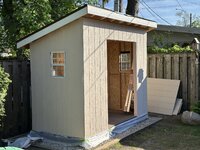
Update: Doors and trim are up! Great success.
There was a good chance to parallelize a couple tasks last weekend. First, I laid out all the trim and gave them a first coat of paint. I used Benjamin Moore AURA exterior paint, in Fresh Brew color, which matches our house trim. Definitely use 1/2" or more nap on the roller, as the
LP siding has aggressive texture. I had used 1x6 LP for the fascia and skirt trim, and the others are 1x2 and 1x4. My wife and I pre-assembled the four sets of window trim. While that dried, I could get to real "woodworking" on the doors


Moving to the
door structure, assembly and mounting... As you saw above, based on my width measurement (59 1/2" total framed opening), I had to use a thinner-than-ideal vertical stile in the middle part of the door. This was because I had already ordered two
24" transom windows. I had ordered those awhile ago, maybe too quickly, since I hadn't fully fleshed out all the dimensions and gap requirements for the door. But since I had the windows in hand already, I really wanted to make them work. I
should have widened the door frame opening in the design, but even as we raised the front wall, I wasn't thinking ahead to the exact details -- for example that the windows need 24 1/4" rough opening (there's a half inch off the available door structure width already).
For the 1.5" wide piece, you're thinking that's just a 2x2"... but good luck finding a straight and true 2x2 at the store. I had to pause for an extra hardware store run to get a couple ideal 2x6, from which I ripped the "2x2".
All that being said, I was worried that 1.5" wouldn't be strong enough, and I wanted to increase strength of that joint with a half lap joint. However, not being a woodworker, I compromised and used glue + screw for the remaining cross and angle joints. Here's the layout of the wood, before joining:
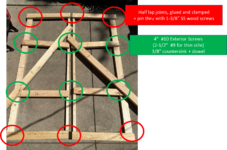
The crosses and angles were scribed and cut to length after the primary structure was assembled, squared, glued, clamped, screwed.
Oh wait, first we need to cut some half laps. I tried to use the stop feature on my miter saw, but found that I operate the saw with inconsistent force on the arm, resulting in different depths. So, I switched to simple Japanese pull saw and vice clamp down in the basement shop. It took about an hour to cut the 16 half laps. Sure, could have also cut the crosses and angles like this, but you have to keep reminding yourself, "it's a shed" and make the right tradeoffs so you get the project done in that one week(end) timeframe.
I don't have to tell anyone how to square these up, but it's worth mentioning to find a really nice flat surface to do this on. And lift it up off that best ground with some equal blocks, like offcuts:
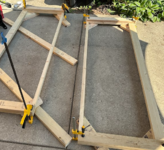
All together, these doors are quite sturdy. Heavy, in a good way (Except my worst shed injury to date is now dropping the edge of the assembled door on my toe -- the one day i wasn't wearing my steel toe project boots). Here's the structure as finished and mounted:
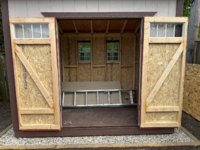
Lets back up though... we have to finish the doors and mount them. After a few beers and talking it through with my friend Justin, who happened to be in town last weekend, we agreed to build and mount the doors in-place. There was some discussion, because I had seen a variety of approaches on YT. Ultimately, I liked
what this builder came up with. You can't see in this image, but behind the door structure are six 2x4 blocks that are temporarily screwed down 1.5" back (door width) inside the frame. Three blocks each top and bottom meant that dimension was already perfect:
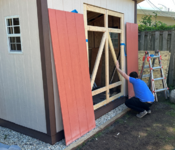
I got a variety of spacers and we put the door structure in place in the frame with the as designed gaps. fit almost perfectly, maybe 1/16" off in the center bottom. no big deal, that's why there's
extra margin built in to the dimensions of the door structure. In general, I kept the door structure 1/4" offset from the frame [top and sides] and 3/4" on bottom. 1/2" in center between doors. With spacers in place, the door structure was basically holding itself in place. Then, one side at a time, we held up the door panel and scribed where it would mount to the structure. While the door panels are the exact cut outs from the walls themselves, we still had to pull out the circular saw. We decided to do a 3/16" space between wall and door panels, which was a bit wider that the kerf left with the initial cut. We also cut off the leading and trailing shiplap edges, but did this AFTER the panels were assembled to the door, in order to cut it flush. Then, take down the structure and assemble. We had some fun and shot 113x2" from the nail gun
[note, dial in the nail depth precisely flush with the siding and it just barely doesn't poke through the door.]
With structure + panel built, we put THAT back in to the frame, with the same block + spacers approach. Then, we cut the trim to length, starting with the frame and hinge side verticals. Next, the cross trims. with those in place, we mounted the
11" T hinges. Since I was only using two hinges (aesthetics mostly), I got some really solid hinges. Of course we had to use our own 2" screws vs the included 1", in order to penetrate down to the structure. Finished with a drop bar latch. It really turned out to work and look fantastic at this point! Again, due to limited space I used a single trim down the center as an astragal. It attaches to the right door, which gets the handle.
Comment: Any recommendations on door holders? Like maybe a magnetic catch to grab and hold the door wide open?
Comment, also: I think it would be a big benefit if others share their approach to building and hanging doors. This might could have been simpler or faster than I made it. But I knew this approach would make it look great even if everything we had done up to now had bad square and plumb.
Looking


I also added 1x2 trim ("frieze block"??) between soffit and wall, which added a really huge level of polish that I didn't initially have in the design.
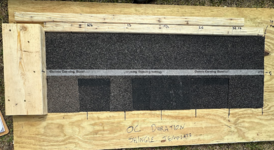
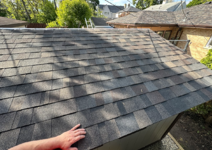
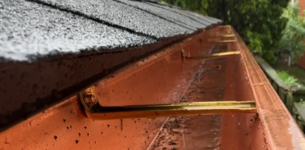
NEXT up: shingles, gutter (we had rain and turns out with drip edge, water lands directly on the rear timbers. duh).