To avoid these ads, REGISTER NOW!

Adding circuits to an already full panel - what are my options?

OP
S

stickshift

Well-known member
Joined
Nov 16, 2011
Messages
1,236
Location
northeastern US
Hey guys, coming back to this as I got sidetracked on other stuff.

Op, do a load calc. Odds are 100A is fine for your house.
I found a NEC standard electrical load calc form for single family dwelling.

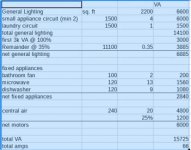
Performed a rough calc - pic attached below. Instead of the minimum 2 small appliance circuits, I used 4. Ballparked the fixed appliance and central air loads.

Oven, dryer, and central heat are all nat gas. No electric vehicles.

So the total load works to ~16k VA and ~66 amps. Assuming my ballpark figures are not way off, I think it's safe to say that 100A service is plenty sufficient for current needs. I'm glad I went through this load calc exercise, so thanks for that suggestion.

As for nice-to-have uses, a 120V compressor would bump up the total load to ~19k VA and ~80A. A 220V welder would put us way over 100A, but arguably even that could probably be managed within a 100A service because it's a rare-use item, so we could schedule it for times when no other large loads are in use (e.g., no AC, compressor, microwave, or dishwasher).

I'm not too worried about potential future needs beyond this because we're not going to be here in 10 years; maybe not even 5 years.

Looking at the main cable, it feels like this may have been a 60A fused service that got upgraded in 1970 with a 100A panel.

Is it REALLY a 100A 'service'?

Looking at the wires, seems like there is old romex, and much old cambric-covered cables. IMO it isn't a clean '1960 install'.

If it isn't wired properly to size for a 100A service, you don't even have that....
I don't know the history, and yeah, there are some pretty old looking cables. Talked to a neighbor (our houses were built at the same time by the same builder) who upgraded to 200A panel a decade ago, and he said his old panel was a CB panel, not fused, but of course it's possible a prior owner made that upgrade.

All I know for sure is that our current use hasn't tripped the main breaker.
 

Attachments
  • load calc.jpg
    load calc.jpg
    19.9 KB · Views: 33
Last edited:
To avoid these ads, REGISTER NOW!
OP
S

stickshift

Well-known member
Joined
Nov 16, 2011
Messages
1,236
Location
northeastern US
I was hoping to tell you about pulling the meter and replacing everything below it with a 100a service hardware (assuming you were capable to safely do that) would be a better approach to purchase new hardware and maximize your labor for the long term solution.

HOWEVER, looking at the exterior pics, you’re really in need of a complete new service from the weatherhead down to the dirt.
[*]The weatherhead is swinging in the breeze,
I assume the weatherhead is the connection just before the wires run into the conduit section that extends out away from the wall? The neutral wire from the pole is anchored to the house and it runs from there to the conduit, so the conductors aren't exactly swinging in the breeze (ok, maybe a little). But I'll post up a better pic of that situation.

[*]the 1” emt above the meter is not terminated properly at either end,

[*]can’t tell if the se cable in the conduit is proper size (might be copper?),
Everything above the meter pan is POCO's responsibility, correct? Maybe I can have them fix whatever is wrong north of the meter pan?

[*]the conduit exiting the meter goes into a sill plate (made for cable) and
[*]I doubt it too properly transitions to sec cable, and
[*]I see some leakage into the basement from the se cable.
I suppose I could seal that up with some caulk?

[*]Can’t be certain but your neutral block may not be bonding to enclosure/ground.
OK, so that's fixable, no?

The conduit above the meter looks somewhat recent – anyone “fix” anything lately?
Yeah, I noticed that too. Talked to my folks about that and they haven't had anything electrical worked on in some time, but they did mention that POCO installed that digital meter about a year ago, so I guess POCO could have updated the conduit (and maybe other replacements precipitated this, or maybe the conduit was just in bad shape).

I also went online and PSEGLI Redbook is very **** about touching their meter/seals but does have provisions for electricians to cut in/cut out with proper notice.
Thanks, good to know.

Whether you tandem/quad out the existing panel or add the 100a main breaker sub panel (re-use for future) you need the entire service changed out very soon.
Because it's a fire hazard or electrocution hazard? We're not planning on being here another 10 years, and perhaps not even another 5 years, so if we can get by with the existing service (and from the load calc described in previous post, it seems that 100A service will suffice), I'd be inclined to not undergo the expense. That said, if the current situation is a fire hazard, that totally changes the calculus.
 
Last edited:

mike93lx

ALLIANCE MEMBER
Joined
Dec 9, 2013
Messages
37,544
Location
Richmond, VA
no, the Poco only owns the meter and the wire from the street to the weather head. you own all wire and conduit on your house, plus the pan/box the meter is in.
 

mm08822

Well-known member
Joined
Jan 13, 2012
Messages
5,925
Location
NJ
I assume the weatherhead is the connection just before the wires run into the conduit section that extends out away from the wall? The neutral wire from the pole is anchored to the house and it runs from there to the conduit, so the conductors aren't exactly swinging in the breeze (ok, maybe a little). But I'll post up a better pic of that situation.

Yes, that is the weatherhead. It is supposed to be secured to the wall.
Another picture won’t fix anything. If you think as it is now, might be ok, then you have no business making any assessment.

The original screw holding it has rusted away. So the brittle cable entering it is now flexed and probably cracked the conductor insulation. Once enough water gets into the cable jacket, it will find its way to the exposed energized conductors through the cracks in the insulation. Maybe during some heavy rain storm or ice storm during winter this will happen. No power = no heat = potential to freeze pipes = leaks = $$$. Then there is the sump pump. No power = rising water = clean up = PIA (Your profile indicates you’re a senior, so mom and dad must be up there in years. Think about the issues/stress this could create for them.)

It also might be hanging on the cable drop.
All of the other screws are in bad shape along with the cable jacket.


Everything above the meter pan is POCO's responsibility, correct? Maybe I can have them fix whatever is wrong north of the meter pan?

Not so. Past the weatherhead out to pole is POCO. You own the weatherhead and below – just not the meter. So they are still the homeowner’s problems.


I suppose I could seal that up with some caulk?

It was done wrong from the start. Caulk is not a fix – just a band-aide.


OK, so that's fixable, no?

Yes.

Yeah, I noticed that too. Talked to my folks about that and they haven't had anything electrical worked on in some time, but they did mention that POCO installed that digital meter about a year ago, so I guess POCO could have updated the conduit (and maybe other replacements precipitated this, or maybe the conduit was just in bad shape).

No, POCO did not touch that. It was done wrong to begin with by whomever – just not the POCO. This conduit could become energized and not being properly grounded, it just becomes a shock hazard waiting to kill someone.

Do understand, if the exterior wiring were to create a short or ground and causes a fault on the POCO side, they will come and pull meter, disconnect the drop at the street. It will not be reconnected until a repair/new service is installed and inspected. Plan for several days to 2 week outage.


Thanks, good to know.

Maybe you could look through it and get a better understanding for a residential overhead service??


Because it's a fire hazard or electrocution hazard? We're not planning on being here another 10 years, and perhaps not even another 5 years, so if we can get by with the existing service (and from the load calc described in previous post, it seems that 100A service will suffice), I'd be inclined to not undergo the expense. That said, if the current situation is a fire hazard, that totally changes the calculus.

Possible electrocution hazard. Continuity of service issue for sure.
You don’t think this will get better in the next 5 or 10 years do you? No home inspector is going to miss that disaster. It will become a hurried last minute replacement at time of pending sale – when you will probably pay more than if you are proactive now and shop a few quotes.

There is no calculus here. It is pretty much 1+1 =2. The elements and lack of preservative maintenance has taken its toll.

It makes no sense to put any money into this if you aren’t going to fix it correctly.

Be proactive.
 
OP
S

stickshift

Well-known member
Joined
Nov 16, 2011
Messages
1,236
Location
northeastern US
Op, do a load calc. Odds are 100A is fine for your house.

Another option is to buy a 200A panel now (30 space or more) and wire it as a sub off your existing panel, just to the side. You can add as many circuits as you want to it (within capacity of the breaker that feeds it). The 200A breaker will only be a disconnect, so for now ignore the rating.

Down the road you can upgrade the service, and now your sub becomes the main.

Looking at the main cable, it feels like this may have been a 60A fused service that got upgraded in 1970 with a 100A panel.

Is it REALLY a 100A 'service'?

Looking at the wires, seems like there is old romex, and much old cambric-covered cables. IMO it isn't a clean '1960 install'.

If it isn't wired properly to size for a 100A service, you don't even have that....

Does your power supplier use smart meters? Here they do and the power company has a device that you can pay a small fee(2$ month) and it will provide you with real time power usage info via a smartphone app.


If all you need is one more circuit I would skip adding a subpanel at this time and use a tandem breaker.

Getting a couple quotes on both replacement of the 100 amp panel with a new 100 amp panel and upgrading the service to 200 amp would be a good idea, if your external riser and meter pan is in good shape a new 100 amp panel may be far more cost effective, if it's in rough shape then a 200 amp upgrade would be a no brainer.

Sent from my SM-G965U using Tapatalk

I was hoping to tell you about pulling the meter and replacing everything below it with a 100a service hardware (assuming you were capable to safely do that) would be a better approach to purchase new hardware and maximize your labor for the long term solution.

HOWEVER, looking at the exterior pics, you’re really in need of a complete new service from the weatherhead down to the dirt.
  • The weatherhead is swinging in the breeze,
  • the 1” emt above the meter is not terminated properly at either end,
  • can’t tell if the se cable in the conduit is proper size (might be copper?),
  • the conduit exiting the meter goes into a sill plate (made for cable) and
  • I doubt it too properly transitions to sec cable, and
  • I see some leakage into the basement from the se cable.
  • Can’t be certain but your neutral block may not be bonding to enclosure/ground.

The conduit above the meter looks somewhat recent – anyone “fix” anything lately?

I also went online and PSEGLI Redbook is very **** about touching their meter/seals but does have provisions for electricians to cut in/cut out with proper notice.

Whether you tandem/quad out the existing panel or add the 100a main breaker sub panel (re-use for future) you need the entire service changed out very soon.

Possible electrocution hazard. Continuity of service issue for sure.
You don’t think this will get better in the next 5 or 10 years do you? No home inspector is going to miss that disaster. It will become a hurried last minute replacement at time of pending sale – when you will probably pay more than if you are proactive now and shop a few quotes.

There is no calculus here. It is pretty much 1+1 =2. The elements and lack of preservative maintenance has taken its toll.

It makes no sense to put any money into this if you aren’t going to fix it correctly.

Be proactive.
Thanks for the insights. I'm going to have an electrician come out and give me an estimate.
 
To avoid these ads, REGISTER NOW!
OP
S

stickshift

Well-known member
Joined
Nov 16, 2011
Messages
1,236
Location
northeastern US
I noticed some buzzing at the electrical panel around the time the home AC compressor kicks on. My first thought was maybe the AC capacitor was on its way out, forcing more of the load onto the house electric. But upon closer listening, the buzzing happens ~15 seconds after the outside unit (compressor and fan) and attic unit (air handler) turn on.

I know some buzzing is somewhat common when large motors first turn on, but my understanding is that the high draw is only in the first second or two (the AC unit is over 20 years old), so it seems like that wouldn't be causing this buzzing so many seconds after the initial motor starting draw.

Here's a video - turn up the volume to hear the buzzing - it's in the last few seconds of the video. You can hear the AC kick in in the first few seconds. Video shows the two relevant circuit breakers - left is the air handler, right is the outdoor AC unit.


I checked the conductors going into the breakers, they are not loose. Any thoughts on what is causing the buzzing, and is it anything to worry about?
 

AntonLargiader

Well-known member
Joined
Nov 20, 2016
Messages
1,372
Location
Charlottesville, VA
Now that I think of it, I believe I replaced it. I think at the time I may have scrubbed it with something and swapped breakers around, but when I reorganized that panel I think I replaced it. I mentioned it in a previous thread.

Not going to pull breakers to confirm, though.
 
To avoid these ads, REGISTER NOW!
Top Bottom