To avoid these ads, REGISTER NOW!

Advise on building weld/fab table using 1" plate

Razorhunter

Well-known member
Joined
Apr 25, 2013
Messages
393
I have obtained ( basically for free) a 5'x10'x1" piece of plate steel.
It is not badly bowed or warped. It currently sits on 6x6 blocks in my driveway, and can be manipulated much easier than I would've guessed via placing shims anywhere between the plate and the 6x6's it resides on.
Now obviously I want it as straight and flat as possible, but I probably won't be able to get it blanchard ground or anything like that.
I just want to fab up a frame out if either tubing or c channel to support the 2040lb plate/top.
Anyone here done this? I know how to weld pretty square and straight off of just a concrete floor (using the three-points-of-contact rule) but I'm considering just fabbing/welding the frame up on top of the plate itself, basically using the plate as a flat plane.
I would of course shim it anywhere necessary first and go from there. As I said, when I tightly pulled a very fine monofilament line across it (yes, backyard engineering), it is amazingly flat.
Just trying to do the best I can with what I've got here. Any help or advice is much appreciated guys.
I've needed a big, thick and flat (as possible) weld/fab table for years and quite frankly I've never felt like I'd be satisfied with 1/2" plate etc. I really hope I can pull this off and have a very acceptable level of flatness when complete.
Thanks for your time guys.
 
To avoid these ads, REGISTER NOW!
OP
R

Razorhunter

Well-known member
Joined
Apr 25, 2013
Messages
393
One more thought....
I guess my main concern is the steel I use to frame this with, and how much possible crowning/bowing it will have? I mean, given the steel used for framing isnt necessarily perfect, how much flatness can I even expect here (regardless of my plates level of flatness)?
Obviously this is a fab/welding table and not a machinists setup/inspection table, but what level of flatness should I be shooting for here? What can be expected?
 

TTMotorsports

Well-known member
Joined
Jan 8, 2019
Messages
1,107
Location
Lucerne Valley, CA
I have a 4x10 1inch thick table. Build a nice 2x2 or 3x3 .250 wall box tube frame under it with legs. Then you can clamp the top tight and stitch weld it on. 4 legs itll be bowed and not flat ever.
 

dr_clyde

Well-known member
Joined
Jan 7, 2009
Messages
6,440
Location
Holland, MI
In my signature I have a link to my fab table build, similar in size and scope to what you’re looking to build.

What you want is a framework that makes a truss under the plate. Basically a big torsion box. I would go with no less than 2.5” x 3/16 tube for the frame, legs can be whatever you want.

Don’t just weld the legs on the plate and call it a day, that size plate can and will bow under its own weight if unsupported.

I personally bolted my top on so I can remove and flip it someday, but I also wanted to avoid welding to the top to minimize any chance of distortion. Welding to a table on purpose is a fireable offense in my shop.
 

rsanter

Well-known member
Joined
Dec 22, 2007
Messages
18,506
Location
visalia ca
First you need to really check and see how straight it is in several directions.
If this is good enough for you, then that easy. If. It then you will need to figure out if you want to pull the crown down or push the dip up.

Built a frame that the top will attach with bolts.
You will then use cross bracing under the top, attached to the frame that you will either bolt the top down to to pull the crown down, or you will install a jack (bolt) that will push the dip up.
Remember the frame will have to be strong enough to apply the force to the plate to make it move and hold it there for a very long time (it is called creep when something yields over time).

The other way will be to grind off the high spots. Could be an option depending.
Or weld on one side of the plate to cause shrinkage to make it move to flat

Bob
 

isb cornbinder

Well-known member
Joined
Nov 3, 2010
Messages
7,073
Location
Pacific South West, BC, Canada
I built a heavy fab/weld table much like the one you describe. Like you, I built the base on the table. Rather than welding the legs/struts to the top, I drilled and welded in pins to the frame keep the top from moving. The pins do not have to go very deep into the top.
I bought 4" square tube at Metal Supermarket. The tube became the frame. I did not weld in corner braces because I thought the size of the tube was large enough to be strong.
This might be a good time to consider two way locking casters.
 
Last edited:

sberry

Banned
Joined
Jun 18, 2005
Messages
35,747
Location
Brethren, Michigan
I worked on a nuke that had inch in the fab shop. They set it on saw horses with some planks under for shelves. It could be beefed with a couple pieces acting as beams long ways but 5 ft wide with a couple posts 6 inches in each side aint gonna sag. I understand the vast experience from buildind a bench and all the speculation from that but I worked in a dozen shops similar, all this **** was never a problem and some oF the most useless were the most complex and expensive.
Shop owners drag some back from sales soon piled with **** and can't use a common clamp on them. No reason to crowd the edges here, 6 inches room is good for clamps. Welding a bit to it not going to warp squat.
My own benches are crude, they work, doesn't matter but I probably built a dozen for various shops and over 200 on one job, not once did anyone ever measure flat or check for infitismal warp. Never did I go to a shop and check. Never.
 

sberry

Banned
Joined
Jun 18, 2005
Messages
35,747
Location
Brethren, Michigan
Set up a fab shop of sorts on a ship deck. Set some plate on blocks with a crane for benches, craned couple engine drives and gang boxes on. Moved the equipment in to build a whole gas compression plant,, not one certifiable table, nothing but a couple plates and mostly pipe stands and gang boxes. Couple 6 packs of welders.
 

bad_idea

Well-known member
Joined
Jun 11, 2011
Messages
4,332
Location
Pasquotank, NC
I'm with sberry. Weld er up. For a welding table close enough truly is close enough. Get the plate flat in your driveway, lay the steel frame on the plate, shim any gaps, and weld it up. I believe you will be hard pressed to warp 1" plate stitching it down to the table frame.
 

dr_clyde

Well-known member
Joined
Jan 7, 2009
Messages
6,440
Location
Holland, MI
If you want a grounded metal surface to work on literally anything will work. You could use a piece of 20 ga over a sheet of plywood on top of 5 gallon buckets.

The OP SPECIFICALLY asked how to to keep it flat.

Welding pipe is a whole different animal than working in a shop. You don’t even NEED a table to weld pipe. Most of it is done on stands with a bubble level. Who cares if the bench is flat. All a bench does in a pipe shop is collect tools.

A couple small welds won’t warp a plate this thick, but it does make it hard to take the top off. More than a couple small welds, you can and will distort the top to some degree. There is NO DOWNSIDE to bolting it on. Only upsides. Same with a flat table. Taking a few hours to make a good base has only benefits. Other than some time and a few extra bucks, why would you not want it as flat as possible?

What possible reason could there be to cut this corner?

I just don’t understand why guys here harp on a guy for wanting to make his stuff nice. You never will have to use the OPs table, nor will it make a lick of difference to any of us how much time and money the OP spend making it as nice as they want.

My flat tables are the most useful things in my fab shop. Knowing they’re flat and that I can trust them makes it that much easier to do good work quickly. Why would you not want this benefit?
 

sberry

Banned
Joined
Jun 18, 2005
Messages
35,747
Location
Brethren, Michigan
It's not harping on them for wanting it nice,, nice is good but the absolute insistence that it has way more value than it does is not accurate and lots of guys going heart and soul, great expence for something that isn't going to make a difference.
I like to see guys get value. I don't comment if a guy says, don't care about the cost, has a reasonable grasp on how useful it is, if he wants to call the snap guy for a new socket he use once that's great but if he is doing this under the impression that it's gonna help him do something in general fab he will be disapointed.
It can be nice without great expence in custom features and much of what looks good in high end and industrial with different space and cost restraints are not such great ideas in more modest shops.
Lots of pipe work in nuke type is similar to structural really, 1/2 pipe, the other half restraints. Very exotic brackets really.
 

matt_i

Well-known member
Joined
Mar 14, 2008
Messages
10,726
Location
SE Michigan
I'd add some leveling mounts (swivel feet) to each leg so you have the ability to make the plane level...anywhere, and also deal with any "rock" caused by the 3-points-define-a-plane-and-you-have-4 conundrum.

It would be handy to have some "accessories" which would be cross-beams that bolt into the legs and allow a pallet jack to be used to move it around, unless you are in possession of a forklift.

Last suggestion would be to set in the center of an area, accessible to all sides rather than pushing it against a wall. Otherwise the back ~2 ft will be very difficult to access and probably gather clutter. If you were locked into that setup, think about building a "mezz" someday which is just a set of cubbies and shelves attached to the top.

The one bench that I built, built a ladder frame of C4 x 5.4 channel and then bolted the legs to that frame, the 5/8" top currently is unbolted and hasn't moved in a long time....on the to-do list :) But I did attempt to make it so that if I ever moved that I could disassemble it with my engine hoist. Later came the forklifts and gooseneck trailer so that plan wasn't really needed, but I could not see that far into the future.
When you do get to drilling, its time to buy, rent, or borrow a magnet drill press. You can do without but it will take 25x longer and the holes will not be straight. Plus you can also tap with that DP, so it can be used for multiple things.

Do some planning on what kind of cabinets you want to put under it when choosing the leg-height.
 

dr_clyde

Well-known member
Joined
Jan 7, 2009
Messages
6,440
Location
Holland, MI
It's not harping on them for wanting it nice,, nice is good but the absolute insistence that it has way more value than it does is not accurate and lots of guys going heart and soul, great expence for something that isn't going to make a difference.
I like to see guys get value. I don't comment if a guy says, don't care about the cost, has a reasonable grasp on how useful it is, if he wants to call the snap guy for a new socket he use once that's great but if he is doing this under the impression that it's gonna help him do something in general fab he will be disapointed.
It can be nice without great expence in custom features and much of what looks good in high end and industrial with different space and cost restraints are not such great ideas in more modest shops.
Lots of pipe work in nuke type is similar to structural really, 1/2 pipe, the other half restraints. Very exotic brackets really.

You bring up value, it's pretty clear that you don't see the value that some of us do in a flat work surface.

But clearly it is a benefit. How much of a benefit is up to each user.

I find a table's flatness to be the single most important feature.

OP has indicated a flat table is important to him. Why would you try to dissuade him from getting what he wants?

You can absolutely do good work with a table that isn't flat, or no table at all. But it takes longer, more measuring is required, and you can't take advantage of ready made tooling.

At the end of the day, it costs almost nothing extra to make it better.
 
OP
R

Razorhunter

Well-known member
Joined
Apr 25, 2013
Messages
393
Yes I totally agree Dr Clyde. I know the benefits of a flat table and if I'm going to do this, I insist on doing it properly. There is nothing I hate more than having a big thick welding table that isnt flat. This causes way more setup and layout time. I want to be able to throw parts up on this table, and clamp them down instantly, without any shimming etc required, and know that my end result is going to be nice and flat/square/planular. Thats just a given for me.
Anyhow, how would you guys bolt the top down? Are we talking about bolting THROUGH the top, or welding tabs/brackets on the underside and bolting through those? Just curious how you've done it?
I'd also be grateful for suggestions on what size holes to drill for fixture clamps? Much of the time standard C or F clamps will be used, but I'd like to drill a series of holes (possibly for clamps or removeable pins? even), so at any time I can instantly throw a couple pieces of material up onto the table and have locating pins arranged at 90 degrees which would hold the two parts at a perfect 90 degrees without any measuring or use of a square needed.
You follow me? Just a few removable locating/reference pins of some sort.
Trying to decide best way to do this? Not sure if zi should drill/tap for screw in pins? Or drill for large taper and use drop in pins? Or just use square pins that drop in with a clearance fit and won't fall through due to a small backing plate tacked underside etc.
Any ideas appreciated.
Will check out your table this afternoon Dr Clyde. Thanks so much.
 

BarryWells

Well-known member
Joined
May 26, 2019
Messages
647
Location
In the mountains
6" c channel facing out all around. Weld 4 x 4 x 3/16 or 14" square tube legs to the inside of the C frame.
Put it where it'll stay.If the floor isnt flat, meaning the C frame wont be either, this is when you lift and add bottom plates to the 4x4's. One may be 1/8" and one may be 3/4 thick. Depends on the floor. I dont care for commercial levelers. Too much money for nothing. Plates will do you fine. Put some paint on all sides of the feet shim plates(if needed). No need to weld.Ine the monsterr is sitting on them it's there for keeps LOL
Set that 1" plate on top and get shimming and leveling all the way around.Bowed part up, of there is any bow. Rent a mag drill and drill the bowed part through the plate and channel. Use some 3/8 countersunk allen bolts to pull the bow down evenly.I thread my C channels but bolt through and nuts are fine. Take your time. Getting the top flat and level will take twice as long as the legs and C-channel frame.With a 1/2 inch plate the whole thing( with paint) is a day and a half.Real easy to shim and pull flat in comparison to that 1" (ALTHO 1/2' is usually bowed up/twisted a bit more) 3 days with the monster plate. I can pull a half inch plate perfect with 2-5 shims and screws.A twisted 1" might take a dozen.
4 legs( forget six) and maybe 3 of the C-channels across the C frame to drill /shim and pull before the plate goes on.Leave those cross pieces a tad lower than the outside...like 1/16.
Leave a foot off that plate the ends and about 6-8 inches off the sides. Then you can start welding together your lower shelf(2 x 2 x 1/4 angle and expanded metal.Weld angle ears to the legs and just let the shelf frame sit on them so it can be removed later for paint or moving the top and frame to another location.The expanded can be attached with 12 dozen little tacks. Nothing more. Paint everything a second round, especially underneath.
If you ever need to move the monster you'll never regret this method of building.
 

Craftfab

Well-known member
Joined
Sep 19, 2018
Messages
411
Location
Garage
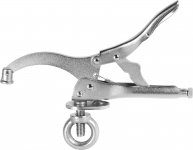
You can get pins like these to drop in 5/8" holes.

https://genuinemetalworks.com/products/aluminum-6061-fixture-stops-x4

5/8" / 16MM holes is what you will see on most all of the tab and slot type fixture tables so there are many companies that make clamps and pins for that hole size. Armor tool the clamps linked below that also use that hole size.

https://armor-tool.com/product/6″-weld-table-clamp/

Bessey and others make F clamps that fit in these holes too but a more budget option is F clamps from HF or the like, cut off the fixed head end and weld it on to a 5/8" bolt and drop that in a hole on your table. Lots of videos on YT of these modifications.
 
To avoid these ads, REGISTER NOW!

dr_clyde

Well-known member
Joined
Jan 7, 2009
Messages
6,440
Location
Holland, MI
Yes I totally agree Dr Clyde. I know the benefits of a flat table and if I'm going to do this, I insist on doing it properly. There is nothing I hate more than having a big thick welding table that isnt flat. This causes way more setup and layout time. I want to be able to throw parts up on this table, and clamp them down instantly, without any shimming etc required, and know that my end result is going to be nice and flat/square/planular. Thats just a given for me.
Anyhow, how would you guys bolt the top down? Are we talking about bolting THROUGH the top, or welding tabs/brackets on the underside and bolting through those? Just curious how you've done it?
I'd also be grateful for suggestions on what size holes to drill for fixture clamps? Much of the time standard C or F clamps will be used, but I'd like to drill a series of holes (possibly for clamps or removeable pins? even), so at any time I can instantly throw a couple pieces of material up onto the table and have locating pins arranged at 90 degrees which would hold the two parts at a perfect 90 degrees without any measuring or use of a square needed.
You follow me? Just a few removable locating/reference pins of some sort.
Trying to decide best way to do this? Not sure if zi should drill/tap for screw in pins? Or drill for large taper and use drop in pins? Or just use square pins that drop in with a clearance fit and won't fall through due to a small backing plate tacked underside etc.
Any ideas appreciated.
Will check out your table this afternoon Dr Clyde. Thanks so much.

I welded brackets on the frame, and drilled and tapped the top through for a bolt. You can easily do this with a magnetic drill, rent one for the weekend if you don't own one. Trust me, it'll be worth it.

As far as holes on the top, mine is drilled 5/8" on 12" centers. This allows the use of common Stronghand hold downs. They aren't tapered, they're just a 5/8" through hole.

You can drill and tap 1/2-13 for mill strap clamp sets, but I find those to be much, much slower than a drop in clamp.
 

royce

Well-known member
Joined
Jun 22, 2014
Messages
3,103
Location
fairbanks ak
Why on earth would anybody build a table that is not flat and level?
It is beyond my comprehension that somebody would advocate against it.

I've mentioned it before but I really like a bolt on square on my table, it really adds speed to fitting up and tacking off.
Nothing fancy, just a couple flat bars, with the inside corner relieved a bit for clearance at the joint.
A few holes for hold down dogs or clamps is handy as well.
Here is a pic

Royce
 

Attachments

  • image.jpeg
    image.jpeg
    124.9 KB · Views: 120

pamike

Well-known member
Joined
Aug 4, 2015
Messages
694
Location
Central PA
Another advantage to bolt on is you can pull the top and have it blanchard ground to flatten it back up if it ever gets messed up.
 

sberry

Banned
Joined
Jun 18, 2005
Messages
35,747
Location
Brethren, Michigan
I worked on a LOT of different benches, in a LOT of different fab shops. Some nice ones, some of the largest contractors in the world, some next to a power pole in a truck lot, welder sat on a pallet under a semi box. I would do what it took to enhance production and tailor it for that if it made a difference.
There are some common features I like and most are not what some seem to be facinated with. I like it solid, only holes and slots on one end in an overhang, very minor. 1/2 is plenty if I am main framing or partial framing. I like overhang, 4 inches, bit more is ok with heavy plate but 1/2 is good and reduces some clamp to bench and piece to piece adjustments. Can drill or burn a hole in if needed and not so fussy a guy gotta worry about hurting it. It's really rare anymore I got to do this.
I like electric under floor if possible, a clamp, hammer and wrench rack and a shelf underneath. Ideally another bench about 4 ft away with rotator vise. Unless I was building dedicated product I like 42 inch wide, 6 ft long with a cut off/burn box at one end for torch plasma dross. Square ends. 99% of flat connections are 1 off small piece, short sections for splices, angle to angle welds all assembled with small common square and using very common c clamps and vise grip 11R which is about impossible to have too many of. I collect them some and take seberal over bolt thru. A place or 2 I would take and drill as needed if needed. I still got a couple holes I should fill I ain't used since I did 1 job with them 25 yrs ago.
 
Last edited:

BarryWells

Well-known member
Joined
May 26, 2019
Messages
647
Location
In the mountains
Another advantage to bolt on is you can pull the top and have it blanchard ground to flatten it back up if it ever gets messed up.

Or just flip it and re-bolt/reshim. New table(and exactly why you put a good coat of paint on the bottom to protect it for later....in case. A table I built for a guy got all screwed up by a 'tard with a plasma cutter.
Flip. Hit the red oxide with a 7' and some 60 grit. A few bolts to flatten it out, DONE. Idiot no longer works there.
He unloads trucks at night at Winn Dixie. Prefect career.
 

Marctrees

Well-known member
Joined
Mar 5, 2015
Messages
6,265
Location
TX/LA border - Toledo Bend
Me thinks you guys arguing about importance of flatness need to state what YOUR meaning of flatness is.

< .030" off in 8' ?

Granite surface plate flatness ?

For 99% of work the first should be more than sufficient.

I'll bet most tables are farther off than that.

The second is OCD... Time for a Dr. visit.... unless doing something very critical.


Marc
 

Marctrees

Well-known member
Joined
Mar 5, 2015
Messages
6,265
Location
TX/LA border - Toledo Bend
Once table frame is set in permanent location and leveled as close as possible... mark floor w spray paint or fat Sharpie...

Then visually check frame top for wind w winding sticks...

Correct as needed ...

So now you are getting close...

Then place top on frame and...

A pair of 1/2" blocks , stretched taut fishing line, a third shy 1/2" block sliding around under t will find hills and valleys to a sufficient accuracy, brass shim stock and push or pull w bolts to frame where needed.

Can even get fancier using feeler gauge leaves on top of sliding block.

Now my OCD is showing... but if product ends up being off I want to have ONLY myself to blame and not a twisted off level table.

Table must be as flat and level as reasonably possible... otherwise there will be limitations on what type of fabrication work can be done on it.

Marc
 
Last edited:

sberry

Banned
Joined
Jun 18, 2005
Messages
35,747
Location
Brethren, Michigan
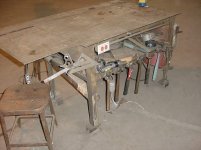
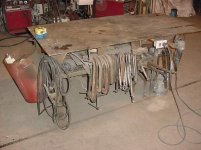
1000's of scuffs.
 

Attachments

  • benches holes.jpg
    benches holes.jpg
    138.8 KB · Views: 79
  • bench welder 4.jpg
    bench welder 4.jpg
    148.8 KB · Views: 73
  • bench1.jpg
    bench1.jpg
    36 KB · Views: 70
  • bench1a.JPG
    bench1a.JPG
    43.2 KB · Views: 57

Monza Harry

Well-known member
Joined
Dec 29, 2018
Messages
1,433
Location
Windsor ON
I think I am more in line with the OP and Dr. Clyde here. I am working towards being in a position come retirement that I can solicit some work for my spending money. I spent about 1/2 of my career doing precision injection moulds. 1/2 thou. was loose, so my OCD is showing. But some may consider this, potential customers will assess some things based on "bragging" not necessarily reality, you do have to aim for the balance between your wants, potential customers expectations and reality as well as your budget. Only you will know and not really until you are done with all of it, so make yourself as happy as you can justify ($$). I am actually getting serious about my welding table build. My legs are 3/16" x 2.5" x 2.5" with a tapered piece of same added I am building a "look" [Thanx Doc's Machine] and strength so mine are about 4 3/4" at the table end with 2"^2 receiver's, and I am going with 3/8" x 3" x 3" "Angle Iron" in between the legs so I will have 4" of "C" clamp depth, 1/2" Wheel Plates (8" wheels) and a floor lock. I will have 2" x 2" 1/4 Angle welded on three sides around the bottom [4th will be bolted for a number of reasons]. I only have room for 3' x 4' but will also be 1" bolted through the "Angle" 6, 1/2-13 screws. For the center I will be using 1/2" strap clamps as they fit my "Bridgeport" and a set each will give a lot of choices. I also plan to have the outside cut square and will add fences for quick square ups. These are just my thoughts for the most useful
"balance" of my needs/space/
$/Visual(?) Also I have some of these, and find them handy, but they all seem to be M12, so I have some adjusting to do. Harry
 

Attachments

  • Clamps.jpg
    Clamps.jpg
    92.9 KB · Views: 14
Last edited:

BD1

Well-known member
Joined
Mar 18, 2007
Messages
4,602
Location
north side
My 4' x 4' x 1 and 1/8'' thick top has 3'' square tube for legs. I boxed the bottom in with 3'' square for a shelf and set flattened expanded metal on it.
At 10' you may consider 6 legs . I see no reason to bolt a top down that size , tacking is fine. If the top was thinner bolting would be better and allow to shim and pull or push for flatness.
Here's a small one I made with my student.

https://weldingweb.com/showthread.php?430711-Small-3%92-x-5%92-rolling-welding-table&highlight=
 

Majordisorder

Well-known member
Joined
Jan 5, 2014
Messages
234
Location
North Idaho
Sounds like you will end up with a nice welding table if you have the space. I would lean toward bolting it to whatever base you fabricate and then you have lots of options to get it as flat as you want. I personally would have no problem fabricating something on a perfectly flat surface and have it be warped anyway :)
 

sberry

Banned
Joined
Jun 18, 2005
Messages
35,747
Location
Brethren, Michigan
Big is good if a guy has work for it. Its ok with multiple men sharing a table but for one man doing general its a lot of walking,,, around and finding it hard to reach the tape or square you left on the other side. My floor is good enough to build common trailers on. Really big and equipment doesn't go on the bench and a guy might need hoisting if it did etc.
As I mention,,, almost anyone ever worked in my shop comments about how easy and workwise it is. A little is due to nice equipment but mostly due to layout and ergonomics really. Not the bench itself so much but the location. Onlyt reason I might make any changes would be for production and tailor a bit as I go for 1 off.
 

slodat

ALLIANCE MEMBER
Joined
Feb 6, 2010
Messages
3,682
Location
Central-ish, WA
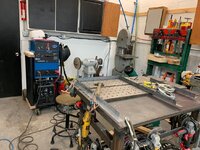
I built the frame for my table a couple years before I found the main part of the top. It's 2 x 3 x .120 tubing, made for a 4' wide x 3' deep top. I originally planned 1" plate with rounded corners and 1/2-13 holes. Then I came across a 3' x 2' x 2.125" cast iron milling machine table. I have two chunks of 1" plate that make up the remaining foot. I still need to fabricate mounts for the 1" to level with the thicker portion. I absolutely love having a flat table to work from. My end results are so much better because of it.

It's still a work in progress..

98d48b2befffa24f1f862c2813c73a1b.jpg

544f6da2f27f0731929b1741698502aa.jpg

Grinder storage on one end.

9b95204a26562dbbf14c57a0d34e9ce1.jpg
 

Attachments

  • 9b95204a26562dbbf14c57a0d34e9ce1.jpg
    9b95204a26562dbbf14c57a0d34e9ce1.jpg
    138.6 KB · Views: 0
  • 544f6da2f27f0731929b1741698502aa.jpg
    544f6da2f27f0731929b1741698502aa.jpg
    188.1 KB · Views: 0
  • 98d48b2befffa24f1f862c2813c73a1b.jpg
    98d48b2befffa24f1f862c2813c73a1b.jpg
    209.2 KB · Views: 2

sberry

Banned
Joined
Jun 18, 2005
Messages
35,747
Location
Brethren, Michigan
I might be tempted to fuss with a section of that plate in a hybrid scheme. Some of this would surely depend on space available, if it fit my layout. If I am doing a bunch I really like a flat clear top and other small bench for vise. Nice to be able to spin stuff around without hitting something.
 
OP
R

Razorhunter

Well-known member
Joined
Apr 25, 2013
Messages
393
Marctrees,
Winding sticks eh? This is a term I've never heard used before. I will have to try and look this one up, as I'm not quite sure what these winding sticks consist of, or how they are used exactly.
Thanks for all the great info guys. Its always great to get new and varied ideas. There is just something about a nice quality welding/fab table that I truly love.
 

NORTON'S SHOP

Well-known member
Joined
Dec 30, 2010
Messages
1,578
Location
Upper Midwest
There's someone on this forum that welded up a IIRC 5'x10' table with a 3/8" thick top and was able to hold .008 flatness across the entire surface without grinding! You may want to search for that thread.

Wish I had the OP's piece of metal sitting in my driveway!
 

346ci

Banned
Joined
Jan 1, 2010
Messages
265
Location
NC, lower part
If it were mine and I had the means, it would be cut in half to make 2 tables and sell one.

For my much smaller table, I welded threaded rod on the underside of the top and bolted it to the frame.
 
OP
R

Razorhunter

Well-known member
Joined
Apr 25, 2013
Messages
393
Hey guys,
A couple of you mentioned cutting the big 5'x10'x1" thick top.
This is actually something I've been struggling with somewhat.
I would love to have this full 5x10' table, but truthfully it is going to be a bit large, and take up more space than I really need it to.
Yes, I've considered selling it, and buying a smaller plate, but honestly thats a hassle, not a ton of buyers, and still not even sure how I'd make out financially speaking.
SO, I had considered cutting it down to something like a 4x8 or 5x8, or even 5x5 all along. However, I dont have easy access to a track torch and I would have to pay at least $100 (times two) for my rollback tow truck buddy to haul it somewhere to get it cut, not to mention the cutting fee.
I had also considered fabbing up some kind of 7" angle grinder "track/guide" and just cutting it slowly with a big 7" angle grinder. A hassle, yes, but possible I feel.
How would you guys go about cutting it? At this time I am still planning to leave it 5x10 and just deal with the monstrosity, but if I had an easy means to cut it I may still consider.
5x10 is going to kill me on shop space, but I dont plan on being here forever and damn if a 5x10 wouldn't be a sweet table. I could definitely make use of it when building some of these driveway swing gates we do. Still kinda torn, but irregardless, I would still like to have options to cut this plate if I decide to go that route. Interested in what you all have to say about cutting methods. Keep in mind I do not wish to pay a ton of money to pay to move it, then have it cut, then move it again. I would love it if someone told me they've successfully used a cutting wheel and some sort of guide/track to do this. Yes, I know it would be one hell of a cutx but doable, no? Or am I insane for even considering?
 
To avoid these ads, REGISTER NOW!
Top Bottom