To avoid these ads, REGISTER NOW!

American Pacemaker - WW2 16x30 back from the dead

OP
8

86turbodsl

Well-known member
Joined
Jul 1, 2005
Messages
6,556
Location
Michigan
Looks like bulletin 16, which does cover my machine, but is not really an instruction manual. The army manual at vintagemachinery does have some in it, but it's not exact.
 
To avoid these ads, REGISTER NOW!

ClappedOutBport

Well-known member
Joined
Mar 30, 2016
Messages
998
Wooo. Subscribed! I really love American lathes, especially the pacemaker. I'd put them up against the best, even Monarchs. I saw a 20" short bed on gov deals for for $600. It hurt me, but I certainly don't have the means for a 9klbs lathe right now. I do have to ask how it's a 50hp shop with only a 20hp phase converter though. :)

Haha! Yeah I'm sure my lathe wouldn't even grunt as it yanked my whole body into it and threw me across the room or worse.

I don't take my hands off the controls unless the spindle is stopped. With exception of the tool post being out of the way and a file at slow speed.

Sent from my LG-TP450 using The Garage Journal mobile app

That thing would certainly wring you out like a beach towel if you got caught up in it. Try to avoid that. :D

I do take my hands off the controls most of the time I am operating a lathe as dark blue chips don't feel good on the hands.

Anybody know what the lever does? Doesn't appear to do anything. I am also ecstatic to report my tailstock is no longer frozen. It spins a full 360 degrees.

Pb blaster is working!
Sent from my LG-TP450 using Tapatalk

As others said, should be the quill lock. Use it with a tailstock center.
 

DocsMachine

Well-known member
Joined
Sep 16, 2006
Messages
1,862
A suggestion for you. Buy a 7/8” triangular, and also a 5/8” round carbide insert paint scraper.

-Mild disagree. The best way to get rust off the ways, that I've found, is a simple razor blade. Use whatever handle or holder you want, and toss it when the edge chips or feels dull. I cleaned up a lathe slightly bigger than that with about half a dozen blades all told.

After the blade scrapes off the heavy stuff, Scotchbrite cut into small squares and lubed with WD-40 works great to scuff off the rest of the rust and bring back a little shine.

Yeah, we're always told never to use abrasives on ways, but in this case, the rust has itself already done more damage than something like Scotchbrite could do even if you had a steam-powered elbow. :D

And don't be afraid to use sandpaper on noncritical surfaces to bring back a little shine.

When I rebuilt mine, I used a little of everything. Vinegar for rust removal, sandblasting, Scotchbrite wheels, electrolysis, needle scalers for paint removal, wet-dry sandpaper, razor blades, Naval Jelly, you name it.

(If you wanna root through that thread, I also had to repair several levers, replace or repair both cross slide and compound handles, repair a couple of gears and make two more from scratch, replace the tailstock handwheel, replace the entire compound, etc, etc.)

Doc.
 
OP
8

86turbodsl

Well-known member
Joined
Jul 1, 2005
Messages
6,556
Location
Michigan
Wooo. Subscribed! I really love American lathes, especially the pacemaker. I'd put them up against the best, even Monarchs. I saw a 20" short bed on gov deals for for $600. It hurt me, but I certainly don't have the means for a 9klbs lathe right now. I do have to ask how it's a 50hp shop with only a 20hp phase converter though. :)


As others said, should be the quill lock. Use it with a tailstock center.

I used to have a 50hp phase converter. It was problematic on a 200A service though. The new phase converter is 20hp, pony start. Much more manageable. I don't have the ability to change the title.

The lathe came with a live center. Makes sense now.
 
OP
8

86turbodsl

Well-known member
Joined
Jul 1, 2005
Messages
6,556
Location
Michigan
-Mild disagree. The best way to get rust off the ways, that I've found, is a simple razor blade. Use whatever handle or holder you want, and toss it when the edge chips or feels dull. I cleaned up a lathe slightly bigger than that with about half a dozen blades all told.

After the blade scrapes off the heavy stuff, Scotchbrite cut into small squares and lubed with WD-40 works great to scuff off the rest of the rust and bring back a little shine.

Yeah, we're always told never to use abrasives on ways, but in this case, the rust has itself already done more damage than something like Scotchbrite could do even if you had a steam-powered elbow. :D

And don't be afraid to use sandpaper on noncritical surfaces to bring back a little shine.

When I rebuilt mine, I used a little of everything. Vinegar for rust removal, sandblasting, Scotchbrite wheels, electrolysis, needle scalers for paint removal, wet-dry sandpaper, razor blades, Naval Jelly, you name it.

(If you wanna root through that thread, I also had to repair several levers, replace or repair both cross slide and compound handles, repair a couple of gears and make two more from scratch, replace the tailstock handwheel, replace the entire compound, etc, etc.)

Doc.

I'll go check it out, but i'm really hesitant to use abrasives on the ways. For obvious reasons. I don't know you ever get them back out again. Then it's basically running down the clock until full grind time.
 
OP
8

86turbodsl

Well-known member
Joined
Jul 1, 2005
Messages
6,556
Location
Michigan
As far as the chuck, I wonder if it had the threads bolted on with those 3 holes somehow. I would think that the bolts would have to go down through the ring as close as they are to the center hole. Weird.
I bought a brand new 3 jaw for mine that is a plain back so I need to decide whether to remove the backing plate from the old one or make a new one or buy one. I have not found a new one for any less than what I paid for the lathe, so rather not do that.

I would have thought if that was an L1 adapter backplate that the threads would stick up and be machined right into the backplate. It does look like something was bolted on around the taper, but i can't fathom what it would look like. I also think most backplates are recessed into the chuck to provide a pilot but this backplate seems to bolt to the face of the chuck. I'm kinda baffled what was going on there. If nothing else, i'll have a permanent chuck on my bridgeport...

Isn't it standard procedure to make your own backplate / adapter for a new chuck? I know you can buy them, but they are fiendishly expensive and you have the tool you need right there so...
 

OccupantRJ

Well-known member
Joined
May 15, 2009
Messages
11,059
Location
Eastern North Carolina
I'll go check it out, but i'm really hesitant to use abrasives on the ways. For obvious reasons. I don't know you ever get them back out again. Then it's basically running down the clock until full grind time.

Burgundy scotchbrite and WD40 is what I use to dress machine ways. A wash with a solvent later will take care of things. No worse than machining cast iron and the powder getting everywhere on it.
 

ClappedOutBport

Well-known member
Joined
Mar 30, 2016
Messages
998
I'll go check it out, but i'm really hesitant to use abrasives on the ways. For obvious reasons. I don't know you ever get them back out again. Then it's basically running down the clock until full grind time.

I doubt I'd worry too much about scotchbright or a brass wire wheel or something on ways that large. The one huge advantage you have is that your ways are removable unlike every other lathe ever. So grinding is now trivial. If I found significant wear, I would try to find a longbed lathe being scrapped, and steal the end of the ways. Those will likely be like new.
 
OP
8

86turbodsl

Well-known member
Joined
Jul 1, 2005
Messages
6,556
Location
Michigan
I doubt I'd worry too much about scotchbright or a brass wire wheel or something on ways that large. The one huge advantage you have is that your ways are removable unlike every other lathe ever. So grinding is now trivial. If I found significant wear, I would try to find a longbed lathe being scrapped, and steal the end of the ways. Those will likely be like new.
Actually this lathe does not have removable ways. That was only on the later models

Sent from my LG-TP450 using Tapatalk
 

jabberwoki

Well-known member
Joined
May 1, 2009
Messages
6,466
Location
puyallup wa usa
Tell me about this pony start set up?
I may have a deal on a 30hp converter and my shop has 200 amp service.
I`ve a 10 hp now but it`s not enough to power up Chomper.
 

DocsMachine

Well-known member
Joined
Sep 16, 2006
Messages
1,862
The one huge advantage you have is that your ways are removable unlike every other lathe ever. So grinding is now trivial. If I found significant wear, I would try to find a longbed lathe being scrapped, and steal the end of the ways. Those will likely be like new.

-Unfortunately, it doesn't work like that. :D

"Replaceable" ways still have to be re-ground back to spec when new ones are installed. All the replaceable version gets you is the ability to go back to factory dimensions after a regrind, rather than being undersized.

I'll go check it out, but i'm really hesitant to use abrasives on the ways.

-Besides the fact that rust is, itself, an abrasive, and the rust pits can and do hold more gunk and grit than can possibly be "embedded" in the cast iron itself, the general rule of thumb is that a grit used between two surfaces will embed in the softer of the two.

To make a cast iron lap, for example, you use a hardened steel bearing as a roller to embed the grit into the iron. Copper laps are commonly used to precisely and finely finish things like small master cylinder bores and the like- the softer copper holds the abrasive, rather than the iron bore.

When using sandpaper or Scotchbrite on cast iron, the paper backing or plastic mesh is of course considerably softer than the iron, making it very difficult to embed any.

Doc.
 

ClappedOutBport

Well-known member
Joined
Mar 30, 2016
Messages
998
-Unfortunately, it doesn't work like that. :D

"Replaceable" ways still have to be re-ground back to spec when new ones are installed. All the replaceable version gets you is the ability to go back to factory dimensions after a regrind, rather than being undersized.


-Besides the fact that rust is, itself, an abrasive, and the rust pits can and do hold more gunk and grit than can possibly be "embedded" in the cast iron itself, the general rule of thumb is that a grit used between two surfaces will embed in the softer of the two.

To make a cast iron lap, for example, you use a hardened steel bearing as a roller to embed the grit into the iron. Copper laps are commonly used to precisely and finely finish things like small master cylinder bores and the like- the softer copper holds the abrasive, rather than the iron bore.

When using sandpaper or Scotchbrite on cast iron, the paper backing or plastic mesh is of course considerably softer than the iron, making it very difficult to embed any.

Doc.

Are you sure? So you'd still have to remove the whole headstock and grind it in? That seems like a waste of money to even swap them then. Who cares if the carriage is dropped by 20 thousands?

Edit: I had be thinking that due to the literature I'd read, which seems to support my case.

Made from a cast-iron mixture containing 40% steel scrap and other ingredients, which produced a semi-steel of approximately 40,000 pounds tensile strength, the bed had detachable V-ways, of solid tool-steel, hardened to approximately 60 Rockwell C, and ground to gauge tolerances for interchangeability with replacement units.

http://www.lathes.co.uk/pacemaker/
 
Last edited:
OP
8

86turbodsl

Well-known member
Joined
Jul 1, 2005
Messages
6,556
Location
Michigan
Tell me about this pony start set up?
I may have a deal on a 30hp converter and my shop has 200 amp service.
I`ve a 10 hp now but it`s not enough to power up Chomper.

It's a WEG 20hp motor connected by belt to a clutch driven by a 2hp single phase motor. I used the clutch so i could automate it and keep friction low. You can just connect a single phase motor to a 3 phase motor. You start the small pony and then throw the contactor for the 3 phase in when its up to speed. It drops starting load current a ton.
 
OP
8

86turbodsl

Well-known member
Joined
Jul 1, 2005
Messages
6,556
Location
Michigan
Are you sure? So you'd still have to remove the whole headstock and grind it in? That seems like a waste of money to even swap them then. Who cares if the carriage is dropped by 20 thousands?

Edit: I had be thinking that due to the literature I'd read, which seems to support my case.


http://www.lathes.co.uk/pacemaker/

My understanding was the early ones did not have replaceable ways at all. And the later ones, it was optional. I know mine definitely does not have the replaceable ones.
 

ClappedOutBport

Well-known member
Joined
Mar 30, 2016
Messages
998
My understanding was the early ones did not have replaceable ways at all. And the later ones, it was optional. I know mine definitely does not have the replaceable ones.

I saw your first post, and know the discussion is irrelevant. But short of jumping over to practical machinist, this seems like the place to discuss it. But I'll hand the thread back now. :)
 

DocsMachine

Well-known member
Joined
Sep 16, 2006
Messages
1,862
Are you sure? So you'd still have to remove the whole headstock and grind it in?

-That's what I was told, Keeping in mind I'm neither a professional machine rebuilder nor a grinding shop operator. :D

Who cares if the carriage is dropped by 20 thousands?

-The carriage does. The rods and shafts are fitted to the carriage at "ride height", for want of a better term. And what usually happens is the hardened ways don't wear as fast as the saddle, which is usually plain iron.

When the bed is ground, typically you also have to machine, grind or scrape the saddle to match the new ways, so between wear and removed metal, you're looking more like 50 thou or more.

There's also the tailstock height to consider...

Edit: I had be thinking that due to the literature I'd read, which seems to support my case.

-Good catch. I was told they had to be ground in place. I may have been thinking of the later LeBlonds.[/QUOTE]

Doc.
 
OP
8

86turbodsl

Well-known member
Joined
Jul 1, 2005
Messages
6,556
Location
Michigan
Don't forget the carriage is driven off a rack on the underside of the front way so as you drop the carriage you are reducing tooth engagement and increasing backlash.

Sent from my LG-TP450 using Tapatalk
 

ClappedOutBport

Well-known member
Joined
Mar 30, 2016
Messages
998
Very good points Doc, 86. I learned some stuff. :thumbup:

So I guess for a machine with a badly sagging ways, a new set might be a good quick fix, but to do it right, you'd want to turcite the saddle and scrape it?
Then the tailstock could be scraped and shimmed and it should be back to like new.

I'm guessing American sold themselves out of business well before anyone ever needed new ways...

It's a WEG 20hp motor connected by belt to a clutch driven by a 2hp single phase motor. I used the clutch so i could automate it and keep friction low. You can just connect a single phase motor to a 3 phase motor. You start the small pony and then throw the contactor for the 3 phase in when its up to speed. It drops starting load current a ton.

I've heard of this method quite a bit. Do you have the big motor on a magnetic starter? The only issue I've heard about is in the event of a short power outage the big motor could burn up when it comes back online if not turned off. Or does the little motor run full time? Also you still need capacitors for the full 3 phase power to fix the power factor, right?
 
To avoid these ads, REGISTER NOW!
OP
8

86turbodsl

Well-known member
Joined
Jul 1, 2005
Messages
6,556
Location
Michigan
I've heard of this method quite a bit. Do you have the big motor on a magnetic starter? The only issue I've heard about is in the event of a short power outage the big motor could burn up when it comes back online if not turned off. Or does the little motor run full time? Also you still need capacitors for the full 3 phase power to fix the power factor, right?

Everything on mine is automated by my plc. Order of operation is lock clutch, spin up single phase motor, check rpm, at 1800, disengage clutch and spin down single phase, engage 3ph. As the big motor is already spinning near unity, there's a slight current inrush as the power is applied because you have to build the magnetic flux in the motor. But is nowhere near the 7X nameplate rating that is typical of a 3ph motor start.

I currently do not have phase capacitors. I would like to add some though, and do some phase voltage monitoring too. It's a work in progress. I have nearly everything to wire the whole shop for 3ph right now, but haven't done it yet.
 
OP
8

86turbodsl

Well-known member
Joined
Jul 1, 2005
Messages
6,556
Location
Michigan
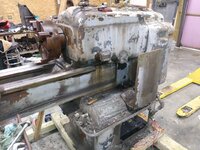
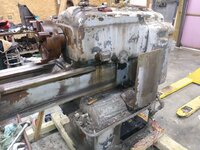
I have continued to chip away at the lathe as i work on cleaning the shop. I've gotten the taper attachement loosened up, and the threading dial is now free.

Main things yet to free - the carriage still doesn't move, and the threading / feed knob doesn't move.
The insides of the headstock/gear box look really good.

Also picked up a needle scaler and it works great at pulling scum off the cast iron. I need to be careful about getting close to dial plates though, it hammers them to death. I nailed one by accident this morning. it had been painted over several times and was invisible.
 
OP
8

86turbodsl

Well-known member
Joined
Jul 1, 2005
Messages
6,556
Location
Michigan
Pulled the switch gear off the backside and now i can see the original motor was a 7.5hp westinghouse. That's gone and in it's place is a higher rpm 10hp motor. I need to put a tach on it and make sure they changed the pulley. Being it's a 5 sheave, it's unlikely they changed it. I may be on the hunt for a 6 pole 7.5 hp motor. I also got the feed/threading lever unstuck. All that remains at this point is the carriage to work on.

My scraper showed up, and it does a nice job pulling rust off ways. So does the scotchbrite. Thanks for the tips guys!

I also found 3 layers of paint on it. Green, light grey and what looks like the original color is a grey/blue. I think this was probably on a navy ship at some point, it looks like a navy grey. I think i'm going to go with that color when i paint it, to honor a war hero.
 
Last edited:

DocsMachine

Well-known member
Joined
Sep 16, 2006
Messages
1,862
I sent the bed of my big Springfield lathe off to be ground, as it had just a little more wear than I'd like to see.

Once I have the bed back, I'll be rebuilding the underside of the carriage (which is worn 40-50 thou in spots) with castable "Moglice", and trying to get it back up to spec. (That is, the carriage is back to the correct height, especially in relation to the control rods and the like.)

Doc.
 

DocsMachine

Well-known member
Joined
Sep 16, 2006
Messages
1,862
Pulled the switch gear off the backside and now i can see the original motor was a 7.5hp westinghouse. That's gone and in it's place is a higher rpm 10hp motor.

-Ditto. Mine had some unknown-HP motor, that according to the old photos, was at least half again bigger than the one that's in it. When I got it, it'd been replaced by a modern 10HP Emerson.

The old motor, like yours, was very likely an 1140RPM unit. The replacement 1725 of course turns everything half again faster.

I don't mind the higher speeds, so I'm probably going to make a new plate that reflects the actual spindle speed. I'll be using a giant VFD to power it, so assuming I need to get back down to the original super-slow speeds, I can just dial the VFD back by 30-40%. :D

I also found 3 layers of paint on it.

-Pretty much all machines of this vintage have changed hands and/or been repainted multiple times. Mine had at least three colors on it, but I was lucky enough to find what I was reasonably sure was the factory dark grey under one of the data plates. Turned out the alkyd enamel I was already using was very nearly the exact same color. :D

(Not that anyone anywhere cares about a "correct restoration" on these things. :D )

I think this was probably on a navy ship at some point, it looks like a navy grey.

-Quite possible. The US Government back in the day used mostly Monarchs, but also had a significant number of LeBlonds, Lodge & Shipleys, DSGs and others.

If it actually saw use on a ship, though, you should run across an anchor stamp, or other Navy emblem. Possibly a riveted brass tag that literally says "Property of the US Navy" or something like that.

While mine was made during WW2 (1943) I have no idea the wartime history of it. I did find evidence it once had a "war production board" tag, so I plan on making a reproduction tag and affixing it in the correct spot.

Doc.
 

ttpete

Well-known member
Joined
Mar 8, 2011
Messages
6,737
Location
Dearborn, MI
-Ditto. Mine had some unknown-HP motor, that according to the old photos, was at least half again bigger than the one that's in it. When I got it, it'd been replaced by a modern 10HP Emerson.

The old motor, like yours, was very likely an 1140RPM unit. The replacement 1725 of course turns everything half again faster.

I don't mind the higher speeds, so I'm probably going to make a new plate that reflects the actual spindle speed. I'll be using a giant VFD to power it, so assuming I need to get back down to the original super-slow speeds, I can just dial the VFD back by 30-40%. :D


-Pretty much all machines of this vintage have changed hands and/or been repainted multiple times. Mine had at least three colors on it, but I was lucky enough to find what I was reasonably sure was the factory dark grey under one of the data plates. Turned out the alkyd enamel I was already using was very nearly the exact same color. :D

(Not that anyone anywhere cares about a "correct restoration" on these things. :D )


-Quite possible. The US Government back in the day used mostly Monarchs, but also had a significant number of LeBlonds, Lodge & Shipleys, DSGs and others.

If it actually saw use on a ship, though, you should run across an anchor stamp, or other Navy emblem. Possibly a riveted brass tag that literally says "Property of the US Navy" or something like that.

While mine was made during WW2 (1943) I have no idea the wartime history of it. I did find evidence it once had a "war production board" tag, so I plan on making a reproduction tag and affixing it in the correct spot.

Doc.

Back in the early 1960s, I served aboard a light cruiser left over from WWII. Our machine shop had Monarchs, two 16" and one 10". We also had a big Cincinnati horizontal mill and a good-sized radial drill.
 

OccupantRJ

Well-known member
Joined
May 15, 2009
Messages
11,059
Location
Eastern North Carolina
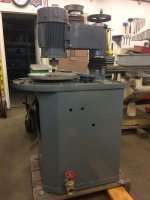
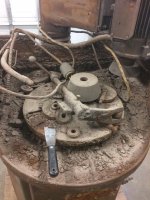
Glad the scraper worked for you. The round version also works great in concave areas of the castings. I use both of mine regularly because there is always a machine of some sort undergoing refurb in my shop. I am working on this flywheel grinder at the moment. That should be a great lathe once again when you are done.
 

Attachments

  • AA5BD993-EA56-4FEA-BDD2-380324ABCF89.jpg
    AA5BD993-EA56-4FEA-BDD2-380324ABCF89.jpg
    142.2 KB · Views: 120
  • B0FD9C8D-819C-4B7C-B7DC-041C7B499F75.jpg
    B0FD9C8D-819C-4B7C-B7DC-041C7B499F75.jpg
    71.5 KB · Views: 117
  • E02C9D3C-7149-48DE-BA5A-3B270223B840.jpg
    E02C9D3C-7149-48DE-BA5A-3B270223B840.jpg
    115.3 KB · Views: 121
OP
8

86turbodsl

Well-known member
Joined
Jul 1, 2005
Messages
6,556
Location
Michigan
Wow what a mess.

Looks fun though. I got the compound off last night but can't for the life of me figure out how to disassemble. Also can't figure out how to get the cross slide off. Making progress though.

e6142c8c8bc3e14fb1920c0445293438.jpgf875e8f3ae0ded240130a8f0963b3646.jpg0d5f69b1972d441ab4750273abd56f4e.jpg9400c8658c43171be85bd5dd2813d28e.jpg

Sent from my LG-TP450 using Tapatalk
 

Attachments

  • e6142c8c8bc3e14fb1920c0445293438.jpg
    e6142c8c8bc3e14fb1920c0445293438.jpg
    81.5 KB · Views: 3
  • f875e8f3ae0ded240130a8f0963b3646.jpg
    f875e8f3ae0ded240130a8f0963b3646.jpg
    132.8 KB · Views: 1
  • 0d5f69b1972d441ab4750273abd56f4e.jpg
    0d5f69b1972d441ab4750273abd56f4e.jpg
    111.9 KB · Views: 1
  • 9400c8658c43171be85bd5dd2813d28e.jpg
    9400c8658c43171be85bd5dd2813d28e.jpg
    130.2 KB · Views: 1

OccupantRJ

Well-known member
Joined
May 15, 2009
Messages
11,059
Location
Eastern North Carolina
If you have not completely removed the gib, you may want to try it. That could reveal some kind of hidden stop that you can only get past with the gib removed.
 

ClappedOutBport

Well-known member
Joined
Mar 30, 2016
Messages
998
Everything on mine is automated by my plc. Order of operation is lock clutch, spin up single phase motor, check rpm, at 1800, disengage clutch and spin down single phase, engage 3ph. As the big motor is already spinning near unity, there's a slight current inrush as the power is applied because you have to build the magnetic flux in the motor. But is nowhere near the 7X nameplate rating that is typical of a 3ph motor start.

I currently do not have phase capacitors. I would like to add some though, and do some phase voltage monitoring too. It's a work in progress. I have nearly everything to wire the whole shop for 3ph right now, but haven't done it yet.

I gotcha. Sounds nice.

Pulled the switch gear off the backside and now i can see the original motor was a 7.5hp westinghouse. That's gone and in it's place is a higher rpm 10hp motor. I need to put a tach on it and make sure they changed the pulley. Being it's a 5 sheave, it's unlikely they changed it. I may be on the hunt for a 6 pole 7.5 hp motor. I also got the feed/threading lever unstuck. All that remains at this point is the carriage to work on.

I'd be tempted to pay Tom Utley to make me a modified tag before I would lug a x-hundred pound motor out. The pacemakers were made to run 2k RPM,so you'd only exceed that by a bit in one gear. Not a bad thing to have faster speeds with modern cutting tools either.

I couldn't get the cross slide gib to move.

Sent from my LG-TP450 using Tapatalk

Is it bridegport sytle? In other words, has a screw going into a slot in the tapered gib? If it's rusty, the screw will never be able to pull it out. My plan of attack would be to:

  1. Rig up a pusher that goes against the back of the gib and rests on something solid
  2. Using the leadscrew to push, apply a small load to the gib
  3. Turn the screw with an impact screwdriver as the pressure is applied

May be best to ask the experts before trying that. It looks to me like once you get the taper attachment off, the whole cross-slide, nut and screw should slide out the back.
 
OP
8

86turbodsl

Well-known member
Joined
Jul 1, 2005
Messages
6,556
Location
Michigan
That's a good idea on the gib. I will keep soaking it down and if it doesn't move in a few days I'll weld something up.

Sent from my LG-TP450 using Tapatalk
 
OP
8

86turbodsl

Well-known member
Joined
Jul 1, 2005
Messages
6,556
Location
Michigan
Got the capscrews on the apron all broken loose and continuing to hose them all down with penetrant.

Also making a half nut lever today. We'll see how it goes.
 
OP
8

86turbodsl

Well-known member
Joined
Jul 1, 2005
Messages
6,556
Location
Michigan
Tonight i got the gib out of the cross slide and the cross slide off. All apron bolts are loose. 2 of the 4 slides on the chuck are loose now. And both chucks are 12" cushman!
A good night! The bushing i made for the half nut lever fits perfect. I ordered a broach to make a keyway and then i'll finish the lever. I think that's the only thing holding the apron from moving.
 

gpw_42

Well-known member
Joined
Apr 24, 2017
Messages
717
Location
NC Sandhills, USA
86, that lathe is an AWESOME acquisition, and will be a tremendous tool when you get it back to functional.

Building on Doc's comment about the acceptance mark, look for something like the one attached to this message, which came from http://www.company7.com/library/sard_7x50_mk.html. The ones I've seen on museum ships were on the tailstock end of the lathe, on the vertical end of the way, not the horizontal side.

As for penetrating oil, Kroil:pB Blaster:: PB Blaster: WD40

I helped a buddy on an 18" Lodge & Shipley restoration; go easy on the gib (like you're doing) and let the penetrating oil get in there and do its thing. If the gib is rusted to the cross-feed, you'll have a helluva time with it. IIRC, there was a screw at each end of the gib. Different brand and size, so that may/may not carry over to what you're doing. As a non-machine shop guy, I was amazed how many gibs were on that L&S.

Items for consideration, which are somewhere in your future:
1) ensure the oil pumps pump
2) be prepared to replace the wipers on the apron and tailstock
3) be prepared to replace the little felt pips in some of the small tubing inside the apron
4) are the cage bearings in the apron functional?
Again, I'm not a machine shop guy, so these sorts of details were amazing to see him dig into. Hope these suggestions are of use to you.

Best of luck as you continue to restore this awesome machine! I'm subscribed!
 

Attachments

  • usn_acceptance_mark.jpg
    usn_acceptance_mark.jpg
    7 KB · Views: 587
OP
8

86turbodsl

Well-known member
Joined
Jul 1, 2005
Messages
6,556
Location
Michigan
Thank you! I know kroil is better than pb, but it's difficult to find in this area. I've only seen it at one auto parts store 20 miles from here and not on the way to anywhere I normally go. I bought a gallon jug of pb and it's done a wonderful job so far.

So far everything has come apart with time and a little persuasion. Got the gib of the cross slide out last night with a little map gas on the gib screw.

Sent from my LG-TP450 using Tapatalk
 
OP
8

86turbodsl

Well-known member
Joined
Jul 1, 2005
Messages
6,556
Location
Michigan
I try to keep my mcmaster orders down. The shipping gets expensive.

I got the last of the 4 jaw loose tonight. It's ready to come off and go into the evaporust bath!

not much to show of pics except the rusty bolts proud of their homes...

also picked up a 14N and 18N jacobs superchucks with MT4 adapters. Added to the live center, i should be set on the tailstock. still need a tool post though.
 

OccupantRJ

Well-known member
Joined
May 15, 2009
Messages
11,059
Location
Eastern North Carolina
Check All Industrial Tools for a QC toolpost. I bought my setup last year right after Christmas for 40% off on everything. They may do that again this year. Not sure.
 
To avoid these ads, REGISTER NOW!
Top Bottom