DEllis
Well-known member
I'm back to finish the outfitting of my new garage. Thread link below.
https://www.garagejournal.com/forum/showthread.php?t=442443
The space is a 23 deep x 24 wide with an in ground lift. It will be climate controlled year round and used as a workshop. The slab was poured in August 2020, 4" thick over a 10mil vapor barrier. The foundation is insulated.
I have picked out the tile, a 24 x 12 LFT. I'd like to lay it in a running bond pattern with 1/3 tile overlaps. I'm starting to work on the prep. Some of the issues I'm trying to work through are listed below. Looking for thoughts and opinions on any of these.
1. The slab is not very flat. With a laser level I mapped out the topography of the floor in a three foot grid. The variation is close to 3/4 inches, with the floor following an inconsistent wave. There is a notable high spot right by the door that I can grind and that would reduce the wave variation to closer to 1/2 inch.
>> I'm considering leveling the entire floor with self leveling concrete. I understand this would be expense, but it seems a reasonable way to get a more consistent surface for the tile. I have prior experience as a flatwork finisher and access to many helpers so I'm confident I can mix and pour fast enough in 3 bag increments to maintain a wet edge with the SLC.
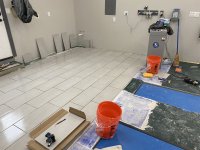
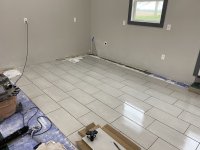
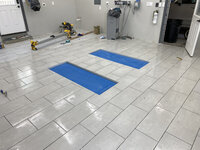
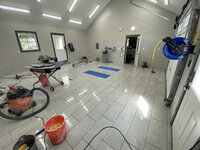
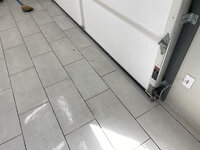
2. The contractor cut quite a few control joints in the tile. I've attached a few pictures below. Sorry I don't have a picture with an unobstructed view, but you can see there's 8 control joints in the slap all originating from a corner of the lift pits. I'm considering the following options.
>> Assume I should cut control joints in the SLC to honor the control joints in the concrete.
>> Option A. Coat floor with Red Guard or AcquDefense. Honor the control joints through the tile and caulk. Cheaper, but the most of the joints will go through the middle of the tile so it will disrupt the pattern.
>> Option B. Lay down NobleSeal CIS on the entire floor which the manufacturer says will allow me to bridge the control joint. I'd then use soft joints/caulk in the adjacent/bridged tiles as specified by their installation sheet.
Any thoughts on the above plan? Cost is not a primary consideration. I want to do this correctly and have the longest lasting floor possible.
thanks in advance,
Duncan
 IMG_0805 by duncanrellis, on Flickr
 IMG_0849 by duncanrellis, on Flickr
 IMG_0853 by duncanrellis, on Flickr
https://www.garagejournal.com/forum/showthread.php?t=442443
The space is a 23 deep x 24 wide with an in ground lift. It will be climate controlled year round and used as a workshop. The slab was poured in August 2020, 4" thick over a 10mil vapor barrier. The foundation is insulated.
I have picked out the tile, a 24 x 12 LFT. I'd like to lay it in a running bond pattern with 1/3 tile overlaps. I'm starting to work on the prep. Some of the issues I'm trying to work through are listed below. Looking for thoughts and opinions on any of these.
1. The slab is not very flat. With a laser level I mapped out the topography of the floor in a three foot grid. The variation is close to 3/4 inches, with the floor following an inconsistent wave. There is a notable high spot right by the door that I can grind and that would reduce the wave variation to closer to 1/2 inch.
>> I'm considering leveling the entire floor with self leveling concrete. I understand this would be expense, but it seems a reasonable way to get a more consistent surface for the tile. I have prior experience as a flatwork finisher and access to many helpers so I'm confident I can mix and pour fast enough in 3 bag increments to maintain a wet edge with the SLC.
2. The contractor cut quite a few control joints in the tile. I've attached a few pictures below. Sorry I don't have a picture with an unobstructed view, but you can see there's 8 control joints in the slap all originating from a corner of the lift pits. I'm considering the following options.
>> Assume I should cut control joints in the SLC to honor the control joints in the concrete.
>> Option A. Coat floor with Red Guard or AcquDefense. Honor the control joints through the tile and caulk. Cheaper, but the most of the joints will go through the middle of the tile so it will disrupt the pattern.
>> Option B. Lay down NobleSeal CIS on the entire floor which the manufacturer says will allow me to bridge the control joint. I'd then use soft joints/caulk in the adjacent/bridged tiles as specified by their installation sheet.
Any thoughts on the above plan? Cost is not a primary consideration. I want to do this correctly and have the longest lasting floor possible.
thanks in advance,
Duncan
IMG_0805 by duncanrellis, on Flickr
IMG_0849 by duncanrellis, on Flickr
IMG_0853 by duncanrellis, on Flickr