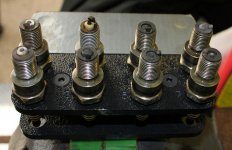
Here's a set of brand new plugs that were installed with copper anti-seize into billet aluminum heads. They only made one 1/4 mile pass and were then removed while still hot. You can see the copper pooled up around the base of the plug. Every new set of plugs (every pass) gets copper anti-seize on the plugs. It's much cheaper and easier than fixing threads in a 15 thousand dollar set of billet heads. Lol.


You are using an out of date browser. It may not display this or other websites correctly.
You should upgrade or use an alternative browser.
You should upgrade or use an alternative browser.
Antiseize on spark plugs?
- Thread starter czgunner
- Start date
Bennylava
Well-known member
at the price of N 7000, its no wonder you have never seen it anywhere else! http://www.ebay.com/itm/Loctite-442...340863?hash=item58d298a3ff:g:GowAAOSwBahVI-MW
It says nuclear grade lol
Guess that's even above aircraft grade
WhiffySpark
Well-known member
- Joined
- Oct 22, 2009
- Messages
- 6,252
I use a tiny dab of super lube
babewatcher
Well-known member
at the price of N 7000, its no wonder you have never seen it anywhere else! http://www.ebay.com/itm/Loctite-442...340863?hash=item58d298a3ff:g:GowAAOSwBahVI-MW
That's a lifetime supply though.
Gila Monster
Well-known member
- Joined
- Jan 2, 2016
- Messages
- 477
My only fear of "not using" anti-seize is I wonder if that's a CYA for the spark plug manufacturers so if somebody globs it on there and it misfires or overtightens it and breaks, it doesn't come back on them when it's first purchased and brought back to the store for a return.
In contrast, no way the spark plug maker gets blamed if it pulls out threads on a head 7 years later when someone changes it out.
I just get very nervous when it comes to aluminum heads.
In contrast, no way the spark plug maker gets blamed if it pulls out threads on a head 7 years later when someone changes it out.
I just get very nervous when it comes to aluminum heads.
My only fear of "not using" anti-seize is I wonder if that's a CYA for the spark plug manufacturers so if somebody globs it on there and it misfires or overtightens it and breaks, it doesn't come back on them when it's first purchased and brought back to the store for a return.
In contrast, no way the spark plug maker gets blamed if it pulls out threads on a head 7 years later when someone changes it out.
I just get very nervous when it comes to aluminum heads.
As long as you install/remove the plug when the engine is cold there should be no worries. Now if only the person before you follows the same rule is the real question. Its not always the end of the world though if the threads get pulled as there are nice timecerts to install in case that happens (a rarity though).
laser3kw
Well-known member
Holy detonation! 
where are the ground straps?!
I hope they aren't embedded in the aluminum....
where are the ground straps?!
I hope they aren't embedded in the aluminum....
Holy detonation!
where are the ground straps?!
I hope they aren't embedded in the aluminum....
Yeah, 7 of the 8 plugs are missing the ground straps, and some of the porcelain. That means one of the cylinders (#2) is still a little bit rich.

WhiffySpark
Well-known member
- Joined
- Oct 22, 2009
- Messages
- 6,252
But I do put a conservative amount of dielectric grease on the insulator to prevent the boot from getting stuck on the plug.
http://www.castlepackspower.com/index.cfm?Page=Castle Brake Life
I use this rather than traditional dielectric grease. It doesn't dry out.
I hate when people slaughter dielectric grease and anti seize on everything
Advice for a young tech, there is a good chance you will be the one working on the same car down the road. I would never use anti seize on any spark plug, because what does the porcelain do when its treated with heat after awhile? it gets brittle and breaks easier! One thing I always use on spark plugs is dialectical grease.
neonlazer
Well-known member
A dab of anti-seize, NOT ALOT!
dragonballz
Well-known member
http://www.castlepackspower.com/index.cfm?Page=Castle Brake Life
I use this rather than traditional dielectric grease. It doesn't dry out.
I hate when people slaughter dielectric grease and anti seize on everything
Slather* lol
But yea, too much dielectric grease and it will insulate what you're trying to conduct!
anndel
Well-known member
I use a tiny dab of super lube
Sorry, I was LMAO regarding your statement but I misread Super Lube for Super Glue.

Just a dab - sparingly of Permatex Anti Seize compound.
Last edited:
I came back and read the thread again and don't know why I thought anti-seize was seize all lol. I don't personally use anti-seize on anything for the fact that I have seen wheels come loose after using it on studs. You cannot adequately torque anything with anti-seize and there is a good chance of stretching the threads. A dab ok I can understand why, would I use it on spark plugs personally? No..
You cannot adequately torque anything with anti-seize and there is a good chance of stretching the threads.
Wrong. There is a simple torque correction formula for various thread lubricants. Fasteners don't self loosen due to anti seize, they loosen if the pre load is insufficient.
From another long winded thread about the exact topic:
Re: Torque number with Anti-seize
The torque required for a bolted joint design comes from a long string of calculations, but boils down to a simple linear equation.
T = Wp x K x dn
Where T=torque; Wp=fastener preload; K=torque coeff; dn=diameter
The factor that changes with dry vs lubricated fasteners is the "torque coefficient" and is published for a variety of cases. Various values exist, mine are taken from DuPont Engineering Specification (10 pages of calcs). Examples:
Dry steel fasteners: K=0.20
Lightly oiled steel: K=0.15
Cad Plated: K=0.14
Anti Seize on steel: K=0.13 (as published by Bostik for their Never Seez products)
Graphite & mineral oil: K=0.10
Using Never Seize versus dry uncoated steel, multiply the specified torque by 0.65.
A very light coating on the threads and head to prevent corrosion and/or galling is all that's needed. As is the case with most Anti Seize applications, a little goes a long way.
jerseykat1
Well-known member
I'm with you on this. I have been doing this for over 15 years. I don't see the need for it.I came back and read the thread again and don't know why I thought anti-seize was seize all lol. I don't personally use anti-seize on anything for the fact that I have seen wheels come loose after using it on studs. You cannot adequately torque anything with anti-seize and there is a good chance of stretching the threads. A dab ok I can understand why, would I use it on spark plugs personally? No..
7 of those years working for ford (3valve v8 debacle)..
it's ok to use a little on the threads but not necessary.
Sent from my Nexus 6P using Tapatalk
GTA Matt
Well-known member
My plugs would look like that after an 1/8th mile pass if one drop of oil or anti seize were placed on the plug and got into the combustion chamber... Plugs go in dry and clean.Here's a set of brand new plugs that were installed with copper anti-seize into billet aluminum heads. They only made one 1/4 mile pass and were then removed while still hot. You can see the copper pooled up around the base of the plug. Every new set of plugs (every pass) gets copper anti-seize on the plugs. It's much cheaper and easier than fixing threads in a 15 thousand dollar set of billet heads. Lol.
I use it on dissimilar metals mainly, but things I usually put it on are plugs, wheels studs. I've have run across plugs that were hard to remove (i don't wrench for a living btw), the same as lug nuts. People have questioned me about it but its what I was taught to do so I keep doing it. Sort of like lubing the gasket on an oil filter, you never really question why you need to do it until you have to remove one that hasn't been lubed in a tight engine compartment 
marlinspike
Well-known member
My only fear of "not using" anti-seize is I wonder if that's a CYA for the spark plug manufacturers so if somebody globs it on there and it misfires or overtightens it and breaks, it doesn't come back on them when it's first purchased and brought back to the store for a return.
In contrast, no way the spark plug maker gets blamed if it pulls out threads on a head 7 years later when someone changes it out.
I just get very nervous when it comes to aluminum heads.
I'll have to see if I can find it (I do have it saved on a computer here somewhere), but at some point BMW put out a TSB saying not to use anti-seize on aluminum engines but also to be sure to use a nickel coated plug, so I don't think it's a CYA.
jerseykat1
Well-known member
I use it on dissimilar metals mainly, but things I usually put it on are plugs, wheels studs. I've have run across plugs that were hard to remove (i don't wrench for a living btw), the same as lug nuts. People have questioned me about it but its what I was taught to do so I keep doing it. Sort of like lubing the gasket on an oil filter, you never really question why you need to do it until you have to remove one that hasn't been lubed in a tight engine compartment
oil filter gaskets always get a bit of oil on them for the reason you stated, they can be very hard to remove if put on dry.
if i encounter a plug thats a little hard to remove i spray pb blaster down there go on to the next then come back to that one last. if i encounter the same problem going on then i use my thread chaser to clean the threads up and it goes back in dry.
i use anti-sieze on duallies because.... well if you ever have to remove the rear wheels on a dump truck without anti-sieve on the hubs you will never put it back together dry again. But not on the studs, just a little pb plaster on the studs.
For general use (non race applications) i don't see it causing any problems i know guys that use it on plugs and never have any issues. I just don't believe its really needed.
My plugs would look like that after an 1/8th mile pass if one drop of oil or anti seize were placed on the plug and got into the combustion chamber... Plugs go in dry and clean.
Interesting....
The plugs I posted came out of a nitro funny car. Nitromethane is one hell of a racing fuel. lol. Especially when you get over 92%. I forget the exact percentage on that pass but it was somewhere between 88-90%.
Beat up the threads on the new plugs, run the wrong size thread chaser through the head, apply liberal quantities of structural hi-temp adhesive mixed with sand and filings from a brake lathe, and then run them in with an impact. Peen and/or stake them into place. A bead of weld couldn't hurt!!! Allow to cure overnight, and you're set! Next time you need to do the plugs, take it to your fave mechanic and demand he do them for the flat rate time.
GTA Matt
Well-known member
Ah, I suspected they may have been out of a nitro car. Mine is a smallish small block spraying roughly 500-550 of nitrous through it. Extremely sensitive to anything in the combustion chamber.Interesting....
The plugs I posted came out of a nitro funny car. Nitromethane is one hell of a racing fuel. lol. Especially when you get over 92%. I forget the exact percentage on that pass but it was somewhere between 88-90%.
View the Galvanic Chart.
Materials close to each other on the scale do not tend to corrode each other much.
So for aluminum heads, use regular cheap zinc anti seize. See how close zinc and aluminum are on the chart. Now observe how copper is far away from aluminum. A copper anti seize may attack or corrode the aluminum.
I use the inexpensive silver zinc anti seize on everything. Some *** puckering moments decades ago trying to get spark plugs out of an aluminum head made me a convert.
Materials close to each other on the scale do not tend to corrode each other much.
So for aluminum heads, use regular cheap zinc anti seize. See how close zinc and aluminum are on the chart. Now observe how copper is far away from aluminum. A copper anti seize may attack or corrode the aluminum.
I use the inexpensive silver zinc anti seize on everything. Some *** puckering moments decades ago trying to get spark plugs out of an aluminum head made me a convert.
Attachments

I don't use anti seize on my plugs BUT most everything else. Instead I use Mobil 1 15/50 engine oil on the plug threads applied with a very small brush. I started doing this after attending a Luguna Seca IMSA race back in 83/84. I was watching the Al Holbert team change out plugs on D. Bell Porsche 962 and noticed them apply a small amount of oil to all 6 plugs threads before installing them. Since I was deiving a Porsche then and I still driving them now I still do it out of habit .
Ah, I suspected they may have been out of a nitro car. Mine is a smallish small block spraying roughly 500-550 of nitrous through it. Extremely sensitive to anything in the combustion chamber.
Thats cool!!!
Are you a small tire radial guy? Do you ever go to SGMP in Valdosta? Lights out 7 is next month.
Have you seen the Duck's new video? lololol
RTCTTFMF
lol
fivespdcat
Well-known member
- Joined
- Oct 25, 2011
- Messages
- 1,520
It's not that simple. Mass of the objects must also be considered for galvanic corrosion.View the Galvanic Chart.
Materials close to each other on the scale do not tend to corrode each other much.
So for aluminum heads, use regular cheap zinc anti seize. See how close zinc and aluminum are on the chart. Now observe how copper is far away from aluminum. A copper anti seize may attack or corrode the aluminum.
I use the inexpensive silver zinc anti seize on everything. Some *** puckering moments decades ago trying to get spark plugs out of an aluminum head made me a convert.
As for spark plugs, anti seize is not recommended on almost all applications, the ones that do recommend specific types and torque levels. Certain anti seize does turn into an adhesive at high temperature...
GTA Matt
Well-known member
Thats cool!!!
Are you a small tire radial guy? Do you ever go to SGMP in Valdosta? Lights out 7 is next month.
Have you seen the Duck's new video? lololol
RTCTTFMF
lol
Yes, run on 28's or 275's. Haven't been to sgmp yet and the car I'm building now won't be ready in time. Duck is a hoot lol
ttpete
Well-known member
I use "Champion 2612 spark plug thread lubricant and anti-seize compound".
It's a liquid that comes in a brush top bottle, and is used on air cooled aviation engines. A little goes a long way. I use it on all of my spark plug installs and have never had any problems.
It's a liquid that comes in a brush top bottle, and is used on air cooled aviation engines. A little goes a long way. I use it on all of my spark plug installs and have never had any problems.
snowpro90
Well-known member
I always put a little on the threads. Makes tune-ups a breeze.
B_Bimmer
Well-known member
I had no opinion. Saw this thread, thought "that sounds interesting". After reading it, I shall apply a small dab of anti-seize... Or just quit buying anything with a gas engine. Diesel is under $2.
guspech750
Well-known member
I always use antiseize on spark plugs and many other threaded parts on my cars and drill rigs at work.
Sent from the White House on tax payers dimes.
Sent from the White House on tax payers dimes.
ollie76
Well-known member
I put a tiny amount of copper anti seize on my 06' Civics plugs when I replaced them a couple years ago. I'll never sleep again.
Mechanical Noise
Well-known member
TOTALLY unconvinced about the presumed effects of anti seize on either conductivity or heat range. This is easily testable with common equipment and I've never seen any claims backed up with a thermocouple reading or an oscilloscope trace. Not to mention the millions of antiseized spark plugs which are operating normally.
First time I used antisieze on spark plugs I learned the problem associated with excessive use. Took me about 5 seconds to figure out what went wrong. Duh! Proper application takes a few extra moments. In a production environment, time is money, and the plugs probably won't seize anyway. If they do, it's the next guy's problem. On my car or motorcycle, I'M the next guy.
The possibility of over torquing plugs is real, but that's no different than with any lubricated thread.
First time I used antisieze on spark plugs I learned the problem associated with excessive use. Took me about 5 seconds to figure out what went wrong. Duh! Proper application takes a few extra moments. In a production environment, time is money, and the plugs probably won't seize anyway. If they do, it's the next guy's problem. On my car or motorcycle, I'M the next guy.
The possibility of over torquing plugs is real, but that's no different than with any lubricated thread.