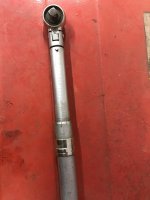
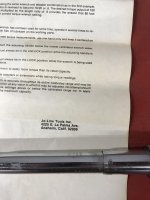
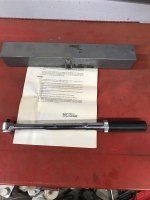
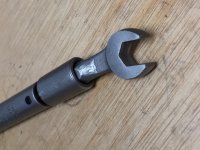
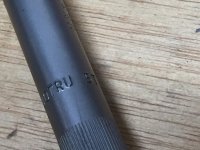
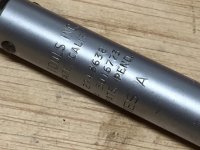
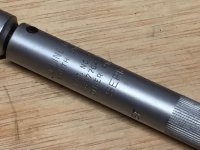
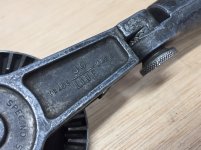
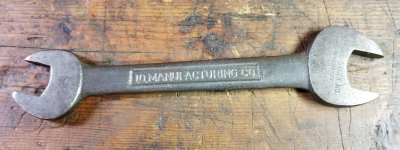
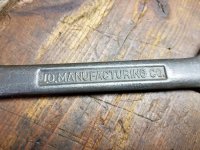
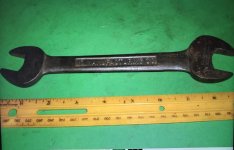
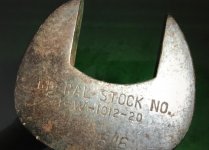
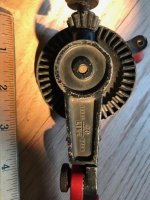
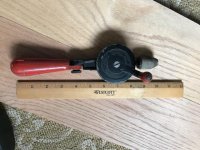
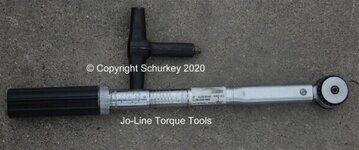
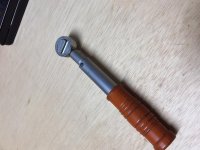
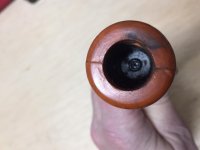
Ok, Grayspoked (Bill) I have suddenly found myself unable to resist buying a Jo-Line piece when I find them, but especially when I find something that seems a bit unusual. And I have to admit that I love hearing the stories coming from you and your dad about these tools!! Here is one I just got today and it is a JOTRU 5T. The patent numbers are the same three as were on my JOTRU 10. The open end wrench on the working end is a 3/8" size and there is a tension screw on the inside of the handle where you can adjust the amount of torque needed. After seeing how the torque indicator works on this wrench I was better able to understand how it works on my JOTRU 10. Anxious to hear more about this 5T and if there were other sizes also made available? Thanks.
Rubicon:
OK, at long last, I can respond with a bit more detail concerning your Jotru 5T. As an absolute digression, I can only warn everyone here never to retire if what you want is some free time. Others around you will find nefarious ways of filling it.....
Dad identified your Jotru 5 as another of the Van Belknap specials to which I have alluded above, dating from the second half of the 1950's. The collapse of government orders in the years following WWII sent my Dad off on a scorched earth effort to find markets for his torque wrenches. Van was convinced that there were specialized needs for torque tools in the auto industry in particular, but also in others. He prevailed upon Dad to make prototypes of all sorts of ideas that Van and my Dad thought might find a niche with the likes of GM and Ford.
My Dad called yours a "torque handle" with a screw at the bottom end that could be screwed in to increase, or screwed out to decrease, the break point. Unlike the later micrometer torque wrenches, this one has no handhold that can be rotated clockwise to increase torque, or counterclockwise to release torque. Instead, you had to tighten or loosen that screw at the end, and then calibrate it to see if you had reached the desired torque. That would mean finding a torque measuring device (I have never heard of J O or Jo-Line ever selling those, although I have seen and worked on them). That never struck me as being terribly attractive to a customer. However,some of that may be due to where Dad took the product after he embedded himself in management in the mid- to late 1950's. I'll have another post about that, later.
Dad thinks that this was not a "pivot-block" wrench, like those described and depicted in patents 2897704 and 3016773. Rather, he expects that your Jotru 5 (and, I suspect, your Jotru 10) was built using "ball and retainer" technology. That means that a ball sat in a retainer, and the retainer sat on top of a spring, all inside what I always referred to at Jo-Line as the "spring tube" and what most people would call the "outside of the wrench." The screw at the end of your wrench added or released tension on the spring. This caused the force necessary to move the ball from its retainer to increase or decrease, thus permitting the operator of the tool to set the precise torque he wished to put onto whatever operation he was performing.
The drive end of your wrench is a female hex, into which a male hex shank could be inserted. The business idea was that there would be all sorts of drives that would be welded to the hex shanks, kind of like Mattel sells Barbie and then sells all the clothes separately. The drives were mostly open-ended wrenches, like yours. Jo-Line did not manufacture the wrench drives that were welded to the shanks, although I would expect that it would have started manufacturing them if enough Jotrus had been sold. The idea was that Detroit would buy thousands of the Jotru wrenches and tens of thousands of the shanks.
Unfortunately, the auto companies didn't buy the Jotru concept. Dad reports having some real tough discussions with Grandfather about manufacturing these wrenches. Grandfather would point out that J O/Jo-Line had no orders for any of these wrenches, and ask why it should invest good money down an unproven (implication: "rat") hole. Dad would respond that they had to do something, because the orders coming in for the present (mid-'50's) lineup of tools was not sufficient to keep the doors open. Grandfather had the last laugh here, because the Jotrus didn't sell. Dad told me that Grandfather lost a lot of confidence in Dad's ability to find profitable civilian applications for torque control. Don't worry, Dad redeemed himself in a way that would keep Jo-Line going for another generation until near the expiration of the critical patents (among which are patents 2897704 and 3016773). I'll have a post on that coming up, too.
Dad said that J O/Jo-Line made some number of these Jotrus, sold a very few, and junked the rest in the late 1960's. So, this one is like your Jotru 10. It is certainly a rarity, and may be unique. It was part of my Dad's frantic effort to find civilian applications for torque technology.
Also, the brand name "Jotru" does not refer to "Van Belknap Specials," although there was a lot of overlap between the two. Rather, Dad told me that Jotru was a line of torque wrenches that differed from all others. All wrenches with the screw-in bottoms, the ball and retainer torque technology, and the female hex head would be referred to as "Jotrus," with the numbering (e.g., 5, 10, etc.) depending on the span of torque values for which each wrench could be used, with higher numbers generally reserved for wrenches that could reach higher torques (e.g., 250 ft. lbs.) and lower numbers for wrenches that reached lower torques (e.g., 75 ft. lbs., like the AC Delco Spark Plug wrenches noted above in this thread, or anything denominated in "inch pounds."
Jo-Line ultimately wangled its way to a civilian customer base that was sufficient to support it. Grandfather came up with torque control technology that appears in patents 2897704 and 3016773. Dad came up with a way to bring the tools featuring this technology to market. The post describing that is coming up.
Dad also gave me some information that amounts to a bit of a digression that you may find interesting. I have referred to all sorts of drive ends being sawed off of products, like Proto's, that J O/Jo-Line would buy, and then weld onto drive ends for use in J O/Jo-Line products. Well, J O/Jo-Line didn't have that kind of welding shop, so where did all of that happen? It happened at a welding shop owned and run by Sid Bann called All Bann Welding. All Bann was located in the Watts district of South Central Los Angeles through the 1950's and 1960's, Near J O/Jo-Line in South Gate. Dad and Sid became "pals" in Dad's words because Dad was running over to All Bann frequently to talk about how Dad wanted this or that welding job done. Sid turned the business over to his son, who succeeded in getting a number of large contracts. The son then saw Watts starting to have troubles (anyone remember the Watts Riots of summer 1965?), and moved his business to Anaheim at about the same time Dad moved Jo-Line from South Gate to Anaheim. Then the son lost those big contracts and the business closed in the early 1970's. Dad describes Sid and his son as people who did a first class job. "Sad" was how he described the demise of All Bann. I remember taking things to and picking things up from All Bann in the Jo-Line company truck. Good people, although I was so low on the totem pole that I never met any member of the Bann family there.
Bill