Love those clamps, Lugz! I gotta keep an eye out for some - I think they more evenly distribute the tightening force around the circumference of the clamp better than "regular" aviation clamps do. Without the chafing of the rubber when they start to get tight.

You are using an out of date browser. It may not display this or other websites correctly.
You should upgrade or use an alternative browser.
You should upgrade or use an alternative browser.
Anyone know anything about JO-Line torque wrenches?
- Thread starter Packard V8
- Start date
thehorse13
Well-known member

Private Lugnutz
Well-known member
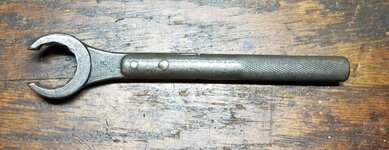
I found this #16 JOBE flare end torque wrench at the flea this morning. It was plugged with some kind of hard but chalky glue at the end, probably sold as a pre-set and not meant to be removed, but I dug it out to reveal the tensioning screw recessed inside that would allow you to adjust the torque setting. @transam81 posted a #10, 11, and 16 in this thread a few years ago, and I think @RagTopTA may have a couple or at least one, as well, not reported on this thread, and I'm not sure which # his is.
Attachments


Billboard guy
New member
- Joined
- Jan 14, 2023
- Messages
- 1


Hi,JO Manufacturing was based in South Gate, CA and developed a full line of torque wrenches back in the day. If you read through this thread a few pages, you'll likely learn more about the company, some of their products and even see some discussions from the son of the founder (Grayspoked). I have an older JO catalog, but your wrench looks to be later and wasn't shown. There are lots of applications for wrenches such as yours on trucks/RV's etc for lug nuts, suspension components etc.
does the JO Line Tools still exist today or has the product name changed?
four.cycle
Well-known member
Jo / Jo Mfg. Co., South Gate, CA (4225 E. La Palma Ave., Anaheim, CA 92803) / "Jo-Line" / patent 2310759 Feb 9 1943 Ira C. Clawson / https://www.garagejournal.com/forum/showthread.php?t=413693 /
do not know if they are still in business. 03/20/23 (first day of spring)
do not know if they are still in business. 03/20/23 (first day of spring)
d42jeep
Well-known member
Post #12 answers the question. I bought my AC Torque wrench in the late ‘60s or early ‘70s and I believe sales kind of slowed down after that. My wrench is still in perfect working condition.
-Don

-Don
Lugz, I'll have a response for you when I have a bit more time over the next 24 hours. I am enjoying reliving a part of my life that I found formative through fielding your questions. However, responding to you requires telling some stories, and I want to do that right. Meanwhile, my wife is telling me that I have to get our Lab out for a run, or else he'll be in our faces during dinner. I'll get in trouble if he (the Lab) does that.
I have a more direct, if not necessarily more brief, response for Barry. My Grandfather got a bunch of patents that were integral to the micrometer torque wrench business in the 1950's and 1960's. My recall is that the heart of the patented system was the "pivot," a small, rectangular shaped piece of metal that sat in the spring tube between the hinge (that's what we called the piece at the top of the wrench that held the ratchet, if the tool in issue had a ratchet) and the spring. As I understood it, Jo-Line had the market largely to itself in high-quality micrometer torque wrenches from the 1950's on because of their patents on this system. Anyway, my Dad looked into the future in the mid-'70's and didn't like what he saw. The key patents were going to expire in the mid-1980's. Already, the Japanese were showing signs of manufacturing precision hand tools at costs that he couldn't touch in the USA. So, he sold the business in late 1979. I don't remember the name of the buyer, but Dad might. He turns 95 this fall, and will probably remember if anyone is curious. Anyway, the buyer closed the factory in California, and moved production back east, Unfortunately, the buyer didn't figure out that one of the crown jewels of the business was its work force, many of whom up through late 1979 loved to take me aside to tell me stories of when they were young men, and my Grandfather would terrorize them. Grandfather died in 1972, so that gives you an idea about how loyal the employees had been. They knew those tools and the machines and processes necessary to manufacture them like no one else, and their loyalty to the company still amazes me. The buyer found himself with a bunch of machinery, expiring patents, and confused customers. What he didn't have was the know-how to make the manufacturing business smooth enough to make a profit at it. As my Dad put it to me, the business just kind of went away in the first few years of the 1980's. That's all he ever said about that, but I will never forget the sad shake of his head as he did so.
I don't know if Jo-Line's private label customers put pricing pressure on my Dad, as they saw the patents expiring and such. However, my Dad's big insight that helped Jo-Line support the second and third generations of my family to be involved in the business was to emphasize the manufacture of private label micrometer torque wrenches for the likes of Snap-On, Owatonna Tool, Central Tool, Ridgid, AC Delco (Dunno if you've seen the special hinge on the spark plug wrench), even Montgomery Ward (true!). Jo-Line manufactured all the Snap-On QJ and QJR 3200s, 3200As, and 3200Bs. The first non-Jo-Line micrometer wrench was the 3200C. I got personally involved in the business in 1969, and the only Jo-Line branded wrenches I ever saw going out of the Shipping Room door were for military contracts and a dribble of some of the more unusual tools, like the JoMite and JoTite lines. Maybe some JoTes, although Ridgid got most of those, with private labelling and special paint jobs. My Dad saw Jo-Line branded product as competing with his private label product for customers whose distribution networks were far better than he could ever dream of having, and so he de-emphasized the Jo-Line brand starting in the early 1960's.
Anyway, my Dad was right from an economic sense. A couple of years ago, I went on Ebay and looked for micrometer torque wrenches. All the new ones were made in China, and they sold for prices that were less than Jo-Line's cost of manufacture in the 1970's, before taking inflation into account. Jo-Line would have been road-kill had he held onto it.
I'll be back to you, Lugz, probably tomorrow.
Bill
Last edited:
This thread is a great read, and really exemplifies how fast history can be lost, but saved in this case by a grandson. In the digital age, I think it will be even worse. Paper catalogs were pretty accurate. Web sites, if they are archived, not so much.
Last edited:
Provincial
Well-known member
It is much easier to change history if it is all saved digitally!This thread is a great read, and really exemplifies how fast history can be lost, but saved in this case’s case by a grandson. In the digital age, I think it will be even worse. Paper catalogs were pretty accurate. Web sites, if the are archived, not so much.
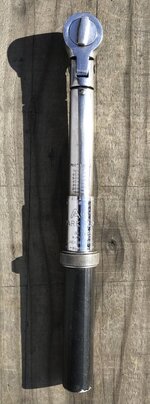
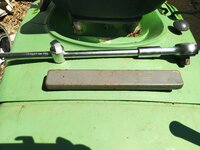
My Type 1 Size 2 Jotite 750 SN W38279 is still quite good as I sent it to the test two years ago (with all the tools from the firm I was working for then) and it managed to stay in a 5% scatter. In the back ground a "modern" ratchet and bar (say 1990) 3/4 Facom.
Attachments


thehorse13
Well-known member
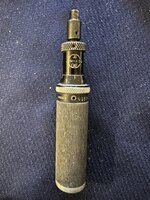
This is a nice find. I've been searching for one of these for a while now. Congrats on digging one up!Just found this at an estate sale. Jomax 50 JJ line hand torque wrench
Mintgrun
Well-known member
This little guy clicks at 50 inch pounds, which seems like about the right torque for hose clamps. The 1/4"-drive head ratchets in the on direction only.
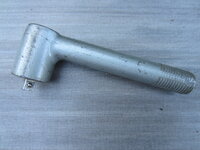
It is shown in the catalog shared by Lugz in post number 10, but the image is too faint/small for me to read. They named it Joel.

Apparently, it makes a good little hammer too. The end is pretty dinged up, but you can still make out Jo Line if you squint.
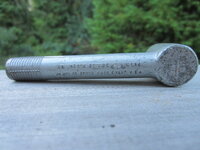
It is shown in the catalog shared by Lugz in post number 10, but the image is too faint/small for me to read. They named it Joel.
Apparently, it makes a good little hammer too. The end is pretty dinged up, but you can still make out Jo Line if you squint.


Private Lugnutz
Well-known member
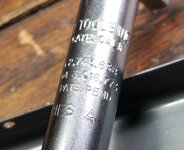
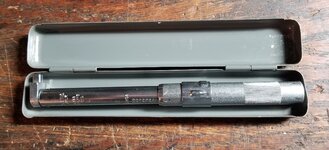
I just found the same "JOTITE" model at the flea this morning, without a Proto ratchet head accessory. Just a regular offset with a 1/4-inch drive stud and detent ball (not shown). In its original case. Last patent (3,016,773) dates to 1962, which is late than I thought the company lasted, and the newest "JO" product I have, the others being wartime and JO Mfg, not JO-LINE Tools.Recently picked this up, never heard of this brand in my 64 years but it was cheap and looked neat so it came home with me, glad I found this thread.
Attachments


Private Lugnutz
Well-known member
@four.cycle
I am bumping this tidbit in response to the manufacturing question that came up on the Garage Sale thread...
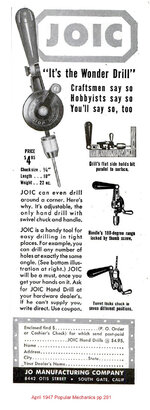
JO was advertising the "JOIC" as early as 1943 in aviation industry trade mags. Snippet-only view example here, scroll down to Aviation Equipment magazine. And as late as 1947. Pop Mech example here.
Proto introduced the "All-Angle" drill, citing the same Clawson patent on the tool, in 1955, and advertised it heavily in 1955 and 1956. Here is a Pop Mech example. No sign of it in 1957 or afterwards.
None of this answers whether JO was making it for Proto or not.
I am bumping this tidbit in response to the manufacturing question that came up on the Garage Sale thread...
According to the patent (2,310,759 / Feb 9, 1943), Clawson, the inventor, listed his address as L.A., but everything else about this anecdote jibes with my conjecture that Clawson retained patent rights and licensed it to JO and others.Its design apparently dates to the very immediate pre-WWII period. Dad says that Grandfather didn't invent this tool. Instead, he entered into a contract manufacturing arrangement with the inventor of this "all angle" hand drill, who was located in the San Diego area.
JO was advertising the "JOIC" as early as 1943 in aviation industry trade mags. Snippet-only view example here, scroll down to Aviation Equipment magazine. And as late as 1947. Pop Mech example here.
Proto introduced the "All-Angle" drill, citing the same Clawson patent on the tool, in 1955, and advertised it heavily in 1955 and 1956. Here is a Pop Mech example. No sign of it in 1957 or afterwards.
None of this answers whether JO was making it for Proto or not.
four.cycle
Well-known member
Thank you. I recalled there had been discussion from a "Jo" family member, but I have been immersed in a patent search for the last 7 hours on a C-clamp.
The reason for my question was because Jo is the only manufacturer listed at datamp.org - I was trying to determine whether Proto and P&C were making their own, or if "Jo" was stamping them out and re-branding them.
The reason for my question was because Jo is the only manufacturer listed at datamp.org - I was trying to determine whether Proto and P&C were making their own, or if "Jo" was stamping them out and re-branding them.
Attachments

Last edited:
RTM
Well-known member
Just to add a little fodder to the Clawson drill story, one of my whirlybird drill experts tossed this info out back in 2002.
Got a Military Issue one the other day; it looks just like the standard ones, except it's Olive Drab, not red and black, and try as I might, I could not get the cap off the handle. Remember about the drills with "no money in 'em" ? I was expecting emeralds at least. Well, it turns out that the Military designers weren't about to contribute to any more such contraband schlepping around, so the handle is solid - and the "cap" doesn't come off ! The only clue is that the rounded portion is fatter than on the regular models.
Got a Military Issue one the other day; it looks just like the standard ones, except it's Olive Drab, not red and black, and try as I might, I could not get the cap off the handle. Remember about the drills with "no money in 'em" ? I was expecting emeralds at least. Well, it turns out that the Military designers weren't about to contribute to any more such contraband schlepping around, so the handle is solid - and the "cap" doesn't come off ! The only clue is that the rounded portion is fatter than on the regular models.
RTM
Well-known member
And a little more on the topic from the 1940 Census information. I didn’t turn up too much on Ira C Clawson, so guessing there aren’t / weren’t too many of them.
Quick summary, he was 56, wife Florence was 40, two daughters, 17 & 7, Ada and Betty, as well as 18yo Thelma, and his son in law, Walter Carlson 25yo, as well as a lodger, Gordon Haines, 27, living in a rented house at 5215 Main Street, LA, in a neighborhood just south of downtown known as South Los Angeles, or the South Figueroa Corridor. Born in Nebraska, wife in Kansas, older Dau in Tennessee, younger two in CA.
He was a machinist, working at Airplane Plant.
And apparently a daughter had a child who put it up for adoption, but story hidden behind a paywall,

Quick summary, he was 56, wife Florence was 40, two daughters, 17 & 7, Ada and Betty, as well as 18yo Thelma, and his son in law, Walter Carlson 25yo, as well as a lodger, Gordon Haines, 27, living in a rented house at 5215 Main Street, LA, in a neighborhood just south of downtown known as South Los Angeles, or the South Figueroa Corridor. Born in Nebraska, wife in Kansas, older Dau in Tennessee, younger two in CA.
He was a machinist, working at Airplane Plant.
And apparently a daughter had a child who put it up for adoption, but story hidden behind a paywall,
Private Lugnutz
Well-known member
You're welcome.Thank you.
As far as I know, that has not been determined.The reason for my question was because Jo is the only manufacturer listed at datamp.org - I was trying to determine whether Proto and P&C were making their own, or if "Jo" was stamping them out and re-branding them.
DATAMP only citing JO in the "Manufacturer:" field could mean they don't even know about the "Any-Angle" variants made with Plomb Tool Company brand names "Proto" and "P&C" marked on them. As far as I can tell, they were only offered by Plomb for a couple years (1955-56).
DATAMP only citing JO in the "Manufacturer:" field could also mean that they are fully aware of the other variants and have evidence that JO was Plomb's OEM. If that were the case, though, one would think they would explain that in the notes down below. Typically, when DATAMP has examples of a tool with multiple mfgr names, they list them all, and if they know, explain the reason. There are hundreds of cases of that on DATAMP. So, I tend to think it's the former.
Hopefully you will find out. It's my understanding you've sent an inquiry.
///////////////////
Since the misreading of the Clawson DATAMP page was the source of a bit of a mini-fracas about this on the Garage Sale thread, I am going to re-address that here in more detail rather than further derail that thread.
The data in the "Manufacturer:" field on a DATAMP page is not always taken from the patent. It's erroneous to assume that. That only happens when the inventor is an employee, and therefore an assignor, for a company, and the company name is on the 1st page of the patent in the title area with the inventor's name. In those cases, and only in those cases, the company name will appear in the "Assignments:" field and the "Manufacturer:" field on the DATAMP page.
If a patent has not been assigned (i.e., if the inventor is just some independent dude in his own shop, as is the case with Ira Clawson), the "Assignments:" field will be empty and the "Manufacturer:" field will typically either be derived empirically, from collected examples of the tool, or from period trade mags, the same way we often derive it here. Simply put, if DATAMP has known examples of the patent, they will list the mfgr's name on those examples in the "Manufacturer:" field and often include a photo of it as the second link in the Pictures area on the right. (Not sure why DATAMP doesn't include any pics of a JOIC or any ads for a JOIC on its Clawson patent page, but they are clearly aware of JO Mfg at the very least selling them.)
No assignments often means the patent rights were bought out by a manufacturer or it is being licensed.
That seems to be the case with Clawson, with his name and his patent number on the "JOIC", and his patent number on the Proto and P&C "Any-Angle". And it sure looks like @Grayspoked is verifying the arrangement with JO with his anecdote.
Private Lugnutz
Well-known member
Quick addendum on the prospects of JO manufacturing the "Any-Angle" for Plomb Tool Company. The subject of a relationship between Plomb and JO has come up before, by me, and others, not just because of geographic proximity, but because Plomb and JO tools are often found together. I have a bunch of 9/32-drive JO-made wingnut sockets, for example, that came with Plomb WF- series 9/32-drive tools. Not unusual, since the USAAF/Air Corps was obviously buying from both of them. And there are a couple anomalies on here (Proto ratchet accessories on Jotru and Jotites, for example) that suggest some cooperation. But if you haven't been following this thread religiously from the very beginning, you may not know that this would have to be considered highly unlikely based on anecdotes from Bill (@Grayspoked)...
Dad called Plomb his "bitter enemies" and said that J O on the one hand and Plomb on the other "didn't like each other very much." I have never in my life - 64 years now and going strong - heard my Dad ever refer to anyone as his "enemy," bitter or otherwise. Until earlier today. Thus, I am taking him at his word on the relationship between him and Morris....[ ]...They didn't cooperate at all.
four.cycle
Well-known member
Private Lugnutz said:(Not sure why DATAMP doesn't include any pics of a JOIC or any ads for a JOIC on its Clawson patent page, but they are clearly aware of JO Mfg at the very least selling them.)
^ The datamp.org steward assigned to "drills" may not have had the material, or may not be quite as much a pedant as is Stan Schulz.
I emailed all of it to them yesterday. Again, I was trying to muddle through patents on a C-clamp at the same time, which probably contributed to my confusion.
Old Radar
Well-known member
Thanks Lugz and 4.C. for sharing the results of your deep dives!

And 4.C., we need to get you some help--and I don't mean a research assistant!...but I have been immersed in a patent search for the last 7 hours on a C-clamp.
Private Lugnutz
Well-known member
Fixed it for ya!And 4.C., we need to get yousome help- an intervention
four.cycle
Well-known member
^ where help is needed is on the LOGOS. need somebody who knows how to use Photoshop to crop/edit/collate/organize them into some form that's usable instead of the impossible mish-mash we currently have. AA chose to use ONLY logos that were "symbols" (as opposed to logos including names or letters) so his is not what one would call "comprehensive".
four.cycle
Well-known member
^ and the wild goose chase on the C-clamp was hardly worth the effort. obscure brand nobody ever heard of (at least not here on GJ.)
time would have been better spent figuring out all the patents on the "Kant-Slip", but I lost that entire folder in December.
time would have been better spent figuring out all the patents on the "Kant-Slip", but I lost that entire folder in December.
Grayspoked
Well-known member
Krisman:Hi,
does the JO Line Tools still exist today or has the product name changed?
I had not realized that there was still interest in Jo-Line Tools and this thread. I had meant to (and still have fond hopes of doing so in the future) post further about some of Jo-Line's (and JO's) products. However, Dad is now 99 and a half years old, and I am his primary caregiver. That takes a lot of my time.
Just a quick response, and then I'll see if I can't respond to some of the other, more recent comments and questions here.
Jo-Line Tools was sold by my Dad to KD Tools in 1979. Dad says that KD was more familiar with die cast tools like wrenches and hammers and things like that. They just didn't get a precision hand tool like a torque wrench. Moreover, they closed the Anaheim facility my Dad had built in 1968 to move Jo-Line's production back east (my recall - fuzzy though it is - is that KD was located in Pennsylvania, but you guys probably no more than I do about KD). In doing that, they gave up the know-how of people like like Les Trimble and Ziggy Sopinski (about whom I have written above), Howie Benton and Cesar Rodriguez in the machine shop, D.A. Miller and Tye Bayless in the parts room, Bill Schaeffer and Larry Way in Assembly, and Helen and Margaret (wish I could remember their last names!) who were the queens of the Jomaxs. Simply making a pivot, which was the heart of the micrometer torque wrench, or the plunger, which was the, err, liver of the tool, took know-how, and KD let go of all the people who had that know-how in order to consolidate production in their eastern facilities. Dad has told me that KD list (but replace that "L" with a "p" - Dad can be salty at times) away the Jo-Line torque wrenches because they simply did not understand how technically complex and precise they were.
Snap-On moved its micrometer torque wrench needs away from KD starting with the QJR-3200C series. I don't know who made the C's - Jo-Line made the QJR-3200's, QJR-3200A's, and QJR-3200B's. I have strong memories of assembling, packing (for shipment), and then repairing those tools. If you happen to have a Snap-On micrometer wrench with a square drive and no ratchet, that would be a QJ-3200 (the "R" stood for "Ratchet"), and were labeled as QJ 3200 blanks, A's, B's, and C's as noted above. I assume (but do not know) that Jo-Line's other customers drifted away from KD at about the same time, the early 1980's.
"JO" was my Grandfather's name for the company and its products. I have discussed JO and where that name came from earlier in this thread. I believe the JO name faded away in the second half of the 1950's or the first half of the 1960's, as my Dad took control. JO is the predecessor of Jo-Line.
Hope that helps. I'll try to respond to other posts in the near future.
Bill
Krisman:
I had not realized that there was still interest in Jo-Line Tools and this thread. I had meant to (and still have fond hopes of doing so in the future) post further about some of Jo-Line's (and JO's) products. However, Dad is now 99 and a half years old, and I am his primary caregiver. That takes a lot of my time.
Just a quick response, and then I'll see if I can't respond to some of the other, more recent comments and questions here.
Jo-Line Tools was sold by my Dad to KD Tools in 1979. Dad says that KD was more familiar with die cast tools like wrenches and hammers and things like that. They just didn't get a precision hand tool like a torque wrench. Moreover, they closed the Anaheim facility my Dad had built in 1968 to move Jo-Line's production back east (my recall - fuzzy though it is - is that KD was located in Pennsylvania, but you guys probably no more than I do about KD). In doing that, they gave up the know-how of people like like Les Trimble and Ziggy Sopinski (about whom I have written above), Howie Benton and Cesar Rodriguez in the machine shop, D.A. Miller and Tye Bayless in the parts room, Bill Schaeffer and Larry Way in Assembly, and Helen and Margaret (wish I could remember their last names!) who were the queens of the Jomaxs. Simply making a pivot, which was the heart of the micrometer torque wrench, or the plunger, which was the, err, liver of the tool, took know-how, and KD let go of all the people who had that know-how in order to consolidate production in their eastern facilities. Dad has told me that KD list (but replace that "L" with a "p" - Dad can be salty at times) away the Jo-Line torque wrenches because they simply did not understand how technically complex and precise they were.
Snap-On moved its micrometer torque wrench needs away from KD starting with the QJR-3200C series. I don't know who made the C's - Jo-Line made the QJR-3200's, QJR-3200A's, and QJR-3200B's. I have strong memories of assembling, packing (for shipment), and then repairing those tools. If you happen to have a Snap-On micrometer wrench with a square drive and no ratchet, that would be a QJ-3200 (the "R" stood for "Ratchet"), and were labeled as QJ 3200 blanks, A's, B's, and C's as noted above. I assume (but do not know) that Jo-Line's other customers drifted away from KD at about the same time, the early 1980's.
"JO" was my Grandfather's name for the company and its products. I have discussed JO and where that name came from earlier in this thread. I believe the JO name faded away in the second half of the 1950's or the first half of the 1960's, as my Dad took control. JO is the predecessor of Jo-Line.
Hope that helps. I'll try to respond to other posts in the near future.
Bill
Bill, it so great that you hope to add to this story! I really appreciate the time you are spending to this history. History that will be lost otherwise. I’m always surprised what can be unrecoverable lost in a few decades. Again, thank you for telling us what happened.
Best Regards,
Eric
Grayspoked
Well-known member
Lentuk:Recently picked this up, never heard of this brand in my 64 years but it was cheap and looked neat so it came home with me, glad I found this thread.

You hold in your hands one of the great, but dirty, secrets of torque-dom. No, it's not the Proto ratchet (about which I will ask Dad when I see him on Wednesday). It's the hinge and location of the drive.
First, I suspect that what you have is a WWII-era tool, but it may date to the first half of the 1950's. Grandfather sold a lot of these to the government in the war years, and then spent the second half of that decade and most of the 1950's trying to figure out how to sell torque tools to the returning G.I.'s who had first encountered them in the motor pools and runways around the world when they were in the service. As I have noted in other posts, Dad moved Jo-Line in the direction of private label manufacturing in the first half of the 1960's, so your tool predates that. Also, Dad started flattening the tops of the spring tubes, maybe by the late 1950's but certainly by the first half of the 1960's, something you may have seen in photos in this thread. The idea was to more closely govern the travel of the hinge against the pivot/plunger combo under it that was the key to the torque technology. Circular spring tubes allowed the hinge to wiggle a bit "north-south" when it needed to travel exclusively "east-west" for maximum accuracy (although round spring tubes were cheaper to manufacture).
There's another clue to the dating of this tool that I will post on in this thread in a moment.
I saw a few of these at the factory in the first half of the 1970's in a tool crib and at Les Trimble's station (more about Les to come, although I have mentioned him before in posts here), but considered them more archeological finds than anything else.
Here's the big, dirty secret. Micrometer torque wrenches manufactured using the technology my Grandfather invented (and is now used in most micrometer torque tools today given that his patents expired a generation ago) are capable of astonishing accuracy if manufactured and used properly. The problem is that proper manufacture involves a design featured in your tool that my Dad has called "ugly" in his conversations with me.
Maximum accuracy in torque tightening occurs when the ratchet (or square drive) is placed directly across from the pin that holds the hinge (that's the part that holds the ratchet in your tool) to the spring tube (that's the round tube to which the hinge is attached). It's not at all difficult to do this as a matter of manufacturing, as your tool shows in your picture at the top. The hinge is manufactured to have a flat head at the top, to which the ratchet/square drive is attached as a dropdown assembly. The drop-down assembly permits the ratchet/square drive to hang directly in a line with the pin. Accuracy is enhanced because the pin is the centerpoint of a fulcrum in a wrench designed like yours, of which the handhold is one lever, and the the ratchet/square drive is the other. Such a torque wrench set at 100 inch/pounds will "break" at 100 inch pounds because the force applied to the handhold and the ratchet/square-drive is balanced at 100 inch pounds precisely where it needs to be - the pin that is the fulcrum of the two levers.
So, what's the problem? Dad found that the mechanics who bought torque tools cared more about what the wrench looked like than they did about maximum accuracy. They thought that hanging the ratchet/square drive off the side like you see in your Jotite was ugly. Dad told me he simply couldn't sell wrenches like yours because they looked funny. Buyers far preferred the micrometer wrenches you see today. These are the ones that have a ratchet at the top of the hinge, so that the wrench looks, well, streamlined.
What's the problem with that, you ask? Well, the center of the fulcrum in the modern torque tool is now the ratchet/square drive, and not the pin at the throat of the hinge. The torque applied at the handhold (where you set the desired torque) and the torque applied at the ratchet/square drive at the moment that the wrench "breaks" are different by a few percent. Dad said that the difference wasn't a whole lot, but it was detectable. He never told me which way this error tended to trend, and I doubt he will remember now (I'll try to remember to ask). However, he told me that he spent years trying to figure out how to correct for this error, and produce a truly accurate tool, but was never successful. He finally gave up and gave his customers what they wanted. Welcome to capitalism, right?
I suspect that you have something of a find from the perspective of a collector. Jotites (branded as such, and not manufactured under private label) with the "off-the-side" ratchet/square drive didn't sell all that well due to, according to Dad, the ugly factor. That, and your tool is probably something on the order of 70 years old at this point. It'd be interesting to know whether it still works. These things, it turns out, were built to last. Many of them still work fine.
Bill
Grayspoked
Well-known member
All:
I just responded to a post by Lentuk that's been up a year or so, about a Jotite he found. My subject in that post was the big, dirty secret about torque tools that his find illustrates.
I left a little teaser in that response about a second way to date JO/Jo-Line torque tools. Here's the payoff on that teaser.
I suspect (don't know for sure) that Grandfather built his torque tools for the government during the golden years of WWII (golden at least for manufacturers of tools the military needed, if not necessarily for the men in uniform who used those tools) according to government specifications. The government would ask for proposals to build a micrometer torque wrench like Lentuk's that, among other things, would break at torque levels between, say 30 to 150 inch pounds. Grandfather made proposals to build these tools. The government accepted his proposals. Grandfather set to work producing them.
Then the war ended. Grandfather had all his tooling to produce tools to government specifications, but no one knew exactly what private industry and consumers would need once the car companies and airplane companies were no longer making tanks and jeeps and B-17s and LSTs and such. The cost of creating new tooling to create torque wrenches for the post-war market was such as to discourage experimentation. I suspect that Grandfather just took the military branding and such off his tools and sold the same tools to private enterprise after the war that he sold to the military during the war.
I have noted elsewhere in these posts that Dad had trouble selling these tools after the war. He told me that he went to Detroit and other places where torque tools could be used (but he has mentioned Detroit every time he and I have talked about this) in the late 1950's to ask the automakers' engineers what precisely would be best or most attractive to them in a torque tool. The answers he got were not consistent with the products JO and Jo-Line were making at the time.
Dad changed and standardized Jo-Line's most popular wrenches and the calibration scales incused into the side of his adjustable products as a result of this market study. I am ignoring here such as the No-Hubs, the Jomaxes (I saw a picture of one of those here), and the 1202s (500-2000 foot pound monsters that were about 9 feet from tip to tail; I recall hearing that they were used on ships' keels and such). Here are the standards that Dad manufactured from the early 1960's until he sold the company in 1979:
Size 0: 5-50 inch pounds
Size 1: Two configurations - 30-200 inch pounds and 30-250 inch pounds
Size 2: Two configurations - 150-1000 inch pounds and 15-100 foot pounds. I recall seeing more inch pound models than foot pound models of Size 2s, because a top of 100 foot pounds wasn't terribly useful for bigger applications. However, the cost of making a jig to stamp foot pound calibration scales wasn't much, so Dad offered them. Some of you have AC Spark Plug wrenches with a flex-head at the top. These kind of look like Lentuk's tool in that the top of the spring tube is round, although later spring tubes were chrome plated as opposed to the satin finish of Lentuk's tool. They had an unusual hinge that flexed forward and back 17 degrees to deal with the placement of spark plugs in a car's engine. They had a calibration scale that ran from 5-75 foot pounds. Their guts generally relied on the same parts as the Size 2's, once you got past the hinge and spring tube.
Size 3: Several configurations. Far and away the most popular and the most numerous of all the torque tools JO/Jo-Line ever manufactured were the Size 3's. These were the ones most useful in the automotive and airplane industries for general application. The single most numerous calibration scale was the 30-250 foot pound models, some of which had a dual scale setup on each side of the wrench, the other being newton meters for the international market. Snap-On was the outlier here. It wanted its Size 3 calibration scales to run from 30-200 foot pounds. Dad believed his job was to keep big customers like Snap-On happy, so he made theirs 30-200 foot pounds, although the guts of the Snap-Ons and the guts of the 30-250 foot pound wrenches were identical (I have built and repaired both). Jo-Line also offered 300-2500 inch pound Size 3s, but I don't recall ever seeing them actually manufactured. I suspect Dad offered them for the same reason he offered Size 2s in foot pounds - it was cheap to make them if he found a buyer for them.
Size 4: The beast of Jo-Line's commonly manufactured torque tools (the 1202s attracted attention by their sheer size and also the infrequency by which they were manufactured). These tools were generally about 3 foot, 3 inches from tip to tail, and were manufactured with calibration scales of 100-600 foot pounds and, rarely, in 1000-6000 inch pounds. There was also a version that was about 8 inches shorter and only went from 50-400 foot pounds, but I don't recall seeing these being made.
Lentuk's tool is illustrative of the situation before Dad standardized it. His tool appears to run from 30-150 inch pounds. This tends to put it in the Size 1 range. However, it lacks a calibration scale that would allow it to top out at 200 inch pounds, like the standardized Size 1s. I therefore date it to a time before Dad standardized Jo-Line's offerings, which probably puts its manufacture at no later than about 1960.
Any of you who have spring tubes that are round at the top (other than AC Delco models) may want to check your calibration scales. You probably have one of Grandfather's pre-standardization specials if the calibration scale on your tool doesn't match up with the standardized models listed above.
Bill
I just responded to a post by Lentuk that's been up a year or so, about a Jotite he found. My subject in that post was the big, dirty secret about torque tools that his find illustrates.
I left a little teaser in that response about a second way to date JO/Jo-Line torque tools. Here's the payoff on that teaser.
I suspect (don't know for sure) that Grandfather built his torque tools for the government during the golden years of WWII (golden at least for manufacturers of tools the military needed, if not necessarily for the men in uniform who used those tools) according to government specifications. The government would ask for proposals to build a micrometer torque wrench like Lentuk's that, among other things, would break at torque levels between, say 30 to 150 inch pounds. Grandfather made proposals to build these tools. The government accepted his proposals. Grandfather set to work producing them.
Then the war ended. Grandfather had all his tooling to produce tools to government specifications, but no one knew exactly what private industry and consumers would need once the car companies and airplane companies were no longer making tanks and jeeps and B-17s and LSTs and such. The cost of creating new tooling to create torque wrenches for the post-war market was such as to discourage experimentation. I suspect that Grandfather just took the military branding and such off his tools and sold the same tools to private enterprise after the war that he sold to the military during the war.
I have noted elsewhere in these posts that Dad had trouble selling these tools after the war. He told me that he went to Detroit and other places where torque tools could be used (but he has mentioned Detroit every time he and I have talked about this) in the late 1950's to ask the automakers' engineers what precisely would be best or most attractive to them in a torque tool. The answers he got were not consistent with the products JO and Jo-Line were making at the time.
Dad changed and standardized Jo-Line's most popular wrenches and the calibration scales incused into the side of his adjustable products as a result of this market study. I am ignoring here such as the No-Hubs, the Jomaxes (I saw a picture of one of those here), and the 1202s (500-2000 foot pound monsters that were about 9 feet from tip to tail; I recall hearing that they were used on ships' keels and such). Here are the standards that Dad manufactured from the early 1960's until he sold the company in 1979:
Size 0: 5-50 inch pounds
Size 1: Two configurations - 30-200 inch pounds and 30-250 inch pounds
Size 2: Two configurations - 150-1000 inch pounds and 15-100 foot pounds. I recall seeing more inch pound models than foot pound models of Size 2s, because a top of 100 foot pounds wasn't terribly useful for bigger applications. However, the cost of making a jig to stamp foot pound calibration scales wasn't much, so Dad offered them. Some of you have AC Spark Plug wrenches with a flex-head at the top. These kind of look like Lentuk's tool in that the top of the spring tube is round, although later spring tubes were chrome plated as opposed to the satin finish of Lentuk's tool. They had an unusual hinge that flexed forward and back 17 degrees to deal with the placement of spark plugs in a car's engine. They had a calibration scale that ran from 5-75 foot pounds. Their guts generally relied on the same parts as the Size 2's, once you got past the hinge and spring tube.
Size 3: Several configurations. Far and away the most popular and the most numerous of all the torque tools JO/Jo-Line ever manufactured were the Size 3's. These were the ones most useful in the automotive and airplane industries for general application. The single most numerous calibration scale was the 30-250 foot pound models, some of which had a dual scale setup on each side of the wrench, the other being newton meters for the international market. Snap-On was the outlier here. It wanted its Size 3 calibration scales to run from 30-200 foot pounds. Dad believed his job was to keep big customers like Snap-On happy, so he made theirs 30-200 foot pounds, although the guts of the Snap-Ons and the guts of the 30-250 foot pound wrenches were identical (I have built and repaired both). Jo-Line also offered 300-2500 inch pound Size 3s, but I don't recall ever seeing them actually manufactured. I suspect Dad offered them for the same reason he offered Size 2s in foot pounds - it was cheap to make them if he found a buyer for them.
Size 4: The beast of Jo-Line's commonly manufactured torque tools (the 1202s attracted attention by their sheer size and also the infrequency by which they were manufactured). These tools were generally about 3 foot, 3 inches from tip to tail, and were manufactured with calibration scales of 100-600 foot pounds and, rarely, in 1000-6000 inch pounds. There was also a version that was about 8 inches shorter and only went from 50-400 foot pounds, but I don't recall seeing these being made.
Lentuk's tool is illustrative of the situation before Dad standardized it. His tool appears to run from 30-150 inch pounds. This tends to put it in the Size 1 range. However, it lacks a calibration scale that would allow it to top out at 200 inch pounds, like the standardized Size 1s. I therefore date it to a time before Dad standardized Jo-Line's offerings, which probably puts its manufacture at no later than about 1960.
Any of you who have spring tubes that are round at the top (other than AC Delco models) may want to check your calibration scales. You probably have one of Grandfather's pre-standardization specials if the calibration scale on your tool doesn't match up with the standardized models listed above.
Bill
Grayspoked
Well-known member
Lugz:I just found the same "JOTITE" model at the flea this morning, without a Proto ratchet head accessory. Just a regular offset with a 1/4-inch drive stud and detent ball (not shown). In its original case. Last patent (3,016,773) dates to 1962, which is late than I thought the company lasted, and the newest "JO" product I have, the others being wartime and JO Mfg, not JO-LINE Tools.
Good to be back in contact with you, if a little tardily so.
My guess is that your tool was actually made for the government, and could easily have been made by Jo-Line rather than JO.
The tip-off on the customer is the metal case, which you described as "original." The only customer that wanted metal cases for its torque tools was the government. Your picture of the top of the metal box with a capacity rating stamped there cinches the deal for me - government product. I recall building and shipping Jotites for the government in those metal boxes even into the mid-1970's.
Your tool has a stamp saying it was made in South Gate. This puts its date of manufacture between 1962 (the date of the patent you mention) and 1968 (when Jo-Line moved to Anaheim). Dad began using the Jo-Line name in the first half of the 1960's at the latest, so a post-1962 patent date is plausible for your tool.
Dad stopped bidding on government contracts in the mid-1970's because the government was cheap; you couldn't make any money selling to them.
I hated those metal boxes. You couldn't stack them very high before they began slipping off the stack and clattering - noisily - to the floor. Their sharp edges left you with ****** hands at the end of a workday. Their hinges and tops sometimes seemed to be afflicted by gremlins. The hinges on those boxes would work, just intermittently. The tops would fit to the bottoms when they saw fit to do so.
I remember one time that the outside vendor made the metal boxes for a government order a half-inch shorter than Jo-Line had asked for. There wasn't time to tell the vendor to take his bad boxes back and give us new ones that corresponded to the contract terms, and still be in compliance with the delivery deadlines for the government order. So, we rolled the handholds of the Jotites that went in those boxes a half-inch higher than we would have liked, so they fit. Of course, that put pressure on the spring in the tool that would eventually shorten its useful life. Sometimes, stuff just happens. Sigh.
Bill
Grayspoked
Well-known member
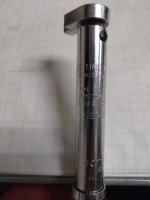
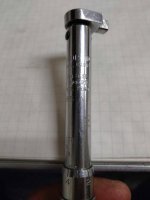
Cruzan:Here is an overall shot, two showing the engraving and a shot of the end. Looks like it is a QC symbol of some kind.
Sent from my Phone 2 using The Garage Journal mobile app


Well, only four years late, but here goes.
What you're looking at in your third picture is the end of the handhold of your wrench, with Cerrosafe filling it. Cerrosafe is still out there, a form of white metal with a low melting point. Underneath the Cerrosafe is probably a hex nut that affixes the handhold to the load screw that is at the bottom of the rest of the wrench and attaches the handhold to the load screw which is at the bottom of the wrench.
The problem Jo-Line was concerned about was people disassembling the wrenches for DIY repairs. When they screwed that up (I have repeated here ad nauseum that micrometer torque wrenches are sophisticated tools), a few of them would send their wrenches in for warranty repairs. The Cerrosafe made that initially hard to do, because it was hard to replace the Cerrosafe plug and make it look like it hadn't been touched if you didn't have other Cerrosafe and the fixtures to melt and hold it. Still, there were those who tried.
The punch mark you see at the end of your tool is a warranty protection device, rather than a QC one. Even someone so sophisticated as to be able to melt out the original Cerrosafe and replace it so that it looked like it hadn't been touched was highly unlikely to have a punch like the one you see here. Basically, that punch mark made it practically impossible for someone trying DIY repairs to avoid voiding his warranty if he screwed up the effort.
Dad changed the handholds in about 1968-1969 to deal with the Cerrosafe issue. It took time to fill those handhold ends properly and the Cerrosafe was not exactly the value of the Crown Jewels, but it wasn't cheap, either. The redesigned handholds had a plate across the bottom of the handhold that allowed for the insertion of a circular nut (called a "handle cap screw") to connect to the load screw in the wrench. The circular nut had a hole allowing the circular nut to be attached or removed with an Allen wrench. The hole was comparatively tiny compared to the Cerrosafe-filled hole in your picture. We'd then daub a little Cerrosafe into the Allen wrench hole. Much cheaper.
Of course, the Allen wrench alternative would not stop DIY'ers. However, Jo-Line had two responses to that issue. First, Jo-Line found found that most people didn't try to fix their broken tools themselves. The charge for repairing a wrench that was out of warranty was pretty reasonable, and the wrenches tended not to break for at least several years after manufacture. For all the thousands of wrenches Jo-Line shipped each year from the mid-1960's on, one full-time guy was able to handle repairing the ones that came back. I spent a few summers in the repair room, and the backlog was never a big deal. Second, Jo-Line began stamping the lock ring retainers that held the lock rings on the handholds with the month of manufacture. The lock ring is the ring on the handhold that you twist counterclockwise to unlock the handhold. You could then turn the handhold so that you could set the amount of torque you wished to apply to your task. A twist of the lock ring in a clockwise direction then locked the handhold so that you could twist and pull the wrench without worrying about whether the torque setting changed. The lock ring was serrated for easy turning. The lock ring retainer sat on top of the lock ring, was smooth, and was finished the same as the wrench (usually chrome plated, but sometimes a satin finish). People could fool with the Cerrosafe if they wanted, but Jo-Line would have a pretty good idea of the warranty status of the wrench.
Last post of the day. We'll see what the morrow brings.
Bill
Cruzan80
Well-known member
Thanks for the info. Still have it bumping around somewhere. So if I am understanding you correctly, all the wrenches would have had the same stamp? And by QC, I really was thinking more of a "manufacturer marking", possibly by the guy who checked it, then filled in the handle (was originally thinking Bob had a stamp, Joe had one, etc).
Grayspoked
Well-known member
Cruzan:Thanks for the info. Still have it bumping around somewhere. So if I am understanding you correctly, all the wrenches would have had the same stamp? And by QC, I really was thinking more of a "manufacturer marking", possibly by the guy who checked it, then filled in the handle (was originally thinking Bob had a stamp, Joe had one, etc).
Taking your thoughts in order.
I think the stamp would have been the same on all wrenches of a certain vintage, and having the full Cerrosafe seal on the bottom of the wrench. It's possible that the stamps changed over time. This style of handhold was in use for about 20 years. This style of handhold was on its way out when I started working at Jo-Line in 1969, so I didn't see that many of them in actual production. However, I saw a fair number of them during my summers in the repair room. We had the stamp that made the mark shown on your wrench in the repair room, so we could stamp repaired wrenches of the vintage of yours. My first reaction when I saw your photo was, "Damn! I haven't seen that mark in decades!" It was definitely familiar. That's why I think that this stamp was used on all wrenches of this style.
The stamp in the Cerrosafe was actually made just after inspection. The inspectors would make sure that the wrench was properly calibrated, and then send it (typically in a gray plastic "pan" holding about 25 wrenches) through a window into the shipping room. There, an employee would put Cerrosafe in the end, let it cool, and then stamp it (sometimes the Cerrosafe and stamping duties would be split - one employee doing each operation, due to the time required for the Cerrosafe to cool and harden; another reason for simplifying this operation with the Allen wrench nut). The wrenches would then be sent to a cleaning table to make them pretty for the customer. Then, the pan of wrenches would be taken to the shipping area, where it would be boxed, packed into a shipping carton, and palletized if the order was big enough. The freight hauler (I mourn the demise of Yellow Freight; they were great) would then pick them up and off they'd go.
There was only one stamp (well, two, if you count the one in the repair room) in action at any given time, and it was applied to all wrenches that made it past inspection.
Bill
Cruzan80
Well-known member
Thanks for the clarification, Bill.
Grayspoked
Well-known member
Lugnutz:I found this #16 JOBE flare end torque wrench at the flea this morning. It was plugged with some kind of hard but chalky glue at the end, probably sold as a pre-set and not meant to be removed, but I dug it out to reveal the tensioning screw recessed inside that would allow you to adjust the torque setting. @transam81 posted a #10, 11, and 16 in this thread a few years ago, and I think @RagTopTA may have a couple or at least one, as well, not reported on this thread, and I'm not sure which # his is.
OK, so I'm catching up on ancient posts that I didn't see because I thought this thread had gone quiet. I won't assume that anymore.
I was putting my wife's Easter decorations up in the garage this morning when I happened to look over at my own collection of hand tools that is stored there. My collection is in no way as large as any of yours, and it encompasses only JO and Jo-Line products, tools that my Dad or I took as souvenirs from Jo-Line as it wound down here in Southern California in 1979.
I found a JOBE in that pile, and it looked just like yours. I take Dad out to lunch on Wednesdays, so I stuck the tool in my pocket so that he could feel it (his eyesight and hearing are pretty much gone 6 months from his hundredth birthday, but touch still works). I handed it to him before the food arrived. He turned it over a time or two in his hands, and then brightened. "I know what that is!" he said. He then told me the story I relate below.
America was a country in some turmoil in 1940 and 1941. War was clearly at hand and the likelihood of our getting into it was high. The government was beginning to spend big (well, for the day - I'm not sure that people in 1940 could even conceive of how much we spend today on government) to get ready for the war. The men were getting drafted, unless they volunteered first. Rosie the Riveter began making her appearance.
We've all seen that famous poster of Rosie. Sleeve rolled up, bicep bulging. "We Can Do It!'

Well, we could do it and it was, in fact, done. But some allowances had to be made.
Women in America coming out of the 1930's had not, by and large, ever worked on a car, or a plane, or a boat, or a farm tractor. In short, it was the unusual American woman in this period who had ever picked up a wrench with intent to do what wrenches are typically used for. Thus, manufacturers of planes, trains, and automobiles (OK, ships and boats, too) were faced with a problem as they hired Rosie and her sisters. You could tell Rosie to go tighten a nut, but what did "tighten" mean? How tight was "tight"? Rosie typically had less upper body strength than did the man she freed up to go to war, so how much harder than that guy did she have to pull to "tighten" a nut?
Your JOBE is part of the answer to that question.
JO Manufacturing apparently made a large number of these JOBEs in the period 1941-1944. They were preset to "click" at a specified amount of torque. Dad didn't say whether JOBEs were calibrated at the company or out in the field, but either would have been easy to do with the screw at the bottom of the tool and a calibration scale. A JOBE could be set at any of several preset calibrations depending on what its owner wanted.
Rosie could be handed a JOBE and told to tighten specified nuts with it. She was to pull on the wrench until it clicked. She was to stop pulling when the wrench clicked. Flawless. Thought not required.
Further, the wrenches were difficult to destroy as a practical matter. The tool itself is basically a tube of steel with a flare end at one end and a screw at the other. I have no idea whether a JOBE was waterproof, but it easily could be so long as it was not allowed to rust after it was dunked. The part that tended to wear out the fastest was the spring that controlled the break point of the wrench. The spring would soften after repeated uses so that the wrench would click before the desired torque had been attained. The solution to this was easy. Just tighten the screw a little more, run the tool through the calibration scale again to make sure you had it right and voila! A brand new tool, as a practical matter.
We'll never know how many women used your tool in their effort to make quality war materials for their men in combat, or supporting combat. But that's why JO manufactured it and American industry bought it.
I can only speculate about the glue you found in the end of your tool. Mine does not have that, and I am unaware of JO or Jo-Line ever using glue to seal their products (as opposed to Cerrosafe, which they certainly did use). My speculation would be that someone in the field put that glue in there to keep users from fiddling with the set screw at the bottom of the tool, thereby changing its calibration.
Sorry to be so tardy with this stuff.
Bill
Private Lugnutz
Well-known member
No need to apologize, Bill. Better late than never! And thanks, as always, for the personal anecdotes. I've said it before, but I'll say it again, it's a real privilege. (There's another fairly active family member here on GJ - in his case, a grandson, in the Porter family, of the Trimo-Porter tools fame. We're very lucky to have you both.)Sorry to be so tardy with this stuff.
four.cycle
Well-known member
@Grayspoked -
This recent acquisition sent me on a search for patents:
Jo / Jo Mfg. Co., South Gate, CA (4225 E. La Palma Ave., Anaheim, CA 92803) / "Jo-Line" torque wrench, drill / acquired by K-D 1979 / patent 2310759 Feb 9 1943 Ira C. Clawson & 2743678 May 1 1956 & 2897704 Aug 4 1959 & 3016773 Jan 16 1962 Robert Glen Woods / https://www.garagejournal.com/forum/showthread.php?t=413693 /
This model 8081A shows up in the 1971 Catalog No. 55 on page 36. The illustration shows what appears to be an identical model. (same torque range: 5-200 in lbs)
It shows up in the 1982 Catalog No. 60 on page 36, but the illustration shows a model with a more "Facom-ish" head than the one in my photo. (different torque range: 30-200 in lbs)
JO sold to K-D (Lancaster PA) in 1979. I have to assume that the model shown in the 1982 catalog is of K-D origin. (K-D went on to change hands again several times.)(list of manufacturers and brands of mechanics hand tools)
My question is: Was this Indestro unit made by Jo? (Indestro outsourced all kinds of stuff - I'm certain this was an item they were not making in house.)
This recent acquisition sent me on a search for patents:
Jo / Jo Mfg. Co., South Gate, CA (4225 E. La Palma Ave., Anaheim, CA 92803) / "Jo-Line" torque wrench, drill / acquired by K-D 1979 / patent 2310759 Feb 9 1943 Ira C. Clawson & 2743678 May 1 1956 & 2897704 Aug 4 1959 & 3016773 Jan 16 1962 Robert Glen Woods / https://www.garagejournal.com/forum/showthread.php?t=413693 /
This model 8081A shows up in the 1971 Catalog No. 55 on page 36. The illustration shows what appears to be an identical model. (same torque range: 5-200 in lbs)
It shows up in the 1982 Catalog No. 60 on page 36, but the illustration shows a model with a more "Facom-ish" head than the one in my photo. (different torque range: 30-200 in lbs)
JO sold to K-D (Lancaster PA) in 1979. I have to assume that the model shown in the 1982 catalog is of K-D origin. (K-D went on to change hands again several times.)(list of manufacturers and brands of mechanics hand tools)
My question is: Was this Indestro unit made by Jo? (Indestro outsourced all kinds of stuff - I'm certain this was an item they were not making in house.)
Attachments


Grayspoked
Well-known member
Radar (I resemble "Old" too much to throw that into your salutation):I believe I found a 1/4" click type torque wrench like Packard V8 was describing in his original post. The calibration certification is dated Jun 16 1959.
I gave a half-hearted attempt at disassembly--the two small screws on the back of the head came out easily, but I couldn't pry the plate out and didn't want to **** it up. I have no pressing need for a 1/4" torque wrench, but I really like it and would like to have it operating smoothly. Currently the twist handle starts to bind around 40 in/lbs and gets worse as I go up. It stops at about 110 and I don't want to force it beyond that.
I'm hoping that Grayspoked (Bill) will chime in with the best way to bring it back to working order and possibly also lend meaning to the codes stamped on the side of the head. (SA AD 2558)
I've really enjoyed Bill's first-hand insights into his grandfather's company. One more question: This wrench has no JO name on it and I couldn't find a name associated with it on Google--is it the predecessor for one of the later named tools?
Thanks again for all the great history of the Jo-Line Tools!
A couple of comments.
I think yours is a Jomi. I am seeing Dad on Saturday and will confirm. The thing that gives it away is the big box ratchet. That was a signature of the Jomis. I was lunching with Dad yesterday, and he told me a bit I didn't know about the Jomis. I'll add more to that thought in a later post (I realize that there are holes in the story I want to tell that he can fill).
Another point that distinguishes the Jomis is that the big square ratchet housing was made out of cast aluminum. That was not a problem from the perspective of the wrench's performance. The housing is not load-bearing, so aluminum's softness was irrelevant to the tool's accuracy. However, mechanics were then and are now generally not known for gently handling their tools such that soft die-cast aluminum doesn't get bent out of shape when dropped on a concrete floor or tossed in a tool box. Dad tells me that the government had to buy a lot of Jomis because military repairmen were none too gentle with those housings. Dad's comment about how lots of Jomis were sold to the military during the war seems consistent with Lugz observation that "SAAD" on your tool means San Antonio Army Depot.
I have never seen a Jomi with a date on it like yours appears to have at the red tape in your photos ("6-59"). The earliest dating I am aware of on JO/Jo-Line tools is maybe the late 1960's. I have a Jotite that is dated 10-70 on its spring tube. Most of the rest of the dating appears on the lock ring retainers. I never saw a tool dated as informally as is yours coming out of Jo-Line. I suspect that the date on your spring tube is a later addition. Maybe it's the date of a repair, or the date of an inventory, or maybe even some sort of early version of a "sell-by" date. Who knows, but June 1959 strikes me as a bit late for a Jomi. Again, I'll confirm with Dad.
Then again, there is the Jo-Line trademark on the ratchet housing. The company was JO, not Jo-Line, into the 1950's.
Now the hard part. The last time I repaired a torque wrench was probably at Christmas, 1976, 47 years ago. I spent about 3 years in the repair room, and saw a lot of historical Jo-Line and JO product come through. I don't ever recall actually repairing a Jomi. We may not even have had parts then to repair one, unless Les Trimble or Ziggy Sopinski was able to scrounge something out of the deepest depths of the tool crib. I have no idea how you would go about repairing one of those. I have exploded diagrams for a lot of Jo-Line's products, but the Jomis are so old I have nothing on them.
Again, I'll ask Dad on Saturday, but my hopes are not high.
Thanks for being patient with me, since you first asked your question - what - 4 years ago? Sigh....
Life has a way of moving on.
Bill