11thfinger
New member
- Joined
- Jan 5, 2026
- Messages
- 2
Are the CAT sockets still made by Willams/Snapon or have they changed the manufacturer? Is it true that they are ending the partnership soon?


Is it true that they are ending the partnership soon?
I wouldn't put any faith into his claim. He's a first time poster.According to who? What is your source?
If they do change manufacturers, it would take some time for old stock to be moved before tools from the new manufacturer would come into play.
I wasn't really claiming it, I was asking if it was true. Someone posted it in a snap on FB group and I thought I ask here in case anyone knew.I wouldn't put any faith into his claim. He's a first time poster.
The 1/4” shallow and deep and 3/8” shallow look just like Snap-on.What is the price differential between Williams and CAT? I suspect the 2 are more similar to each other than either are to Snap on
Odd…my 1/4 Williams and my 1/4 Snap Ons look just alike.The 1/4” shallow and deep and 3/8” shallow look just like Snap-on.
They do not look like Williams.
CAT sockets and wrenches If i'm not mistaken have actual snap-on markings/emboss, eg the special stamps for year or date codes. I don't think I've seen those on williams, but someone can correct me If i'm wrong.Odd…my 1/4 Williams and my 1/4 Snap Ons look just alike.
CAT sockets and wrenches If i'm not mistaken have actual snap-on markings/emboss, eg the special stamps for year or date codes. I don't think I've seen those on williams, but someone can correct me If i'm wrong.
The sockets are Snap-On with Cat rollmark.Interesting. I was under the impression that CAT wrenches are not Snap On, but Williams… and the sockets were the same as the Williams with a CAT roll mark.
And Williams are Snap-On with a Williams rollmark.The sockets are Snap-On with Cat rollmark.
My guess is they are identical as it would require big investment to set up a separate USA production line just for Cat labeled stuff. Simply switching marking dies for a run of standard product would seem to me more cost effective. Leading to or letting customers believe the Cat tools were somehow a lesser quality could justify the price difference.Ive watched a few videos and from what I saw they do indeed look like Snap-ons right down to the made in USA markings. I get the whole marginal revenue > marginal cost it makes sense to produce more product if there is excess capacity. What I can't seem to wrap my head around is why Snap-on would risk ******* off its core customers and dealers by selling the same product for a fraction of the price with different branding. Makes zero sense to me. I get the warranty is not the same and warranty is a huge benefit for Snap-on customers. I'd really like to see someone do a metal analysis to see if they truly are identical but for the branding. Ive also noticed the CAT products seem to have the Remanufactured and Non-returnable icons on these sockets (on its website) so wondering if its made with recycled steel or something. Quite puzzling to me anyway
Please post pictures of williams sockets or wrenches with snap-on date codes...And Williams are Snap-On with a Williams rollmark.
Seems so circular…
No doubt I just can't wrap my head around business strategy they have to be alienating their core customers if true. Also would be interested to learn why theyre marked "Remanufactured" on CAT'S website. If they're made on same line with recycled steel I can understand the extraordinary price difference. Pretty sure a used set of Snap-on sockets would sell for a multiple of new CAT branded sockets. Just don't understand the strategy.My guess is they are identical as it would require big investment to set up a separate USA production line just for Cat labeled stuff. Simply switching marking dies for a run of standard product would seem to me more cost effective. Leading to or letting customers believe the Cat tools were somehow a lesser quality could justify the price difference.
What the Cat tools demonstrate for me is the huge profit margins on Snappy branded stuff. I'll wager some of the Cat branded sells for less than the truck salesman's cost, which surely pleases them to no end.
Any Snappy dealers here wish to comment?
AND while those interested in CAT tools are listening would someone please tell me if they offer 1/2" dr. fractional inch(SAE) SIX point shallow sockets? I've browsed the catalogs I can find on-line and only find 12pt. Seems odd, no?
Date codes is what we are hung up on?Please post pictures of williams sockets or wrenches with snap-on date codes...
I have very little marked Williams but this Allen socket was close to hand.Please post pictures of williams sockets or wrenches with snap-on date codes...


Date codes would imply Snap Ons internal system that would, in theory, mean origination from within the SO system as opposed to one of its subsidiaries.Date codes is what we are hung up on?
Date codes and snap-on go back like 100+ years...you sound like you've never heard of them.Date codes is what we are hung up on?

Williams has two socket lines that I can see, an offshore line equivalent to Blue Point and their SO lite versions.Williams and CAT sockets are made on the same lines as mainline SnapOn…this has been established for quite some time. CAT wrenches are not Snap-On for the majority of the line, they are Williams Supercombos. This, too, has been established. There is no great mystery or conspiracy.
Dates codes or not….and yeah, I’m well aware of what they are.

It would take a LOT to deter the Snap-On tifosi. Some wear(and BUY!) SO clothingNo doubt I just can't wrap my head around business strategy they have to be alienating their core customers if true. Also would be interested to learn why theyre marked "Remanufactured" on CAT'S website. If they're made on same line with recycled steel I can understand the extraordinary price difference. Pretty sure a used set of Snap-on sockets would sell for a multiple of new CAT branded sockets. Just don't understand the strategy.
Most steel, no matter the source, has some percentage of recycled stock in it.No doubt I just can't wrap my head around business strategy they have to be alienating their core customers if true. Also would be interested to learn why theyre marked "Remanufactured" on CAT'S website. If they're made on same line with recycled steel I can understand the extraordinary price difference. Pretty sure a used set of Snap-on sockets would sell for a multiple of new CAT branded sockets. Just don't understand the strategy.
Yeah but most new socket sets dont say remanufactured.Most steel, no matter the source, has some percentage of recycled stock in it.
A quick search suggests that Cat sells Reman ratchets and Reman electrical connection “ plugs, harnesses and sockets”Yeah but most new socket sets dont say remanufactured.
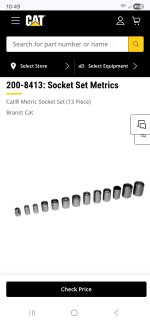
This is one example two pics I couldn't get everything on one page. The key for product includes remanufactured. I'm not saying one socket returned by a customer I'm saying an entire product line produced under contract by Snap-on. Could they be using recycled steel? I don't know. But this could explain why CAT sockets appear identical to snap-on but sell for 1/5 the price. Maybe they're made on same line but with different grade of steel? I don't know this to be the case just wondering why the sockets are sold with the remanufactured key on product page for substantially less than nearly identical Snap-on product.A quick search suggests that Cat sells Reman ratchets and Reman electrical connection “ plugs, harnesses and sockets”
I couldnt come up wuith any reference to Reman hand tool sockets.
Look at it logically: ratchets are rebuilt every day by tool dealers and individuals. Just disassemble, inspect, replace worn or damaged parts, then reassemble.
the same could be done with electrical harnesses, sockets, and plugs. Replace damaged pins, wires, and sheathing. We’re not talking about a $10 harness in your Toyota. The harness for an earthmover would cost thousands of dollars.
Cat provides a factory 1 year warranty for reman plugs, (electrical) sockets, and harnesses, as well as ratchets.
There’s no way to “remanufacture” a broken mechanics socket, unless there’s some sort of burr or maybe even a chrome defect.
Broken sockets would be returned to the vendor (SnapOn in this scenario) if Cat included warranty in the purchasing contract. My experience is that large corporations often buy low value parts without warranty and self insure. That wouldn’t be true for high value items. The vendor, ie SnapOn, if he wanted the part back simply sends the part to a scrap dealer, or, again in the case of SnapOn, who, has no self owned steel mill, send it to one of their steel suppliers for use in a furnace melt.
The other scenario is in the event of a customer return a complete set is returned for some reason, the individual pieces would be inspected and resold as Reman.
Bottom line : there’s no way in the world that Cat could economically remelt an individual socket, reforge the steel, machine, package and distribute a socket and make money. A broken socket goes through a scrapping process (if it doesn’t go to the landfill.).
All steel processes use some percentage off remelt scrap.


The strategy is to sell into as many markets as possible without diluting their tool truck sales. Government contracts are a fairly closed market, Cat dealers are a sort of legacy agreement if I had to guess. If enough techs started ordering through Cat dealers, I’m guessing the model would be changed.Don't understand what Snap-on is thinking from a business strategy perspective and suspect this may prove to have significant reputational risk if products are in fact identical but priced so far apart.
Explain the logistics of remanufacturing a set of sockets.This is one example two pics I couldn't get everything on one page. The key for product includes remanufactured. I'm not saying one socket returned by a customer I'm saying an entire product line produced under contract by Snap-on. Could they be using recycled steel? I don't know. But this could explain why CAT sockets appear identical to snap-on but sell for 1/5 the price. Maybe they're made on same line but with different grade of steel? I don't know this to be the case just wondering why the sockets are sold with the remanufactured key on product page for substantially less than nearly identical Snap-on product.