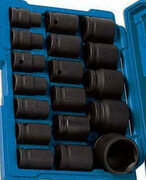
I've read this view on impacts many times here but the opposite with chromes where the consensus is that it is worth paying the extra for tighter tolerances and durability. I'm interested to know what makes impact sockets different to chromes in this respect? Are more expensive impacts from Snap on not more precisely and consistently manufactured and with stricter qc than the cheaper ones? How is it that cheaper brands can make impacts equal to Snap on but when it comes to chromes they make sockets that are said to not fit fasteners as well?

With chrome sockets, Snap-On and other high quality brands will tend to use higher alloy steels. These materials are more expensive to buy and require more expensive equipment to work during manufacturing, which contributes to cost.
The benefits to these materials are, in general, that they wind up much harder/stronger and thus the sockets made from them can be made much thinner, which is a big benefit. Secondly, because of the way these materials react to machining operations, they can be made to tighter tolerances.
The tolerance thing isn't about material though. My opinion is that the primary reason that companies like snap-on show better tolerances than no-name competitors selling at bottom prices is about their machine setups. Snap-On clearly sets up the machines that make their parts to produce the best quality possible in both surface finish and tolerances- any machinist can look at a snap-on socket and tell you it's well machined. Holding tolerances in operations like broaching the socket opening comes down to replacing tools at the right time. Closer tolerances means replacing broaches and tooling a LOT more often, and Snap-On (and other companies producing good quality) are willing to do that even though it's an expensive approach.
The chroming on Snap-On tools is also extremely high quality, and quality chroming is expensive.
So for chrome sockets it matters.
Impact sockets are different because their primary duty is impact- they're made from different material. Almost everyone uses very similar grades of chrome molybdenum steel (as opposed to chrome vanadium or other grades used for chrome sockets) in order to arrive at a final product which is very tough, to handle impact load, at the expense of hardness/stiffness. To make them stiff enough to do the job, they increase the wall thickness. This is why impact sockets are almost always a lot bigger- because the steel used isn't as hard and it needs the wall thickness for hoop strength around the broach.
Because you typically aren't trying to snake an impact socket into some tight place, a company using slightly less high-quality material and needing a thicker wall, or spending a little less money on the machine work etc just doesn't matter as much.
Add in the fact that the sockets aren't chromed (which makes them a lot cheaper to make) and the fact that anyone using them in a professional setting expects impact sockets to be a wear item long term and in my opinion it just doesn't make sense to spend the big money for Snap-On impact sockets UNLESS you need the service (you're in a critical industry, etc).