
AgDieseler
Member
- Joined
- Jan 7, 2011
- Messages
- 21
The Willomet Garage
Howdy!
I wish I would have discovered the Garage Journal earlier in my build project. I've found lots of valuable information so far, especially the Made in USA threads. Here’s my garage.
Our Arts & Crafts Bungalow was built in 1917 and resides in a historic district in Dallas, TX, so when it came time to build our garage there were lots of rules to study. The short details are this: heavy duty slab on grade, 6” wood frame, wood siding – pine 117 and cedar bevel – and traditional Arts and Crafts trim, and custom carriage style folding doors. I’ve acted as my own GC, contracting out the foundation work and roof install. My girlfriend and I have completed the balance with significant help from our friends and family. Enjoy the pictures, and watch the seasons change from summer to fall to winter.
We hated doing it, but we had to sacrifice our 42 year-old paper shell pecan tree to make room for the foundation. I’ve kept and split the logs – good for smoking:

The foundation started with excavation of 24” of North Texas black clay, and replaced with select fill “cushion sand”. In our part of Dallas, one doesn’t have to dig more than a couple of feet to find bedrock. While the beams were being cut, the trencher was bucking limestone bedrock.
Beams are 12” wide and 36” deep, with spacing at 8’ on each axis. #6 steel for the beams, and #4 for the 5.5” thick slab. The green overspray is termite pre-treatment for the soil.

Concrete was a 3ksi pump mix.
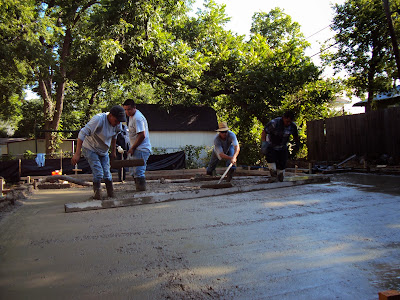
Concrete contractor had a top-notch crew, and was very hands on – not a touch-and-go type that’s not present for form surveys and setback inspections. We kept a lawn sprinkler on the slab for 3 days as it cured.
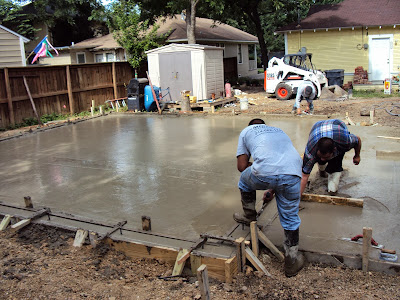
With the help of about 8 family and friends, the walls went up in one weekend. We had 4 folks return, and the trusses were up the following weekend. In between the walls and trusses, I would lay the Turfstone (Acme brick product) over 12 tons of decomposed granite (DG). DG is a great composite fill. It packs in hard like a flex-base, and is very drainage friendly. We filled it back in with another 9 tons of DG.

After two weeks, the suburban parks on the pad for the first time.

I did hire a roofing contractor to install the decking, felt, flashing, and shingles. As my own GC, I competitively bid all materials separately from any labor, and controlled them separately to avoid contractors from having to pass on a 20%+ markup.
Tyvek, siding, and trim went on fairly quickly. The DeWalt 18V cordless finish nailer, which definitely gets the Most Valuable Tool award for this project.
I didn’t want to give up any vertical space inside the garage. My truck is about 8.5’ tall, and I want to be able to use a lift for a coming hot rod project. Carriage doors would seem like a natural solution, except the turn into the garage is somewhat tight and clearing an open carriage-style door would be tough. Plus, those kinds of doors are expensive.
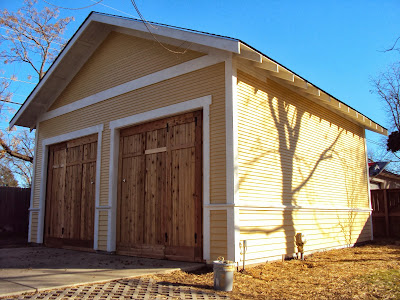
My solution was to build my own carriage doors that folded over against the side of the garage using three hinges per side. The frames are 2” square steel, and skinned in lap and groove cedar. I’m not quite done with them, yet.
This is where we are right now – primer is done, and paint is well underway. The door trim is coming to a close, and after setting up some bar-locks and getting stain on the doors, we’ll be ready to close out our permit. Next steps involve getting everything inside organized so I can unload the storage unit I rent, and start on wiring and lighting the space. It’s been such a great experience, and we’ve had so much fun that I might be a little sad to finish. But, as I think about it further, I bet this project will be like most of my other projects – I never can leave them alone.

I do look forward to getting back to work on some other projects, and bending tube on my '55 1st series Chevy.
I’m glad to be on the board, and look forward to sharing progress and learning more from everybody else’s builds.
David
Howdy!
I wish I would have discovered the Garage Journal earlier in my build project. I've found lots of valuable information so far, especially the Made in USA threads. Here’s my garage.
Our Arts & Crafts Bungalow was built in 1917 and resides in a historic district in Dallas, TX, so when it came time to build our garage there were lots of rules to study. The short details are this: heavy duty slab on grade, 6” wood frame, wood siding – pine 117 and cedar bevel – and traditional Arts and Crafts trim, and custom carriage style folding doors. I’ve acted as my own GC, contracting out the foundation work and roof install. My girlfriend and I have completed the balance with significant help from our friends and family. Enjoy the pictures, and watch the seasons change from summer to fall to winter.
We hated doing it, but we had to sacrifice our 42 year-old paper shell pecan tree to make room for the foundation. I’ve kept and split the logs – good for smoking:
The foundation started with excavation of 24” of North Texas black clay, and replaced with select fill “cushion sand”. In our part of Dallas, one doesn’t have to dig more than a couple of feet to find bedrock. While the beams were being cut, the trencher was bucking limestone bedrock.
Beams are 12” wide and 36” deep, with spacing at 8’ on each axis. #6 steel for the beams, and #4 for the 5.5” thick slab. The green overspray is termite pre-treatment for the soil.
Concrete was a 3ksi pump mix.
Concrete contractor had a top-notch crew, and was very hands on – not a touch-and-go type that’s not present for form surveys and setback inspections. We kept a lawn sprinkler on the slab for 3 days as it cured.
With the help of about 8 family and friends, the walls went up in one weekend. We had 4 folks return, and the trusses were up the following weekend. In between the walls and trusses, I would lay the Turfstone (Acme brick product) over 12 tons of decomposed granite (DG). DG is a great composite fill. It packs in hard like a flex-base, and is very drainage friendly. We filled it back in with another 9 tons of DG.
After two weeks, the suburban parks on the pad for the first time.
I did hire a roofing contractor to install the decking, felt, flashing, and shingles. As my own GC, I competitively bid all materials separately from any labor, and controlled them separately to avoid contractors from having to pass on a 20%+ markup.
Tyvek, siding, and trim went on fairly quickly. The DeWalt 18V cordless finish nailer, which definitely gets the Most Valuable Tool award for this project.
I didn’t want to give up any vertical space inside the garage. My truck is about 8.5’ tall, and I want to be able to use a lift for a coming hot rod project. Carriage doors would seem like a natural solution, except the turn into the garage is somewhat tight and clearing an open carriage-style door would be tough. Plus, those kinds of doors are expensive.
My solution was to build my own carriage doors that folded over against the side of the garage using three hinges per side. The frames are 2” square steel, and skinned in lap and groove cedar. I’m not quite done with them, yet.
This is where we are right now – primer is done, and paint is well underway. The door trim is coming to a close, and after setting up some bar-locks and getting stain on the doors, we’ll be ready to close out our permit. Next steps involve getting everything inside organized so I can unload the storage unit I rent, and start on wiring and lighting the space. It’s been such a great experience, and we’ve had so much fun that I might be a little sad to finish. But, as I think about it further, I bet this project will be like most of my other projects – I never can leave them alone.
I do look forward to getting back to work on some other projects, and bending tube on my '55 1st series Chevy.
I’m glad to be on the board, and look forward to sharing progress and learning more from everybody else’s builds.
David
Last edited:


