To avoid these ads, REGISTER NOW!

Atlas 10F Lathe tear down/cleaning, Work In Progress thread

subroc

Well-known member
Joined
Apr 22, 2017
Messages
781
Location
Dover, NH
Looks good. Color isn't bad. After all the times I have gone through Vintage Macinery and looked at all the color choices many had made or just mixed up with paints that were left over colors they had on hand with bizarre results that looks good to me.

Make sure you understand operation when you start it especially as it relates to forward/reverse gear box and all the apron parts. Zamak parts break but can last decades if operated per the manual. Make sure it is well lubricated.
 
To avoid these ads, REGISTER NOW!
OP
S

skeer

Well-known member
Joined
Sep 14, 2021
Messages
1,042
Location
Standish, MI Area
So I guess I had forgotten how the counter shaft was mounted originally, Since it requires being mounted to the lathes table that's not going to work out very well in my situation. I don't have/can't dedicate a table/support just for this guy for the foreseeable future. Now where it sits now is it's final resting place but man tacking on the 'horizontal' counter shaft takes up a decent chunk of real estate.

I think I'll probably try to sell this one and find a used vertical counter shaft instead.
 

subroc

Well-known member
Joined
Apr 22, 2017
Messages
781
Location
Dover, NH
Mount the lathe and countershaft/motor assembly on a piece of plywood. If you need to hang some of it off the front of the bench consider doubling up the plywood as a glue up. Might work. Or, find some other way to extend the table.

When you say gear case housing do you mean the forward/reverse gear case or the banjo? They call it a bracket I believe.
 
OP
S

skeer

Well-known member
Joined
Sep 14, 2021
Messages
1,042
Location
Standish, MI Area
Eh, so the work bench it's currently on isn't deep enough to both provide the room behind for the Horizontal mount and beefy enough on the front for the weight to shift forward that much.
I could beef up the front but this shed is just wide enough to allow me to pull my truck into when I need to work on something and allow enough clearance for me to move around. So extending the front of this surface out isn't in the cards.

I went looking for when I said gear case housing and I can't find it but yeah if this is talking about the broken Zamac pieces: the fwd/rev housing and the 2-gear housing behind the apron.. the parts manual calls them both 'Gear Case'.

I haven't quite gotten all the common named committed to memory yet ;)
 
Last edited:
OP
S

skeer

Well-known member
Joined
Sep 14, 2021
Messages
1,042
Location
Standish, MI Area
So I figured out the ram clamp, so that's good. The paints drying on the tailstock. Realized yesterday that the shims that came on the tooling saddle aren't thick enough or numerous enough.
For the side closest to the operator, there is 2 shims.. I didn't break out the caliper yet but they are really thin. The far side had one and it feels as thick as the former two.
But with all installed except the gib, and the bolts tightened snugly, I cannot slide the saddle from tailstock to headstock.

Going to make a shim out of beer can to try to gauge how much shimming it's gonna need.
 

RaisedByWolves

Well-known member
Joined
Feb 4, 2023
Messages
3,629
Location
SE PA.
You sure you have the shims in correctly?

When you say all the bolts are tight, that excludes the gib screws, correct?

They don’t get tightened, they get set.

I would draw it all out and measure everything without the shims in. Do this for both the saddle and bed and you’ll know what to do.
 

subroc

Well-known member
Joined
Apr 22, 2017
Messages
781
Location
Dover, NH
Well, there is certainly wear on an old machine like that. Depending on how much wear, it is likely you will end up with a tight spot no matter what. I would take the measurements with the gib in place. Even if it isn't adjusted perfectly it will position the saddle in a more likely operating position where the measurement will be more true given any wear. Even a few thousands will tighten it up.
 
OP
S

skeer

Well-known member
Joined
Sep 14, 2021
Messages
1,042
Location
Standish, MI Area
Ok so, when looking at the bed with the headstock to my left:
Read from left reading to right readings.
Inside way edge, closest to me;
.380-.404

Inside way edge, furthest from me;
.374-.394

Outside way edge, near me;
.375-.380

Outside way edge, furthest from me;
.375-.379


So it seems to me who ever was using this for years the bed was un-level or maybe the shims and bearing plates were cantered somehow.
 

RoninB4

Well-known member
Joined
Jul 22, 2020
Messages
3,518
Location
Under My House
-The bed needs to be set with a precision machinist level before attempting anything because this is your reference for everything else. Twist, bow, and warp must be dealt with first. Otherwise everything changes as you move left/right along the bed. A carpenters level is really not good enough for this but you use whatever is in your budget. If you're bolted to a wooden stand the wood may also be warped. There's a procedure for setting the bed, several videos and text are on the internet. Use a set of feeler gauges instead of a beer can wuddja. :bitchslap
 
OP
S

skeer

Well-known member
Joined
Sep 14, 2021
Messages
1,042
Location
Standish, MI Area
So I cut three strips from a beer can, templated from both fore and aft saddle shims. After adding them I can tighten down the bearing plate bolts and still slide the saddle back and forth. And after snugging the gib plate screws I have no perceivable looseness laterally, or vertically. However it does get tight when the leading legs of the saddle reach to almost perpendicular to the headstock. And again in the opposite direction (towards the tailstock) roughly 10 inches from the end of the bed.

So yeah, this guy saw some action or was used without adequate lubrication.

I have a feeler gauge, I'll try to figure out and mark on the bed exactly where the friction overloads the movement forces. I did take a large ******* file and with flat side down tried to lightly slide and mark any high spots. Interestingly enough the outer edge, furthest side showed marks, as did the outer edge, nearest the closer you get the the right end the more pronounced.
 
OP
S

skeer

Well-known member
Joined
Sep 14, 2021
Messages
1,042
Location
Standish, MI Area
-The bed needs to be set with a precision machinist level before attempting anything because this is your reference for everything else. Twist, bow, and warp must be dealt with first. Otherwise everything changes as you move left/right along the bed. A carpenters level is really not good enough for this but you use whatever is in your budget. If you're bolted to a wooden stand the wood may also be warped. There's a procedure for setting the bed, several videos and text are on the internet. Use a set of feeler gauges instead of a beer can wuddja. :bitchslap
Yeah I certainly don't have a precision level, but what I do have are a particular set of skill... err wait, no I don;t! lol.
No I've got a brand new Angle Cube, and I believe I also have a short length of aluminum that's perfectly flat and straight. Watched a few bed levelling videos last night.
Logically I find it odd that the guys only placed shims underneath the foot closest to the bolt hole instead of the entire circumference of the foot. Meh, either way I'll pickup a cheap set of feelers from Oreilly and see what shakes out.

Im sure Im not alone in this but man, I never would have thought the bed, being so heavy and thick and relatively short could have twist introduced so easily.
 

RoninB4

Well-known member
Joined
Jul 22, 2020
Messages
3,518
Location
Under My House
I did take a large ******* file and with flat side down tried to lightly slide and mark any high spots.
- :scared:
-Do NOT do that again. First off a ******* file is far too rough/coarse to use on ANY precision surface. Secondly, newer made files in the last 20 years are not what they once were. Many reports from machining board members state they aren't even all that flat anymore, having noticeable bow/warp to them. Most of the old/reliable makers of files are no longer owned/operated/located by or in the USA any longer. Not a statement bashing any other culture, just a statement regarding the results, draw your own conclusions. Reportedly the steel (and therefore the heat treating as well) is not the same anymore. Cost cutting from the usual suspects have rendered files as disposable items unworthy of repurposing. Can't verify, all my files are decades old, many still new.

Any topping of "high spots" should only be performed with a fine India stone (wet) in a very gentle manner once the bed was been corrected for twist/warp/bow. Any distortion to the bed will result in the stone taking material off where it shouldn't be. An obvious high spot from a ding (displaced metal) can be and should be removed but don't go massaging the bed with a stone until it's been restored to proper alignment.
 

RoninB4

Well-known member
Joined
Jul 22, 2020
Messages
3,518
Location
Under My House
Im sure Im not alone in this but man, I never would have thought the bed, being so heavy and thick and relatively short could have twist introduced so easily.
-Yeah it is a bit eye opening. Who would have thought a large mass of cast iron could change like that? It does. I have a 5,000 pound jig borer, all quality cast iron, that I'll need to level soon as I'm certain it has also changed a little bit over the last 6 years. Metal actually changes over the span of time, called creep, and it's a documented phenomenon. Like many things, heat and vibration accelerate the process. Odd to think of a huge chunk of metal moving around but it does.
 
OP
S

skeer

Well-known member
Joined
Sep 14, 2021
Messages
1,042
Location
Standish, MI Area
If the ways themselves are out of whack.. worn too much in the middle or unevenly. Am I looking at a machine shop visit to get it surfaced?
 
To avoid these ads, REGISTER NOW!

RoninB4

Well-known member
Joined
Jul 22, 2020
Messages
3,518
Location
Under My House
If the ways themselves are out of whack.. worn too much in the middle or unevenly. Am I looking at a machine shop visit to get it surfaced?
-That's a tough call to make. Regrind of a lathe bed is expensive and usually not worth the cost, unless it's a Monarch EE or of that class. Usually it's best to just do the best you can with what you have and go forward. The amount of deviation/distortion will affect what you make but if you're only making 3" long bushings that are +/- .002 OD/ID it will probably be fine. Where the deviation/distortion will show up is making shafts that are as long as the bed. Even with that, some careful application of grit cloth by hand will bring those deviant sections to dimension. Cutting tools that are less than optimal can result in inconsistent diameters too, happens a lot. When I get a new-to-me lathe at work doing this I'll estimate how long it will take me to figure out and correct the problem. If using a bit of polishing will correct the problem that's what I'll do. The important thing, most times, is making the part to what you need. Perfection without justification is wasted time/effort. Even with a dimension that +/- .0005 I don't attempt cutting on the lathe to final size. Surface finish matters also so I'll purposely leave a bit of material for polishing to final size. There's a lot of strategies to employ when making things and a perfect machine isn't really one of them.
 

RoninB4

Well-known member
Joined
Jul 22, 2020
Messages
3,518
Location
Under My House
1682599964292.png

Understood, no using of a hammer for tweezers job. I did not even think about the chance the file could be, itself, not level.
-:lol:

-Yeah when it was reported on a machining board it was one of those things of disbelief. Files aren't perfect but they've been a predictable surface to use for rough flattening for decades and were relied upon for just that. So when that post came up it caused much wailing and gnashing of teeth. Welcome to the global economy....
 

slowtwitch73

Well-known member
Joined
Apr 18, 2019
Messages
5,876
Location
Hellgate
No way... that lathe isn't worth a regrind. Biggest bang for buck is keep thrashing around in the world of shims, leveling, maybe Turcite. There's a lot to learn as your finding out.. you have a good 'learner' lathe there to cut your teeth on.. in the refurb and then in the using.. if you can make that thing sing, you'll earn your wings.

If you just had to do a regrind, you can always do it down the road.

Also keep in mind that thing was never 'aerospace grade'.
 

RaisedByWolves

Well-known member
Joined
Feb 4, 2023
Messages
3,629
Location
SE PA.
-That's a tough call to make. Regrind of a lathe bed is expensive and usually not worth the cost, unless it's a Monarch EE or of that class. Usually it's best to just do the best you can with what you have and go forward. The amount of deviation/distortion will affect what you make but if you're only making 3" long bushings that are +/- .002 OD/ID it will probably be fine. Where the deviation/distortion will show up is making shafts that are as long as the bed. Even with that, some careful application of grit cloth by hand will bring those deviant sections to dimension. Cutting tools that are less than optimal can result in inconsistent diameters too, happens a lot. When I get a new-to-me lathe at work doing this I'll estimate how long it will take me to figure out and correct the problem. If using a bit of polishing will correct the problem that's what I'll do. The important thing, most times, is making the part to what you need. Perfection without justification is wasted time/effort. Even with a dimension that +/- .0005 I don't attempt cutting on the lathe to final size. Surface finish matters also so I'll purposely leave a bit of material for polishing to final size. There's a lot of strategies to employ when making things and a perfect machine isn't really one of them.
I reground the bed of one of these in our shop on an old Kent grinder we had. It was barely big enough to do the job, but it turned out ok. I’m thinking it’s one of the cheapest types of lathe beds to have ground, but still probably near the cost of buying the same machine in good shape.

As to imperfect machines, most of the equipment we have at work is junk. We’re one of the big three in HVAC and we’re fixing dies with junk machines.

The power feed on our moriseki lathe took a **** and my boss said we would get a new one(pipedream). I talk him I wanted the old one fixed and he didn’t understand.

I explained to him that I knew all the faults of this lathe and just how to lean on it (figuratively speaking) to bend it to my will.

With a new machine I’d have to learn everything all over.
 
OP
S

skeer

Well-known member
Joined
Sep 14, 2021
Messages
1,042
Location
Standish, MI Area
Using a sharpie earlier I colored a few places on the ways then worked the saddle back and forth to hopefully mark so I can see the spots where it’s hanging. I don’t have an ink pad for this.. I found one spot along the outer edge of the lower way. Dressed it just a bit to remove the slight… very slight bulge I could feel.
It still hangs along the same spot. I have a pair of short steel pieces, they look like miniature girders with the flats obviously machined. No idea what their original purpose was. Going to caliper them to see how even the sides are.
 

RoninB4

Well-known member
Joined
Jul 22, 2020
Messages
3,518
Location
Under My House
I knew all the faults of this lathe and just how to lean on it (figuratively speaking) to bend it to my will.
-Sounds like you just need to lean on the boss to bend him to your will.

-Die repair/maintenance on worn out machinery is difficult. Even more difficult to accept when the company is an industry leader making big buck profits. They can't grasp the impact so, in ignorance, they adopt the mentality of "Run it till it breaks and we'll do something about it". It seems like Crisis Management is all they can grasp.
 

slowtwitch73

Well-known member
Joined
Apr 18, 2019
Messages
5,876
Location
Hellgate
I have no idea how an Atlas is laid out, but don't forget that with way locks, there can be wear on the underside where the lock(s) would ride... it collects all kinds of ****, doesnt generally have a way to easily lube it, and is usually forgotten about. So any kind of observations of the saddle feeling easy or tight..... you need to keep that in mind ie it's not just highs and lows on the top at play.
 
OP
S

skeer

Well-known member
Joined
Sep 14, 2021
Messages
1,042
Location
Standish, MI Area
Yup, I need to flip the beast over on its side so I can better eyeball the underside of the way lips.

Also, I believe I found a perfectly level/straight bar. I’m going to use this with my feeler gauges and try to find the low spots. I have one that goes down to .001”42F5ED63-D8ED-41B6-841A-5A867D5598E5.jpeg149A1464-31A4-4A92-8F31-87AE47B9D754.jpeg08F0334F-3FEB-4301-8201-F5B5DFE1A0A0.jpeg
 
OP
S

skeer

Well-known member
Joined
Sep 14, 2021
Messages
1,042
Location
Standish, MI Area
From googling I believe this is an older RSK precision straight edge. RSK is stamped on one end but no other markings. Looks like their I-beam edges just I couldn’t find pics of one with holes in the center.
 

RoninB4

Well-known member
Joined
Jul 22, 2020
Messages
3,518
Location
Under My House
-Hate to be critical but a caliper (even a digital one!) is NOT accurate enough for the type of work you're attempting. I know you have to work with what you have but a caliper isn't a reliable instrument below +/- .002 -.005. Also, a parallel is not the same as a straight edge. It may be parallel but that's not the same as being flat/planar. Work with what you have.
 
OP
S

skeer

Well-known member
Joined
Sep 14, 2021
Messages
1,042
Location
Standish, MI Area
-Hate to be critical but a caliper (even a digital one!) is NOT accurate enough for the type of work you're attempting. I know you have to work with what you have but a caliper isn't a reliable instrument below +/- .002 -.005. Also, a parallel is not the same as a straight edge. It may be parallel but that's not the same as being flat/planar. Work with what you have.
Agreed, like you said, it's what I've got. And like someone else said, these lathes weren't originally meant to turn for NASA, lol.
 

RoninB4

Well-known member
Joined
Jul 22, 2020
Messages
3,518
Location
Under My House
these lathes weren't originally meant to turn for NASA, lol.
-As long as it does what you want it to then that's all that matters. Even if you end up getting a better/larger lathe this one can still serve a purpose for secondary operations to run in conjunction with the larger lathe (drill/chamfer/tap after turning/boring a shaft/bushing for example). I've got a tiny lathe I keep for that very reason although I have a larger/better lathe. You're doing fine, keep at it.
 

MBfreak

MEMBER EMERITUS
Joined
Dec 10, 2010
Messages
2,301
Location
Linkoping , Sweden
A simple way to find out high areas on the machined bed.
Get machinists blue ( artist blue oilpaint in a small tube perfect)
Get hold of a thick piece of "shop window " glass that covers both sides and longer than 8 "
Clean the ways with aceton. Smear with blue, a THIN layer
Put the glass piece over with very low pressure.
You will see the high areas even after you have carefully lifted off the glass

Ola
 
Last edited:
OP
S

skeer

Well-known member
Joined
Sep 14, 2021
Messages
1,042
Location
Standish, MI Area
That’s what I was attempting with the sharpie, hoping the saddle would rub the high spots. Mixed results so far.
 

slowtwitch73

Well-known member
Joined
Apr 18, 2019
Messages
5,876
Location
Hellgate
Only time I use glass is if it's sitting on a surface plate.

The glass out of printers is about as good as you can get... I always grab any junk printers for the glass.. the steel rods are also quite nice.
 

Cruzan80

Well-known member
Joined
Jul 22, 2015
Messages
4,200
Location
Denver, CO
Instead of sharpie, maybe a small can of dykem bluing? I think the sharpie may be too thick.

I was spoiled, as when checking two different beds, I just went to a buddy who had a 6'+ surface plate, and we slid a dial indicator along to check comparative wear...
 
OP
S

skeer

Well-known member
Joined
Sep 14, 2021
Messages
1,042
Location
Standish, MI Area
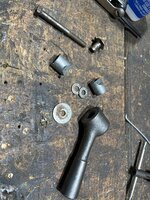
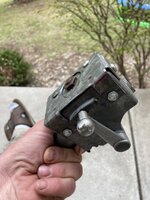
Ok so the fwd/rev gear box is fixed. Damn proud of how tight the backing plate is 😀

Next steps are to get matching machine bolts and nuts, mix up some JB then paint it.
Was thinking on the smooth surfaces, maybe drilling some pilot holes thru the plate but only into the zamak maybe a 16th or an 8th at most. Give the JB something else to grab onto perhaps.E4CED203-B040-4AFD-B95D-25EA2BA1D154.jpegB3CE134B-238A-4871-BB5C-C84A0B747DA8.jpeg
 
To avoid these ads, REGISTER NOW!
Top Bottom