Wow amazing info! Thanks!I bought my no-name (same as HF) 10 ton hydraulic crimper for $15 (shipped) on eBay in 2017 (I just pulled up the invoice). I've done about 30 crimps on wires from 6AWG through 2/0, and it hasn't started leaking yet. The dies have a chrome finish that's ugly as sin, but that same chrome would show up even the slightest deformation, and they're clearly unblemished.
As for the incorrect comments about die sizes, charts that match metric to AWG cross sectional areas are easy to find.
+100 to FTZ Powerlugs! These have a wider contact area so you can double crimp them, have a closed front end so they're weather-tight, have the best plating I've seen, and are beefier than anything else out there. I cannot find anything better (and I've looked quite a bit).
I bought the 16 ton hydraulic crimper for $32 in 2019, because I had the need to have 4/0 capacity on-hand. But the 16 ton is just more unwieldy to use, so I hardly use it. If you're sure you won't need more than 2/0, stick with the 10 ton that has the C jaw instead of the 16 ton that has the cross pin.
Skip the grease or no-alox and use marine grade double wall heat shrink. Any grease will interfere with the adhesive shrink liner's bond to the insulation, so if you do grease don't waste you money on the better heat shrink. And (I'm sure you know this, but just for others reading), NEVER apply ANYTHING to the strands before crimping. The crimp MUST start out DRY.
Also, don't try to finish a hex (or square) crimp in a single crush. Hex dies will pinch off ears on each side, giving you something that looks like lugnut71's post above mine (his aren't that bad, but a hydraulic die can crush that down to foil). The right way to hex (or square) crimp is to close the jaws until the fitting has spread to the point it is about to be (but isn't yet) pinched. Then release and rotate the hex jaws one face and finish. You'll get a perfect hexagon with no crushed ears sticking out. Those ears are a weakness in the crimp, and will cut into your heat shrink. More modern crimping systems use oval crimps to compress in a single step, but they're more sensitive to die sizes.


You are using an out of date browser. It may not display this or other websites correctly.
You should upgrade or use an alternative browser.
You should upgrade or use an alternative browser.
Battery Cable Crimper
- Thread starter JWC86
- Start date
laser3kw
Well-known member
^^^ this is correct - the cable / lug is to be assembled and heat shrink. The Noalox is to be used on the connection / terminal to protect the lug / post from corrosion .Skip the grease or no-alox and use marine grade double wall heat shrink. Any grease will interfere with the adhesive shrink liner's bond
I kind of jumbled up my thought
After assembly of battery cable and connection terminal, smear on a coat of NoAlOx / Noalox (Ideal industries)
Last edited:
Soldering any connection that might see movement or vibration is alway second choice to crimping in my opinion. I’ve came to this conclusion after reading tests and studies from aviation and racing wiring specialist. You won’t see any soldered connections on a high end wiring harness for a racing application unless it’s absolutely necessary and if so it will almost certainly be potted.That’s hilarious. A good solder joint connects at the molecular level, and is corrosion resistant.
Crimps would be better for aluminum, and in high heat applications.
I spent a lot of years doing this wrong myself, always soldering rather then crimping and sometimes even soldering my crimped connections. I’ve since seen the way. The key here is a properly crimped connection takes more skill(and tooling) than a soldered connection and I think some people(I did) get a bad feeling about it as when not done well it will be less secure. Soldering in wires even done poorly will seem very secure.
Is there a connection on the planet that does not see movement or vibration?Soldering any connection that might see movement or vibration is alway second choice to crimping in my opinion. I’ve came to this conclusion after reading tests and studies from aviation and racing wiring specialist. You won’t see any soldered connections on a high end wiring harness for a racing application unless it’s absolutely necessary and if so it will almost certainly be potted.
I spent a lot of years doing this wrong myself, always soldering rather then crimping and sometimes even soldering my crimped connections. I’ve since seen the way. The key here is a properly crimped connection takes more skill(and tooling) than a soldered connection and I think some people(I did) get a bad feeling about it as when not done well it will be less secure. Soldering in wires even done poorly will seem very secure.
I just never realized how much cheaper and easier soldering is than crimping.
nadogail
Well-known member
I like mechanical connections for large conductors.
Walkers
Well-known member
Which is likely why OEM uses soldered eyelets, oh wait, they don't... JKI took over managing a fleet of about twenty-five trucks (mostly R-Models) and about ten pieces of gas and diesel powered equipment back in the ‘80s, about half of which would not start.
Replaced all the suspect clamps with solder-on clamps and 90% of the problems went away. Never had one go bad.
Crimps have become more popular than soldering because it’s faster, easier and low/no skill, not because they’re better.
That said, I’ve only ever crimped/clamped welding cables, primarily because corrosion is not a significant issue the way it is with batteries.
I bought my no-name (same as HF) 10 ton hydraulic crimper for $15 (shipped) on eBay in 2017 (I just pulled up the invoice). find anything better (an
What are good eBay search terms for that crimper?Been using this for 30 years ,works very well, was expensive back then and still is. I just bought a second one used on ebay few months ago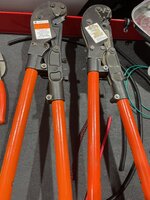
Walkers
Well-known member
high heat applications would include starter cables because of the amps drawn. Also winch cables, big lights, etc.Crimps would be better for aluminum, and in high heat applications.
rlitman
Well-known member
Except that a good solder joint also wicks up between the wires locking them in position, which puts undue stress in individual strands subject to motion (crimps lock wires together, but all in a single uniform zone straight across the cable). And even with the molecular level bond, you can measure higher resistance across the solder joint than you can on a good crimp. When current is applied, that resistance will create heating, which leads to copper oxidation (not under the solder, but adjacent to it) and more heating, creating a cycle of failure. But not all solder joints are doomed to fail. Tinned wire is far more resistant to oxidation (that's why I use ABYC wire for many things), and if you keep the current (and heating) low enough, this may all be immaterial. But "engineering" is all about using the least material to get the same results, so not all of us can afford to ludicrously oversize things just for the luxury of soldering.That’s hilarious. A good solder joint connects at the molecular level, and is corrosion resistant.
Crimps would be better for aluminum, and in high heat applications.
I wasn't posting a correction, more of an addition, because there is the evil temptation to grease wires before crimping. Oxidation destroys copper, so keeping wires oxygen free improves their longevity. The FTZ Powerlugs I mentioned have a closed front (though technically the crimp itself should act as an oxygen barrier, I prefer the belt and suspenders option), so that side is sealed, leaving you with the responsibility of protecting the back.^^^ this is correct - the cable / lug is to be assembled and heat shrink. The Noalox is to be used on the connection / terminal to protect the lug / post from corrosion .
I kind of jumbled up my thought

Ordinary heat shrink goes a long way towards blocking oxygen, as does grease (of which noalox is a great choice), but greases don't penetrate well to the core of cables (Fluid Film will, as will DeOxit), and I feel that you're not going to do better than double-wall heat shrink, so I now just skip the other stuff and keep my crimps dry.
You are misinformed. Do a little research on the topic. This debate has long been settled. There is a reason NASA specs crimping over soldering whenever possible. Nuclear Industry, it’s the same. You passed up a good opportunity to become better informed after a commenter posted something that contradicted your erroneous point of view. You doubled down with “that’s hilarious” as if the poster was grossly misinformed. It may be humorous to you but it’s also true that crimping is a superior method whenever possible. It always baffles me when people post incorrect information with seeming authority in subjects far outside their area of expertise.That’s hilarious. A good solder joint connects at the molecular level, and is corrosion resistant.
Crimps would be better for aluminum, and in high heat applications.
I would think NASA’s speaker wires are mission critical! LolI wonder if NASA crimps their speaker wires, or just the mission critical stuff.
I dunno all they ever seem to do is play Honky Tonkin' on them.I would think NASA’s speaker wires are mission critical! Lol
So far, no one has brought anything to the discussion but their own chin-music, and a magazine article.You are misinformed. Do a little research on the topic. This debate has long been settled. There is a reason NASA specs crimping over soldering whenever possible. Nuclear Industry, it’s the same. You passed up a good opportunity to become better informed after a commenter posted something that contradicted your erroneous point of view. You doubled down with “that’s hilarious” as if the poster was grossly misinformed. It may be humorous to you but it’s also true that crimping is a superior method whenever possible. It always baffles me when people post incorrect information with seeming authority in subjects far outside their area of expertise.
Walkers
Well-known member
You have brought even less!So far, no one has brought anything to the discussion but their own chin-music, and a magazine article.
mslim
Well-known member
FWIW I'm in the crimp camp, provided it is properly done. The fact that aviation mechs use it is enough for me.I am getting ready to do some battery cable work. I am looking at the 16 ton, long handle, blue colored import on Ebay. You can get the whole kit with 13 dies for $50~. The dies will hex crimp from 8 awg up to 4/0awg(?)
This will have the giddy-up to do more than you need. I looked at custom cable builders and the brag about using 10 ton units.
Be careful what cable you use. The "welding cable" type jacket is not good in oil or petroleum environments - no matter what they say.
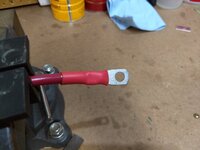
When I cleaned up my RV battery box, I used Temco shrink wrap, terminals, and the TH0012-8 crimper. If you have the need for the interchangeable dies and the extra money, the hydraulic one looks good for a buck and a half.
The lever one like I used, required putting on a solid surface like a garage floor and using both hands and body weight to compress. Other caveat is that the gauge scale on the side is more of a suggestion. Dial up what you think you need, crimp and pull test the fitting. Look for voids around the terminal that can allow corrosion to seep in.
Attachments


Last edited:
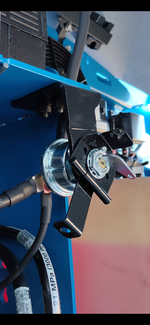
I have one of these and have used it half a dozen times with good success.
I paid $25ish for it a few years ago and would probably skip it if I had to pay the $63 it seems to cost now.
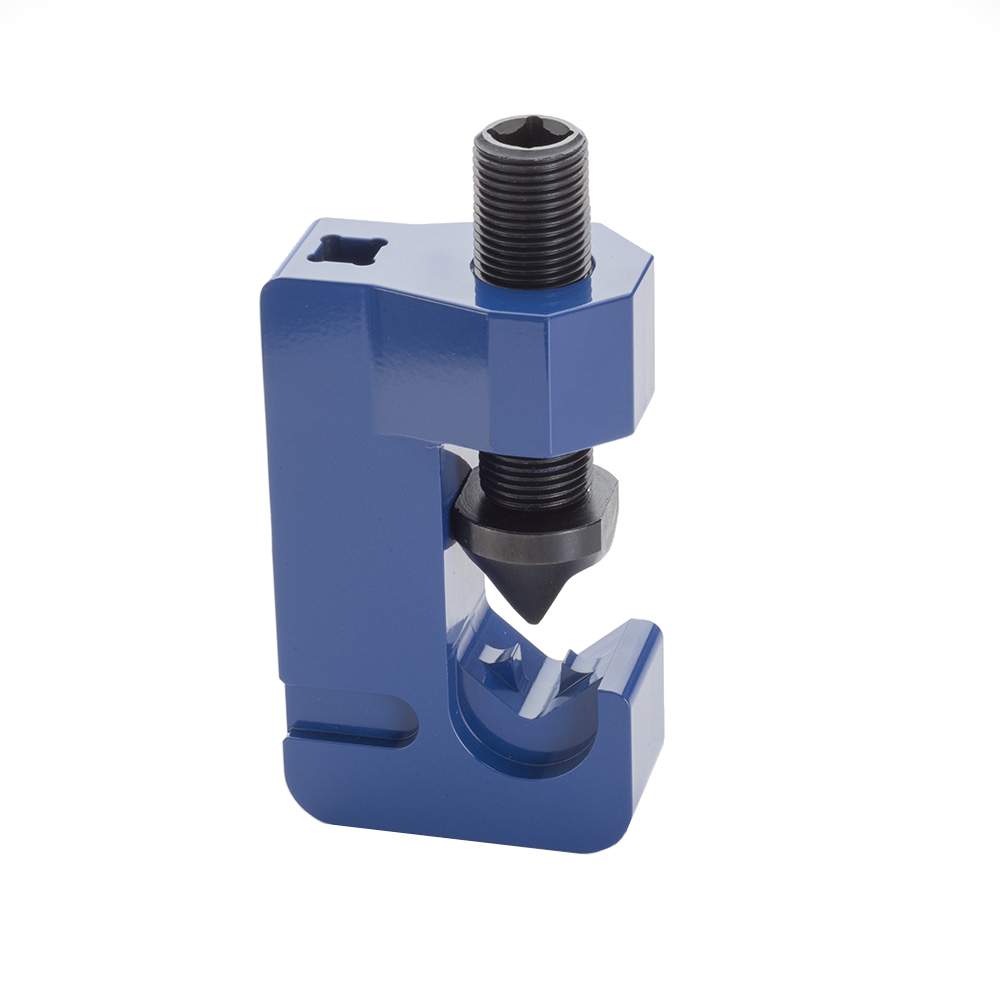
3 Point Crimper - EZRED
No need for pricey long handle crimping tools and replacement jaws. This tool does a 3 point crimp all at one time and it crimps up to 4/0 AWG cables. The B7946 is a new versatile wire crimping tool. Tight work areas are not a problem for this small hand held crimper. Can be held with a...ezred.com
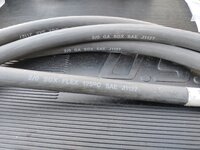
Myself and 2 other guys in my group at the shop have these EZ-Red crimpers. They're not blue and yes, it's a bit expensive. But it works. We use them nearly every day.
We have a hydraulic crimper in the tool room, but this is just faster. A little tricky to do solo with only two hands, but it can be done. Using an impact makes the job easier, though it's quite a bit of torque so hold on tight.
We use it mostly on large 2 gauge battery cable (but also some smaller cables) and crimp ring terminals.
Attachments
mikepelchy
Active member
I use the HF hydraulic crimper quite often for 2ga-8ga wires and it works flawlessly, way easier especially when the cable is already ran on the piece of equipment and you are just putting a new end on it. I have never tried this crimper with the top post type of connector and have only used it on eye-let type connectors.
I also ended up picking up a cheap chinese hydraulic crimper off Amazon for the bigger stuff, like 0/2ga. Worked great when I needed to build new battery cables for my jeep.
I also ended up picking up a cheap chinese hydraulic crimper off Amazon for the bigger stuff, like 0/2ga. Worked great when I needed to build new battery cables for my jeep.
I’m rubber, you’re glue, what you say bounces off me and sticks to you!You have brought even less!
Schurkey
Well-known member
I picked up a "hammer crimper" decades ago. Worked great when assembling cables on the bench. Inexpensive, versatile. Best used in a vice or better-yet, an arbor or hydraulic press rather than with a hammer...but the hammer works.
Problem is, it's useless for repairing cable ends "in place" on the vehicle. There's nothing on the vehicle that's sturdy enough to use as a support for the crimper when you swing the hammer.
Thus I bought a cheap-**** "hydraulic" crimper from Amazon. My mistake was believing that the Metric dies can be used on AWG cable lugs. Well...they can, but it's a pain in the tuckus. Given the few cable crimps I make, it's not worth upgrading. But if I were buying this again, I'd spend the money for a crimper that has actual AWG dies.
Problem is, it's useless for repairing cable ends "in place" on the vehicle. There's nothing on the vehicle that's sturdy enough to use as a support for the crimper when you swing the hammer.
Thus I bought a cheap-**** "hydraulic" crimper from Amazon. My mistake was believing that the Metric dies can be used on AWG cable lugs. Well...they can, but it's a pain in the tuckus. Given the few cable crimps I make, it's not worth upgrading. But if I were buying this again, I'd spend the money for a crimper that has actual AWG dies.
kaymccampbell
Well-known member
I've got the HF crimper and it's the nuts. I've used it on winch cable and some battery cables..
seber
Well-known member
I've always used a V block and cold chisel for larger cables. It works as well as anything you can buy and there is no limit on size. Been working well for sixty years.
mike93lx
ALLIANCE MEMBER


whateg01
Well-known member
I have a set like that and it works great. Not as pretty of a crimp as a factory job but solid. Mine are older, no idea the brand, but forged handles and HEAVY! Gets the job done though.I install battery systems in big boats and use these at least once a week. I like them because you can dial in the setting you want, if your lugs are sligtly smaller or bigger than they should be (two 4/0 lugs from two manufacturers will be slightly different sized). Also, in tight spaces like a boats bilge, I can work my way up to the size I need in a few strokes rather than 1 hard stroke. These do 8 awg up to 4/0 awg.

Sky High Car Audio Crimper
Sky High Car Audio - Elevate Your Ride with Premium Car Audio Solutions. Explore a world of top-quality car audio systems and accessories. Experience crystal-clear sound today!skyhighcaraudio.com
You can buy the same ones from lots of electrical stores, but they are twice the cost for literally the same thing. Also, yes the harbor freight hydraulic crimper *****. You need to change out dies, and they dont last.
Schley 15600. No hammer needed.

this is a clever design for access since you can use a socket extension and/or a power impact or wrench.
EZRed sells a similar one that goes bigger too: https://ezred.com/product/3-point-crimper/this is a clever design for access since you can use a socket extension and/or a power impact or wrench.


