To avoid these ads, REGISTER NOW!

Bike torque wrench error tolerance

fishwatcher

Well-known member
Joined
Jan 26, 2023
Messages
751
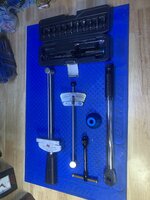
I just picked up a used pair of Park Tools I beam style torque wrenches. I already have a small Lezyne tool that goes up to 10nm. And a click style torque wrench from Amazon that I think goes up to 20-ish nm.

I compared the three 1/4” bit/socket torque wrenches.

The Lezyne is the most conservative. After I set a bolt at 5nm with it, the 1/4” bit Park Tools I beam torque wrench will turn some more, almost a full nm to reach 5nm. Then I take the click style torque ratchet wrench and it turns more again for almost another half or up to one more nm before it clicks.

This range of difference is about the same at 7 or 10nm targets.

How acceptable is this range of error? I’m assuming the park tools I beam style is the most accurate. It measures right in between the other two.

Am I testing wrong? Are these results expected given the different styles I have?

I didn’t try the big torque wrench. I tried the 3/8” Park Tools and 10nm mark is so small, it’s not going to be in the best range to use for small nm specs.

Thanks. IMG_1023.jpeg
 
Last edited:
To avoid these ads, REGISTER NOW!

slowtwitch73

Well-known member
Joined
Apr 18, 2019
Messages
5,876
Location
Hellgate
That's a big thick subject... cliffs notes... none of those are great torque wrenches, and you're 'just working on bikes'.. not a snub.. I do the same.

The fact you are comparing and noting the differences.. you'll be fine.
 

Odd-job

Well-known member
Joined
Aug 13, 2017
Messages
2,261
Location
SF Bay Area
The internet seems to support an up to 20-25% variation on smaller fasteners as a rule of thumb, but a lot of variation can go into this such as cleaning, lubrication, loctite, fastener material, etc. Something seems off though with an extra full turn of the fastener (did I interpret that right?). That seems like it would be a huge variation when torque to yield applications are torque + 90 degrees or so.

out of curiosity are you calibrating with a electronic torque adapter?

1724420505298.png

Beam, dial, and digitals seem to be more accurate (or less chance for user error) in these low torque applications based on my trial and error experiences.

Luckily most low torque bicycle fasteners aren't too fussy except for those stem bolts on carbon fiber handlebars and the new integrated seat post clamps...
 
OP
F

fishwatcher

Well-known member
Joined
Jan 26, 2023
Messages
751
The internet seems to support an up to 20-25% variation on smaller fasteners as a rule of thumb, but a lot of variation can go into this such as cleaning, lubrication, loctite, fastener material, etc. Something seems off though with an extra full turn of the fastener (did I interpret that right?). That seems like it would be a huge variation when torque to yield applications are torque + 90 degrees or so.

out of curiosity are you calibrating with a electronic torque adapter?

1724420505298.png

Beam, dial, and digitals seem to be more accurate (or less chance for user error) in these low torque applications based on my trial and error experiences.

Luckily most low torque bicycle fasteners aren't too fussy except for those stem bolts on carbon fiber handlebars and the new integrated seat post clamps...
Not an extra full turn. maybe up to half a turn (but I could test again). Also, I didn’t pull the bolt out to clean it before testing. I loosened it and put a drip of lube.

Starting with Lezyne at a target nm like 4 or 8, the park tool will say 3 or 7 and require up to half a turn to get to 4 or 8.

If I went for 4 or 8 with the click, the park will start to move when it registers 5 or 9.

So the range if of difference between these tools in the range of 4-10nm is 1-2nm difference.

I don’t have a digital torque device.
 
Last edited:

AdAstra

Well-known member
Joined
Aug 27, 2021
Messages
195
Getting something moving takes more torque than keeping it moving (static vs dynamic friction). So inferring torque applied by how much it takes to get it moving in the same direction isn’t going to be accurate.

Instead, try marking the head of the fastener, and seeing where it points after torquing with one tool, then loosening half a turn and torquing to same setting with another tool.

Alternately you could rig sockets/bits in a way to read off your beam type torque wrench while torquing on it with one of the clickers to see if the needle is in approximately at the setpoint when the clicker triggers.
 
Last edited:

tamaraw

Well-known member
Joined
Jun 6, 2022
Messages
842
But of a broad stroke here. Bikes can cost over $10k and component failures can result in significant injury. But if those are the use case, a higher end tool is probably justified
I can agree with that, but here's a counterpoint:

Nothing on a bicycle requires significant torque and these specs are mostly to prevent damage from ugga-duggaing. And if something does come loose, you will often have advance warning.

The only things I can think of that really require a torque wrench to work on would be spoke ******* but I don't see that type of wrench in the photo.
 

jayemm

Well-known member
Joined
Dec 18, 2018
Messages
1,521
Location
up high down low
The TQ's look to be in good shape, so if it were me, I'd be inclined to say the small beam is the most accurate. The clicker is one of many cheaper generic one's that carry a bunch of brand names. Doesn't mean it's bad though. As mentioned above, I would hook the clicker and larger beam together and check the clicker at different settings vs. the beam and see what the beam reads when the clicker releases. The beam should be within 4% by design. If you do this be sure to "exercise" the clicker first to loosen up the internal mechanism before checking it.
 
Last edited:

dnschmidt

Well-known member
Joined
Oct 3, 2014
Messages
7,271
Location
Phoenix, AZ
One of my best friends is a sicko bike rider. He has won races for the 70 and older crowd and has a $14,000 carbon fiber bike. For a competition bike like his you don't take chances as these things are insanely expensive. I gave him a TOPTUL torque screwdriver for anything under 5 N-m and had him order from Amazon an Eclatorq 1/4" drive low range digital torque wrench that I think he paid about $100 for. You don't guess with carbon fiber.
 

RoninB4

Well-known member
Joined
Jul 22, 2020
Messages
3,518
Location
Under My House
Not sure if "bike" means bicycle or motorcycle. Excluding carbon fiber parts or really high end components I don't see a real need to torque to spec. When I rode (almost daily) I just relied on Loctite (blue or purple) and drove the fastener until it was snug.

For motorcycles I have much the same approach unless it's engine internals (rod caps, etc.) where a torque to deformation yield was important. For all other components the fastener is usually there to keep the component from falling off. Some "blue glue" and an educated feel for when threads were getting stretched was always sufficient. Over the years and the thousands of fasteners installed I've developed a "feel" for things and only break out the torque wrench (long out of calibration) for really critical applications. If the assembly just needs to stay assembled I usually rely on feel...... and Loctite. Never had a problem with this method on anything.

A friend once insisted that I use a torque wrench for the chromed fasteners (aftermarket) to the valve covers on her Valkyrie. I snapped one (cheap material for appearance purposes) much to her displeasure and admonishment of my abilities. I just snugged the last few on my side and handed her the torque wrench. She proceeded to snap off two on her side. "Oh that's how you do it huh?"

Too many things I've worked on either have fasteners/components that are barely more sturdy than solder (Asian COO) or some ham fisted idiot has gorilla torqued (poorly set pneumatic driver?) until the threads have been stretched and are ready to come out. Simply going for a given torque value does not allow for either circumstance. It's good to use factory specs in the beginning, developing a "feel" for non-critical applications can avoid wailing and gnashing of teeth that will occur some day on a torque value never achieved. JMO.
 

dscheidt

Well-known member
Joined
Apr 26, 2017
Messages
2,888
Been a while since I worked on a bicycle but I don't recall ever using a torque wrench.
probably should stay away from anything intended for people over 10 or so, then. Modern bikes are stupidly sensitive about torque, with carbon fiber stuff the difference between too loose and broken from over tightening can be a Nm or less.
 

lund

Well-known member
Joined
Nov 2, 2019
Messages
766
Location
Michigan
Yeah I mean I guess you could lose a wheel and fall into traffic and die because your nut was torqued 2 inch pounds off.

Amen. It surprises me there is so much written on GJ on torque limits, tolerances, etc. With pretty rare exceptions, it will not matter much if a fastener is +- 10-20% ish. The torque wrench is to get you in the ball park. Flanges on engines with seals may be more important, but the issue there is more uniformity from fastener to fastener rather than absolute values. Condition of the fasteners and any lubrication will also change the effective torque applied over a range of 20% ish. Also, you are assembling devices at a particular temp and expansion condition with (often) dissimilar materials that will have different thermal expansion coefficients etc. So torques will shift with ambient conditions of operation evolve. If you have corrosion ... things get even much more difficult.

If you have to have things torqued to ~20% or you risk catastrophic failure ... well the engineer who designed it did a horrible job. People are likely fixating too much on this issue.

I agree with others who say that electronic torque adapters are often surprisingly accurate over their design range. They can be easily used to check and calibrate other torque wrenches that might be convenient or use by themselves. But it appears to me that many are over fixating on this issue. Particularly (not here) with tire studs on cars. Some act like a 10% error will make your wheel fall off but seem unconcerned on corrosion etc.
 

PCustoms

Well-known member
Joined
Jul 23, 2011
Messages
22,629
Location
VT
Something seems off though with an extra full turn of the fastener (did I interpret that right?).

The issue is is that the fastener has already been torqued, then the OP is using ANOTHER wrench to torque it AGAIN.

Of course it moved.

I could repeat the experiment with 5 wrenches, of the same brand, calibrated last week, and have the same results.

Very the wrench is in calibration, tighten it to torque and leave it alone.
 

dchawk81

Well-known member
Joined
Jul 31, 2014
Messages
14,361
probably should stay away from anything intended for people over 10 or so, then. Modern bikes are stupidly sensitive about torque, with carbon fiber stuff the difference between too loose and broken from over tightening can be a Nm or less.
Probably. I had a Huffy.
 

slowtwitch73

Well-known member
Joined
Apr 18, 2019
Messages
5,876
Location
Hellgate
Anyone with some mechanical empathy and common sense can successfully work on a carbon uber bike and components without a torque wrench.

A torque wrench is better..at least to use once in a while to get a feel for correct torque.

The fact the op has a number of them and is 'paying attention' puts him well ahead of the curve.. he'll be fine.

I have a few TQ's and use them on high end bikes... wouldn't bat a eye at not using them though.

Some guys are just breakers of things.
 
To avoid these ads, REGISTER NOW!

Terra Nova

Well-known member
Joined
Feb 26, 2012
Messages
4,193
Location
Michigan
I just picked up a used pair of Park Tools I beam style torque wrenches. I already have a small Lezyne tool that goes up to 10nm. And a click style torque wrench from Amazon that I think goes up to 20-ish nm.

I compared the three 1/4” bit/socket torque wrenches.

The Lezyne is the most conservative. After I set a bolt at 5nm with it, the 1/4” bit Park Tools I beam torque wrench will turn some more, almost a full nm to reach 5nm. Then I take the click style torque ratchet wrench and it turns more again for almost another half or up to one more nm before it clicks.

This range of difference is about the same at 7 or 10nm targets.

How acceptable is this range of error? I’m assuming the park tools I beam style is the most accurate. It measures right in between the other two.

Am I testing wrong? Are these results expected given the different styles I have?

I didn’t try the big torque wrench. I tried the 3/8” Park Tools and 10nm mark is so small, it’s not going to be in the best range to use for small nm specs.

Thanks.

Yes. As mentioned, big difference in dynamic vs static torque on fasteners.

Couple things to keep in mind. Torque wrenches have tolerances, and that tolerance is at the full-scale value. It propagates down but the error will be larger on the lower end of the wrench and less at the high end.

Your Lezyne tool is 0-10 N·m with an accuracy of ±0.5
The Park Tool Beam Wrench is 0-7 N·m with a published accuracy of ±4%. For your 7 N·m that is an error of ±0.28 N·m

If your Lezyne erred on the low side, your have tightened the nut to 4.5 N·m, and if your park tool beam wrench is on the high side it is applying 5.28 N·m, A delta of 0.78 N·m (16% difference) would certainly allow the fastener to continue to spin. I suspect your Amazon click type accuracy is ±4-6% or more.

5 N·m is a gnat sneeze of torque, I would venture a guess that YOU are the biggest influence on the outcome of your testing. Beam type wrenches take skill and click type aren't as fool proof as they seem. At that low of a torque all sources of error are coming into play. The speed you're turning, the angle you're pulling, the distance from your hand to the end of the wrench, etc. are all compounding the error.
 
Last edited:

tvand13

Well-known member
Joined
Aug 20, 2015
Messages
76
Location
Northern Virginia
One thing I haven't seen mentioned yet to test the dynamic vs static theory being put out, torque with one of the wrenches, then repeat on the same fastener with the same wrench. I'll bet you'll find that OP is right, the calibration of the wrenches is really that far off.
 

Odd-job

Well-known member
Joined
Aug 13, 2017
Messages
2,261
Location
SF Bay Area
"calibrating" with a $40 Hobo Freight torque adapter......Good one, I love it. :ROFLMAO:
hey man its better than nothing! Actually surprisingly accurate along with their rebranded Eclatorq digital torque wrenches. I have admittedly become a fan boi... don't judge.
 

Grant Gunderson

Well-known member
Joined
May 17, 2013
Messages
2,319
Location
Bellingham, WA
I can thing of several ways the OP’s test is flawed. However let’s move beyond that. You can certainly get by without having a torque wrench for bikes for general maintenance but when it comes to carbon components they are cheap insurance. However some BB’s / hubs require them for proper bearing preload. E-bikes should use them when tightening the drive sprocket to the motor. Speaking of E-bikes the Brose motors found on many specialized e-bikes require them to properly set the internal belt tension.

Where torque wrenches / torque limiting screwdrivers are essential is for servicing suspension. Often they are required to set the preload on the shim stacks to an exact torque. Too little or too much will make a big difference in how the dampers perform.

The park torque wrench’s all ****. I got rid of all but one of mine years ago and bought all Snapon. For me it’s worth having ones that are reliable and consistent.

IMG_0123.jpeg
I like Wera for torque limiting screw drivers. the only Park torque wrench I still have is there lightweight beam style and I only use it for setting the clutch on shimano derailleurs. It ***** and I wish I had never bought it, but since it only gets used for a single task I’ve not bothered replacing it.

Truth be told with a few exceptions most of Park tools ****. Most of the time other mfgs just do it better such as Abby, Pedro’s, Unior. I used to own everything Park makes and year after year you find less and less of their stuff on my boxes as I upgrade to better made tools and ones that do the task more efficiently.
 

Doozer75

Well-known member
Joined
Oct 24, 2009
Messages
260
Location
Buffalo NY
If you want your torque setting tools to be accurate
take them to a gauge calibration service and let them
test your wrench to NIST standard referenced dead weight.
Anything else is just guessing.
Using s digital this or that is just a joke.
Digital means NOTHING.
Getting your torque tool calibrated is probably going to cost
as much as the tool itself. But if you want to play, you gotta pay.
I know most of you people here won't do this, because I bet no
one here wants to pony up the cash. You guys like to talk talk talk
and opine opine opine, but aren't ever serious. I calibrate my
home shop torque tools on a NIST certified traceable load cell.
The most accurate are my Steurtavant Ridgemont flat beam
wrenches. My clickers have the least repeatability.
For my use, rod bolts and head bolts and mains get torqued.
Even with a full shop full of machines, not too much need that
precise degree of torquing. If you use a torque wrench on hose
clamps, you have mental problems. Get help.

-Doozer
 

dnschmidt

Well-known member
Joined
Oct 3, 2014
Messages
7,271
Location
Phoenix, AZ
If you want your torque setting tools to be accurate
take them to a gauge calibration service and let them
test your wrench to NIST standard referenced dead weight.
Anything else is just guessing.
Using s digital this or that is just a joke.
Digital means NOTHING.
Getting your torque tool calibrated is probably going to cost
as much as the tool itself. But if you want to play, you gotta pay.
I know most of you people here won't do this, because I bet no
one here wants to pony up the cash. You guys like to talk talk talk
and opine opine opine, but aren't ever serious. I calibrate my
home shop torque tools on a NIST certified traceable load cell.
The most accurate are my Steurtavant Ridgemont flat beam
wrenches. My clickers have the least repeatability.
For my use, rod bolts and head bolts and mains get torqued.
Even with a full shop full of machines, not too much need that
precise degree of torquing. If you use a torque wrench on hose
clamps, you have mental problems. Get help.

-Doozer
You are wrong with respect to digital means nothing if the torque wrench uses a strain gauge to measure torque as most digital torque wrenches do as these are quite accurate and robust. If it's just a digital display on an analog wrench then that means nothing.
 

jayemm

Well-known member
Joined
Dec 18, 2018
Messages
1,521
Location
up high down low
Right, but how exactly is that an analog wrench?

Your telling me there isn't a strain gage inside?
Apparently not. I read in the description and reviews that there is an audible click and tactile release felt just like regular clickers. Looks like just a digital readout of the torque you set rather than numbers stamped on the barrel. Seems like just another thing that could go wrong.
 

dchawk81

Well-known member
Joined
Jul 31, 2014
Messages
14,361
Apparently not. I read in the description and reviews that there is an audible click and tactile release felt just like regular clickers. Looks like just a digital readout of the torque you set rather than numbers stamped on the barrel. Seems like just another thing that could go wrong.
Well that sounds like a scam product to me. Lol.
 

CarBikeGuy70

Well-known member
Joined
Mar 12, 2015
Messages
170
Location
Western CT
If you are concerned about correct torque value a Park Tools torque wrench should be avoided- especially at the lower values a bicycle mechanic mostly encounters. Buy a Snap on or similar and move forward. Park tools are somewhat ok at best- nothing special they are not. I speak the truth after too many years in the bike biz.
 
To avoid these ads, REGISTER NOW!
Top Bottom