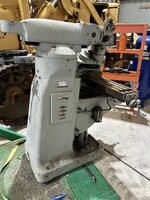
OP
bulletpruf
Well-known member
Your thread is changing a bit. If you want to edit the title and need help, just shoot me a PM
Eric - Sending you a pm. Thanks, Scott

Your thread is changing a bit. If you want to edit the title and need help, just shoot me a PM
Done and glad to help.Eric - Sending you a pm. Thanks, Scott
Done and glad to help.
Now that you have it, and haven't made a trip to HGR, I will still suggest a trip. Even if it's just to look around, it's like a grown man's candy store.
That pin has nothing to do with preventing slipping, it's to aid in tightening the collet or other arbor in the r8 spindleFor all you B-port type guys, Scott are you listening?
There is a pin in the spindle of your machine, it keeps the R8 collet in position when you tighten them. The reason B-port 'suggests' 3/8 drills in steel or not using 3" face mills deep in steel are because these pins can shear easily. This is the biggest issue with R8 spindles. Tread lightly on your chip load. Turret mills are the most versatile milling machine, they are also the most delicate!
Sure,That pin has nothing to do with preventing slipping, it's to aid in tightening the collet or other arbor in the r8 spindle

I think all those stupid pins should be removed. A sheared off pin spinning around and damaging the bore is definitely something to worry about.Sure,
That is the purpose of the pin. It is also very common for that pin to shear under high loading of the spindle. Never heard of a pin shearing from tightening a collet!
I believe the 3/8” max drill size is only referring to the automatic down feed! The gears that drive it are mainly designed for single point boring, not drilling!Thanks for the details. It appears that I still need a drill press for the shop!
This is one of those things that isn't worth fixing.It's always a bit of a treasure hunt when buying old stuff, isn't it? Finding broken stuff, MIA parts, shoddy old repairs. Hope this one doesn't have a lot of unpleasant surprises.
Thanks
Easy peasy, now that you’ve done it once! It’s not as hard as people think but, it’s not that hard to dump one either!
Here is an write up by Barry at H&W Machine - my source for Bridgeport parts. There are youtube videos and other articles he has written which may be of interest.I think all those stupid pins should be removed. A sheared off pin spinning around and damaging the bore is definitely something to worry about.

 machinerypartsdepot.com
So the pin keeps the collet from spinning...except it apparently doesn't, as they keep sheering off. Tighten the drawbar tight and the taper should hold it.Here is an write up by Barry at H&W Machine - my source for Bridgeport parts. There are youtube videos and other articles he has written which may be of interest.
Collet Alignment Screw Replacement
Discover step-by-step guidance for replacing collet alignment screws. Ensure optimal machine performance with our expert instructions!
Video not taken ?
Have 2 Bridgeports one with and one without. I find that the pin only serves to annoy me when installing a tool. Keep meaning to remove it, but it’s the machine with the 8” riser so I don’t use it much.
Nice job on the move! Looks kinda close to the wall. I like to leave enough room to pass a floor broom thru.


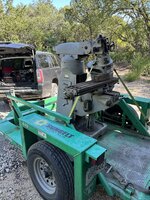


Keep in mind, the gear that tilts the head is not stout enough to crank it back up! Use a ratchet on the nut with one hand and support the head with your other hand. Lift and turn, lift and turn… once you’re within 20 degrees or so it’s not going to break!
My experience is different from yours. When I went through National Tool and Die Training in the early 70's we were taught to locate the R8 collets to indicate them by rotating them to the pin. Every BP I have worked on for the last 50 plus years of my life, that is what I have done. I don't understand why this has been standard on every BP if it wasn't necessary. Give Barry a call at H&Of the 4 Bridgeport type machines I've operated, none had the key. Small sample size, yeah. A cousin of mine spent 40 years as a "real" machinist before retiring. He came over to use mine awhile back and asked if mine still had the key. I said no. He said none that he had ever operated did.
So the pin keeps the collet from spinning...except it apparently doesn't, as they keep sheering off. Tighten the drawbar tight and the taper should hold it.
Mine is gone and when I rebuild my spindle next year I'll look to see how much damage is done to the top of the collet area.
I am absolutely not an expert, just going by the opinion of experts.
So the pin keeps the collet from spinning...except it apparently doesn't, as they keep sheering off. Tighten the drawbar tight and the taper should hold it.
Mine is gone and when I rebuild my spindle next year I'll look to see how much damage is done to the top of the collet area.
I am absolutely not an expert, just going by the opinion of experts.
I believe that Bridgeport put the pins in for a reason. I first learned on Bridgeports in the mid 70's when I went through National Tool and Die Apprenticeship training and we were instructed to rotate the R8 collets so that the keyway in the collet aligned with the pin in the spindle. All of the Bridgeports I have worked with since I have followed this practice. The very accomplished Tool and Die makers I worked with in the Aerospace industry that had CNC Bridgeports all had the pin in their machines. Just my take on it. I'm still an amatuer. In the end "To each his own".So the pin keeps the collet from spinning...except it apparently doesn't, as they keep sheering off. Tighten the drawbar tight and the taper should hold it.
Mine is gone and when I rebuild my spindle next year I'll look to see how much damage is done to the top of the collet area.
I am absolutely not an expert, just going by the opinion of experts.
I would recommend a test indicator over a dial indicator to tram the head and indicate the vise. For years I have used a test indicator in a collet to sweep the table using 1-2-3 blocks. The test indicator can be used to square up the vise. In my experience it is much more accurate than a dial indicator.Kurt vices are magic because the moving jaw has a mechanism that makes it clamp down as it moves in. Keeps the work piece squarely against the fixed jaw. Used collet's can be a **** shoot they do ware and loose consentrisity you also don't need a complete set 1/4,3/8,1/2, and 3/4 would probably cover your needs. Think about buying new. Used end mills can be a good deal just remember that regrinds are not the size marked on the shank you need to measure them before use. You will need a dial indicator and a holder that you can clamp to the mills spindle to do set up work.
I agree wholeheartedly.That pin has nothing to do with preventing slipping, it's to aid in tightening the collet or other arbor in the r8 spindle
It sheared because the drawbar wasn't tight enough.Sure,
That is the purpose of the pin. It is also very common for that pin to shear under high loading of the spindle. Never heard of a pin shearing from tightening a collet!
Exacatacaly - New wordIt sheared because the drawbar wasn't tight enough.
Erickson 30 is very nice, all our series 2 had erickson 40 and I loved them. But.... its getting hard to find tool holders new.May have missed it, but a power drawbar should be on the list of wants. You don't have a spacer on that column, so it's definitely feasible to spin the drawbar nut with the wrench all the time. But hitting the button for the power drawbar is so much more enjoyable. One step better is swapping the spindle for an Erickson Quick Change 30...but that's a ways in the future.