Don't knock it if you haven't tried it. Actually, it makes perfect sense. I don't think you bothered to consider the dynamics of what's occurring. You need to pour yourself a beer.
Now that you've got that beer in-front of you, where are the bubbles going? Down? Like you're trying to force the bubbles when you bleed the brakes by having someone step onto the brake pedal, while you watch 2-3 cc/ml of fluid be evacuated by the master cylinder stroke?
No, they're rising. And as I stated, when you reverse-bleed, you're pushing a considerably larger amount of fluid each time upwards, which is going to wash all those pesky trapped bubbles upwards as-well, because (look at your beer glass) "bubbles rise!"
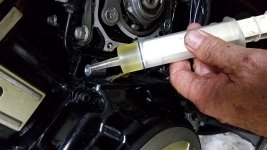
If you followed the directions I wrote, and emptied the master cylinder reservoir first, when you reverse-flush, each single emptying of the syringe will be equivalent to
many episodes of having your partner "OK, press the brake pedal down, and hold-it!" That makes perfect sense to me, one person doing the work of two. And, doing it much-quicker.
An added advantage is that you're removing any particulate matter that may be in-suspension, along with hygroscopically-infused water molecule-laden brake fluid. As the contaminated fluid empties-into the master cylinder, pools into the master cylinder reservoir, the heavier contaminants actually eddy and swirl around in the bottom of the master cylinder reservoir, with the less-contaminated brake fluid above it. This gives you the opportunity to see just what's collected in the lines, which has been pushed-up-to the master cylinder reservoir and to remove it with your syringe.
As you continue to reverse-flush your system, introducing fresh fluid into the bleeder, and watching it collect upwards in the master cylinder reservoir, you will notice that the opaque material suspended in the brake fluid has been flushed-out of your brake system. Now the fluid becomes lighter in color, and when it runs clear as fresh fluid from the new brake fluid container, you have effectively purged all of the contaminants from your brake system. That 'makes sense' to me.
Put it another way: do you want to fill an 12 oz glass (fluid measure) with a teaspoon, or do you want to pour it full from a pitcher? Let's say it's a beer glass, so you can watch those bubbles of carbonation rise to the surface. The teaspoon is the 'stomp and hold the brake pedal' method, the pitcher is akin to the syringe, and its increased volume. Plus you can 'pour your own,' an advantage, unless you have this lass drawing your pint+.
https://thechive.files.wordpress.co...-12-photos-13.jpg?quality=85&strip=info&w=600
No, "disconnect the brake lines from the master cylinder and push on the brake pedal after hooking-up the ram's horns' to dump the fluid back into the reservoir," no "jack-up the vehicle so the fluid and bubbles will shift towards the master cylinder reservoir," no "bench-bleed the master cylinder before installation." It's just not needed. Work smart, not longer and harder.
I tried the traditional method, and used it for years to work on my vehicles. Then about 1980 I got my first Mityvac, and that made things go easier, and quicker, and made it possible to easily do things by myself. Then I tried the syringe back-flush reverse-bleed, and I've never had to pick-up my Mityvac since.
A pressure-bleed system is great for a professional mechanic, but it uses a lot of fluid, they are expensive, and unsuitable for the average guy in his garage doing his brakes once in awhile, even if he has multiple vehicles.
https://t4.ftcdn.net/jpg/01/21/10/63/240_F_121106392_gSqaa3cfJ7bJvglf0UedThZ4PJyo0SZX.jpg
I consider the advice of, "use a fresh unopened bottle of brake fluid each time you replenish your reservoir" to be a sop to the sellers of fluid. I've been working on my own stuff for 50 years, cars, trucks, and motorcycles, and I've never had anything that I would consider a brake failure due-to using a previously-opened container of brake fluid. For replacing the calipers, or for disassembly of brake components, I usually buy a quart, and I use the left-over fluid from that time, for topping-off. It's in a sealed bottle, once the cap is screwed-on, how-much water vapor can there be in the limited volume of the half-full container of brake fluid? If you're running a race car or bike, and it makes you have more-confidence in your vehicle, sure, open a new bottle. You do realize your master cylinder has a vent to the atmosphere, to allow the brake fluid to move with brake application, and to account for the pad or shoe wear? Shouldn't this be a concern? No, not really.