To avoid these ads, REGISTER NOW!

Brake bleeding

smalltown

Well-known member
Joined
Jul 9, 2015
Messages
985
Location
Western Maine
After rebuilding my calipers installing new pads, and rotors I have a soft pedal. I had the calipers off for some time, and I am not positive if the fluid in the master cylinder got too low.

I have bled the brakes twice with the engine off starting with the brake furthest from the master cylinder, and worked myself closer. At first I thought they were ok, but when I backed out of the garage I realized they were too spongy.

Next I tried bleeding with the engine running. The point that I am at now is I have a great pedal with the engine off, but once started the pedal goes down, and feels spongy. The pedal does not go all the way to the floor.

It's a 2005 Ford Explorer Sport Trac, and according to my Haynes manual I do not need to have the dealer bleed the brakes. Mine are bled in the conventional manner.

I do not have an ABS light lit. I am bleeding with just a wrench, and a clear plastic tube in a bottle with an assistant pumping the brakes and holding.

Any thoughts ?
 
To avoid these ads, REGISTER NOW!

KRB52

Well-known member
Joined
Sep 25, 2013
Messages
2,650
How is the master cylinder? The rest of the system may be fine, but if that is no good, you will have the same symptoms. My other thought is that you may still have air somewhere in the system.
 
OP
S

smalltown

Well-known member
Joined
Jul 9, 2015
Messages
985
Location
Western Maine
KRB52 Don't know how to verify the master cylinder is ok. If I had let air into the master cylinder would repeated bleeding at the wheel brakes get it out ?
 

theoldwizard1

Well-known member
Joined
Feb 22, 2011
Messages
43,076
Location
SE MI
Next I tried bleeding with the engine running. The point that I am at now is I have a great pedal with the engine off, but once started the pedal goes down, and feels spongy. The pedal does not go all the way to the floor.

I know you said you rebuilt the calipers, but if one is still hanging on the slide/guide pin, you will get the same reaction. Good pedal, until you really stand on it hard, then it will drop some, but not all the way to the floor.

The best way to resolve this is a rebuilt caliper and caliper mounting bracket with new pins, purchased as an assembly. About $110 from Amazon, FREE shipping, no core. $59 from Rock Auto, but you have pay a core charge and shipping both ways.


I'm an old school DIY. I always do a final 2 man bleed. I have also found out some cars need to have the engine running.
 
Last edited:

Schurkey

Well-known member
Joined
Oct 27, 2011
Messages
2,366
Location
The Seasonally Frozen Wastelands
Master cylinders are often mounted to the vehicle with the front tipped "up". It's a wonderful way to align the pushrod with the brake pedal. It's also a great way to promote trapped air deep in the master cylinder casting.

If the master is tipped "up" in front, unbolt it from the booster or the firewall WITHOUT disconnecting the brake tubes. Push the front end down so that it's lower than level. Tickle the piston with a screwdriver or wood dowel. Any air in the cylinder will be forced into the reservoir via the compensating ports. Reconnect master to the booster or firewall.
 

tlc1976

Active member
Joined
Apr 3, 2017
Messages
27
Location
Michigan
New or rebuilt calipers can be a real pain to get all the air out. Lots of places for air bubbles to lodge. What I do is repeatedly smack the caliper with a block of wood between openings of the bleeder valve. You'll probably continue to get tiny bubbles out and might have to do this for awhile. But as long as you're getting air out, the pedal should gradually get better and better.
 

BF88

Member
Joined
Oct 27, 2017
Messages
7
You can try bench bleeding the master cylinder. Remove it, bleed it off the truck, put it back in, bleed the master cylinder extensively, then, commence bleeding each wheel. I personally have never gone through and bled every single wheel, although I know that is technically the correct way to do it. However, I believe you are supposed to work around the car, not just start from the furthest point away, not sure though.

Any sponginess you feels is probably air somewhere in the brake system that needs to be bled out. I also have never bled breaks doing the tube in a bottle either. I have had one person pump a few times, then hold the brake in, while I crack it open, and then close it, and they pump it a few more times, then repeat. I have always done it this way and have never once had a brake issue because of it.
 

ambenz

Well-known member
Joined
Dec 12, 2010
Messages
4,236
Location
NW Chicago Suburbs
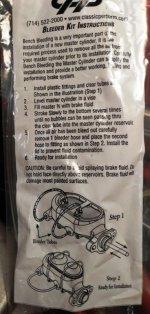
I agree bleeding the master cylinder on the bench.
They make a kit you can easily do this...

attachment.php


Maybe try Schurkey and tlc1976 tricks first.... and if those tricks don't work, pull it!
 

Attachments

  • bleed1.jpg
    bleed1.jpg
    58.8 KB · Views: 1,168
Last edited:

driftpin

Well-known member
Joined
Dec 22, 2016
Messages
11,178
Location
Miami-Dade/Broward Co. Florida
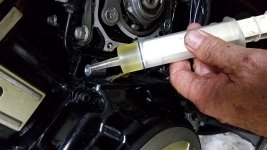
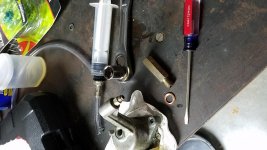
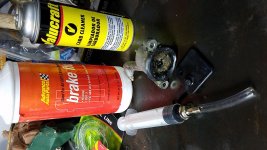
I have to work on my motorcycle brakes and hydraulic clutch far-more than on my other vehicles, and what I do for the motorcycle, which may help you, is to 'reverse-bleed' with a large-capacity (60 cc or ml) syringe.

You see it has a tapered tip on the syringe body, which is the type of syringe you want. There is one called a 'luer-lock' which has an outside collar and a smaller inside tip, that is used to hold a hypodermic needle, do not get that type. Large bore syringes can be bought online very cheaply, look on Amazon. You don't need a prescription for one. Sometimes the simple tapered-tip type is referred to as an 'irrigation syringe.' People who use catheters have to flush-out tubing, trauma staff need to irrigate tissue for aseptic reasons... you get the idea.

I use a short piece of 1/4" clear plastic tubing and a hose clamp holding the tubing to the bleeder ******, and then you just slip the other end over your tapered tip. I usually don't bother with a clamp there. This method can get a bit messy, if you care about getting the floor dirty, use something to catch the excess.

Load the syringe with brake fluid and place it on the ****** with the fluid almost to the top of the clear plastic tubing, I squeeze the tubing on the ****** to help it seal, and then slowly press the syringe plunger. You are pushing brake fluid into the caliper. The fluid will back-flow upwards to the master cylinder. See below for how to deal with this, and what to observe.

I am not dealing with ABS brakes on my motorcycles, if there is a specific method for bleeding them, follow your shop manual.

The advantage to a 'reverse-bleed' is any air bubbles are pushed upwards to the master cylinder. You will also see the contaminated residue of the system is forced upwards and into the master cylinder. I usually empty the master cylinder of fluid using the syringe before I begin this process. Since you aren't having anyone step-onto the brake pedal and hold it down while you open and close the brake bleeder valve, you don't have to worry about having fluid in the master cylinder. Don't worry, as-soon as you begin the reverse-bleed, it will fill with brake fluid, and you will have to evacuate your master cylinder to prevent it from overflowing.

What will happen is that your master cylinder will eventually fill with fluid. You may have to remove the fluid several times from the master cylinder. Each time, the fluid should be cleaner as the residue and old fluid is purged from the system as it's pushed upwards. As mentioned, air is also carried upwards, and is expelled from the system into the bleed holes at the bottom of the master cylinder. You will see a steady stream of tiny bubbles erupt into the reservoir. When all the air is purged, you will instead of bubbles see a geyser of fresh fluid erupting in a solid stream from the master cylinder holes. Be careful! You may find that geyser is capable of spraying brake fluid a considerable distance if you are too-exuberant in your syringe plunger pressure! Protect painted surfaces.

I start from the farthest point and work towards the master cylinder. I also use this method to bleed the hydraulic clutch line. I have a Mityvac, more-than one, actually, and I used to use them for brake bleeding, but I've found that the 'reverse-bleed' using a syringe is a quicker, more-efficient way of bleeding my lines. Once I get a solid geyser of brake fluid into the master cylinder, I tighten the bleeder *******, and a few pumps of the brake lever or foot-pumps of a brake pedal results in a good, firm pedal or hand lever. Of course, test your brake function before getting on the road.

Do not re-use old brake fluid. It's cheap, and you do not want to contaminate your system. DOT 3, 4 and 5.1 are all compatible with one-another. The higher the number, the higher the boiling point. DOT 5 is it's own fluid and is not compatible with DOT 3, 4, or 5.1!

Once you try this method, and find how easy it is to expel your bubbles from the system, and how-quickly it goes, you will never again be asking your wife to come to the garage to help you bleed your brakes. It's a 'one-man show.'

You will see two different syringes, the first one has the tapered tip, the second one was the 'luer-lock' type that I cut-off the double-wall tip, and used a Schrader valve bolt-in wheel valve, with the valve core removed.
 

Attachments

  • 20170831_195603.jpg
    20170831_195603.jpg
    147 KB · Views: 123
  • 20170831_191752.jpg
    20170831_191752.jpg
    149.6 KB · Views: 116
  • 20170831_200356.jpg
    20170831_200356.jpg
    148.8 KB · Views: 114
  • 20170831_212213.jpg
    20170831_212213.jpg
    150.9 KB · Views: 109
Last edited:
OP
S

smalltown

Well-known member
Joined
Jul 9, 2015
Messages
985
Location
Western Maine
Brake pedal does not slowly go to floor: once the engine is started the pedal travels much more and stops above the floor just doesn't feel right.

Rubber lines look fine, flexible and no bulging.

I hope it's not the master cylinder. Priced them on RockAuto last night, and for a motorcraft it's $185
 

Chevy-SS

Well-known member
Joined
Feb 11, 2010
Messages
1,484
Location
Rhode Island
I owned two service stations back in the day and did hundreds (or maybe thousands) of brake jobs. Bleeding new/rebuilt calipers is usually a piece of cake. I typically gravity bleed them and that works 90% of the time. If brake pedal not firm I will use a power bleeder, or have assistant work the pedal.

Based on the story in the initial post, I suspect master cylinder (MC) was allowed to run too dry, thus you need to bench bleed the MC, as others have said. After that, bleed the system.

Master cylinder should still be perfectly fine, but it needs bench bleed IMHO.......
 
Last edited:

PromiseKeeper

New member
Joined
Sep 5, 2013
Messages
3
I once had a similar problem. At someone else's suggestion, I opened the bleeder at the back wheel on the opposite side from the master cylinder. I put a container under it to catch what came out and made sure the master cylinder didnt go dry. It probably took a quart of brake fluid but my problem was solved.
 

driftpin

Well-known member
Joined
Dec 22, 2016
Messages
11,178
Location
Miami-Dade/Broward Co. Florida
As long as your system is in good shape, and it's got functional integrity except for what seems to be air in the lines, you should try the reverse-bleed, starting from the right rear, and working towards the master cylinder. I think you will be able to obtain a firm pedal, and it can be done alone, no-need for the helper.
 

pi_guy

Well-known member
Joined
Jul 27, 2014
Messages
2,808
Location
N/A
Reverse bleeding makes no sense, putting contaminated fluid and dirt back into master.

The best method is two people one pumping brakes and holding. The other person with a tube and bleeder bottle opening bleeder screw watching for air bubbles and contaminated fluid.

Pump five times open bleeder watch the flow.
Use new fluid unopened I have a tester that checks for moisture in fluid bottles open for a few days start to pick up moisture, this is a no no.
Some times jacking the car up on one end helps to get the air bubbles out. But you must check out the line lay out in your vehicle.
 

yeldogt

Well-known member
Joined
Jan 2, 2012
Messages
18,184
How much fluid have you passed .. when you say you did it three time?

I like to use pressure bleed -- it can take a fair amount of fluid when the whole system has been opened.

Also -- do you have any issues with any of the calipers? my local guy stopped rebuilding his own years ago -- said too may problems.
 

tlc1976

Active member
Joined
Apr 3, 2017
Messages
27
Location
Michigan
I'm just a DIYer, but I have replaced my share of calipers and NEVER have had an issue with getting the to bleed and get a hard pedal.

I'm a DIYer and been doing brakes for 20 years, replaced/rebuilt many calipers. That's just my experience anyway, YMMV. Depends on the caliper, like some of them with the parking brake built in took a lot of encouraging the air out. I helped another guy who was ready to give up and this was what worked. Last winter I did the rear calipers on my gf's 05 Escape and while they're a basic caliper, it still took some encouraging to get the air out of them. I could bleed and bleed with no new air, but smacking the calipers for awhile resulted in the rest of the air coming out and the pedal getting better. I think it has to do with the surface tension of the fluid and getting it all to "stick" to the new surfaces and dislodge the bubbles. Especially the gap between the piston and bore.

This, as long as any air in the master cylinder has been taken care of, like others posted.
 

brownbagg

Well-known member
Joined
Mar 20, 2006
Messages
5,208
you dont have to remove the master to bench bleed, just remove the brake line and install the plastic hose and route back to the master fill. pump the pedal couple times
 
To avoid these ads, REGISTER NOW!

Schurkey

Well-known member
Joined
Oct 27, 2011
Messages
2,366
Location
The Seasonally Frozen Wastelands
you dont have to remove the master to bench bleed, just remove the brake line and install the plastic hose and route back to the master fill. pump the pedal couple times
If you don't tip it down in front, you'll waste a lot of time.

If you do tip it down in front, you don't need to remove the tubes. Just stroke the primary piston an eighth-inch or so to encourage the air to move through the compensating ports into the reservoir. When you have a little "geyser" in each compensating port--with no bubbles--you're done bleeding the master cylinder.

The master can be popped-off the booster or the firewall. Some guys lift the back end of the vehicle so that the front of the master is tipped down.
 

dogdog

Well-known member
Joined
Nov 15, 2011
Messages
12,711
you better check the service manual not Haynes... most cars can be bleed just with bleeding 4 brakes in either furthest to closest or closest to furthest sequences....if you just have spongy brakes and not a open system.

But if you have left the lines open for a while and let air entered the ABS, you would needed to start from the MC, ABS, then 4 brake in their proper sequences....

Some of the brake system also required you to bleed your clutch like the VWs.... PITA, I think Ford shares a lot of similarity with VW systems. But don't quote me, I am not a ford guy or a pro mechanic. Just a mechanic slave to my VW.
 

johnyg

Well-known member
Joined
Nov 11, 2015
Messages
319
Location
boca raton fl
i have had good luck just cracking the m/c lines , one at a time with a rag to catch the mess. hose down after as needed.
 

driftpin

Well-known member
Joined
Dec 22, 2016
Messages
11,178
Location
Miami-Dade/Broward Co. Florida
Don't knock it if you haven't tried it. Actually, it makes perfect sense. I don't think you bothered to consider the dynamics of what's occurring. You need to pour yourself a beer.

Now that you've got that beer in-front of you, where are the bubbles going? Down? Like you're trying to force the bubbles when you bleed the brakes by having someone step onto the brake pedal, while you watch 2-3 cc/ml of fluid be evacuated by the master cylinder stroke?

No, they're rising. And as I stated, when you reverse-bleed, you're pushing a considerably larger amount of fluid each time upwards, which is going to wash all those pesky trapped bubbles upwards as-well, because (look at your beer glass) "bubbles rise!"

If you followed the directions I wrote, and emptied the master cylinder reservoir first, when you reverse-flush, each single emptying of the syringe will be equivalent to many episodes of having your partner "OK, press the brake pedal down, and hold-it!" That makes perfect sense to me, one person doing the work of two. And, doing it much-quicker.

An added advantage is that you're removing any particulate matter that may be in-suspension, along with hygroscopically-infused water molecule-laden brake fluid. As the contaminated fluid empties-into the master cylinder, pools into the master cylinder reservoir, the heavier contaminants actually eddy and swirl around in the bottom of the master cylinder reservoir, with the less-contaminated brake fluid above it. This gives you the opportunity to see just what's collected in the lines, which has been pushed-up-to the master cylinder reservoir and to remove it with your syringe.

As you continue to reverse-flush your system, introducing fresh fluid into the bleeder, and watching it collect upwards in the master cylinder reservoir, you will notice that the opaque material suspended in the brake fluid has been flushed-out of your brake system. Now the fluid becomes lighter in color, and when it runs clear as fresh fluid from the new brake fluid container, you have effectively purged all of the contaminants from your brake system. That 'makes sense' to me.

Put it another way: do you want to fill an 12 oz glass (fluid measure) with a teaspoon, or do you want to pour it full from a pitcher? Let's say it's a beer glass, so you can watch those bubbles of carbonation rise to the surface. The teaspoon is the 'stomp and hold the brake pedal' method, the pitcher is akin to the syringe, and its increased volume. Plus you can 'pour your own,' an advantage, unless you have this lass drawing your pint+.
https://thechive.files.wordpress.co...-12-photos-13.jpg?quality=85&strip=info&w=600

No, "disconnect the brake lines from the master cylinder and push on the brake pedal after hooking-up the ram's horns' to dump the fluid back into the reservoir," no "jack-up the vehicle so the fluid and bubbles will shift towards the master cylinder reservoir," no "bench-bleed the master cylinder before installation." It's just not needed. Work smart, not longer and harder.

I tried the traditional method, and used it for years to work on my vehicles. Then about 1980 I got my first Mityvac, and that made things go easier, and quicker, and made it possible to easily do things by myself. Then I tried the syringe back-flush reverse-bleed, and I've never had to pick-up my Mityvac since.

A pressure-bleed system is great for a professional mechanic, but it uses a lot of fluid, they are expensive, and unsuitable for the average guy in his garage doing his brakes once in awhile, even if he has multiple vehicles.

https://t4.ftcdn.net/jpg/01/21/10/63/240_F_121106392_gSqaa3cfJ7bJvglf0UedThZ4PJyo0SZX.jpg

I consider the advice of, "use a fresh unopened bottle of brake fluid each time you replenish your reservoir" to be a sop to the sellers of fluid. I've been working on my own stuff for 50 years, cars, trucks, and motorcycles, and I've never had anything that I would consider a brake failure due-to using a previously-opened container of brake fluid. For replacing the calipers, or for disassembly of brake components, I usually buy a quart, and I use the left-over fluid from that time, for topping-off. It's in a sealed bottle, once the cap is screwed-on, how-much water vapor can there be in the limited volume of the half-full container of brake fluid? If you're running a race car or bike, and it makes you have more-confidence in your vehicle, sure, open a new bottle. You do realize your master cylinder has a vent to the atmosphere, to allow the brake fluid to move with brake application, and to account for the pad or shoe wear? Shouldn't this be a concern? No, not really.

Reverse bleeding makes no sense, putting contaminated fluid and dirt back into master.

The best method is two people one pumping brakes and holding. The other person with a tube and bleeder bottle opening bleeder screw watching for air bubbles and contaminated fluid.

Pump five times open bleeder watch the flow.
Use new fluid unopened I have a tester that checks for moisture in fluid bottles open for a few days start to pick up moisture, this is a no no.
Some times jacking the car up on one end helps to get the air bubbles out. But you must check out the line lay out in your vehicle.
 
Last edited:

d.mcfarland

Well-known member
Joined
Jun 18, 2012
Messages
6,562
Location
Western PA
How long are you planning on keeping the vehicle? I think that has to be taken into account here. IF you want it for a while, might want to pony up for some new parts.
 
OP
S

smalltown

Well-known member
Joined
Jul 9, 2015
Messages
985
Location
Western Maine
Took a peek under the hood today. I have a question about master cylinders.
I read somewhere in my web scouring that some master cylinders have a bleed screw.
Not sure if that's true or not, but before I try the bleeding once again making sure the master cylinder is a least level.

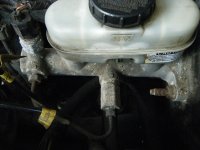
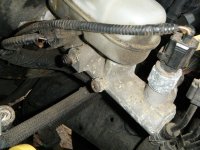
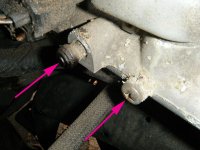
I noticed while looking at my master cylinder, and comparing it others I have seen pictures on the web that I have a question.

I took 3 photos of my MC I can see that it has 2 outlets on the fender side going to what must be the ABS unit. One the inboard side I see what looks like a Philips screw in the MS (seemed odd to me), and toward the firewall what looks like a plug. Is this a bleed plug for the MS or just a plugged outlet for some other application?

With regards to MC bleed kits that are available from the local auto parts I noticed that people complained that the kits do not have more than one of each plastic fitting, and I would need 2 one for each outlet. I was thinking I should be able to bench bleed the MS on the vehicle with the kit(s) by having somebody depress the brake pedal slowly ?

I appreciate all your comments.
Probably going to by a MC at my local parts store.
Found 2 online CARQUEST Wearever for $56.99 or Napa for $79.99
Going to head over and by the Carquest Werever.

Turns out none in stock locally. Will try to pick one up out of town Tuesday.
 

Attachments

  • DSCF1848a.jpg
    DSCF1848a.jpg
    45.8 KB · Views: 55
  • DSCF1847a.jpg
    DSCF1847a.jpg
    69.5 KB · Views: 58
  • DSCF1849ab.jpg
    DSCF1849ab.jpg
    110.2 KB · Views: 58
Last edited:

pi_guy

Well-known member
Joined
Jul 27, 2014
Messages
2,808
Location
N/A
Don't knock it if you haven't tried it. Actually, it makes perfect sense. I don't think you bothered to consider the dynamics of what's occurring. You need to pour yourself a beer.

Now that you've got that beer in-front of you, where are the bubbles going? Down? Like you're trying to force the bubbles when you bleed the brakes by having someone step onto the brake pedal, while you watch 2-3 cc/ml of fluid be evacuated by the master cylinder stroke?

No, they're rising. And as I stated, when you reverse-bleed, you're pushing a considerably larger amount of fluid each time upwards, which is going to wash all those pesky trapped bubbles upwards as-well, because (look at your beer glass) "bubbles rise!"

If you followed the directions I wrote, and emptied the master cylinder reservoir first, when you reverse-flush, each single emptying of the syringe will be equivalent to many episodes of having your partner "OK, press the brake pedal down, and hold-it!" That makes perfect sense to me, one person doing the work of two. And, doing it much-quicker.

An added advantage is that you're removing any particulate matter that may be in-suspension, along with hygroscopically-infused water molecule-laden brake fluid. As the contaminated fluid empties-into the master cylinder, pools into the master cylinder reservoir, the heavier contaminants actually eddy and swirl around in the bottom of the master cylinder reservoir, with the less-contaminated brake fluid above it. This gives you the opportunity to see just what's collected in the lines, which has been pushed-up-to the master cylinder reservoir and to remove it with your syringe.

As you continue to reverse-flush your system, introducing fresh fluid into the bleeder, and watching it collect upwards in the master cylinder reservoir, you will notice that the opaque material suspended in the brake fluid has been flushed-out of your brake system. Now the fluid becomes lighter in color, and when it runs clear as fresh fluid from the new brake fluid container, you have effectively purged all of the contaminants from your brake system. That 'makes sense' to me.

Put it another way: do you want to fill an 12 oz glass (fluid measure) with a teaspoon, or do you want to pour it full from a pitcher? Let's say it's a beer glass, so you can watch those bubbles of carbonation rise to the surface. The teaspoon is the 'stomp and hold the brake pedal' method, the pitcher is akin to the syringe, and its increased volume. Plus you can 'pour your own,' an advantage, unless you have this lass drawing your pint+.
https://thechive.files.wordpress.co...-12-photos-13.jpg?quality=85&strip=info&w=600

No, "disconnect the brake lines from the master cylinder and push on the brake pedal after hooking-up the ram's horns' to dump the fluid back into the reservoir," no "jack-up the vehicle so the fluid and bubbles will shift towards the master cylinder reservoir," no "bench-bleed the master cylinder before installation." It's just not needed. Work smart, not longer and harder.

I tried the traditional method, and used it for years to work on my vehicles. Then about 1980 I got my first Mityvac, and that made things go easier, and quicker, and made it possible to easily do things by myself. Then I tried the syringe back-flush reverse-bleed, and I've never had to pick-up my Mityvac since.

A pressure-bleed system is great for a professional mechanic, but it uses a lot of fluid, they are expensive, and unsuitable for the average guy in his garage doing his brakes once in awhile, even if he has multiple vehicles.

https://t4.ftcdn.net/jpg/01/21/10/63/240_F_121106392_gSqaa3cfJ7bJvglf0UedThZ4PJyo0SZX.jpg

I consider the advice of, "use a fresh unopened bottle of brake fluid each time you replenish your reservoir" to be a sop to the sellers of fluid. I've been working on my own stuff for 50 years, cars, trucks, and motorcycles, and I've never had anything that I would consider a brake failure due-to using a previously-opened container of brake fluid. For replacing the calipers, or for disassembly of brake components, I usually buy a quart, and I use the left-over fluid from that time, for topping-off. It's in a sealed bottle, once the cap is screwed-on, how-much water vapor can there be in the limited volume of the half-full container of brake fluid? If you're running a race car or bike, and it makes you have more-confidence in your vehicle, sure, open a new bottle. You do realize your master cylinder has a vent to the atmosphere, to allow the brake fluid to move with brake application, and to account for the pad or shoe wear? Shouldn't this be a concern? No, not really.
you waste a lot of text and are still wrong
 

old__man

Well-known member
Joined
Apr 29, 2017
Messages
294
Location
Gander, Canada
I did rebuilt calipers once. I was warned that the rubber seals inside tend to have a memory at first. As in they retract the pistons too much. Sure enough, that's what I think happened to me. It took a while of using the brakes and heating up the calipers for the rubber seals to sort themselves out.

You could have also caused the master cylinder to travel outside it's every day limits and encounter some dirt and crud causing that seal to be damaged.
 

6768rogues

Banned
Joined
Nov 28, 2007
Messages
4,524
Location
Western NY
When I have a problem, I gravity bleed them. Open the bleeders, keep the master full and wait for fluid to drip out for a while. Have coffee and let it drip. If the drips bother you, attach a tube to each bleeder and run it to a tin can. It even works if you did not bench bleed the master.
 

Tonyuk

Well-known member
Joined
Jun 9, 2017
Messages
1,539
Location
Scotland
If your having difficulty bleeding the brakes take them to the dealership and have them sort it. Most likely they'll be using a pressure bleeder which will sort the air in the MC also. As discussed most now have 2 or 3 bleed screws of their own so taking it out could be unnecessary.

If your car is fitted with ABS then more than likely you'll need a pad or laptop fitted with the cars management software to open the ABS pump system and allow fluid to move through freely, if the lines haven't run dry however i wouldn't bother as air rarely gets into a closed ABS system.
 

matt01073

Well-known member
Joined
Feb 1, 2013
Messages
134
Location
western mass
Are you bleeding all 4 wheels or just the 2 you worked on, if you are only bleeding only the calipers you had apart you have to bleed all 4 .
 

BillK

Well-known member
Joined
Aug 24, 2006
Messages
9,296
Location
Beautiful Southern Maryland
small,
Sometimes you just have to use a pressure bleeder. I have had to replace the master cylinder and later a wheel cylinder on my 99 Tahoe. No matter what I tried, I just could not get a good pedal. One of my repair shop customers came by and picked it up and in less than an hour he was back with it and it had a rock solid pedal. I have been doing this for 50 years now and sometimes you just have to admit takes a better tool than what you have.
 

pi_guy

Well-known member
Joined
Jul 27, 2014
Messages
2,808
Location
N/A
I clearly explained to the Long Island Luddite how to do the work easier, quicker, and with a single person, but that's wrong? Have a nice day.

It not easier it just wrong.

point 1 you contaminate the master cylinder with **** and bad fluid.
you can not clean it out unless you disassemble it
Two you fail to realize brake fluid is a hygroscopic liquid

point 3 is your just a troll that is recommending a dangerous concept with out understanding what your doing.
 

Larey

Well-known member
Joined
Sep 10, 2013
Messages
135
Location
Fussa, Japan
May be a dumb question but did you by chance put the caliper on the wrong side and now your bleed port is on the bottom? I have seen this before and it allows air to stay in the system.
 

CJM8515

Well-known member
Joined
Mar 8, 2014
Messages
9,286
Location
NJ
It not easier it just wrong.

point 1 you contaminate the master cylinder with **** and bad fluid.
you can not clean it out unless you disassemble it
Two you fail to realize brake fluid is a hygroscopic liquid

point 3 is your just a troll that is recommending a dangerous concept with out understanding what your doing.
You FILL the syringe with brake fluid and push new fluid into the system from the bleeder AFTER you push fluid out the bleeder itself. There is no nasty stuff going into the master besides the fluid already in the system.

Wanna make quick work of it all you drain the master with a turkey baster and refill with clean fluid, then let gravity bleed all lines and then syringe trick. You can also do a 1 man bleed with a jar full of fluid and a hose as well so long as the hose is submerged in the jar.

Reality is depending on the car either the master piston was forced to far forward due to bleeding and caused a seal issue and now its internally leaking or the car has a finicky abs unit that might need to be computer bled or you can activate abs on a gravel road and bleed it again.
 
To avoid these ads, REGISTER NOW!
Top Bottom