
You are using an out of date browser. It may not display this or other websites correctly.
You should upgrade or use an alternative browser.
You should upgrade or use an alternative browser.
Britool (Made in England) thread
- Thread starter D350RDV
- Start date
winchman
Well-known member
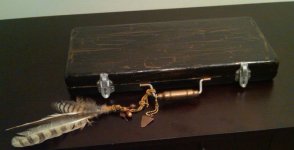
This is a padlock that came with one of my 1960s sets which I believe to be the original.

To give an idea of scale, the keys are about the same size as a suitcase lock, but the padlock is a bit bulkier than today's luggage locks.
Thanks
i will keep an eye out
Thanks, Anthony, for pointing this out to me.
I remember this crackle red finish now. And think I have an old socket box in this finish somewhere, I'll have a rummage soon.
What confused me was when 'crackle finish' red was mentioned, I immediately thought of the black finish used on e.g. some MG dashboards, steering wheel mounting bosses, etc. Was this 'crackle finish' or 'wrinkle finish'. (I suspect it is 'wrinkle').
B.
I have to confess I only found it by doing a Google search! The finish on the Britool boxes is smooth. I know the textured finish you refer to on MGs etc and I'd agree with your description of wrinkle finish, but i have often seen it referred to as crackle finish as well.
I haven't yet found anyone selling a product to reproduce the finish on the early Britool boxes which is a shame as I have an early Tractor Service Set box which is still in daily use and in good condition other than the lid which from the paint has almost completely worn off.
The original crackle finish I believe to be stove enamelled - even the plain red finish inside the box is as hard as nails whereas the slightly later Universal Service Set box I bought in a mad "I must collect everything Britool" moment has the hammered finish which is brittle rather than hard if that makes sense.
Nigelhirst
Well-known member
Good find, and usefully available in a range of sizes as well. They're not quite right - the Britool lettering is a bit bold, and the bits round the outside are a bit skinny. There should also be a black border round the outside as below:

The crackle finish boxes had riveted on aluminium badges - the stickers were an economy measure introduced with the red hammer finishboxes. I have wondered about the legality (in respect of rights to the name) of having a some made by one of the chassis plate replica manufacturers, but I only need a couple so it didn't seem worthwhile.
Where did you get yours made? They look very good.
I don't think SBD will worry too much about folks replicating old Britool labels!
Nigel
Nigelhirst
Well-known member
That's what was confusing me - some people call it Crackle, others call it Wrinkle, others call it Crinkle!
I did a bit of a search and found a site discussing Crinkle/Wrinkle paints and how to make this effect occur using 2 different types of paint applied one over the other. (www.finishing.com/0400-0599/409.shtml) It seems one of these techniques could be used to make any shade/colour you want. There's also mention of using an oven to cause the reaction to occur ( a bit like stove-enamelling?).
VHT do a wrinkle paint in RED but it looks a much lighter shade than used by Britool., it's more like what Ferrari used on it's camcovers (i.e. Testarossa) so similar to MG dashboard finish, idk if this would be the same as Britool Crackle Red.
Anyway, it's available from Frost and Co. in the U.K. or on Amazon. (This VHT brand may have been referred to earlier).
B.
Yes I think you are right. The wrinkle VHT stuff I have on my Lotus cam covers and a) it is too light, b) it is too easily scratched for toolbox use and c) it doesn't look like the original finish so far as I can tell (but there are very few images of good original tool boxes)
Nigel
Nigelhirst
Well-known member
I have to confess I only found it by doing a Google search! The finish on the Britool boxes is smooth. I know the textured finish you refer to on MGs etc and I'd agree with your description of wrinkle finish, but i have often seen it referred to as crackle finish as well.
I haven't yet found anyone selling a product to reproduce the finish on the early Britool boxes which is a shame as I have an early Tractor Service Set box which is still in daily use and in good condition other than the lid which from the paint has almost completely worn off.
The original crackle finish I believe to be stove enamelled - even the plain red finish inside the box is as hard as nails whereas the slightly later Universal Service Set box I bought in a mad "I must collect everything Britool" moment has the hammered finish which is brittle rather than hard if that makes sense.
I don't suppose you have a good picture of the original stove enamel finish and, even better, a RAL shade?

Nigel
See post 28 - the outside is a crackle (NOT wrinkle) finish.
The closest I've found to the solid red used on the inside of the boxes was a RAL shade available in a Rustoleum aerosol. I'll look it up and get back to you. From memory it was a bit orangey, but near enough so long as you didn't have an original next to it.
The closest I've found to the solid red used on the inside of the boxes was a RAL shade available in a Rustoleum aerosol. I'll look it up and get back to you. From memory it was a bit orangey, but near enough so long as you didn't have an original next to it.
Nigelhirst
Well-known member
See post 28 - the outside is a crackle (NOT wrinkle) finish.
The closest I've found to the solid red used on the inside of the boxes was a RAL shade available in a Rustoleum aerosol. I'll look it up and get back to you. From memory it was a bit orangey, but near enough so long as you didn't have an original next to it.
Thanks for that. For some reason when I try to zoom on that photo, all I get is a black square! The photo hosting on this site can be very variable.
I've found one on eBay for a kings ransom:
https://www.ebay.co.uk/itm/Vintage-...861796?hash=item3d50a2f4a4:g:ZTQAAOSwSypY9j5Q
I suspect the wrinkle finish is/was unique to whoever did it 'in period' and can't be emulated with modern paints....
I guess that a rust oleum inner and Hammerite outer might just be acceptable.
winchman
Well-known member
About 20 years ago I worked on a place that had a powder coating plant, they could produce a very similar finish with powder
fanders
Well-known member
That's a very interesting thought - I know the local powder coater fairly well so I'll ask the question after the Christmas shutdown.
Here's a close up of the crackle finish on my 100A 1/2" socket set:
View media item 78408
And a wide shot:
View media item 78407
The base colour seems to be the same on the inside as well as underneath the crackle black finish, and looks close to RAL3000 'Flame Red' to my eye:
View media item 78413
View media item 78414
View media item 78415
fanders
Well-known member
Here's a look inside; I bought the missing items some time ago:
View media item 78409
The previous owner was the Chief Engineer on one of the big ocean liners, might have been the Queen Mary. He certainly kept it in good condition.
View media item 78410
I managed to get the older "British BRITOOL Made" replacements for the missing E70 sliding T-bar and E99 long extension, but could only find a later "Made in BRITOOL England" E42 speed brace. Nice to have the set back together again anyway. I haven't had much use out of the AF or WW sockets yet, so I'll have to wait until I have a proper mid-life crisis and buy a vintage car.
View media item 78411
View media item 78412
View media item 78409
The previous owner was the Chief Engineer on one of the big ocean liners, might have been the Queen Mary. He certainly kept it in good condition.
View media item 78410
I managed to get the older "British BRITOOL Made" replacements for the missing E70 sliding T-bar and E99 long extension, but could only find a later "Made in BRITOOL England" E42 speed brace. Nice to have the set back together again anyway. I haven't had much use out of the AF or WW sockets yet, so I'll have to wait until I have a proper mid-life crisis and buy a vintage car.
View media item 78411
View media item 78412
winchman
Well-known member
I am not certain but it may have been supplied by Carr's paintsThat's a very interesting thought - I know the local powder coater fairly well so I'll ask the question after the Christmas shutdown.
3baygarage
Well-known member
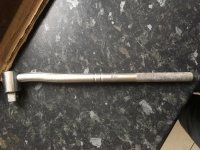
Very nice. I can't get over how they and Williams pretty much had the same design for the sliding t bar.
Nigelhirst
Well-known member
Fanders that's beautiful! If I ever work out how to post pictures on here I will show you mine ��
Nigelhirst
Well-known member
That's a very interesting thought - I know the local powder coater fairly well so I'll ask the question after the Christmas shutdown.
He could do a job lot if we all sent our boxes....

winchman
Well-known member
Very nice. I can't get over how they and Williams pretty much had the same design for the sliding t bar.
I wonder if Britool made it?
Britool did manufacture parts for other people,
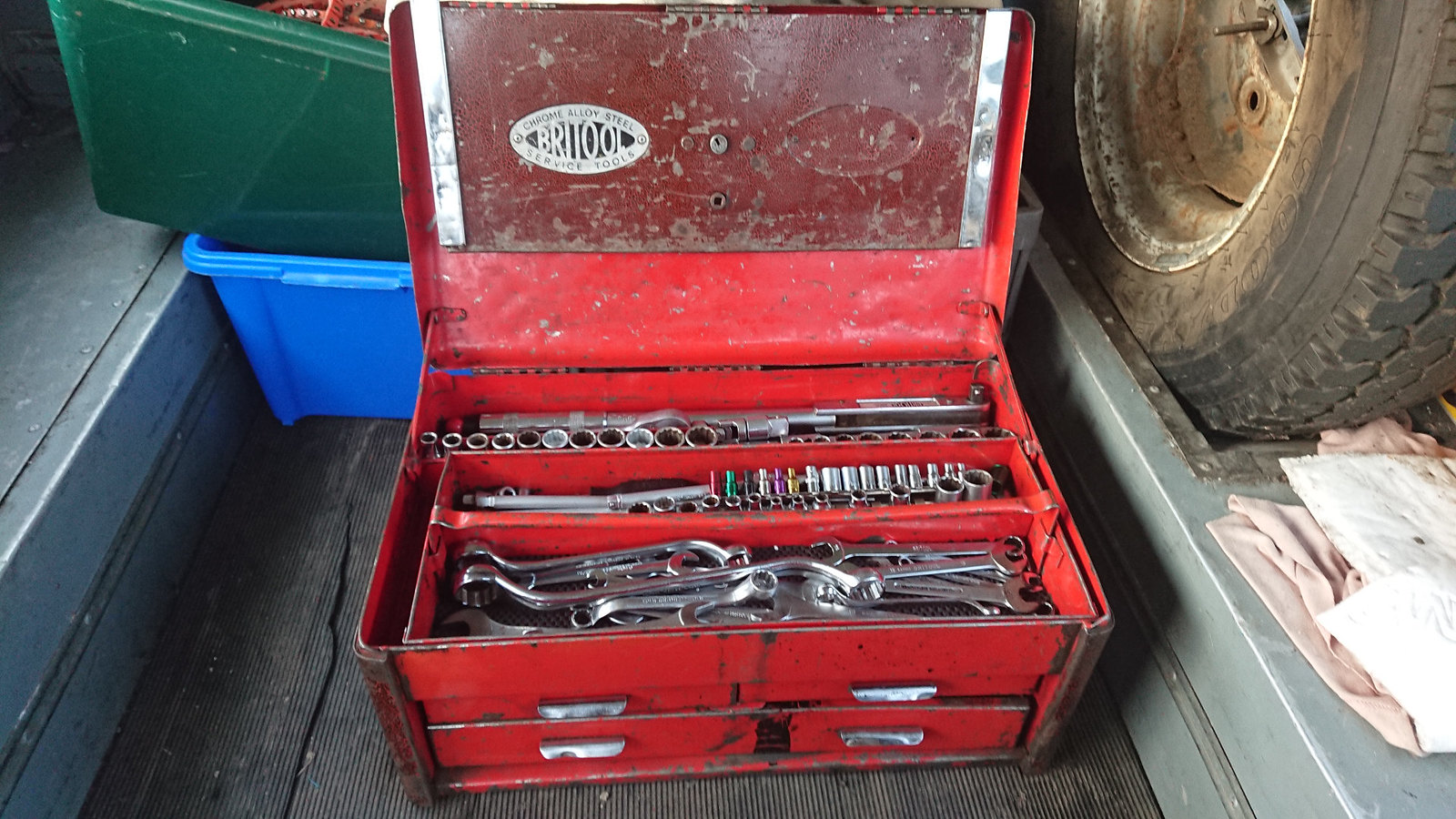
I also think Britool were not adverse to adopting other manufacturer's good ideas or even designs. I've long thought that some Black Hawk stuff was very similar to Britool, and I tripped over this Black Hawk boc on here yesterday https://www.garagejournal.com/forum/showpost.php?p=6902323&postcount=2
The similarities to the Britool Tractor service box are striking. I'll post some pictures of the Britool box in question in a moment.
The similarities to the Britool Tractor service box are striking. I'll post some pictures of the Britool box in question in a moment.


dutchgray
Well-known member
Not posted this before but had it a while
View media item 78457Crackle paint has unfortunately mostly come off, but
View media item 78458The Whitworth set has seen very little use,
View media item 78459I even managed to pick up these hex to square drive adapters at a local autojumble so I can use these on a 3/8" ratchet if I need to use a Whitworth socket.
View media item 78457Crackle paint has unfortunately mostly come off, but
View media item 78458The Whitworth set has seen very little use,
View media item 78459I even managed to pick up these hex to square drive adapters at a local autojumble so I can use these on a 3/8" ratchet if I need to use a Whitworth socket.
winchman
Well-known member
Heres a pic of the detail on the sliding T barVery nice. I can't get over how they and Williams pretty much had the same design for the sliding t bar.
Attachments
3baygarage
Well-known member
Thanks. The Williams definitely says Made in USA. I do have one in the collection. If I ever get to my couple Britool ratchets I will post them up. Always looking at British ratchets but seldom get a chance at them this side of the pond.
Private Lugnutz
Well-known member
On the crackle finish subject…
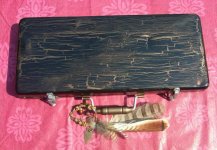
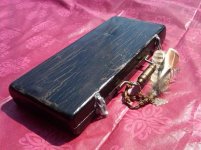
I see you guys may have found an off the shelf product, which is terrific, or possibly a painting service, if I was following the conversation correctly, but if you're interested in trying it yourself, it's not overly difficult. I did a black and gold crackle finish on the attache style case for a c.1920's Blackhawk Q.D. socket set a few years ago and I was pleasantly surprised with the results. The process is very similar to classic 1970’s decoupage.
Here is a link to my restoration thread and you can see the thumbnails below for some photos.
If you're interested in trying...
The process:
You are essentially applying three coatings to the case: paint (base), glue (crackling medium), and paint (layer that crackles). The first coat is put on and let to dry completely. The crackling and the top coat are put on one right after the other, but in very small areas (2 or 3 square inches) at a time.
(1) Apply the base coat. (Looking at fanders’ wonderful example, it looks to me like red is the base coat and black is the crackle coat.) Use something with high-gloss that will dry hard. Let it sit for days or longer. Make sure it’s truly dry.
(2) Using standard white household or school glue (I used Elmer’s, which is a very common brand over here…), apply it in a small area. Let it start to dry, but don’t let it dry completely.
(3) As the glue is drying (tacky, sticky but no longer wet), apply the top coat of black paint right over the top of the drying glue. As the paint contacts the glue and the glue dries up completely, it dries up the black paint with it. You will see this almost immediately as the paint is applied and it will continue as the glue dries completely, leaving non-uniform cracks.
One thing to keep in mind is that the paint crackles in the direction of the top coat brush stroke. Unable to find a photo or surviving example of a single original Blackhawk Q.D. case with a crackle finish, I was going for a sort of wood-grain/alligator skin look. So my brush strokes were long and linear. If you want to do the effect shown in fanders’ outstanding example, I think you would need to use a sponge or a rag or something like that to dab it, or even twirl it. If I were doing it, I would find some sheet metal or old castaway boxes and experiment until I achieved the desired look.
And if you'd rather not, I won't be offended.
I see you guys may have found an off the shelf product, which is terrific, or possibly a painting service, if I was following the conversation correctly, but if you're interested in trying it yourself, it's not overly difficult. I did a black and gold crackle finish on the attache style case for a c.1920's Blackhawk Q.D. socket set a few years ago and I was pleasantly surprised with the results. The process is very similar to classic 1970’s decoupage.
Here is a link to my restoration thread and you can see the thumbnails below for some photos.
If you're interested in trying...
The process:
You are essentially applying three coatings to the case: paint (base), glue (crackling medium), and paint (layer that crackles). The first coat is put on and let to dry completely. The crackling and the top coat are put on one right after the other, but in very small areas (2 or 3 square inches) at a time.
(1) Apply the base coat. (Looking at fanders’ wonderful example, it looks to me like red is the base coat and black is the crackle coat.) Use something with high-gloss that will dry hard. Let it sit for days or longer. Make sure it’s truly dry.
(2) Using standard white household or school glue (I used Elmer’s, which is a very common brand over here…), apply it in a small area. Let it start to dry, but don’t let it dry completely.
(3) As the glue is drying (tacky, sticky but no longer wet), apply the top coat of black paint right over the top of the drying glue. As the paint contacts the glue and the glue dries up completely, it dries up the black paint with it. You will see this almost immediately as the paint is applied and it will continue as the glue dries completely, leaving non-uniform cracks.
One thing to keep in mind is that the paint crackles in the direction of the top coat brush stroke. Unable to find a photo or surviving example of a single original Blackhawk Q.D. case with a crackle finish, I was going for a sort of wood-grain/alligator skin look. So my brush strokes were long and linear. If you want to do the effect shown in fanders’ outstanding example, I think you would need to use a sponge or a rag or something like that to dab it, or even twirl it. If I were doing it, I would find some sheet metal or old castaway boxes and experiment until I achieved the desired look.
And if you'd rather not, I won't be offended.
Attachments

Last edited:
Nigelhirst
Well-known member
Thanks Lugz. I will give that a go after Christmas!
Best
Nigel
Best
Nigel
dutchgray
Well-known member
winchman
Well-known member
Nice, we often see these at car boot sales but generally the Chinese ones not seen a Britool one yet
winchman
Well-known member
Heres the set the hex is from
https://www.ebay.co.uk/itm/vintage-...668306?hash=item2cccbf93d2:g:UT8AAOSwkLhaR9sf
https://www.ebay.co.uk/itm/vintage-...668306?hash=item2cccbf93d2:g:UT8AAOSwkLhaR9sf
Dave455
Well-known member
On the crackle finish subject…
If you're interested in trying...
The process:
You are essentially applying three coatings to the case: paint (base), glue (crackling medium), and paint (layer that crackles). The first coat is put on and let to dry completely. The crackling and the top coat are put on one right after the other, but in very small areas (2 or 3 square inches) at a time.
(1) Apply the base coat. (Looking at fanders’ wonderful example, it looks to me like red is the base coat and black is the crackle coat.) Use something with high-gloss that will dry hard. Let it sit for days or longer. Make sure it’s truly dry.
(2) Using standard white household or school glue (I used Elmer’s, which is a very common brand over here…), apply it in a small area. Let it start to dry, but don’t let it dry completely.
(3) As the glue is drying (tacky, sticky but no longer wet), apply the top coat of black paint right over the top of the drying glue. As the paint contacts the glue and the glue dries up completely, it dries up the black paint with it. You will see this almost immediately as the paint is applied and it will continue as the glue dries completely, leaving non-uniform cracks.
One thing to keep in mind is that the paint crackles in the direction of the top coat brush stroke. Unable to find a photo or surviving example of a single original Blackhawk Q.D. case with a crackle finish, I was going for a sort of wood-grain/alligator skin look. So my brush strokes were long and linear. If you want to do the effect shown in fanders’ outstanding example, I think you would need to use a sponge or a rag or something like that to dab it, or even twirl it. If I were doing it, I would find some sheet metal or old castaway boxes and experiment until I achieved the desired look.
And if you'd rather not, I won't be offended.
Wow! Thanks for all that info Lugz, what a superb post!
Yes, I'll be attempting this at some point. The common problems with any Classic Britool set seem to be that the ratchet is totally worn out and the outside of the box is tatty!
A couple or random observations. Although , from a distance, the boxes seem to be dark red, the component colours that make this up are actually a 'brick' red (for the basecoat) and black (for the topcoat).
I wouldn't be surprised if Britool bought in the paint from somewhere like Trimite. I spoke to them a few years back and they confirmed that they had made both 'crinkle' and 'crackle' paints in the past!
winchman
Well-known member
Just picked up a nice Brittool 1/4 drive box, sadly empty but its painted brown?
Nigelhirst
Well-known member

Nigelhirst
Well-known member
Ok, ok. I should have looked at post #2 
Question about the screws still stands.....
Question about the screws still stands.....
Nigelhirst
Well-known member
I wonder if they might be BA (British Association) threads.
7BA has a thread outer diameter of 0.0984 in. (only 6 thou. larger than your measurement).
Can you measure thread angle and threads per inch (t.p.i.), possibly using a thread profile gauge? ( if you have one). BA threads have a 47.5 degree thread angle and the t.p.i. won't be an even number e.g. 7BA is 52.91 t.p.i.
Iirc new screws were supplied with ratchet repair/rebuild kits.(back in the day).
B.
I think they might be 3/32 Whitworth as that is nearly a perfect diameter match - I've ordered some to see. I haven't got any thread gauges this small!
Looking at the ones which came out, the threads which go into the faceplate are flattened anyway, almost as if they were intended as 'one shot' use....
N
Nigelhirst
Well-known member
Right. 3/32 Whitworth work fine, other than the heads are slightly smaller than the originals. I suspect the 7BA would be equally good as screwing them into the faceplate simply flattens the threads (as it did with the originals). I guess they were designed to be 'one-shot'. It doesn't look as if the faceplate is tapped....