What an absolutely epic weekend.
It's Monday morning after the big machine-moving event. Nobody got hurt, the house wasn't damaged, none of the machines were damaged, and so far it looks like no parts went missing either. Can't ask for more than that.
On Friday after work, I headed to my Dad's shop and we made a fixture for mounting a one-ton cable hoist to the floor. We used a scrap piece of LVL from the ridge beam as a base, some heavy steel angle and square tubing, and 1/2" wedge anchors. The hoist cable ran up the stairs, around a pulley, back down to a pulley mounted to a sled, and back up the top of the stairs. We built a small sled out of 2x6 lumber, with a heavy 4" angle bracket at the bottom. The angle is what the sled pulley was bolted to, and that's what held the weight of the cargo. Between that and getting various other parts prepped, I wasn't home till midnight.
I picked up a trailer from U-Haul at 8am and loaded up our gear. I recruited a few friends to help me out.

We managed to remove everything from the basement in 1.5 hours using nothing but a regular hand cart, leaving only the lathe, mill knee, and mill column downstairs.
Next up was assembling the sled system.

You can see here how the hoist is bolted to some heavy angle, which is then through-bolted to the floor. The cable runs under a pulley, positioned so the cable path parallels the stairs.

Here's a clearer look at the sliding tracks. It's a 2x8 with a 2x4 on top, waxed to make it slippery. On the left, my brother-in-law Giles is contemplating the structural integrity of the pulley-mounting bolt that will support 1,000 lbs in just a few minutes. I'm not sure what my Dad is doing here, but he seems quite happy with the little M12 1/2" impact.

At the top of the stairs, I bolted a one-ton truck bed hoist to some heavy-wall 2" square tubing. I used my truck hitch on one end for ballast, and an 8' piece of tubing perpendicular for balance. This little hoist was a huge help. It picked up the cargo off our sled at the top of the stairs, and we could walk it out the door in steps. Here, Jeff is looking bemused at the redneckery of our approach.
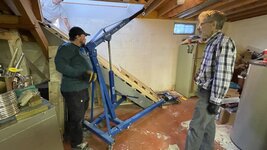
Downstairs, we used a 2-ton engine hoist to load the sled. Our stair cribbing got in the way of the hoist legs, so it took some fussing to allow the hoist to drop the cargo right over the sled.

We started with the knee, as it was the smallest and lightest item. This was really easy, and had us feeling confident. The whole sled system worked beautifully. The truck crane was just the right length to poke through the door and pick it off the sled. At all times the load was supported from above and below.

Next up was the lathe. This was a bit more awkward on account of the length. I removed the headstock, tailstock, cross and compound slides, motor and some of the gears to make it lighter. With a little effort, it fit on the sled and came upstairs without too much effort.
That just left the mill column. The main event. Honestly, I think everyone was feeling quite nervous about this. It is just
so big and so heavy. And if something goes wrong, it will go very wrong, very fast.
The first challenge was just getting the column onto the sled. This took quite a long time, actually. Because the ceiling height is low, we tried several times to lift the column but couldn't get the column's bottom to clear the staircase stringers. We needed to tip the column almost 45 degrees and then lift it up.

This took a lot of work and coordination. We tried a few approaches and finally landed on something that worked and that everyone was comfortable with. We used lifting slings around the top of the column, pulled short and tight to the hoist shackle. Then put some 3/4" lifting eyes at the 'toe' of the column base, and hooked up a come-along in a V shape between the hoist shackle and each lifting eye at the toe. This way, by tightening the come-along, it pulls the column base closer to the hoist shackle, causing the base to tilt.
This way, we could lift the column as high as the engine hoist would go, then ratchet the come-along until the column was tilted enough that its base would clear the stair stringer. At that point, we raised the sled until it was positioned under the column, then lowered the column onto the sled. The sled was actually halfway up the stairs already when it was aligned to receive the column.

The first thing that may jump out here is that someone is standing below the load. That is a huge no-no, and something we reminded everyone about routinely. But I will say, in this photo, the column is supported in four different ways. There is the blue hoist from the side, the truck hoist from above, it's strapped to the sled supported by the cable hoist, and we lagged a stop block right under the sled here, so if all three hoists failed, the sled still wouldn't move. That felt safe enough to stand below and make some final adjustments.
I don't have any photos or videos of the actual move. As you can imagine, we were all hyper-focused on the task at hand. When it got to the top of the steps, I ran a lifting sling through the column and pulled it upright with the truck hoist, setting it down on the stair landing.
This was a HUGE moment of relief. There were many cheers. The homeowners were standing behind us, watching in disbelief that we actually got this thing out of their house lol.

From this point on, we used a combination of the truck hoist and rolling dollies to move everything into the trailer. By the time we got home and unloaded, it was almost midnight. But we DID IT.
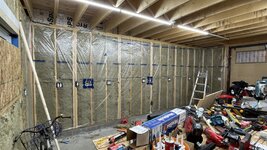
Now I have the much more enjoyable task of reassembling the mill, making room to continue the final steps on the shop's interior finishing.