To avoid these ads, REGISTER NOW!

Between 265 & 485 SQ/FT Building a 16x22 Gambrel Workshop

Workspaces sized between 265 and 485 squarefeet.
OP
O

old_smokey

Well-known member
Joined
May 16, 2018
Messages
410
Location
Manitoba
I think my builder got it from Star, and if not there, windsor plywood. I'll double check.
Edit: Got it from Star. it's fir. $77/sheet in march of 2023. ouch!
Ouch indeed! Cheapest 1/2 G1S I can find is $50 a sheet. I need about $800 in plywood to do the walls. I figure drywall, mud, primer and paint is about $200 cheaper, but also takes way longer and won't hold up as well. $77 a sheet is another thing though.

What kind of plywood did you use? Fir? Did you paint it? Send me a pic!
 
To avoid these ads, REGISTER NOW!

crashmtb

Well-known member
Joined
Aug 2, 2006
Messages
93
Location
Winnipeg
Ouch indeed! Cheapest 1/2 G1S I can find is $50 a sheet. I need about $800 in plywood to do the walls. I figure drywall, mud, primer and paint is about $200 cheaper, but also takes way longer and won't hold up as well. $77 a sheet is another thing though.

What kind of plywood did you use? Fir? Did you paint it? Send me a pic!
5/8” Fir G1S from Star. Didn’t paint it. Had designs on oiling or staining but havent got to it.
 
OP
O

old_smokey

Well-known member
Joined
May 16, 2018
Messages
410
Location
Manitoba
Quick update on my progress on the shop.

After passing my inspections, I was free to start insulating. I was flipping back and forth on what insulation to go with, but in the end decided to bite the bullet and put mineral wool in. It's more expensive, but so much nicer to work with, easier to get tight fits and full coverage, and is fireproof to boot. So I picked up a pile of R22 Rockwool and got to work.

IMG_9413.jpg

Another nice thing about this is how easy it is to cut with a breadknife-type saw. It was no sweat cutting around electrical boxes, or even splitting it lengthwise in half to fish around wiring.

The shop was a lot quieter inside after doing this! And it's staying cooler inside too. I still have to do upstairs, but this is a solid start.

Next up were the soffits. For some reason, I was putting this job off. I think I thought it would be harder than it actually was. I decided to make my own vented assemblies using scrap LP panels and some perforated, galvanized sheet metal I had bent up at a local shop. I painted the steel with Stix primer, a requirement for galvanized steel, followed with some leftover black paint I had from my house. I made a template for how the soffits would interface with the gable overhangs, cut my soffit material, and stapled the steel vents in from the back. They are an upside-down tophat shape, so they nestle in the cutout tight. Then I simply lifted them into place and nailed it off. They turned out great IMO!

IMG_9394.jpgIMG_9414.jpgIMG_9418.jpg

And then it was on to siding. I'm doing LP Smartide board and batten using 4x10 panels and 2.5" battens. The panels are cut to width, nailed to 3/4 furring strips, then battens every 16". There is a bunch of 3.5" trim that gets installed yet as well, but that's for later.

The window trim is made from 40-year-old cedar I bought off a farmer. It was stored in a dry barn the whole time and was great to work with. It took the paint really well and is a perfect match. It will get some LP casing yet. I'll share some more detailed photos when the siding is finished.

IMG_9476 copy.jpg

It's getting dark really quickly now. So my Dad brought over some lights to hook onto the scaffolding. I feel like I'm keeping the neighbourhood awake working late, but then I realize it's not even 8pm yet!

IMG_9483.jpg

I'll be working on the gable ends next. My hope is to have the siding finished, or at least nearly finished, by the end of next week.

The week after, it's time to move the mill and the lathe home, so I gotta get this wrapped up! Snow is not far away!
 
OP
O

old_smokey

Well-known member
Joined
May 16, 2018
Messages
410
Location
Manitoba
Curious why you regretted painting the walls. I painted mine, and see other folks on here quite liking their painted ply.
I just really liked the warm, natural wood feel to unfinished plywood. In my old shop, I painted the walls white, and while it was great for making the space feel brighter, it felt a bit sterile to me. Nothing at all wrong with it, just a personal aesthetic preference.
I just found a supplier nearby that is selling 1/2" birch, G2S plywood with a prefinished UV coating for $55 a sheet. I'm going to use that. It is a nice, warm wood tone, and hopefully will be easier to keep clean-ish with the clearcoat on it. I'll need about $1,000 of plywood to do my main level. Not sure what I'll do upstairs yet. I'll leave that unfinished until I get the main level wrapped up, in the interest of time.
 
OP
O

old_smokey

Well-known member
Joined
May 16, 2018
Messages
410
Location
Manitoba
Another weekend of being hit by heavy rain meant I wasn't able to get as far on the siding as I hoped. But even so, my Dad and I banged out a lot of exterior work. The mandoor trim went on, all the transition drip cap details were finished, and we got all the soffits done, plus the south gable wall panelling.

To panel the walls, we made a DIY panel hoist using a small winch. It's very simple - just two 2x's nailed together, with a pulley at the top, and the winch fastened to the bottom. The cable goes up to the pulley, then back down, where it's attached to a small piece of scrap wood with a J-shaped piece of aluminum on the bottom edge, which acts as a hook under the panels. The top of the contraption has a set of castors on it, so the panels can slide behind it as it is raised, holding the panels tight against the wall. This way, we can raise the panels into position and dial in the location from a ladder or scaffolding without struggling.

IMG_9495.JPEG
IMG_9497.JPEG
IMG_9500.JPEG
IMG_9505.JPEG

We started on the trim and battens, but rain put an end to our work. We should be finished with this wall tonight, I expect. I think this puts me on track to have the whole exterior completed by Sunday, leaving about two weeks to get the interior ready enough for moving the mill and lathe into place.
 

Aladinsane07

Well-known member
Joined
Aug 13, 2020
Messages
70
Location
MN
This is such a rad build. I'm really happy you commented over on my page because somehow I had missed this. Following along now (y)
 
OP
O

old_smokey

Well-known member
Joined
May 16, 2018
Messages
410
Location
Manitoba
Big milestone hit this weekend. The exterior is complete!

I started working Friday after work. The main jobs left were the north-facing gable wall and window trim, and the main-level battens. The windows were tricky as there are two small windows next to each other. I put two windows in simply because I got a really good price on these, plus it made it easy to work around the ridge beam post. There was just enough room to fit these windows in and not have the trim touch the rake trim above, or have each window touch each other, making for an awkward detail.

IMG_9539 (1).JPEG

Here you can see me roughing in the window trim. I made them from cedar and painted to match the siding. The unpainted cedar on the perimeter was added afterward, as I originally intended the panel siding to overlap and get nailed into the window jambs, locking it all together. But with my tight working area, I didn't have a way to integrate a head flashing that way. Probably ok, as they're right under the overhangs, but I didn't want to chance it. So I filled in the window frames and butted the panels up against them, then used the casing to lock it together. Hard to explain... the details were confusing for this one!

IMG_9554.JPEG

Working under the lights was a challenge. At least once, I nearly stepped right off the scaffolding. I'm really glad it's taken down and returned now, and nobody was seriously injured by it.

IMG_9563.JPEG
Here you can see a bit better how the window installation went. The head flashing above tucks behind the panel siding. The blue skin goes right back to the rigid foam WRB, so if somehow water did get behind the flashing, it wouldn't pool on the window frame - it would be forced to run to the side, into the rain screen channels, and drain out at the next level of flashing where the first/second floor break is. The sill is sloped 20 degrees for runoff as well.

IMG_9570.JPEG
With the windows being so close together, the centre batten was a challenge to fit! Kudos to my Dad for this one, as he made these cuts and they were bang on. The window sills aren't cut here, rather the batten has two angled cuts that match the sills, and it slid right between. The window casing got a releif cut in the back with a dado blade, so it overlaps the batten, making for a really nice, clean, tight finish.

IMG_9571.JPEG

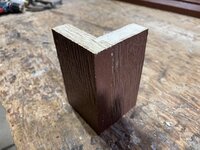
I had to do the corners as well, which was 5/4 material, and cut a groove to lock them together, like this little test piece:

IMG_8907.JPEG

I got stopped by the rain on saturday, but was at least able to caulk the windows to the trim, clean up and do a few odds and ends. The end was in sight.

IMG_9574.JPEG

After that, it was just production mode with the battens. I measured them all at once, batch cut them, and nailed them in place.

IMG_9598.JPEGHere you can see the home stretch - the corner trim is glued and clamped in place. I replaced the white outlet covers with black ones. I have paint ordered for the steel man-door and will paint it a deep, forest green, if weather permits.

IMG_9604.JPEG

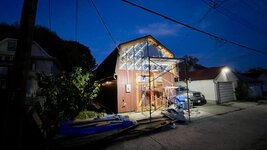
And here is how she stands as of this morning. I put another coat of poly on the doors, started cleaning up, touched up all the nail heads. I have a little fixing up to do on where the corner trim meets the rake trim, and a bit of missing caulking. Maybe 30 minutes work at most. Close enough to call the exterior done. Woo!

Next up - interior. I may have a line on some prefinished 5/8 Birch plywood for the walls, $55 a sheet.
 

captain14

Well-known member
Joined
Dec 19, 2012
Messages
7,056
Location
Near College Park Maryland 20740
I am Sure you’re glad the exterior is finished before the cold weather hits.

Window details look good and you can see it from your house .

Did I miss it or did you have to run a separate electric meter for the building? I see a meter on the alley side.
 
OP
O

old_smokey

Well-known member
Joined
May 16, 2018
Messages
410
Location
Manitoba
I am Sure you’re glad the exterior is finished before the cold weather hits.

Window details look good and you can see it from your house .

Did I miss it or did you have to run a separate electric meter for the building? I see a meter on the alley side.
Thanks! It's a big relief to have the exterior done for sure. We got snow a bit north of us this week so it's definitely on the way. I'm still hoping to get snow-bars on the metal roof before it gets really cold, as I'm worried snow will accumulate and then avalanche over the sides.

Regarding the meter, that is the only meter on the property now. Before this project, I had overhead lines that ran to my house. The meter socket was on the side of the house. I had a buried cable providing power to a sub-panel in my old garage.

For the new shop, I wanted 100A service at a minimum. My options were to rerun the overhead wires to the house, update my house panel, and bury a heavier-gauge wire to the new shop. OR... run the overhead wires to my new shop and install a new meter socket on the shop wall. I then buried a cable to my house, and converted the house panel from the main into a sub-panel.

Doing this approach accomplished a few things - I saved a lot of money by not having to replace my house panel, I eliminated my overhead power lines in the yard (a small bonus, but still nice enough), and my shop has 200A service now. That's way more than I'll probably ever need in my life. But I'd rather have too much than too little.

With my house panel no longer feeding the shop, I could remove the subpanel breaker as well, freeing up some space. I've got at least 25% of the house panel empty now.

If there is any downside to this, it's only that my meter is now farther away from the house, making meter readings in the dead of winter a bit of a chillier affair.
 

crashmtb

Well-known member
Joined
Aug 2, 2006
Messages
93
Location
Winnipeg
Thanks! It's a big relief to have the exterior done for sure. We got snow a bit north of us this week so it's definitely on the way. I'm still hoping to get snow-bars on the metal roof before it gets really cold, as I'm worried snow will accumulate and then avalanche over the sides.

Regarding the meter, that is the only meter on the property now. Before this project, I had overhead lines that ran to my house. The meter socket was on the side of the house. I had a buried cable providing power to a sub-panel in my old garage.

For the new shop, I wanted 100A service at a minimum. My options were to rerun the overhead wires to the house, update my house panel, and bury a heavier-gauge wire to the new shop. OR... run the overhead wires to my new shop and install a new meter socket on the shop wall. I then buried a cable to my house, and converted the house panel from the main into a sub-panel.

Doing this approach accomplished a few things - I saved a lot of money by not having to replace my house panel, I eliminated my overhead power lines in the yard (a small bonus, but still nice enough), and my shop has 200A service now. That's way more than I'll probably ever need in my life. But I'd rather have too much than too little.

With my house panel no longer feeding the shop, I could remove the subpanel breaker as well, freeing up some space. I've got at least 25% of the house panel empty now.

If there is any downside to this, it's only that my meter is now farther away from the house, making meter readings in the dead of winter a bit of a chillier affair.
The exterior looks fantastic!

I did the same with my garage - feeding the house from a 200A panel in the garage. Lots of room, enough to add something like a surge protector for the house in the panel.
It's really nice not having the overhead wire crossing the yard anymore.

Jump on that plywood, it's an excellent price if you can get enough.
 
OP
O

old_smokey

Well-known member
Joined
May 16, 2018
Messages
410
Location
Manitoba
The exterior looks fantastic!

I did the same with my garage - feeding the house from a 200A panel in the garage. Lots of room, enough to add something like a surge protector for the house in the panel.
It's really nice not having the overhead wire crossing the yard anymore.

Jump on that plywood, it's an excellent price if you can get enough.
Just finished unloading!

I got 25 sheets of 5/8 prefinished UV birch for $55 a sheet. That’s enough for my main floor, plus the second floor gable walls. I’m thinking I may drywall the ceiling.

My plan is to use my router to make a slot along the plywood edges and put a floating spline between the panels. The spline will be painted black, and create a consistent 1/8” reveal between the panels.

Of course that means I have to trim every single panel, but turns out these are 1/2” oversized anyway. I also have to make up 4” in height due to my full length studs and double top plates. But I have a plan for all this. More to come soon…

IMG_9616.jpegIMG_9618.jpeg
 

crashmtb

Well-known member
Joined
Aug 2, 2006
Messages
93
Location
Winnipeg
Just finished unloading!

I got 25 sheets of 5/8 prefinished UV birch for $55 a sheet. That’s enough for my main floor, plus the second floor gable walls. I’m thinking I may drywall the ceiling.

My plan is to use my router to make a slot along the plywood edges and put a floating spline between the panels. The spline will be painted black, and create a consistent 1/8” reveal between the panels.

Of course that means I have to trim every single panel, but turns out these are 1/2” oversized anyway. I also have to make up 4” in height due to my full length studs and double top plates. But I have a plan for all this. More to come soon…
Oh man. That birch is beautiful. Where'd you find it?
The spine idea is interesting, i'd paint it BRG like your mandoor though. Presumably you're putting the sheets vertically then?

I drywalled the ceiling on the taller part of my garage as I knew I wouldn't be attaching anything there. Painted it white. Reflects light nicely.

Here's how it looked after floor coating, not all lights are up. Coated birch plywood like you've got would've looked much nicer than the fir i did, especially at that price.

Speaking of floors, you'd mentioned you are not coating yours. Given the machine tools that are going in there have you thought about doing end grain wood?
1760636376856.jpeg
 
OP
O

old_smokey

Well-known member
Joined
May 16, 2018
Messages
410
Location
Manitoba
Oh man. That birch is beautiful. Where'd you find it?
The spine idea is interesting, i'd paint it BRG like your mandoor though. Presumably you're putting the sheets vertically then?

I drywalled the ceiling on the taller part of my garage as I knew I wouldn't be attaching anything there. Painted it white. Reflects light nicely.

Here's how it looked after floor coating, not all lights are up. Coated birch plywood like you've got would've looked much nicer than the fir i did, especially at that price.

Speaking of floors, you'd mentioned you are not coating yours. Given the machine tools that are going in there have you thought about doing end grain wood?
1760636376856.jpeg
Your shop looks amazing! Is than an epoxy floor coating?
I got the plywood from Formations on Church Ave. They are a commercial B2B sheet goods supplier. I heard they sometimes sell to the public, so I just gave it a chance. Called them up and they said they'd sell to me for one or two projects, but then I would need to setup an account. I picked up enough sheets to do my shop, plus an additional ten sheets for some projects my Dad has going on. They have an enormous warehouse of stuff there.

Painting the splines to match the door is a cool idea. I wouldn't have considered that... I might just have to do that.

Sheets are going in vertically. I'm going to make a bit of a base trim out of some solid oak I have lying around. That will help set a dead-level reference surface to sit the plywood on, and hopefully make installing it easier on the body. I'll probably make a small matching moulding to go at the top, against the ceiling joists, just to tie it all together. I need to make up 4.5" in height. I actually wondered about making the lower base a bit thicker than the ply, so rolling tools and cabinets would bump against it first, before dinging up my nice plywood walls.


I don't follow your suggestion about end grain wood. You're talking about the concrete floor, right? My intention was to leave that bare concrete. It has a sealer on it now, which the concrete guys put on. I do need to think of something to go over the plywood subfloor upstairs though.
 
OP
O

old_smokey

Well-known member
Joined
May 16, 2018
Messages
410
Location
Manitoba
Oh man. That birch is beautiful. Where'd you find it?
The spine idea is interesting, i'd paint it BRG like your mandoor though. Presumably you're putting the sheets vertically then?

I drywalled the ceiling on the taller part of my garage as I knew I wouldn't be attaching anything there. Painted it white. Reflects light nicely.

Here's how it looked after floor coating, not all lights are up. Coated birch plywood like you've got would've looked much nicer than the fir i did, especially at that price.

Speaking of floors, you'd mentioned you are not coating yours. Given the machine tools that are going in there have you thought about doing end grain wood?
1760636376856.jpeg
I also just noticed you've got radiant heat as well. Talk to me about your boiler setup - where did you source it? Was it an assembled kit, or did you piece it together yourself? I've talked to some outfit in Winkler called Heat Innovations, but I haven't had the most responsive customer service. I was also looking at ordering something from Nordik and assembling it myself.
 
To avoid these ads, REGISTER NOW!

crashmtb

Well-known member
Joined
Aug 2, 2006
Messages
93
Location
Winnipeg
Your shop looks amazing! Is than an epoxy floor coating?
I got the plywood from Formations on Church Ave. They are a commercial B2B sheet goods supplier. I heard they sometimes sell to the public, so I just gave it a chance. Called them up and they said they'd sell to me for one or two projects, but then I would need to setup an account. I picked up enough sheets to do my shop, plus an additional ten sheets for some projects my Dad has going on. They have an enormous warehouse of stuff there.

Painting the splines to match the door is a cool idea. I wouldn't have considered that... I might just have to do that.

Sheets are going in vertically. I'm going to make a bit of a base trim out of some solid oak I have lying around. That will help set a dead-level reference surface to sit the plywood on, and hopefully make installing it easier on the body. I'll probably make a small matching moulding to go at the top, against the ceiling joists, just to tie it all together. I need to make up 4.5" in height. I actually wondered about making the lower base a bit thicker than the ply, so rolling tools and cabinets would bump against it first, before dinging up my nice plywood walls.


I don't follow your suggestion about end grain wood. You're talking about the concrete floor, right? My intention was to leave that bare concrete. It has a sealer on it now, which the concrete guys put on. I do need to think of something to go over the plywood subfloor upstairs though.
Thanks! it is a polyaspartic coating. The company that did it did a very good job, although the coating is not as thick as I would've liked.
I wanted to use an industrial floor coating company I'd dealt with at an old job, but I couldn't get a quote out of them.

Looked up Formations; interesting company. Seems they also build cabinetry.

I used leftover 2x6 as a baseboard/rub strip, as it sticks out a bit. Since it's just normal 2x6es it's very replaceable. Sits on top of my curb/stem wall, so I don't worry about whatever's going against the wall damaging the wall or the concrete damaging the object. Also covers the gap between plywood and concrete. Your oak will be nicer though.

Here is an example of an end grain floor. Historically used in places where really heavy and or delicate large items are made. Really neat.

I also just noticed you've got radiant heat as well. Talk to me about your boiler setup - where did you source it? Was it an assembled kit, or did you piece it together yourself? I've talked to some outfit in Winkler called Heat Innovations, but I haven't had the most responsive customer service. I was also looking at ordering something from Nordik and assembling it myself.
The boiler is a Concept Manufacturing LEB 7kw, incidentally made in Winnipeg. The system was spec'd and installed by Flo-Pro Plumbing & Mechanical. They've done a bunch of work on my house too. Very good to deal with.
One thing I wish I did and might do in the future is add a mini split. Presently I use a dehumidifier in winter - keeps humidity down with snowy cars melting off. I have an exhaust fan to do that but its intake is too small. You won't have that problem though, since you're not using it as a car hole! A mini split would do that too in addition to keeping temps bearable in summer.
 
OP
O

old_smokey

Well-known member
Joined
May 16, 2018
Messages
410
Location
Manitoba
Thanks! it is a polyaspartic coating. The company that did it did a very good job, although the coating is not as thick as I would've liked.
I wanted to use an industrial floor coating company I'd dealt with at an old job, but I couldn't get a quote out of them.

Looked up Formations; interesting company. Seems they also build cabinetry.

I used leftover 2x6 as a baseboard/rub strip, as it sticks out a bit. Since it's just normal 2x6es it's very replaceable. Sits on top of my curb/stem wall, so I don't worry about whatever's going against the wall damaging the wall or the concrete damaging the object. Also covers the gap between plywood and concrete. Your oak will be nicer though.

Here is an example of an end grain floor. Historically used in places where really heavy and or delicate large items are made. Really neat.


The boiler is a Concept Manufacturing LEB 7kw, incidentally made in Winnipeg. The system was spec'd and installed by Flo-Pro Plumbing & Mechanical. They've done a bunch of work on my house too. Very good to deal with.
One thing I wish I did and might do in the future is add a mini split. Presently I use a dehumidifier in winter - keeps humidity down with snowy cars melting off. I have an exhaust fan to do that but its intake is too small. You won't have that problem though, since you're not using it as a car hole! A mini split would do that too in addition to keeping temps bearable in summer.
That floor is so cool! I've never heard of that. Like a gigantic cutting board!

I think my days of wood floors in the shop might be over, though. At least for now. It was definitely really nice to walk on. Never had sore feet or knees. I've thought that if one day I'm not into the concrete floor for whatever reason, porcelain tile would be the way to go for me now. But I have no plans to do that.

Thanks for the tip on the boilers. I'm calling BA Robinson at lunch to price it out. Looks like a nice unit. Any particular reason you went with a make-up tank as well? I've seen systems with and without them. My thinking is that if you need make-up fluid, you've got a leak, and bigger problems. But I'm not a hydronic expert. I'm just thinking about how to keep the system size to a minimum in my small space.

I do have plans to add a mini-split down the road as well. My shop has no shade at all. The backyard regularly gets to mid-40s in summer. And now it has a black metal roof. So it will be hot hot hot. Hopefully all my insulation work will minimize the impact inside. I had a cobbled together AC system in my old little shop and it was soooo nice.
 

crashmtb

Well-known member
Joined
Aug 2, 2006
Messages
93
Location
Winnipeg
That floor is so cool! I've never heard of that. Like a gigantic cutting board!

I think my days of wood floors in the shop might be over, though. At least for now. It was definitely really nice to walk on. Never had sore feet or knees. I've thought that if one day I'm not into the concrete floor for whatever reason, porcelain tile would be the way to go for me now. But I have no plans to do that.

Thanks for the tip on the boilers. I'm calling BA Robinson at lunch to price it out. Looks like a nice unit. Any particular reason you went with a make-up tank as well? I've seen systems with and without them. My thinking is that if you need make-up fluid, you've got a leak, and bigger problems. But I'm not a hydronic expert. I'm just thinking about how to keep the system size to a minimum in my small space.

I do have plans to add a mini-split down the road as well. My shop has no shade at all. The backyard regularly gets to mid-40s in summer. And now it has a black metal roof. So it will be hot hot hot. Hopefully all my insulation work will minimize the impact inside. I had a cobbled together AC system in my old little shop and it was soooo nice.
If I was building a workshop only space, where I knew there wouldn't be water on the floor often, i'd have end grain floors.
Friends of ours built a shed/pavillion in their back yard, and made an end grain floor from all their leftover bits of wood. Beautiful an nice to walk on.
Tile would be nice too.

I didn't spec anything in the system, Flo-Pro did it all. So i'm not entirely sure. That said, feeder/tank unit in my system seems to be more for pressure management and monitoring. if there is excess pressure you bleed it into the tank, and then fluid is reintroduced via the tank. Being it is a closed loop - as you say if makeup fluid is needed you've got a big problem!
There are things like flat expansion tanks, shaped like a gas can, that could make the footprint smaller. but ultimately you still need 2' in front of the boiler for example if you use one in the same series as mine.

I have a dark gray metal roof, it doesn't seem to be a huge factor in interior temperatures due to insulation.
Mini split will be very good for temp and humidity control. I should've done one from the start.
 
OP
O

old_smokey

Well-known member
Joined
May 16, 2018
Messages
410
Location
Manitoba
Step one of the sure-to-be legendary, basement-machine-moving saga is underway.

I recruited a friend to help me strip the bridgeport-clone mill down while my dad worked on shoring up the staircase. It took us four hours to strip the bridgeport down completely, which was faster than I thought. Compared to an engine, this machine is really simple to take apart. I don't even have many fasteners left to keep track of, which is a nice surprise.

Another nice surprise was just how good the condition of the ways and dovetails is. All the scraping marks are clear as day.

We started off by removing the motor, then the head, ram, turret, table, saddle, and finally the knee. Probably the hardest thing to remove was ironically the motor, as the variable speed pulleys capture a wide belt and it's hard to slip it off.

IMG_9652.JPEG

It also has an interesting lead screw nut design. Slightly different than a 'real' brigeport, but honestly strikes me as a better system. The two bronze screws sandwich a casting. One side is fixed, the otherside has slotted bolt holes so you dial in the backlash, then lock in place.

IMG_9654.JPEG

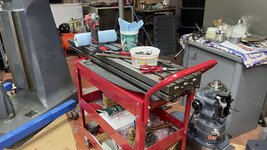
Removing the table was an easy affair thanks to this service cart that was in the basement. I lowered the knee to the right height and it slid right off.

IMG_9653.JPEG
Here's a closer look at the condition of the machine.

IMG_9669.JPEG

It looks like a disaster, but rest assured all the important parts are categorized and tucked away.

IMG_9648.JPEG

The column was bolted to the floor with wedge anchors, so I had to lift the entire column up and off the studs. An engine hoist made for quick work of it. The next BIG challenge is getting this all up those stairs. You can see each tread now has a triple 2x6 under it, and you can't see it in the photo, but there is a double header spread across the width of each tread as well. It goes down to the concrete into a bottom plate that is tap-con'd do the floor. Same goes for under the landing at the top, though it's not completed in this photo here - four additional 2x supports under the joists, with a few columns under them.

I have an electric stair climbing dolly rated for 1,500lbs rented. It will make for easy moving of all the parts except the column, which will be hard no matter what. I'm working on some secondary and tertiary safety options for that. Can't have it tipping forward and tumbling down the stairs on me.

IMG_9660.JPEG
Stripping down the lathe was pretty basic and I didn't take any photos. I removed the tail stock, cross and compound slides, motor, some of the back gears and cover, then unbolted it from the tray and table. It will tip up vertically and go up on the stair climber dolly as well.

IMG_9629.JPEG
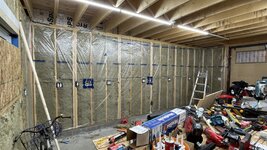
Back at the shop, I've been starting to add my vapour barrier so I can start panelling the walls this week. I won't finish it all in time for the machine moving on Saturday, but all I need are these two walls to be finished. I'm using Certainteed Membrain, a 'smart' variable permeable barrier that allows a wall to dry in two directions depennding on the moisture in the wall. I used it in my basement a few years ago and it seems to work well with rockwool and rigid foam.

And there you have it - onward!
 
OP
O

old_smokey

Well-known member
Joined
May 16, 2018
Messages
410
Location
Manitoba
Progress has been made on the walls. The first four panels are up and I'm starting to get a feel for the rhythm of installing them. It's actually quite fast per panel. Way faster than I am at drywall.

The process is as follows:
- First step was milling some oak for the base. My walls are 8' 4.5", and the sheets are 1/2" oversized in length. The base is milled to take up that room, while allowing for a 1/8" gap at the top for ease of installation. I'll cover that with trim later. The oak has a small rabbet cut at the top, to mimic the reveal between the sheets I'm aiming for. I set a laser up, then nailed them in place with a 15g air nailer. I put a spline between the joints to try and keep them nice and flush with each other.

IMG_9687.JPEG

- Each plywood sheet came 1/2" oversize in width and height. Given I want about an 1/8 reveal between the panels, I have to cut panel by 5/8". I bought a 106" long track saw guide rail to make quick work of this.

- next step is to use a router with a slot cutting bit to cut a full-length 1/8" channel down each long edge. This is to accept a painted spline, which is just a decorative detail between each panel. I'm using hardboard for this, painted dark green to match my door. Thanks for that great suggestion @crashmtb !

IMG_9688.JPEG

- Next I measure the location of the box cutouts and the distance from the neighbouring panel edge. My Dad 3D printed me a little router template that snaps into a track saw guide rail. This means I can just clamp the guide rail to my sheet at the correct height, then slide the template to the right spot, tighten the lock screws down and go to town with a little 1/4" trim router and a carbide upcut bit. The template allows for a 1/8" gap around the boxes for wiggle room, which has worked great. To speed things up, my Dad would call out the measurements for each cutout while I'd mark the locations on the panel. After a few panels, we got into a great rhythm and the walls went up quickly.

IMG_9691.JPEG
IMG_9689.JPEG

- Next, I slide the spline into the sheet, drop the panel on the oak base, and tap the two sheets together with a rubber deadblow and wood block. Once in place, I pre-drill with a bradpoint bit, then fasten the panels in place with a few GRK cabinet screws. I've been using a template to make all the fasteners line up.

IMG_9714.JPEG

At the corners, I still put a spline in both ends, but just allow the splines to but up against each other. It makes for a cool corner reveal detail that matches the rest. I need to shim the top of one panel to get the reveal consistent top to bottom, but it will work out.

IMG_9715.JPEG

Putting these four panels up took maybe 2.5 hours, getting quicker with each one. And now they're DONE. No mudding, sanding, painting etc. I should be able to have the main floor finished in a week I expect.


But for now, my focus must switch back to the machinery moving. I rented a powered stair climber from Sunbelt Rentals. I stopped by at lunch yesterday to check some dimensions on it, and was informed it was broken and would not be fixed for some time. They offered no solutions and showed no interest in helping me. Truly a terrible customer experience. So now that I've lost my primary means of moving things, I'm back to the drawing board.

Thankfully, I've got some ideas. Something involving an electric hoist to pull a skid up the stairs, and a 2 ton engine hoist poking through the door opening at the top to pick things up as they reach the door. I hit up Princess Auto and bought a bunch of lifting slings, lifting eyes, cables and a winch. More to come... tomorrow is the big day.
 
Last edited:

crashmtb

Well-known member
Joined
Aug 2, 2006
Messages
93
Location
Winnipeg
The walls look great!
I have a 500kg chain hoist, probably a bit small for what you need to do.

Jobsite rentals (204) 283-0060 lists the same stair climbing unit on their website - maybe they even actually have it?
 
OP
O

old_smokey

Well-known member
Joined
May 16, 2018
Messages
410
Location
Manitoba
The walls look great!
I have a 500kg chain hoist, probably a bit small for what you need to do.

Jobsite rentals (204) 283-0060 lists the same stair climbing unit on their website - maybe they even actually have it?
Gave them a ring, it's booked long-term, and they'd have to bring one in from Ontario. Thanks for the tip though!

I think I will be ok, though. The show must go on.
 

crashmtb

Well-known member
Joined
Aug 2, 2006
Messages
93
Location
Winnipeg
Gave them a ring, it's booked long-term, and they'd have to bring one in from Ontario. Thanks for the tip though!

I think I will be ok, though. The show must go on.
Bummer. I wonder how they got the machines down there in the first place.
 

badmatt

Well-known member
Joined
Dec 27, 2018
Messages
147
Location
America's hat.
Could you lag two deadheads into the basement slab, mount the winch and have a ****** block up the staircase on a stringer / pair of 2x6's? depends i suppose on how invasive you're allowed to be. You could make a slider from some plywood or plastic sheet. I may have a half sheet of 1/4" thick HDPE or UHMW I could donate to the cause. Or i could borrow you my spare 9000lb smitty built winch.

Also, Look into safe movers and see if they are willing to take the job on.
 
OP
O

old_smokey

Well-known member
Joined
May 16, 2018
Messages
410
Location
Manitoba
Could you lag two deadheads into the basement slab, mount the winch and have a ****** block up the staircase on a stringer / pair of 2x6's? depends i suppose on how invasive you're allowed to be. You could make a slider from some plywood or plastic sheet. I may have a half sheet of 1/4" thick HDPE or UHMW I could donate to the cause. Or i could borrow you my spare 9000lb smitty built winch.

Also, Look into safe movers and see if they are willing to take the job on.
That is very close to what I'm in the middle of building. My cable hoist will be anchored to the concrete floor at the bottom (I'm ok to drill and install wedge anchors here). I have two 2x8s in the truck to make skids. A ****** block at the top, cable returns to the sled, then goes back up again to a lifting eye, so I get some more mechanical advantage and also a slower lift rate.

I got four quotes to have this moved... three were $4,000 LOL. Those were all from commercial heavy machinery moving companies. Then I got a third for $1,500, from a regular moving co. They said they'd bring four guys and rent a powered stair climber. So that's obviously not going to work either.
 

crashmtb

Well-known member
Joined
Aug 2, 2006
Messages
93
Location
Winnipeg
That is very close to what I'm in the middle of building. My cable hoist will be anchored to the concrete floor at the bottom (I'm ok to drill and install wedge anchors here). I have two 2x8s in the truck to make skids. A ****** block at the top, cable returns to the sled, then goes back up again to a lifting eye, so I get some more mechanical advantage and also a slower lift rate.

I got four quotes to have this moved... three were $4,000 LOL. Those were all from commercial heavy machinery moving companies. Then I got a third for $1,500, from a regular moving co. They said they'd bring four guys and rent a powered stair climber. So that's obviously not going to work either.
I bet they regular movers would try to rent the one from sunbelt!
It would be cool to see a knuckle boom crane snake its way down there...
 
OP
O

old_smokey

Well-known member
Joined
May 16, 2018
Messages
410
Location
Manitoba
What an absolutely epic weekend.

It's Monday morning after the big machine-moving event. Nobody got hurt, the house wasn't damaged, none of the machines were damaged, and so far it looks like no parts went missing either. Can't ask for more than that.

On Friday after work, I headed to my Dad's shop and we made a fixture for mounting a one-ton cable hoist to the floor. We used a scrap piece of LVL from the ridge beam as a base, some heavy steel angle and square tubing, and 1/2" wedge anchors. The hoist cable ran up the stairs, around a pulley, back down to a pulley mounted to a sled, and back up the top of the stairs. We built a small sled out of 2x6 lumber, with a heavy 4" angle bracket at the bottom. The angle is what the sled pulley was bolted to, and that's what held the weight of the cargo. Between that and getting various other parts prepped, I wasn't home till midnight.

I picked up a trailer from U-Haul at 8am and loaded up our gear. I recruited a few friends to help me out.

IMG_9729.JPEG

We managed to remove everything from the basement in 1.5 hours using nothing but a regular hand cart, leaving only the lathe, mill knee, and mill column downstairs.

Next up was assembling the sled system.

IMG_9735.JPEG

You can see here how the hoist is bolted to some heavy angle, which is then through-bolted to the floor. The cable runs under a pulley, positioned so the cable path parallels the stairs.

IMG_9744.JPEG

Here's a clearer look at the sliding tracks. It's a 2x8 with a 2x4 on top, waxed to make it slippery. On the left, my brother-in-law Giles is contemplating the structural integrity of the pulley-mounting bolt that will support 1,000 lbs in just a few minutes. I'm not sure what my Dad is doing here, but he seems quite happy with the little M12 1/2" impact.

IMG_9745.JPEG

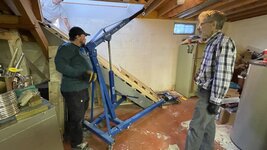
At the top of the stairs, I bolted a one-ton truck bed hoist to some heavy-wall 2" square tubing. I used my truck hitch on one end for ballast, and an 8' piece of tubing perpendicular for balance. This little hoist was a huge help. It picked up the cargo off our sled at the top of the stairs, and we could walk it out the door in steps. Here, Jeff is looking bemused at the redneckery of our approach.
IMG_9751.JPEG

Downstairs, we used a 2-ton engine hoist to load the sled. Our stair cribbing got in the way of the hoist legs, so it took some fussing to allow the hoist to drop the cargo right over the sled.

IMG_9748.JPEG

We started with the knee, as it was the smallest and lightest item. This was really easy, and had us feeling confident. The whole sled system worked beautifully. The truck crane was just the right length to poke through the door and pick it off the sled. At all times the load was supported from above and below.


IMG_9752.JPEG

Next up was the lathe. This was a bit more awkward on account of the length. I removed the headstock, tailstock, cross and compound slides, motor and some of the gears to make it lighter. With a little effort, it fit on the sled and came upstairs without too much effort.

That just left the mill column. The main event. Honestly, I think everyone was feeling quite nervous about this. It is just so big and so heavy. And if something goes wrong, it will go very wrong, very fast.

The first challenge was just getting the column onto the sled. This took quite a long time, actually. Because the ceiling height is low, we tried several times to lift the column but couldn't get the column's bottom to clear the staircase stringers. We needed to tip the column almost 45 degrees and then lift it up.

IMG_9758.JPEG

This took a lot of work and coordination. We tried a few approaches and finally landed on something that worked and that everyone was comfortable with. We used lifting slings around the top of the column, pulled short and tight to the hoist shackle. Then put some 3/4" lifting eyes at the 'toe' of the column base, and hooked up a come-along in a V shape between the hoist shackle and each lifting eye at the toe. This way, by tightening the come-along, it pulls the column base closer to the hoist shackle, causing the base to tilt.

This way, we could lift the column as high as the engine hoist would go, then ratchet the come-along until the column was tilted enough that its base would clear the stair stringer. At that point, we raised the sled until it was positioned under the column, then lowered the column onto the sled. The sled was actually halfway up the stairs already when it was aligned to receive the column.

IMG_9761.JPEG

The first thing that may jump out here is that someone is standing below the load. That is a huge no-no, and something we reminded everyone about routinely. But I will say, in this photo, the column is supported in four different ways. There is the blue hoist from the side, the truck hoist from above, it's strapped to the sled supported by the cable hoist, and we lagged a stop block right under the sled here, so if all three hoists failed, the sled still wouldn't move. That felt safe enough to stand below and make some final adjustments.

I don't have any photos or videos of the actual move. As you can imagine, we were all hyper-focused on the task at hand. When it got to the top of the steps, I ran a lifting sling through the column and pulled it upright with the truck hoist, setting it down on the stair landing.

This was a HUGE moment of relief. There were many cheers. The homeowners were standing behind us, watching in disbelief that we actually got this thing out of their house lol.

image000000.jpg

From this point on, we used a combination of the truck hoist and rolling dollies to move everything into the trailer. By the time we got home and unloaded, it was almost midnight. But we DID IT.

Now I have the much more enjoyable task of reassembling the mill, making room to continue the final steps on the shop's interior finishing.
 
Last edited:

slim_grim

Well-known member
Joined
Oct 19, 2014
Messages
232
Location
Central NC
Phenomenal! Those walls are gonna look fantastic. I considered going that route in the moto shed, but I cheaped out since I knew my walls would be covered up with cabinets and tools. Looking forward to following this one!

mightyhare on advrider, BTW

Edit: Just went and looked back at your other thread... No idea how I missed that when I was trying to find some inspiration for a small moto shop. Great stuff.
 
Last edited:
OP
O

old_smokey

Well-known member
Joined
May 16, 2018
Messages
410
Location
Manitoba
Phenomenal! Those walls are gonna look fantastic. I considered going that route in the moto shed, but I cheaped out since I knew my walls would be covered up with cabinets and tools. Looking forward to following this one!

mightyhare on advrider, BTW

Edit: Just went and looked back at your other thread... No idea how I missed that when I was trying to find some inspiration for a small moto shop. Great stuff.
Hey thanks! I love your thread as well. I'm on advrider as well, same username as here. Your moto shed is sweet. I really enjoyed my little shop. If it wasn't literally falling apart, I probably wouldn't have done this new shop project for at least a few more years. You can do so much in a small space with a little creativity.
 

Jayman17

Well-known member
Joined
Feb 6, 2017
Messages
3,809
Location
Seattle, Wa
Looks like a great process you have figured out for the wall panels, that printed router template is slick, and the results look great.
Congrats on getting everything moved with no incidents or damage. 👌
 
OP
O

old_smokey

Well-known member
Joined
May 16, 2018
Messages
410
Location
Manitoba
Another busy week! @crashmtb no dice on that fridge. Funny enough, I did open it to see if it was in use, and it was being used as a storage closet for multimeters and other electrical tools lol.

After recovering from last Saturday, I got to work reassembling the mill before I forgot where everything goes. It was a lot easier than I expected, thankfully. I gave everything a thorough cleaning, lubed the ways with way oil, cleaned the wipers, and greased the head pivot worm gear.

IMG_9784.JPEG

Before putting the head and motor back on, I took the chance to push the mill a bit tighter to the corner. I still have room to slide the ram all the way back, and the table has full left/right travel. It takes a little less room than I expected. Bonus!

At that point, I had to make an unexpected switch to roofing again. I was thinking about adding snow retention bars to the roof, since my neighbours park right alongside the shop, and we have a walkway to the driveway on the opposite side. Last year, my Dad was caught in the face by sliding snow from his shop's metal roof, and he got a nasty cut around his eye. I figure it was probably a good idea to put bars up right away.

While talking to a rep from S-5! snow retention systems, I was thinking through how to install them and what actually holds the weight of the snow when it suddenly hit me. I checked the installation instructions and...uh oh... I missed something pretty important.

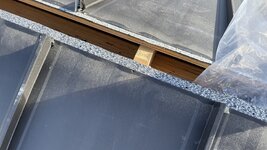
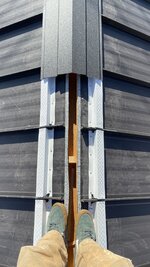
My roof is a snap-lock system. So the panels are held down by retention clips along one edge, and the opposite edge is held in place by the neighbouring panel snapping over it. At the bottom, the panel is folded over a Z-cleat to hold it flat against the roof deck. The whole idea is that the panel can freely expand and contract, moving slightly under the retention clips. But that assumes the panel is fastened to the roof deck at the very top, under the ridge cap, through the Z-closures.

I didn't do that. And to be honest, it was an accident. The panels I received were slightly too short, and the ridge cap was slightly too small. That meant I had to install the Z-closures as tightly as possible to the ridge opening, even bending them slightly so the ridge cap could snap over them. However, it had the unintended consequence of causing my Z-closure screws to fasten above the top of my panels, rather than through them. So my roof panels were not actually attached to anything, anywhere. They were free-floating under the clips, held to the deck by friction. It was a lot of friction, mind you, but not enough to combat sliding wet snow, I'm sure.

So I had a sudden panic and worked up a solution. I got a wider ridge cap made up, new vented Z-closures, and got back up on the roof. After tearing the old ridge cap off, it was as I expected.

IMG_9804.JPEG

You can see on the near side, only one screw actually captured the roofing panel, and only by the tiniest of margins. All the rest missed completely. On the opposite side, it was better, but still very close to the edge, and not many screws.


IMG_9806.JPEG


Here's a look at the new solution. The Z-closures have butyl tape and a bead of metal roof sealant underneath them, as well as along the vertical legs. Four screws penetrate the closures and roof panels, so they are now properly locked down. The new ridge cap was slid over the closures, which then lock into a hem, and are riveted in place. I did a 6" overlap at ridgecap joints, with plenty of sealant. It was a disappointment to have to redo this job, but I can rest easy now, knowing my panels won't slide down under heavy snow.

Ok. NOW I am done with roofing.

That brings me to last night. Leif came over and we finished rebuilding the mill. Getting the motor in was way easier than removing it, now that we understood how the variable-speed drive worked. Everything got a deep clean and plenty of lube. I had a brief moment of head scratching while wiring it up, but I figured it out soon enough and was able to fire up the machine last night. It sounds really good - smooth and quiet. The only thing that might need some attention is the x-axis power feed. When disengaging the feed, the table doesn't stop immediately. It coasts to a stop, and sounds rough in the power feed drive box. So something in there needs attention. That's for another day, though.

IMG_9816.JPEG

Next up is assembling the lathe, and then a big cleanup so I have room to finish insulating upstairs and panelling the walls.
 
To avoid these ads, REGISTER NOW!
Top Bottom