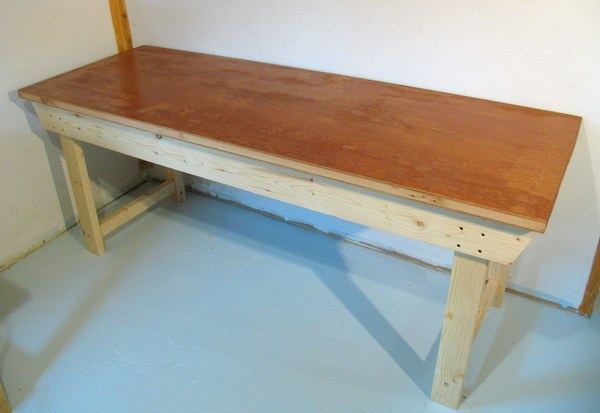
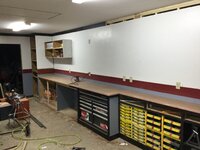
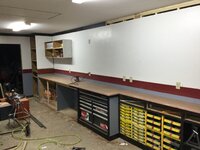
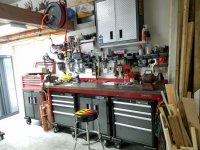
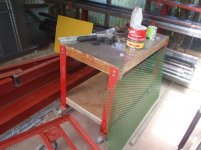
I chose to use commercial products instead of making my own, but I just used a frame from Sears, and made my own tabletop. I got one of the formed sheetmetal Craftsman frames. It's 2' x 8' and I topped it w/a 4' x 8' x 3/4" CDX plywood sheet ripped to make two 2' x 8' pieces, which I them glued & screwed together to make the countertop. I went to a sheet metal shop and bought a 3/16" steel sheet and 3/4" strips to case the edges of my wood tabletop. I made the dimensions of the steel sheet to overhang the wood tabletop by the thickness of the edge steel banding. I wanted a surface that I could put mechanical components onto and wail-away on them without having to worry about denting a thinner surface, as-in some lighter gauge of steel sheet. I countersunk the holes in the 3/16" sheet steel so I could use flat-top machine screws for a flush finish. Since the top surface does tend to oxidize, I keep it waxed. I've thought about getting a cap of stainless steel to just sit on-top, but it's not high on my priority list. Underneath I have Craftsman drawer roller cabinets, or shelved cabinets, all on casters, the three fit perfectly. The workbench is against a masonry wall, so a few fasteners into that, and it's as rigid as you could want.
Above the countertop I have Whirlpool Corp. brand Gladiator wall panels for adjustability of hanging an assortment of frequently-used tools. I also have my cordless chargers mounted to the wall panels to get them off the benchtop, I made some plywood brackets to mount them using the stamped-steel brackets Gladiator includes with their wall-hanging cabinets, but which I didn't use for cabinet-hanging, as I tapconed my 30" x 30" x 12" wall cabinets in-place.
I made sure I used 4" electrical boxes so I could wire-in two duplex outlets at each box. The 4" boxes are 3' o.c. I also have a 20 amp 220 volt box for my Powermatic 64 table saw I bought from a Coast Guardsman in Key West, the best $125 investment I ever made.
I installed a Harbor Freight Tools (HFT) 50' air hose retracting reel above the workbench. When I'm done with work, I simply blow-out the overhead doors all the floor debris of a small nature, the big stuff and metal shavings I generally sweep-up to prevent trauma from it lying in the driveway, or getting embedded in someone's shoe sole, and then defacing the interior of the house's red oak floors we recently re-finished.
All the Gladiator and Craftsman stuff I waited until it went on-sale, I saved up to 80% (!) off the retail cost by waiting for close-outs and sales. The roller Craftsman cabinets under the workbench were $325-400+ retail, I paid $84 apiece. When the salesman told me the price, I asked him, "how-many do you have at that price?" I bought them all, limited to 'stock on-hand.' The workbench frame was $208 retail, I paid $80. All was new-in-box, not returns. I don't have the time to spend making all the cabinets and drawers I would need, so this worked out well for me.
I like reading about how others approach the construction, in my case, it was easier to just get permission from "The War Dept." to get new stuff, and then to buy it. The Gladiator cabinets are welded, though they do have knock-down ones too, I found the welded Pro line to be more-sturdy.