To avoid these ads, REGISTER NOW!

Can we stop calling it 220?

To avoid these ads, REGISTER NOW!

tdkkart

Well-known member
Joined
Jun 17, 2006
Messages
6,887
Location
Eastern Iowa
So, if standard household 220,240, whatever the hell we're calling it, is NOT 2 phase,
why is it that when we homebrew 3 phase we only have to create one phase, b e c a u s e.....guess what.....the other 2 are already there??
 

Alchymist

Well-known member
Joined
Mar 1, 2009
Messages
4,423
Location
Central PA
If you google "rotary phase converters", most everyone states "single phase to three phase conversion".

Rotary phase converters do use the two legs of the SINGLE phase as two legs of the three phase when a rotary converter is constructed. But look at the waveforms - The 1st picture (lifted from another website) shows a full 3 phase waveform. The second shows the output of a rotary converter.

The two "phases" made from the single phase input is no where near 120 degrees. The 180 degree input is "pulled toward a 120 degree shift, but never makes a true 120 deg shift. This is the cause of the "wild leg", usually much higher in voltage than the other two.
 

Attachments

  • Phase1.jpg
    Phase1.jpg
    10.7 KB · Views: 3
  • Phase2.jpg
    Phase2.jpg
    10 KB · Views: 3

theoldwizard1

Well-known member
Joined
Feb 22, 2011
Messages
43,095
Location
SE MI
Rotary phase converters do use the two legs of the SINGLE phase as two legs of the three phase when a rotary converter is constructed.
Learn something new every day ! I thought all "rotary phase converters" were built on the motor-generator principle !!

Motor-generators are not very efficient, but they give nice stable power.
 

Stephenw

Well-known member
Joined
Dec 21, 2006
Messages
1,911
Location
Utah
I don't participate in this section of the forum. I also don't give electrical advice. I wouldn't want anyone to misunderstand me and electrocute themselves. The one time I stumbled in here, I found this thread, the first and only that I clicked.

Against my better judgement, here is my 2 cents...

120/240 supplied to the typical home is single phase.

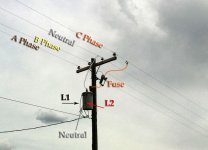
I took a picture of a utility pole today. This pole has four wires on top. There are 3 hot phase wires and a neutral. Often, the pole will have three wires on top and the neutral will be strung lower, below the transformer.

Note that a SINGLE PHASE, highlighted in orange, is taken from the line. It goes through a fuse and down to one side of the transformer primary winding. The neutral wire is connected to the other side of the primary winding and is highlighted in gray.

The secondary wires are connected to terminals on the side of the transformer. There is an L1, a center tapped neutral (correctly called the grounded conductor), and an L2.

The colors I used were mostly just for picture clarity.
 

Attachments

  • Pole.jpg
    Pole.jpg
    82.9 KB · Views: 254

Stephenw

Well-known member
Joined
Dec 21, 2006
Messages
1,911
Location
Utah
Here is a closeup of one of the pole mounted transformers we have stored in our yard. Note the two primary connections and the secondary connections I have labeled. This particulary transformer has a 2400 volt single phase primary and a 120/240, center tapped secondary.
 

Attachments

  • Transformer.jpg
    Transformer.jpg
    144.7 KB · Views: 26

Stephenw

Well-known member
Joined
Dec 21, 2006
Messages
1,911
Location
Utah
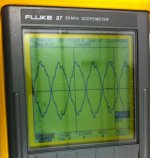
Let me appologize for the next 2 pictures. I do not have the software or cable to transfer screen captures from my Fluke 97 to a computer. I took these with my iPhone.

This picture shows channel A connected to L1. Channel B is connected to L2. You can see what appear to be two phases, 180 degrees apart.

As far as the 120 loads are concerned, each device only sees a 120 volt (RMS) sine wave. They don't care if they are connected to L1 or L2.
 

Attachments

  • L1L2.jpg
    L1L2.jpg
    21.7 KB · Views: 21

Alchymist

Well-known member
Joined
Mar 1, 2009
Messages
4,423
Location
Central PA
Let me appologize for the next 2 pictures. I do not have the software or cable to transfer screen captures from my Fluke 97 to a computer. I took these with my iPhone.

This picture shows channel A connected to L1. Channel B is connected to L2. You can see what appear to be two phases, 180 degrees apart.

As far as the 120 loads are concerned, each device only sees a 120 volt (RMS) sine wave. They don't care if they are connected to L1 or L2.

Appearances can be deceiving. :headscrat
 

Stephenw

Well-known member
Joined
Dec 21, 2006
Messages
1,911
Location
Utah
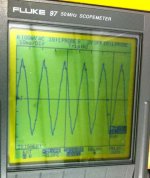
In this picture, I have connected channel A to L1 and the ground to L2.

240 volt loads do not use a neutral wire. Usually only L1, L2, and a ground wire are connected to a 240 volt device. The ground wire does not carry current. The ground is only used to clear a fault (trip the circuit breaker) if one of the lines were to short to the case of the device.

As you can see, we now have a 240 volt (rms) single phase sine wave.

The 240 volt device only sees a single 240 volt sine wave. It does not see two 120 volt sine waves that are 180 degrees apart.

I hope this clarifies the issue.

Time for me to go back to my regular forum sections.
 

Attachments

  • 240.jpg
    240.jpg
    28.8 KB · Views: 10

Stephenw

Well-known member
Joined
Dec 21, 2006
Messages
1,911
Location
Utah
Let me add that the center tap is provided so that 120 volt devices can be used. Without the center tap, everything would have to be 240 volt; your toaster, hair dryer, radio, everything.
 

ddawg16

Well-known member
Joined
Jul 11, 2008
Messages
21,005
Location
S. California
We can have a lot of fun playing on words......

The reality is....it's single phase....give me a transformer with an adjustable center tap and I can move the reference anywhere you want.

The key fact that shows that it's single phase is how you hook it up....both wires can go to a single transformer winding....if it was 2 phase, you would have to have two seperate transformers.

For example, I will sometimes use a 3-phase control xformer (480 to 120). I have to use a 3phase load center....which means I end up with 3 120Vac feeds....they all have the same neutral....but each phase is 120 hz out of phase with the adjacent phase. If I go and measure from the hot of one phase to the other, am I going to get 240/241? NO....I will get 208 Vac RMS (using a Fluke meter).

But in a single phase 120/240 system....if I measure from one hot to the other....I get 240/241 (what ever it takes)
 

Hurricane_Whisperer

Well-known member
Joined
Nov 2, 2009
Messages
359
We can have a lot of fun playing on words......

The reality is....it's single phase....give me a transformer with an adjustable center tap and I can move the reference anywhere you want.

The key fact that shows that it's single phase is how you hook it up....both wires can go to a single transformer winding....if it was 2 phase, you would have to have two seperate transformers.

For example, I will sometimes use a 3-phase control xformer (480 to 120). I have to use a 3phase load center....which means I end up with 3 120Vac feeds....they all have the same neutral....but each phase is 120 hz out of phase with the adjacent phase. If I go and measure from the hot of one phase to the other, am I going to get 240/241? NO....I will get 208 Vac RMS (using a Fluke meter).

But in a single phase 120/240 system....if I measure from one hot to the other....I get 240/241 (what ever it takes)

This thread, after it no longer was about what to call 240, has not been about convincing the unconvincible.

It has been about preventing the unconvicible from misinforming the not yet knowlegable.
 

Bull

Super Moderator
Joined
Dec 12, 2005
Messages
16,189
Location
MA
I think you guys in the field are making this confusing on purpose, to keep ignorant people like me from ever learning your craft. A job security measure, I suppose.

Because, after reading this whole damn thread, I still don't know what to believe.
 

Alchymist

Well-known member
Joined
Mar 1, 2009
Messages
4,423
Location
Central PA
I think you guys in the field are making this confusing on purpose, to keep ignorant people like me from ever learning your craft. A job security measure, I suppose.

Because, after reading this whole damn thread, I still don't know what to believe.

Half the people on here, and all the industry sources call it single phase ....go figure. :lol_hitti
 

JimDon

Well-known member
Joined
Jan 23, 2007
Messages
602
Bull,
There is no disputing what it is. This is not job security to obfuscate and make it incomprehensible for some. This is just plain factual. There really is only one person who continued to dispute what are plainly, and simply put, the correct interpretation. Many, many engineers and sparkies have chimed in one after the other and said that it is single phase. You can believe them. Or you can do your own homework and Google most of what they have said and find that it is true. Go to the Mike Holt electrical forum and search around. The NEC is very clear. The answer is very clear.
There's one item, research, that I see the younger generation being unable or unwilling to do -- on many topics and maybe it is only age and wisdom that turns that around -- I'm just not sure.
Cheers,
And good job to all those who continued to add on with their own information, diagrams, pictures, etc.
JimDon
 

Bull

Super Moderator
Joined
Dec 12, 2005
Messages
16,189
Location
MA
Fair enough, Jim.

I'm not sure how young I am in comparison to you. But, having gone to graduate school at an institution in Rhode Island, I am no stranger to rigorous research.

But, with the available hours I have in my day, I can really only research what is most immediately useful. This topic here became interesting to me because of this thread. But, the interest is merely casual right now.

That's what I often use this site for: casual research.

Bull,
There is no disputing what it is. This is not job security to obfuscate and make it incomprehensible for some. This is just plain factual. There really is only one person who continued to dispute what are plainly, and simply put, the correct interpretation. Many, many engineers and sparkies have chimed in one after the other and said that it is single phase. You can believe them. Or you can do your own homework and Google most of what they have said and find that it is true. Go to the Mike Holt electrical forum and search around. The NEC is very clear. The answer is very clear.
There's one item, research, that I see the younger generation being unable or unwilling to do -- on many topics and maybe it is only age and wisdom that turns that around -- I'm just not sure.
Cheers,
And good job to all those who continued to add on with their own information, diagrams, pictures, etc.
JimDon
 
To avoid these ads, REGISTER NOW!

JimDon

Well-known member
Joined
Jan 23, 2007
Messages
602
Bull,
I did my graduate work in an institution in Milwaukee 37 years ago, so you can pretty much do the math. My remark about younger folks was really not aimed at you in particular, but many of the "younger" generation that I see today -- my two college graduate youngsters included. They want easy, simple fast answers with not a lot of thought put into it and not a lot of gray outside the "clearly" defined black and white borders that they see. Didn't mean to step on toes, just a bit of frustration peaking out around the edges as to what I see an an overall problem today.
Cheers,
Jim
 

Bull

Super Moderator
Joined
Dec 12, 2005
Messages
16,189
Location
MA
No toes stepped on, Jim. You're too respectful in your communication for me to have taken it that way.

I'm a teacher, and so struggle with the research issue all the time when I assign essays.

What I know well, I know from real research. What I am merely familiar with, I know from casual research, like what I do here.

Anyway, I guess I see what direction to go WRT this phase topic now.

Bull,
I did my graduate work in an institution in Milwaukee 37 years ago, so you can pretty much do the math. My remark about younger folks was really not aimed at you in particular, but many of the "younger" generation that I see today -- my two college graduate youngsters included. They want easy, simple fast answers with not a lot of thought put into it and not a lot of gray outside the "clearly" defined black and white borders that they see. Didn't mean to step on toes, just a bit of frustration peaking out around the edges as to what I see an an overall problem today.
Cheers,
Jim
 

Steve from Socal

Well-known member
Joined
Jan 27, 2009
Messages
3,491
Location
Hutchinson Ks.
Well Bull,

I don't have a C-10 or an EE but, when you have an interest in something you learn about it. I wish I knew somebody to work for to get credit towards a C-10, I have done industrial electrical work for over 25 years. I also have a garage full machinery and while most of them are single phase a few are three phase. In order for the three phase motors to work you have to either pay somebody or learn how to generate three phase. Now days it is really easy with a VFD inverter but, every strategy has pluses and minuses.

I do find it hard to comprehend a well educated individual with a degree in engineering blindly ignoring reams of data?

Steve
 
Last edited:

rwhite692

Well-known member
Joined
Mar 4, 2008
Messages
1,850
Location
Central Valley, CA
If you google "rotary phase converters", most everyone states "single phase to three phase conversion".

Rotary phase converters do use the two legs of the SINGLE phase as two legs of the three phase when a rotary converter is constructed. But look at the waveforms - The 1st picture (lifted from another website) shows a full 3 phase waveform. The second shows the output of a rotary converter.

The two "phases" made from the single phase input is no where near 120 degrees. The 180 degree input is "pulled toward a 120 degree shift, but never makes a true 120 deg shift. This is the cause of the "wild leg", usually much higher in voltage than the other two.


Uh, yeah, that is why run capacitors are used to balance a rotary phase converter.
 

kaffine

Well-known member
Joined
Dec 13, 2009
Messages
3,610
Location
Henderson, NV
Get me enough cable and I will make 3 phase from single phase. I just need a lot of cable. 1,611,111 meters of cable between phase A and Phase B and another 1,611,111 meters between Phase B and Phase C should be enough. Assuming 60Hz I would need a bit more cable for 50Hz. I might be able to cut down on the cable a little bit by using a center tapped transformer and connecting the Phase B to the center tap and Phase C to the 180º line out of the transformer but then I would be working on the secondary side of the transformer and need larger cables. I can see how this works in theory not practical to even try in reality though.

I will add that electricity does some strange things when you get to 1/4 and 1/2 wavelengths so it may not even work in theory.
 
Last edited:

Alchymist

Well-known member
Joined
Mar 1, 2009
Messages
4,423
Location
Central PA
It will work in theory - they are called inductors. You can cut down on the cable length by coiling the cable, and reduce it even more by using an iron core. You should see what a 1 inch length of wire does at 10 Ghz!
 

ajaynejr

Member
Joined
Feb 1, 2011
Messages
14
You can still call it 220 but remember that 220 volts versus three phase 208 volts remains a non-trivial difference and equipment meant for one cannot be used on the other unless intended for such usage perhgaps as evidenced by labeling.
Alchymist said:
The two "phases" made from the single phase input is no where near 120 degrees. The 180 degree input is "pulled toward a 120 degree shift, but never makes a true 120 deg shift. This is the cause of the "wild leg", usually much higher in voltage than the other two.
While you may get differing phase to neutral voltages from the three phases out of a single phase to 3 phase converter, the imperfect pulling of the phases is not the reason for a wild leg.

The wild leg situation exists because, when the neutral is assigned to the center tap of one of the three transformers in a 3 phase delta arrangement, the phase to neutral voltage of the third leg (the leg not on the center tapped transformer) is 1.73 times the phase to neutral voltage for the other two legs. For a phase converter, any pulling away from 0 or 180 degrees to get a third leg will either result in a lower phase to phase voltage and/or result in a higher phase to neutral voltage for the third leg compared with the other two.
 
Last edited:

theoldwizard1

Well-known member
Joined
Feb 22, 2011
Messages
43,095
Location
SE MI
Get me enough cable and I will make 3 phase from single phase.
Reminds me of a lab we did in one of my EE classes. We had to determine the length of coax by injecting a pulse at one end and then observing the reflection and the same end. Interesting especially when you change the terminator (or lack there of).
 

theoldwizard1

Well-known member
Joined
Feb 22, 2011
Messages
43,095
Location
SE MI
You can still call it 220 but remember that 220 volts versus three phase 208 volts remains a non-trivial difference and equipment meant for one cannot be used on the other unless intended for such usage perhgaps as evidenced by labeling.
Yep. I was very concerned after I ordered some computer equipment that was listed as 220V when I found out that only 208V was available in the building. Worse the corporate electricians install the wrong receptacle instead of the NEMA 6-20R that was requested.

A quick run to an electric supply house and a check with the tech installing the equipment who pointed out the multi-tap input transformer and my concerns were taken care of.
 

6768rogues

Banned
Joined
Nov 28, 2007
Messages
4,524
Location
Western NY
240 is single phase. There are two 120V lines that are in the same phase and are additive, giving 240V.
Three phase 208V is three 120V phases that are 120 degrees out of phase with each other. Since they are not in the same phase, they are not additive. The resultant power is calculated using a root mean square equation so three 120V phases 120 degrees out of phase gives 208V. Same thing for 480, it is three 277V phases that are 120 degrees off from each other.
 

Alchymist

Well-known member
Joined
Mar 1, 2009
Messages
4,423
Location
Central PA
Reminds me of a lab we did in one of my EE classes. We had to determine the length of coax by injecting a pulse at one end and then observing the reflection and the same end. Interesting especially when you change the terminator (or lack there of).

It's called TDR- Time Domain Reflectometry. There are oscilloscope like instruments for this. Using one of these, one can pinpoint an open or short or even a mechanical problem in a cable - and tell exactly where in the cable it occurs.
 

Alchymist

Well-known member
Joined
Mar 1, 2009
Messages
4,423
Location
Central PA
You can still call it 220 but remember that 220 volts versus three phase 208 volts remains a non-trivial difference and equipment meant for one cannot be used on the other unless intended for such usage perhgaps as evidenced by labeling.

While you may get differing phase to neutral voltages from the three phases out of a single phase to 3 phase converter, the imperfect pulling of the phases is not the reason for a wild leg.

The wild leg situation exists because, when the neutral is assigned to the center tap of one of the three transformers in a 3 phase delta arrangement, the phase to neutral voltage of the third leg (the leg not on the center tapped transformer) is 1.73 times the phase to neutral voltage for the other two legs. For a phase converter, any pulling away from 0 or 180 degrees to get a third leg will either result in a lower phase to phase voltage and/or result in a higher phase to neutral voltage for the third leg compared with the other two.

Golly gee, I thought that's what I said. :confused:
 

theoldwizard1

Well-known member
Joined
Feb 22, 2011
Messages
43,095
Location
SE MI
It's called TDR- Time Domain Reflectometry. There are oscilloscope like instruments for this.
We were only given a 'scope so it was a bit "more challenging" !

Using one of these, one can pinpoint an open or short or even a mechanical problem in a cable - and tell exactly where in the cable it occurs.

Like when someone drills the hole for an old Ethernet cable vampire tap right through the center conductor :bounce: :wtf: :shocking: !
 
Last edited:

A_Pmech

Well-known member
Joined
May 8, 2007
Messages
8,002
Location
IL
I have a bad feeling this thread is going to be almost as epic as the divining rod thread on Practical Machinist.
 

kaffine

Well-known member
Joined
Dec 13, 2009
Messages
3,610
Location
Henderson, NV
It will work in theory - they are called inductors. You can cut down on the cable length by coiling the cable, and reduce it even more by using an iron core. You should see what a 1 inch length of wire does at 10 Ghz!

Wouldn't you also need a few capacitors? Otherwise you would only delay the current. We didn't really cover delay lines that much in class though. The wavelenght of 10GHz should be just over an inch I know 1/4 wavelength is a short and 1/2 is an open but I'm not really sure what happens on longer cables. I would think that every 1/4 and 3/4 would look like a short and 1/2 and 1 would look like an open but I'm not sure. I know there are lab setups with a piece of waveguide that was slotted so you could move a detector back and forth to measure the standing wave but I never got to use one.

I would like to take a RF class with a lab. The class I had was only theory. I don't understand RF all that much but the little I did grasp from that class certainly helped with other classes. Especially amps and why you get max power when the impedances match.

I am starting my BSEE in the fall and hope to finish before I retire.
 
To avoid these ads, REGISTER NOW!
Top Bottom