To avoid these ads, REGISTER NOW!

Carbide burrs

pepi

Well-known member
Joined
Mar 27, 2013
Messages
2,883
Location
Woodstock, GA
Replacing some burrs, what I would like to find out is what do you prefer, single, double or diamond cut and the reason.

Speed of material removal, finish of the cut, burr durability and control. I will be using them with a die grinder, mostly steel now and then some aluminum .

Thanks
 
To avoid these ads, REGISTER NOW!

plinker

Well-known member
Joined
Feb 28, 2007
Messages
4,286
Location
Northern Wi
I have preference for 3/8 size cylinder and round nose tree type, I have mostly double cut but one single cut and one of the double cut is an end cut type. The single cut is a bit smoother, but slower material removal. I also like a 1/2 size burr in a round nose cylinder shape for general use.
I should really get a couple 1/4 body burr's as I have run into a couple time where I could have used one. I have not used diamond cut.

I use the burr's for enlarging holes/or slotting them, deburring edges, & for weld clean up on a number of different thing's (an example is smoothing out the inside of a pin boss that had to be built up with weld).

If you're going to cut aluminum you'll need specfic aluma-cut type burr's (if you didnt know). I used the one I have the other day for the first time and it worked great.

I've bought from Epstiens and Buckeye carbide. Both have great price's. No issues with either source quality wise, but dont use a die grinder that has a lot of runout (like the POS Matco's I have) or they'll chatter all the teeth off.
 

Ign

Well-known member
Joined
Jul 7, 2006
Messages
12,769
Location
Butte Peak ND
I prefer double cut 'cause it cuts faster and is less likely to "wrap" or "twist" around the ID of a hole, but they all do this to some degree. I'm rarely concerned with finish when I'm using a die grinder, if I care about round hole ID finish or the finish of a slot into the mill it goes.

ATRAX from Enco! US made.
 

rlitman

Well-known member
Joined
Oct 18, 2010
Messages
24,751
Location
Long Island
Diamond cut is not for cutting metal. It is for things like ceramic tile or concrete, but I've had luck with it on plastics and rubber too.

Single vs double cut is like the difference between a mill and ******* file.
 
OP
P

pepi

Well-known member
Joined
Mar 27, 2013
Messages
2,883
Location
Woodstock, GA
Good info you are using them the same as I will. Die grinder is IR, 3/8 is the size, think I'll get at least one 1/4, you definitely make a good point there. Single cut, I am looking at the Epstiens, but I will take a cyber ride over to Buckeye carbide. Thanks you, your information was helpful.
*********
Diamond cut is not for cutting metal. It is for things like ceramic tile or concrete, but I've had luck with it on plastics and rubber too.

OK nix the diamond cut for me.. do not do ceramic or concrete.
Single vs double cut is like the difference between a mill and ******* file.
also informative thanks
*********
I prefer double cut 'cause it cuts faster and is less likely to "wrap" or "twist" around the ID of a hole, but they all do this to some degree. I'm rarely concerned with finish when I'm using a die grinder, if I care about round hole ID finish or the finish of a slot into the mill it goes.

ATRAX from Enco! US made.

Epstiens also US made, the wrap around the ID of a hole is pain, and is a consideration replacing these..

Thank you also.

Looks like there could be at least 1 double cut in the mix now.
 
Last edited:

jjjrmx5

Well-known member
Joined
Dec 30, 2010
Messages
3,431
Location
Cincinnati, OH
Garr carbide double cut burrs are the norm for me.

USA made.

Used on various metals and armour plate.

Never had a problem. Wear like a champ.

1/4" collet die grinders on huge-*** rotary compressor 150 psi shop air.

What you need burr wise is dictated by the work you do. Both size and shape.

Or, in general GJ terms, yes, you need ALL of them.

:)

The Garr counter sinks have served me well for years as well. Both for hand use pressed in a handle and using in a drill press.
 

rockchucker

Well-known member
Joined
Mar 27, 2010
Messages
1,764
Location
Seattle WA
Here are some pics of my arsenal. All US made and they are all still in use after many projects. This project is removal of the Casting Flash on the Coolant Galley of a Cast Iron Twin Turbo 3.0l V-6 Block...


DSC07341.jpg


Before...


DSC07346.jpg


Before...


DSC07349.jpg


Carbide Burrs...


DSC08013.jpg


After...


DSC08330.jpg


After...


DSC08332.jpg


After...


DSC08336.jpg


More Tools...
DSC08349.jpg


Album...

http://s61.photobucket.com/user/generacerator/library/Coolant_Galley_Casting _Flash_Removal


Here are some pics of some very straightforward Aluminum removal with the Burrs. the thing about Aluminum is you really have to run at a lower speed and let the Cutting Tool do the work. Too many RPM or too much pressure only results in clogged Burrs.

Straight cut just enlarging an opening...


DSC05351.jpg


Before...


DSC05353-1.jpg


During...


DSC05440.jpg


During...


DSC05452.jpg


After...


DSC05454.jpg


After...


DSC05455.jpg


After...


DSC05489.jpg


The only real thing I can say is do not waste your time with the cheapie HF Burrs. If you buy a quality Burr it will last a LONG time when not abused and treated properly. Yes they are VERY expensive but they are well worth it once you start using them and realize why you paid that much for a tiny little hunk of metal. Single Cut Burrs for Aluminum and Double Cut Burrs for Cast Iron. When using the Double Cut on the Aluminum they tend to clog very fast. Double Cut on Cast Iron seems to remove material a touch faster than a Single Cut Burr.
 
Last edited:
OP
P

pepi

Well-known member
Joined
Mar 27, 2013
Messages
2,883
Location
Woodstock, GA
Oh, I forgot to mention one other style of die grinder burr.
There is a type where slivers of carbide are brazed onto a shank, standing up. It is only made for cutting wood, but is an animal at what it does:

http://www.woodcraft.com/category/2000943/kutzall-tungsten-carbide-burrs.aspx

I am a metal worker and car builder wood tools are not on the list. I am just replacing burrs I already have and was looking to upgrade. The double cut will be the style, and actually what I have. I recently replaced a carbide burr that had seen its better days. With this new one I learned they could be reground, with that in mind. I plan to replace the others cause they are just about ready and will keep the storage tubes, experience is the great educator.

Thank you, your comments are well taken.
 

theknurl

Banned
Joined
Dec 18, 2010
Messages
921
Location
SoCal
Diamond cut is not for cutting metal. It is for things like ceramic tile or concrete, but I've had luck with it on plastics and rubber too.

Single vs double cut is like the difference between a mill and ******* file.

really????

they've been working for me for 40+years in steel, cast iron and brass

rockchucker;
i don't ever use cylinder burrs for porting, they always leave end marks like in your pictures and balls are about useless too

most used in porting;
rounded tree
pointed tree
olive
flame

it's real easy to blend surfaces with curved burrs

for aluminum get some Aluma burrs they have 6 flutes and you can run them FULL speed
go to a machinist supply and get a 'Wax Stick' to lube the burrs works better than WD-40, makes way less mess too:thumbup:
 
To avoid these ads, REGISTER NOW!

rlitman

Well-known member
Joined
Oct 18, 2010
Messages
24,751
Location
Long Island
I said: > Diamond cut is not for cutting metal . . .

really????

they've been working for me for 40+years in steel, cast iron and brass

rockchucker;
i don't ever use cylinder burrs for porting, they always leave end marks like in your pictures and balls are about useless too

most used in porting;
rounded tree
pointed tree
olive
flame

it's real easy to blend surfaces with curved burrs

for aluminum get some Aluma burrs they have 6 flutes and you can run them FULL speed
go to a machinist supply and get a 'Wax Stick' to lube the burrs works better than WD-40, makes way less mess too:thumbup:

Weeeelllllll, I'll stick with that's not their intended purpose. They have a grinding action more than cutting. That can be useful on cast iron or brass, I guess. I couldn't see it working well on steel, but if it works for you, I say keep doing what you like. One nice thing about the diamond cut is that they are less grabby, so there is a little less kickback. They're also amazing in fiberglass.

I don't do porting, but your comments about shapes are spot on, and I can see how porting would put burrs to tests in all sorts of ways.
Yep, ball shapes are not very useful in most cases. Cylinder too.

My go-to shapes are a rounded cone and flame. I also have one of those carving burrs in a domed cylinder that I like.

I have a few stick shaped diamond cut burrs to make cutouts in plastic, fiberglass, sheetrock, etc. Basically using a die grinder as a mega-rotozip.
 

Corndoggeh

Well-known member
Joined
Apr 2, 2016
Messages
1,198
Hands down, any kind of burr that has a rounded face, I've used them in both my garage and at when I worked in a dental lab (thats how I was introduced to them) They are the only thing I use if I need to drill out a tap.
 

CudaChick1968

Member Emeritus
Joined
Jul 1, 2011
Messages
1,800
Location
Northwest Tennessee (38230)
Hey Burman, after typing this up I see you aren't accepting Private Messages.

I'd love to learn more about your bur restoration services. I have a small {on GJ scale anyhow lol} selection I've been looking to replace for awhile but learning they may possibly be saved sounds like a win/win situation.

How does your service work? Do you accept PayPal or prefer postal money orders?

Feel free to give me a call if you'd rather save the typing. I appreciate your time.

P.S. My stupid phone keeps changing 'bur' to '****.' Cracking myself up here with my request for **** Restoration ... too funny! :D
 

wafrederick

Well-known member
Joined
Jul 3, 2010
Messages
6,060
Location
Holton,Mi
I have a couple Matco sets,not cheap with a lifetime warranty on them.One set id for ferious metals and the other set is for non ferious metals.
 

JMP

Well-known member
Joined
Jul 6, 2024
Messages
436
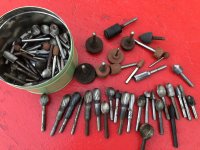
Earlier this summer I picked up these burrs at an estate sale along with some other tools including a couple pneumatic die grinders. I don't know too much about these other than they are a single cut and many of them are marked 'HSS' so not the expensive carbide burrs. I am wondering about the usage of some of these such as what materials or jobs these might be good for or things to avoid should the need arise to employ them. Quite a wide array of different shapes.

IMG_4230.jpeg
 

rlitman

Well-known member
Joined
Oct 18, 2010
Messages
24,751
Location
Long Island
Earlier this summer I picked up these burrs at an estate sale along with some other tools including a couple pneumatic die grinders. I don't know too much about these other than they are a single cut and many of them are marked 'HSS' so not the expensive carbide burrs. I am wondering about the usage of some of these such as what materials or jobs these might be good for or things to avoid should the need arise to employ them. Quite a wide array of different shapes.

IMG_4230.jpeg
A few of those look like they might be carbide tipped. Most do not. The HSS should be fine cutting softer metals, but isn't ideal for steel. Can't tell from here if they're sharp or dull junk. I'm not to keen on using old abrasive stones. Too much of a chance they'll explode on you.
 
  • Like
Reactions: JMP

JMP

Well-known member
Joined
Jul 6, 2024
Messages
436
A few of those look like they might be carbide tipped. Most do not. The HSS should be fine cutting softer metals, but isn't ideal for steel. Can't tell from here if they're sharp or dull junk. I'm not to keen on using old abrasive stones. Too much of a chance they'll explode on you.

Is there a quick way to tell if carbide? Some of these were certainly used but a bit of everything with some appearing to be unused. I guess you can never tell about old stones. I know with bench grinders there is the ring test. What about 50+ year old stones unused in package? Likely still fine to run? Without access to shop air at home I typically run whatever I can fit to my dremel or electric drill and not at 20k rpm or whatever a die grinder runs.
 

RoninB4

Well-known member
Joined
Jul 22, 2020
Messages
3,700
Location
Under My House
Is there a quick way to tell if carbide?
-Do the magnet test, carbide won't stick to a magnet. Don't test on the shank as it's likely made from steel.
Some of these were certainly used but a bit of everything with some appearing to be unused.
-First thing after testing is you want to find a way to cover/protect the cutting edges whether HSS or carbide. Sitting in that can is not a good idea. Cutting edges rolling/banging into other cutting edges will chip the edges. Use small carboard tubes, wax, tape, or anything that will protect the edges. The only thing that should ever contact a cutting edge is either your finger or the material to be cut. Cutting edges are more fragile than most people realize.
I guess you can never tell about old stones. I know with bench grinders there is the ring test.
-Used mounted stones should never be trusted. Either toss them or make sure you're out of the debris path if you insist on using them.
What about 50+ year old stones unused in package?
-Had the package been crushed or the stone subjected to stress of any kind? You don't know, that's the problem.
Likely still fine to run?
-Unknown, mounted stones are always a .....maybe. A long time ago there was a story about a nearby shop and a jig grinder spooling up to speed when the mounted stone came apart. It threw a small chunk of stone through the chest of the experienced man, warming the machine up like he did every morning. It was before coffee break and he was dead before he hit the floor.
Without access to shop air at home I typically run whatever I can fit to my dremel or electric drill and not at 20k rpm or whatever a die grinder runs.
-insufficient PSI/RPM puts more pressure/stress on the stone and increases the chance of it exploding unexpectedly. The tiny mounted stones that fit a Dremel type moto tool are a bit safer than the 1/4" shank types but they ALL can come apart. Stand off the debris path and wear appropriate eye/face safety equipment.
 

rlitman

Well-known member
Joined
Oct 18, 2010
Messages
24,751
Location
Long Island
Is there a quick way to tell if carbide?...
I usually just look. Carbide comes in two flavors. Solid carbide, where the whole tool is carbide, and carbide brazed onto a shank, where the shank is steel, and you can usually make out a "yellow metal" line at the base of the burr head (better quality ones will have a harder to spot joint).

Carbide is a whole lot heavier than steel. That sets apart the solid carbide burrs pretty easily. Carbide doesn't rust, so the brown and blue/black tips are steel (but carbide can get coated in rusty grease). And by eye, polished carbide has a darker color than the mirror silver color steel polishes to. On the color spectrum of silver metals, I'd put steel halfway between carbide and aluminum.

Carbide also isn't all that magnetic (unlike steel).

As a quick guess as to what I'd be looking at first, there's that cylindrical burr in the middle of the picture that might be carbide on a steel shaft, and all the way to the right next to the countersink at the end, you've got that flame (could be solid carbide), and the flame tip next to it.

...-First thing after testing is you want to find a way to cover/protect the cutting edges whether HSS or carbide. Sitting in that can is not a good idea. Cutting edges rolling/banging into other cutting edges will chip the edges. Use small carboard tubes, wax, tape, or anything that will protect the edges. The only thing that should ever contact a cutting edge is either your finger or the material to be cut. Cutting edges are more fragile than most people realize.
...
-Had the package been crushed or the stone subjected to stress of any kind? You don't know, that's the problem.
...
-insufficient PSI/RPM puts more pressure/stress on the stone and increases the chance of it exploding unexpectedly. The tiny mounted stones that fit a Dremel type moto tool are a bit safer than the 1/4" shank types but they ALL can come apart. Stand off the debris path and wear appropriate eye/face safety equipment.
Agreed. Don't have your files or burrs banging around in a can.
I'll add to this that chemical exposure (oils and even humidity) and time will break down the stone's glue matrix.

As for the Dremel, I think it's a toss up. Running the bit too slowly will increase the shock impact of each bump because it wants to dig in more, but the centrifugal stresses from running at full speed are also enormous. At least the lower power of the Dremel reduces the energy available to the escaping chunks.
 
Last edited:

JMP

Well-known member
Joined
Jul 6, 2024
Messages
436
-First thing after testing is you want to find a way to cover/protect the cutting edges whether HSS or carbide. Sitting in that can is not a good idea. Cutting edges rolling/banging into other cutting edges will chip the edges. Use small carboard tubes, wax, tape, or anything that will protect the edges. The only thing that should ever contact a cutting edge is either your finger or the material to be cut. Cutting edges are more fragile than most people realize.

That is a great idea. Everything pictured was how I acquired it and for what I paid I couldn't buy a single one at today's prices. I also have a pile of nice Greenfield HSS taps that unfortunately were stacked on top of each other in a small box without protection. All the time I come across taps just sitting in a can in a can or whatever. Whenever I need a tap though it's not like I'm working on something super expensive.

Also it's good too know I should honestly start pitching the random danger stones I come across.
 
To avoid these ads, REGISTER NOW!
Top Bottom